Med Spa Marketing: 12 Strategies That Book and Keep Patients

Key Takeaways
- AmSpa puts the average med spa at $1,398,833 in revenue with 73% repeat patients, so retention is half of marketing, not an afterthought.
- Start with Google Ads for treatment searches, then Meta ads, both pointed at one landing page per hero treatment.
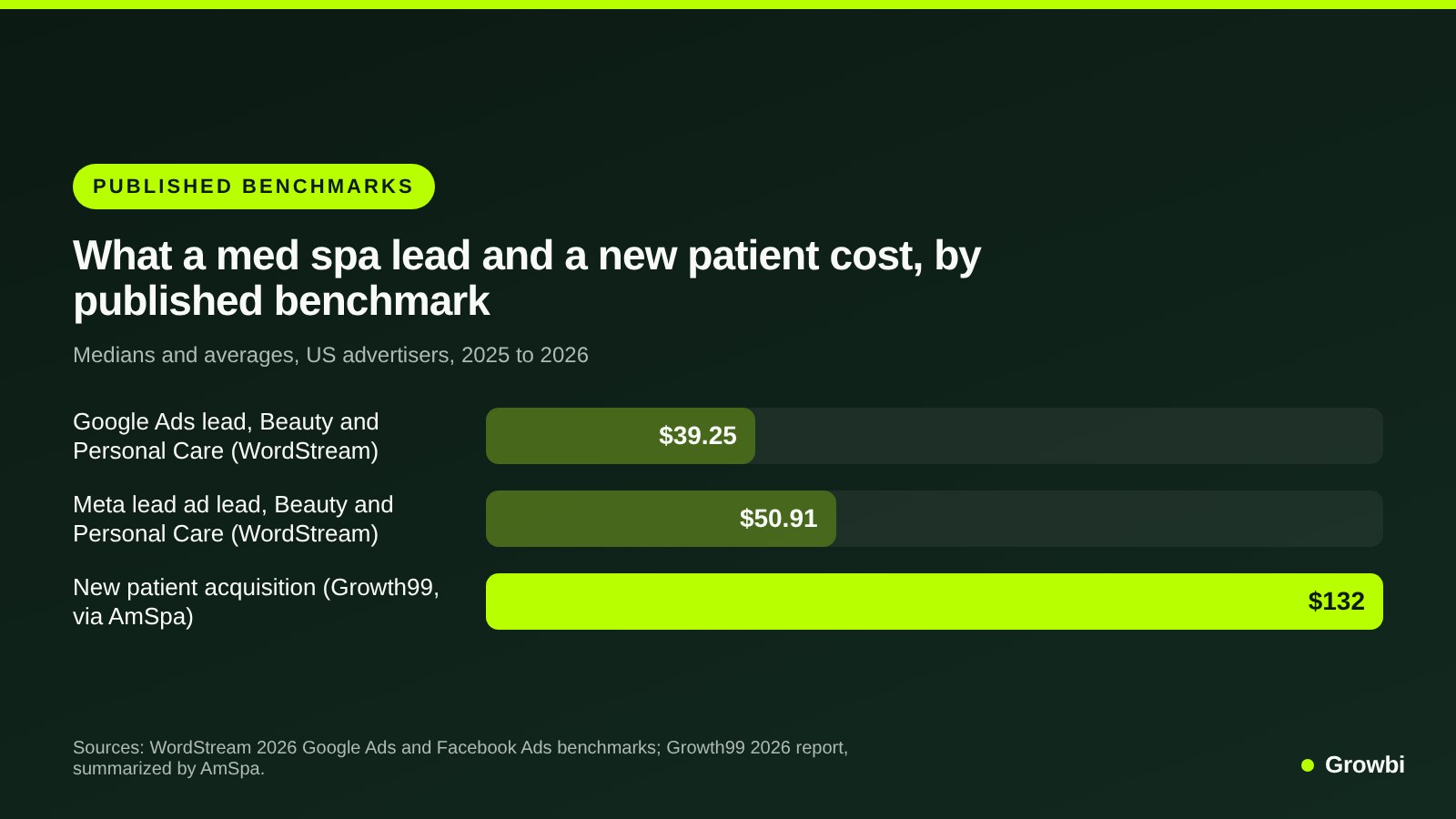
- WordStream's 2026 benchmarks put Beauty and Personal Care leads at $39.25 on Google and $50.91 on Meta lead ads.
- AmSpa reports med spas spend about 7% of revenue on marketing on average, within a 2% to 15% range.
- Judge every channel by cost per arrived patient, and answer new leads within 15 minutes.
- State boards, the FTC review rule and Google and Meta health policies all apply to med spa ads.
Med spa marketing is the system that turns local demand for aesthetic treatments into booked, arrived and returning patients. The strongest plans pair Google Ads for treatment searches and Meta ads under health rules with local SEO, reviews, fast follow-up, email and SMS, and memberships, and judge every channel by cost per arrived patient.
Med spa marketing is the system that turns local demand for aesthetic treatments into booked, arrived and returning patients. The strongest plans pair Google Ads for treatment searches and Meta ads under health rules with local SEO, reviews, fast follow-up, email and SMS, and memberships, and judge every channel by cost per arrived patient.
This guide puts 12 strategies in the order a clinic should build them, with the published benchmarks behind the budget and the AmSpa, FTC, Google and Meta rules every campaign has to pass. Each one links to a detailed playbook.
What Is Med Spa Marketing?
Med spa marketing is everything a medical aesthetics practice does to attract, convert and keep patients: ads, search visibility, reviews, content, follow-up and retention offers. It differs from retail marketing in two ways. The services are medical, so licensing boards and platform health policies apply, and most revenue comes from patients who come back.
The AmSpa 2024 State of the Industry summary puts numbers on it: average revenue of $1,398,833, 245 patient visits a month, 73% repeat patients, an average spend of $527 per visit, and 89% female patients.
So the return visit matters as much as the first. In AmSpa's coverage of CorralData research across more than 100 medspa brands, the median practice grew revenue 19.2% year over year in the first half of 2026 while new-patient growth was 1.2%. The growth came from existing patients returning more often, spending more and joining memberships.
Strategies 1 to 3: Positioning, Offers and the Booking Path
Ads only multiply what is already there. Before any budget goes live, decide what you lead with, what you offer and where the click lands.
1. Lead With Two Hero Treatments
Pick one or two treatments that bring in new patients and lead to repeat visits, usually neurotoxin, filler, laser hair removal, body contouring or a medical weight loss program. Every campaign, landing page and email sequence starts with them.
Positioning means one concrete reason to choose you for that treatment: the provider's credentials, a specific technique, availability this week or a membership price. Words like "luxury" and "results-driven" do not count, because every competitor uses them.
- Neurotoxin: offers, creative and the drug-name rules in Botox marketing ideas.
- Body contouring: the consult-to-package funnel in CoolSculpting marketing.
- Laser hair removal: package pricing and rebooking in laser hair removal marketing.
- Medical weight loss: filling consults in weight loss program marketing.
2. Sell Value, Not Discounts
A percentage-off sale fills one week and teaches patients to wait for the next one. Offers that hold up better: a consult fee credited toward treatment, a package with the second session booked at checkout, a membership with a monthly treatment credit, or a gift card bonus redeemable in a slow month.
Every offer has to pass the FTC's pricing rules before it runs, including real former prices and honest deadlines. Our med spa Black Friday deals guide walks through those rules with holiday examples.
3. Build One Landing Page per Treatment
Send paid traffic to a page about the treatment in the ad, never the home page. It needs a price or starting price, the provider, consented before-and-after photos, reviews, and booking in one tap by calendar, call or text.
Pages built to book are covered in med spa website design. Track every form, call and online booking as a conversion before a dollar goes into ads.
Strategies 4 and 5: Google Ads and Meta Ads
Google captures people already searching for a treatment, and Meta creates demand among people who were not searching yet. Most med spas need both, in that order.
4. Capture Treatment Searches With Google Ads
Build one campaign per hero treatment around tight keyword themes such as "laser hair removal near me", "lip filler" plus your city, and "med spa near me", plus a brand campaign so competitors cannot take your name.
WordStream's 2026 Google Ads benchmarks, from 13,474 US campaigns run between April 2025 and March 2026, put Beauty and Personal Care at a $4.62 median cost per click, a 10.35% conversion rate and $39.25 per lead.
Two policies shape the account. Google's healthcare and medicines policy restricts prescription drug terms in ads, landing pages and keywords, and neurotoxins such as Botox are prescription drugs, so expect brand-name keywords and ads to be limited.
Health is also a sensitive interest category in Google's personalized advertising policy. Ads that fall into it cannot use advertiser-curated audiences such as your own data segments, Customer Match or lookalike segments, so plan around keywords, not retargeting.
Pro tip: Add negative keywords on day one: jobs, salary, training, course, certification, school, DIY, at home and kit. Med spa searches pull in job seekers and students, and one ad group without negatives can spend a week of budget on them.
5. Create Demand With Meta Ads Under Health Rules
Meta ads suit visual treatments and clear offers: a short provider video, a consented result or a membership price.
WordStream's 2026 Facebook ads benchmarks put Beauty and Personal Care lead campaigns at $50.91 per lead with a 5.63% conversion rate, from US campaigns run between April 2025 and June 2026.
Meta's Health and Wellness policy requires ads for cosmetic procedures, including injectables, dermal fillers, laser and skin treatments, to target people 18 and older. It bans statements that attack someone's appearance or body parts, and sensational health claims that promise specific outcomes within a set time.
Meta can also limit your tracking. Its data sharing restrictions page describes three levels for sensitive data source categories: core setup, limits on certain mid and lower funnel events, and full restrictions. Check the category assigned in Events Manager before you build campaigns on lead or purchase events.
How to split budget between the two platforms is in Google Ads vs Meta for med spas.
Copy rules and legitimate workarounds for restricted accounts are in med spa Meta ads compliance.
Strategies 6 to 8: Local SEO, Reviews and AI Search
Paid ads stop the day the budget does. Local search and reviews keep producing bookings and make every ad convert better.
6. Win the Map Pack With Your Google Business Profile
Google says local results are based mainly on relevance, distance and prominence. It names review count, ratings and links among the signals behind prominence.
Google Business Profile Help also says complete, accurate information makes a profile more likely to show. For a clinic, that means the right primary category, every treatment listed as a service, fresh photos, accurate hours and one service page per treatment on the website.
The full ranking checklist for clinics is in med spa SEO.
7. Ask Every Patient for a Review
Patients read reviews before they trust anyone with their face. Volume and recency matter as much as the star rating.
The BrightLocal Local Consumer Review Survey 2026, a panel of 1,002 US adults, found 47% of consumers will not use a business with fewer than 20 reviews, 74% only care about reviews from the last three months, and 31% will only use a business rated 4.5 stars or higher.
Ask every patient, at checkout and by text the same day, not only the happy ones. The FTC's consumer reviews rule Q&A says incentives tied to positive reviews break the rule, and that asking only satisfied customers could violate the FTC Act.
Pro tip: Never confirm in a public reply that the reviewer is a patient or name their treatment. AmSpa's legal team points out that the fact someone is a patient is itself protected health information, so thank them without details. More reply rules are in med spa review management.
8. Get Recommended by AI Search
BrightLocal's 2026 survey found 45% of consumers used ChatGPT or other generative AI tools for local business recommendations, up from 6% the year before.
AI tools draw on your website, listings and reviews. Clear treatment pages with prices and provider credentials, the same name and address everywhere, and a steady flow of recent reviews make a clinic easier to cite. The method is in our answer engine optimization guide.
Strategies 9 and 10: Social Content, Email and SMS
Social media and your patient list protect repeat revenue. Neither needs a big budget, only a steady schedule.
9. Post Content That Answers Consult Questions
The posts that book are the ones that answer consult questions: what a treatment feels like, how long results last, who the provider is and what a visit costs. Film the provider answering the five most common questions, then run the two best clips as Meta ads.
In the Growth99 2026 report summarized by AmSpa, 70% of practices named Instagram their most effective platform, while only 7% used TikTok effectively.
Before-and-after photos need written consent that covers public, commercial use, and stock photos or paid models must be disclosed, according to AmSpa's guide to medical aesthetics advertising.
10. Reactivate the List You Already Own
Patients who came once and never returned are the cheapest bookings you have. Segment them by last treatment and send a reminder timed to that treatment's natural interval, with one reason to book now.
Sequences, timing and text message consent rules are in med spa email and SMS follow-up.
Strategies 11 and 12: Speed to Lead and Memberships
Much of the money in med spa marketing is lost after the click: the lead waits, the patient does not show, or the first visit is the last.
11. Answer Every Lead Within Minutes
In the CorralData research AmSpa reported, a small group of practices answered new leads in under 13 minutes while the rest took from four hours to 24 days. Every practice that responded within 15 minutes and booked over 30% of appointments online landed in the top half for growth.
Set up an instant text reply, a human call attempt within five minutes during opening hours and a booking link in every message. Scripts are in our speed to lead guide.
Then protect the appointment with confirmations, reminders and an easy reschedule path. How to reduce med spa no-shows covers the options without upfront deposits.
12. Turn First Visits Into Memberships
Membership was the strongest lever in the CorralData data: members spent 2.5 times more than non-members and retained 35 percentage points better, across every practice that ran a program.
Offer it at checkout after the first treatment, while the result is fresh, with a monthly credit for the treatment the patient just had. Pricing, perks and cancellation terms are in med spa membership programs.
How Much to Spend on Med Spa Marketing
There is no single right number, but there are reference points, and they all start with revenue.
According to AmSpa's guidance on marketing spend, medical spas invest about 7% of revenue in marketing on average, with aesthetic industry budgets ranging from 2% to 15%. At AmSpa's average revenue of $1,398,833, 7% comes to about $97,900 a year, or roughly $8,200 a month.
Many clinics spend far less. The Growth99 2026 report found 52% of med spa practices invest less than $2,500 a month in marketing and only 25% reach $5,000. It puts the average cost per lead at $39 and new patient acquisition at $132, against an average visit value of $527.
Source: WordStream 2026 Google Ads and Facebook Ads benchmarks; Growth99 2026 report, summarized by AmSpa
Budget is the second question, not the first. AmSpa's October 2026 article on growth plans argues that you should check the calendar before raising spend: which providers have openings, whether inquiries get answered and whether first-time patients return.
Pro tip: Size the ad budget from the calendar. Count next month's open provider hours for the hero treatment, turn them into appointments, and work backward through your show rate and booking rate to the leads you need. Raise spend only when the hours and the follow-up can absorb it.
To turn these strategies into dated campaigns, our med spa marketing plan lays out a 90-day launch and a 12-month calendar.
Agency fees come on top of ad spend. Fee models and real ranges are in med spa marketing agency cost.
Measure Cost per Arrived Patient, Not Cost per Lead
A cheap lead that never books is the most expensive lead you can buy. The number that should decide budget is cost per arrived patient: a channel's total marketing cost divided by the new patients from it who actually showed up.
Here is example math, not data. A $3,000 month on one treatment campaign at $40 per lead brings 75 leads. If 40% book, that is 30 consults, and if 80% show up, 24 patients arrive. Cost per arrived patient is $125.
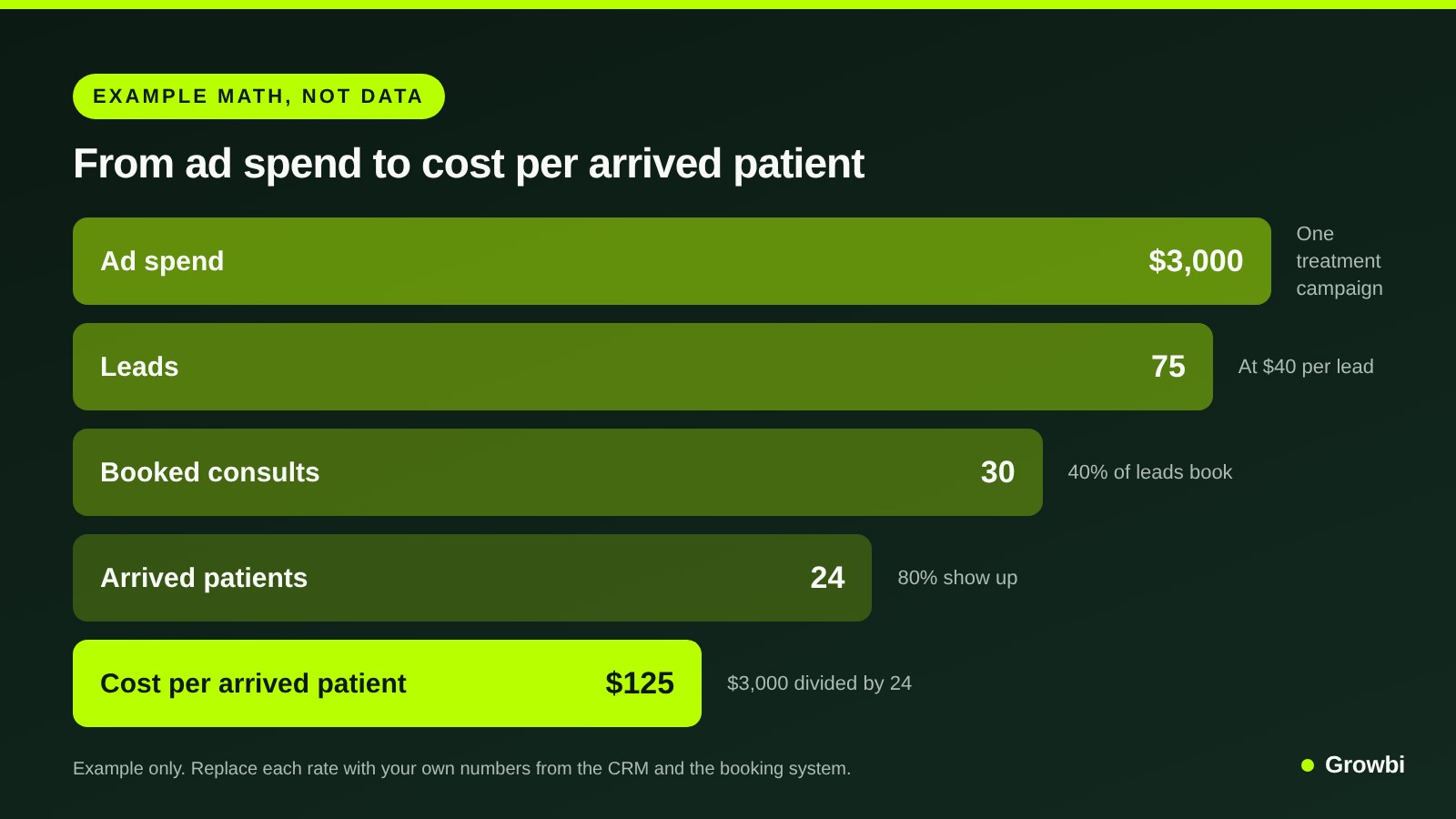
Now raise the booking rate from 40% to 60%. The same $3,000 produces 45 consults, 36 arrivals and a cost per arrived patient of about $83. A med spa CRM that tracks each lead from ad to arrival makes this visible.
To measure it, track calls, forms and online bookings as conversions, pass the lead source into your CRM, and mark every lead as booked and arrived. The setup is in Google Ads conversion tracking.
The Compliance Rules Every Med Spa Campaign Must Pass
Med spa advertising is regulated by state licensing boards, federal consumer protection law and the ad platforms. When an ad crosses a line, the license at risk is the provider's, not the agency's.
- State boards: AmSpa's legal guide notes that boards almost universally ban false, deceptive or misleading claims, and many restrict guaranteed results, unprovable superiority claims such as "best injector", and misused titles such as "doctor". Some states require the practitioner's name and license in ads.
- Patient privacy: photos and testimonials need consent that covers public, commercial use, and a social reply must never reveal that someone is a patient.
- Reviews and testimonials: the FTC rule bans fake reviews, incentives tied to positive sentiment and review suppression through threats or intimidation.
- Website tracking: AmSpa's article on pixel tracking lawsuits warns that tracking tools on booking and treatment pages have drawn demand letters and privacy suits, and that a privacy policy and cookie banner alone do not remove the risk.
- Ad platforms: Meta's 18+ targeting and appearance rules, plus Google's limits on prescription drug terms and health audience targeting.
Pro tip: Keep a one-page claims sheet for each hero treatment with approved wording, banned words such as painless, permanent and best, the results disclosure and who signs off. Every ad, post and landing page goes through it before launch.
If you hire help, ask how claims are reviewed before anything goes live. Our list of med spa marketing companies includes the questions to ask.
FAQs
How do I market my med spa?
Pick one or two hero treatments, build a landing page for each, and run Google Ads for people searching for those treatments. Add Meta ads that follow health ad rules, optimize your Google Business Profile, ask every patient for a review, answer new leads within minutes, and offer a membership after the first visit. Judge each channel by cost per arrived patient.
How much should a med spa spend on marketing?
AmSpa reports that medical spas invest about 7% of revenue in marketing on average, with aesthetic budgets ranging from 2% to 15%. At AmSpa's average revenue of about $1.4 million, 7% is roughly $8,200 a month. Newer clinics and those pushing growth sit higher, but check calendar capacity and follow-up before raising spend.
Is a med spa business profitable?
Demand is strong. AmSpa's 2024 report shows average medical spa revenue rising from $1,307,587 to $1,398,833, with 73% of patients returning and an average spend of $527 per visit. Profit depends on provider pay, product cost and rent, so marketing that brings first-time patients back usually adds more to profit than extra lead volume.
What is the best advertising for a med spa?
Google Ads is usually the first paid channel, because it reaches people already searching for a treatment near them. Meta ads come second, for creating demand with video and offers, within Meta's 18+ and appearance rules for cosmetic procedures. Local SEO and reviews support both. The best channel is the one with the lowest cost per arrived patient.
Can med spas advertise Botox on Google and Facebook?
With limits. Google restricts prescription drug terms such as Botox in ads, landing pages and keywords, so brand-name ads are often limited. Meta allows injectable treatment ads targeted to people 18 and older, as long as the copy does not attack anyone's appearance or body. Many clinics advertise the treatment and clinic rather than the brand name.
What does a med spa marketing agency do?
A med spa marketing agency plans and runs patient acquisition: Google and Meta ad campaigns, landing pages, local SEO, review generation, conversion tracking and often follow-up automation. A good one reports cost per booked and arrived patient, not just clicks and leads, and reviews ad claims against state board, FTC and platform rules before anything goes live.
Conclusion
Med spa marketing works as a system: two hero treatments, offers that sell value, Google and Meta ads that follow health rules, a strong Google Business Profile and fresh reviews, then fast follow-up, reactivation and memberships that bring patients back.
Build it in that order, measure it by cost per arrived patient, and run every claim past the state board, FTC and platform rules before it goes live.
If you want to see what your calendar could book from paid ads, get a free patient forecast and we will map the leads, bookings and arrivals behind your goal.
Get this system built for your business
Book a strategy call and we will model a realistic appointment target from your budget, market, and offer.
Keep reading

Med Spa Marketing Plan: A 90-Day Launch and a 12-Month Calendar
Med Spa Advertising: Channels, Costs and Compliant Ad Examples

Med Spa SEO: How to Rank Your Clinic in the Map Pack

Med Spa Meta Ads Compliance: Health and Wellness Restrictions and Legitimate Workarounds
Med Spa Membership Programs: How to Price, Launch and Keep Members
Speed to Lead: Why the First 5 Minutes Decide Who Books