How Do You Get Your Business Recommended by ChatGPT?
 Mor RomanoCTO, Growbi12 min read
Key Takeaways
- BrightLocal's 2026 survey found 45% of US consumers used AI tools to find local businesses, up from 6% a year earlier.
- AI engines recommend businesses they can verify across several sources: your site, Google Business Profile, Yelp, directories and reviews.
- Google says AI Overviews need no special markup, so AEO is strong SEO plus consistent off-site signals.
- Allow OAI-SearchBot in robots.txt, or ChatGPT search cannot show your pages.
Answer engine optimization (AEO) is the work of getting AI tools like ChatGPT, Gemini and Google AI Overviews to name your business when someone asks for a recommendation. These tools pull from your website, reviews, listings and third-party mentions, so AEO means clear answers on your site, consistent listings, steady reviews and open access for AI search crawlers.
Table of Contents
Ask ChatGPT for the best med spa in Scottsdale or an emergency dentist open on Saturday, and it does not hand back ten blue links. It names three or four businesses, explains why, and the person often books without visiting a single search result.
If your business is not on that short list, you were never in the running. Try it now with your own city and service. Most owners we show this to have never checked, and the names that come back are rarely the ones they expected.
What Is Answer Engine Optimization?
Answer engine optimization (AEO) is the practice of making your business the answer an AI tool gives. Search engine optimization earns a position in a list of links. AEO earns a mention inside the answer itself, in ChatGPT, Gemini, Perplexity, Google AI Overviews and Google AI Mode.
You will also see the term generative engine optimization (GEO). The two names describe the same goal from different angles: GEO comes from academic research on generative search, AEO from the marketing side. For a local business the work is identical, so this article uses AEO throughout.
- Goal. SEO: Rank a page in the results; AEO / GEO: Be named or cited in the AI answer
- Where it shows. SEO: Google and Bing result pages; AEO / GEO: ChatGPT, Gemini, Perplexity, AI Overviews, AI Mode
- What the user sees. SEO: A list of links; AEO / GEO: A short list of businesses with reasons
- Main inputs. SEO: Your pages and links to them; AEO / GEO: Your pages plus reviews, listings and mentions elsewhere
- Success metric. SEO: Position and clicks; AEO / GEO: Mentions, citations and booked calls from AI referrals
Why AEO Matters for Local Businesses Right Now
Because your next customer is already asking AI first, and the shift happened in a single year.
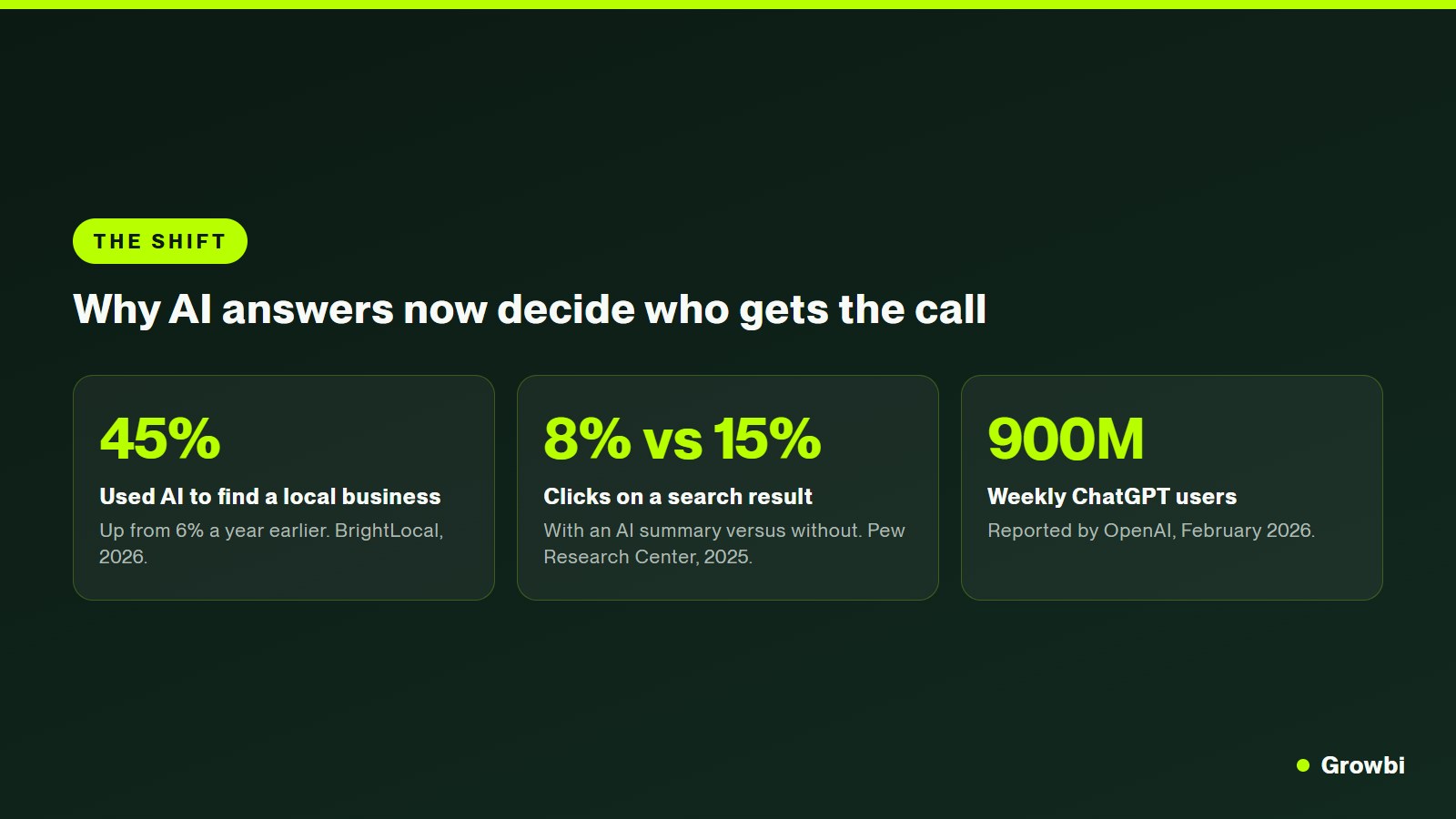
The BrightLocal Local Consumer Review Survey 2026 found that 45% of US consumers used AI tools to find local businesses in the past year, up from 6% the year before. That puts AI third among discovery sources, behind only Google and Facebook.
The audience is enormous. OpenAI reported 900 million weekly ChatGPT users in February 2026, and Google says AI Overviews reach more than 2 billion people a month.
AI answers also change what happens after the search. A Pew Research Center study of 900 US adults found people clicked a traditional result on 8% of Google visits that showed an AI summary, against 15% when no summary appeared. Only 1% of visits included a click on a link inside the summary.
Source: BrightLocal LCRS 2026, Pew Research Center (July 2025), OpenAI via TechCrunch (February 2026)
Put together, fewer people click through and compare. The business named inside the answer gets the call, and everyone else is invisible.
How ChatGPT and Google AI Choose Which Businesses to Recommend
They recommend what they can verify. An AI engine answering a local question searches the web, reads several sources and names the businesses that appear consistently and positively across them.
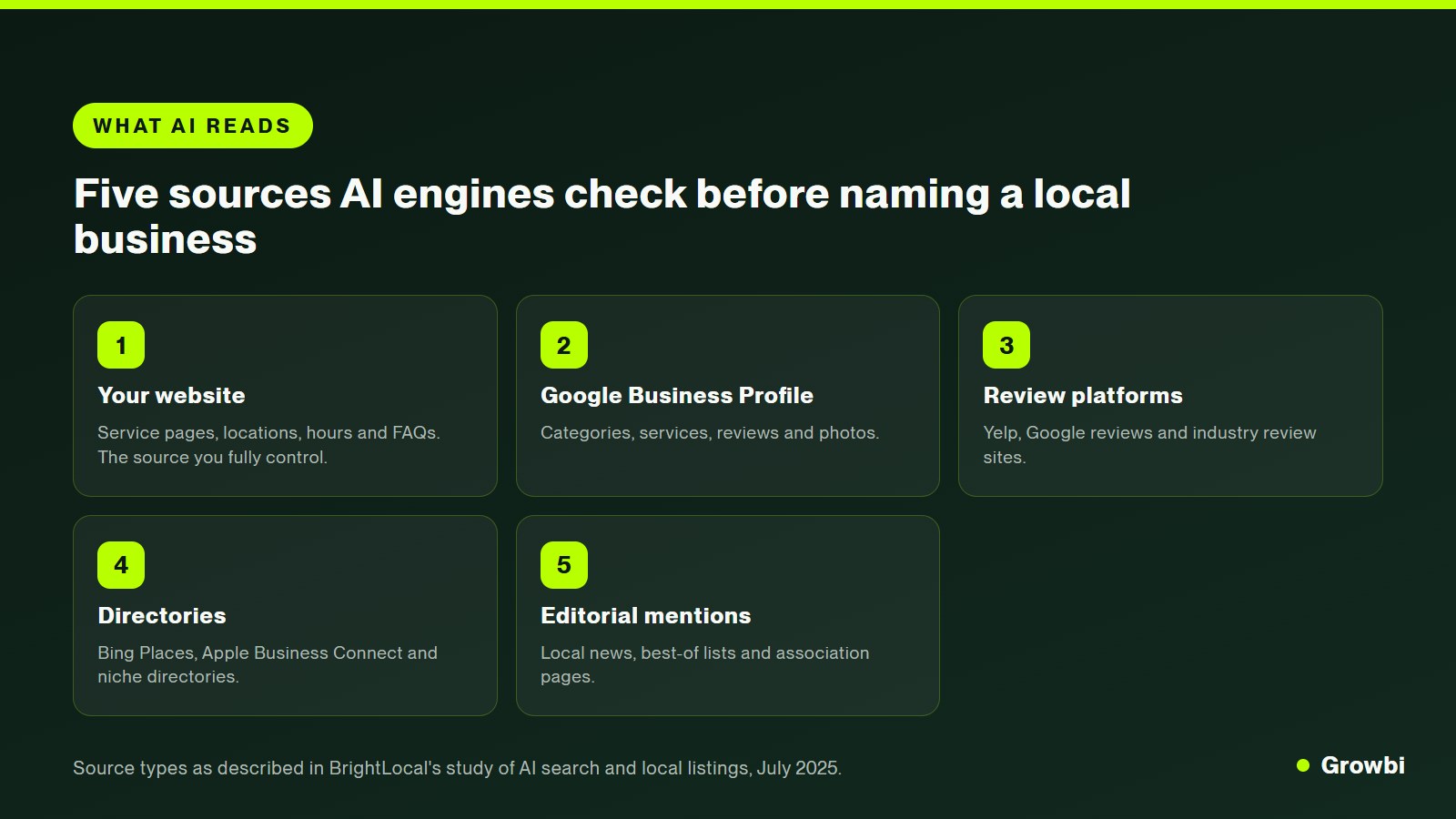
BrightLocal tested which sources AI tools cite for local searches. In its study of AI search and local listings, business websites were the largest source type across every AI tool and industry, ChatGPT cited business websites 58% of the time, and Yelp appeared in 33% of searches. Google AI Mode leaned heavily on Google Business Profile data.
- Your website. Service pages, prices or price ranges, locations, hours and FAQs. This is the source you fully control.
- Google Business Profile. Categories, services, reviews and photos. Google's own AI features read it directly.
- Review platforms. Yelp, Google reviews and industry sites such as RealSelf for aesthetics or Healthgrades for dentists.
- Directories and data aggregators. Bing Places, Apple Business Connect, Foursquare and niche directories that confirm your name, address and phone.
- Editorial mentions. Local news, best-of lists, association pages and partner sites that describe what you do.
Source: BrightLocal, AI Search Makes Local Listings More Important Than Ever (July 2025)
AEO vs. SEO: What Actually Changes
AEO is mostly SEO done properly, with more weight on what others say about you.
Google is explicit on this point. Its guidance on AI features says there are no additional requirements to appear in AI Overviews or AI Mode, and no special schema to add. A page needs to be indexed and eligible to show a snippet, and that is it.
Anyone selling a secret AI markup is selling something Google says does not exist.
Three things do shift in emphasis. AI answers are built from passages, so a page that states its answer in plain sentences is easier to quote. AI tools cross-check facts across sources, so a phone number that differs between your site and Yelp costs more than it used to.
And because the answer names businesses rather than pages, your reputation on other sites counts nearly as much as your own content.
The short version. If your SEO foundation is weak, AEO will not rescue it. If it is solid, AEO is the extra 20% of work that decides whether the AI names you or your competitor. Our guides on med spa SEO and dental SEO for small practices cover the foundation.
What the Research Says Gets Content Cited
The most rigorous test so far is the GEO study from Princeton University and partners, published at the KDD 2024 conference. The researchers rewrote web pages using nine methods and measured how much each one increased the page's visibility inside generative engine answers.
- Quotation addition. What it means: Adding a relevant quote from a named expert or source; Change in visibility: +41%
- Statistics addition. What it means: Replacing vague claims with specific numbers; Change in visibility: +31%
- Fluency optimization. What it means: Making the text read smoothly; Change in visibility: +28%
- Cite sources. What it means: Naming and linking the sources of claims; Change in visibility: +27%
- Keyword stuffing. What it means: Repeating the target query; Change in visibility: -8%
The lesson is direct. Concrete numbers, named sources and quotes make a page more quotable, and stuffing keywords makes it less visible. The full method and results are in the GEO paper on arXiv.
For a clinic or contractor this means writing like an expert who shows the work. "Most Botox appointments take 15 to 20 minutes and results appear in 3 to 14 days" is quotable. "We offer amazing Botox results" is not.
How to Set Up AEO, Step by Step
This is the order we work in for clients. The first three steps fix what AI engines read about you; the last four make you easier to quote and keep you visible.
Plan on two to four weeks for the setup, then a monthly review.
- Run a baseline prompt test. Ask ChatGPT, Gemini, Perplexity and Google AI Mode the 10 questions your customers ask, such as best med spa in your city or emergency plumber near a named neighborhood. Record who gets named and which sources are cited.
- Make your listings match exactly. Use the same business name, address, phone, hours and categories on your website, Google Business Profile, Bing Places, Apple Business Connect, Yelp and the top directories in your industry.
- Open the door to AI search crawlers. Check robots.txt and your CDN or firewall settings. Allow Googlebot, Bingbot and OAI-SearchBot so your pages can appear in Google AI features, Copilot and ChatGPT search.
- Build one page per service and location. Each page opens with a 40 to 60 word answer, then covers price range, who it suits, how long it takes, recovery or timeline, and the questions people ask before booking.
- Add facts that can be quoted. Credentials, years in business, number of treatments or jobs completed, warranties and named sources for any medical or technical claim. Specific beats impressive.
- Earn reviews that describe the service. Ask every happy customer for a review that names the service and the area. AI summaries quote review text, so a review about lip filler in Austin helps more than five stars with no words.
- Get mentioned beyond your own site. Local press, association member pages, supplier case studies and best-of lists. Each independent mention gives an AI engine another source that confirms you are real and recommended.
How to Write Pages AI Engines Can Quote
Write every page as if a customer asked you the question in person. Lead with the answer, then the detail. AI engines extract passages, and the passage that answers the question in its first two sentences is the one that gets used.
- Use the question as the heading. "How long does Morpheus8 recovery take?" beats "Recovery".
- Answer in the first 40 to 60 words, then expand with steps, ranges and exceptions.
- Give ranges when you will not publish prices. "Most patients need 3 sessions spaced 4 to 6 weeks apart" is useful and safe.
- Keep key facts in text, not only in images, PDFs or video. Google lists text availability as a basic requirement for its AI features.
- Add an FAQ section with the real questions your front desk hears every week, each answered in full sentences.
Structured data helps machines read the page but does not create rankings on its own. Use LocalBusiness or MedicalBusiness schema that matches what is visible on the page, and treat it as hygiene rather than a shortcut. Our guide to med spa website design shows a page layout built this way.
The same structure works for any practice. A dental office can follow the layout in our dental practice website design guide, with one page per treatment and the answer to the patient's question in the opening lines.
The Listings and Review Sites That Matter Most for AI Recommendations
Start with the sources the AI tools are known to read, then add the ones your industry trusts. Accuracy across all of them matters more than the number of listings you create.
- Google Business Profile. Why it matters for AI answers: Feeds Google AI Overviews and AI Mode directly; Priority: Highest
- Your website. Why it matters for AI answers: Largest cited source type across AI tools in BrightLocal's test; Priority: Highest
- Yelp. Why it matters for AI answers: Cited in 33% of AI local searches BrightLocal ran; Priority: High
- Bing Places. Why it matters for AI answers: Microsoft's local data powers Bing and Copilot answers; Priority: High
- Apple Business Connect. Why it matters for AI answers: Controls your details in Apple Maps and Siri; Priority: Medium
- Industry sites (RealSelf, Healthgrades, Angi). Why it matters for AI answers: Confirm specialty and reputation for niche queries; Priority: Medium to high
Reviews deserve the most ongoing effort, because they are the one signal that keeps changing. The same BrightLocal survey found 82% of consumers read AI-generated review summaries. Our med spa review management guide lays out a request and reply system any clinic can run.
Blocking vs. Allowing AI Crawlers
Allow the search crawlers, decide separately about training. OpenAI runs different bots for different jobs, and blocking the wrong one removes you from ChatGPT search answers.
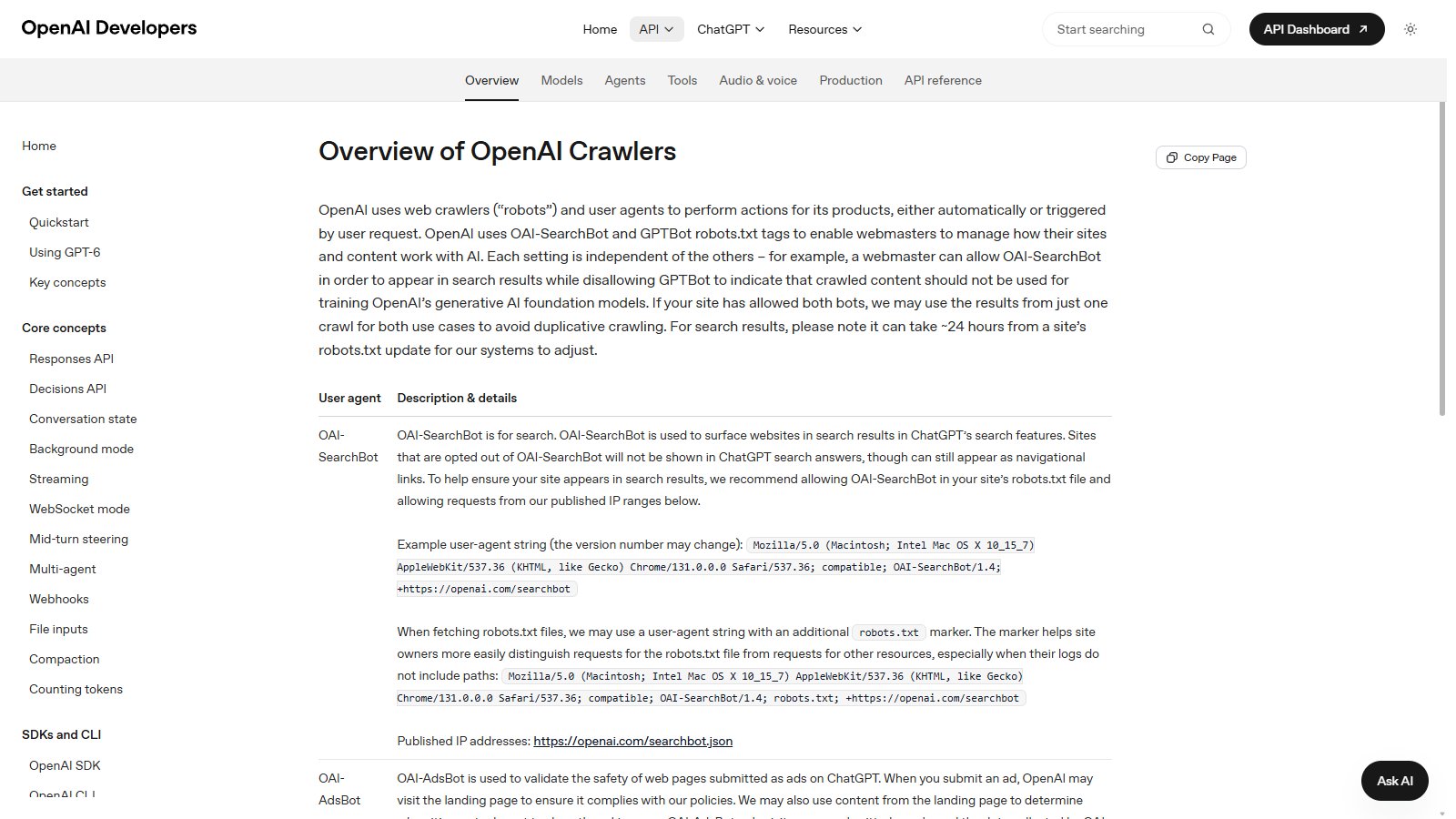
- OAI-SearchBot surfaces websites in ChatGPT search. OpenAI's crawler documentation recommends allowing it, and notes robots.txt changes take about 24 hours to apply.
- GPTBot collects content that may train OpenAI's models. Blocking it does not remove you from ChatGPT search.
- ChatGPT-User fetches a page when a person asks ChatGPT to open it. It is user-triggered, not a crawler.
- Google-Extended controls use of your content for Gemini training and grounding. It does not affect Google Search or AI Overviews eligibility.
Being named in answers is free, and it is separate from paying for placement. ChatGPT now sells ads below its answers too, and our guide to advertising on ChatGPT explains the costs and which local businesses OpenAI allows.
Many sites block these bots by accident through a security plugin or CDN bot setting. Check your firewall logs as well as robots.txt, because a blocked request at the CDN never reaches the file.
How to Measure Whether AI Engines Recommend You
No AI tool gives you a full report yet, so combine four imperfect signals and watch the trend each month.
- Repeat the baseline prompt test monthly with the same 10 questions and log who is named and which sources are cited.
- Check AI referrals in analytics. Visits from chatgpt.com, perplexity.ai and gemini.google.com show up as referral traffic, and ChatGPT adds utm_source=chatgpt.com to many of its links.
- Read Search Console with care. Google counts AI Overviews and AI Mode traffic inside the normal Web performance report, so impressions there include AI features.
- Ask every new customer how they found you, and add "ChatGPT or another AI tool" as an answer on your intake form.
Then connect those numbers to booked appointments, not visits. The Growbi System keeps the source of each lead, the conversation and the appointment in one record, so an AI referral is judged by revenue like every other channel.
The AEO Mistakes That Waste the Most Time and Money
- Buying or faking reviews. The FTC's 2024 rule bans fake reviews, including AI-generated ones, and buying reviews tied to a positive sentiment. It is also the fastest way to lose a Google profile.
- Paying for special AI files or markup. Google states that no new machine-readable files or special schema are needed for its AI features.
- Keyword stuffing pages for AI. The GEO study measured an 8% drop in visibility from it.
- Letting listings drift. An old address on one directory and a new one on your site makes an AI engine less confident about naming you.
- Hiding answers in images or PDFs. Price ranges inside a menu graphic cannot be quoted.
AEO also connects to everything else in your marketing. Content that answers real questions earns links and leads on its own, which our guide to content marketing that produces leads covers in detail.
FAQs
What is answer engine optimization?
Answer engine optimization is the practice of getting AI tools such as ChatGPT, Gemini, Perplexity and Google AI Overviews to name or cite your business in their answers. It combines clear, answer-first website content with consistent listings, strong reviews and mentions on other sites, because AI engines recommend businesses they can verify across several sources.
What is the difference between AEO and GEO?
There is no practical difference for a business owner. Generative engine optimization is the term used in academic research, including the 2024 Princeton GEO study, while answer engine optimization is the marketing term. Both describe making your content and business more likely to appear inside AI-generated answers rather than only in a list of links.
How do I get my business recommended by ChatGPT?
Allow OAI-SearchBot in your robots.txt so ChatGPT search can read your site, make your name, address and phone identical across your website, Google Business Profile, Bing Places and Yelp, publish service pages that answer common questions in plain sentences, and build a steady flow of detailed reviews. Then test monthly with the questions your customers actually ask.
Does Google need special schema for AI Overviews?
No. Google's Search Central guidance states there are no additional requirements and no special schema.org structured data needed to appear in AI Overviews or AI Mode. A page must be indexed and eligible to show a snippet. Structured data still helps machines understand your business, but it should match visible content and is not a ranking shortcut.
Conclusion
AI tools have become the first stop for a large and growing share of customers choosing a local business. They name the businesses they can verify, across your website, your profiles, your reviews and what other sites say about you.
Answer engine optimization is not a trick. It is the disciplined version of local marketing: identical listings, pages that answer real questions, reviews with real detail, and crawlers allowed in.
If you want to see where you stand, book a free strategy call and we will run the AI recommendation test for your business and your top competitors.
Get this system built for your business
Book a strategy call and we will model a realistic appointment target from your budget, market, and offer.