Med Spa Email and SMS Follow-Up That Cuts No-Shows

Key Takeaways
- Most med spa revenue comes from returning patients, so follow-up messages pay back faster than another month of new-patient ads.
- Five triggered stages cover the whole patient path: inquiry, booking, visit, rebooking and reactivation.
- Use SMS for anything with a deadline and email for anything a patient needs to read twice.
- Commercial texts need written consent under FCC rules, and email opt-outs must be honored within 10 business days.
Med spa email marketing works best as automated follow-up, not monthly newsletters. Text new inquiries within a minute, confirm every booking, remind 48 hours before and the morning of the visit, then send aftercare, a review request and a rebooking prompt timed to each treatment. Get written consent before any marketing text.
Most clinics treat email as a newsletter and SMS as a reminder tool. The clinics that fill their books run both as one follow-up system with clear triggers.
Below you get the sequence map, the exact messages to paste into your booking software, the timing we use on Growbi accounts, and the federal consent rules from the FCC and the FTC.
Why follow-up outearns new ads for med spas
Returning patients carry the business. The American Med Spa Association reports that an average of 73% of med spa patients are repeat patients.
The same AmSpa 2024 State of the Industry recap puts average spend at $527 per visit and the average clinic at 245 patient visits per month. That is roughly $129,000 of monthly visit revenue riding on show rates and rebooking.
Run the math on your own book. If 1 in 20 of those 245 visits is a no-show (our assumption for the example), that is 12 empty slots, or about $6,300 a month at $527 each. Three reminder texts cost a few cents per patient.
That is why a working email marketing strategy for a clinic starts with follow-up, not with a design template. Newsletters come later, once every booking is protected.
The five follow-up stages every med spa should automate
Every message in med spa email marketing belongs to one of five stages, and each stage starts on a trigger your software already records.
- New inquiry. Trigger: Form, call or DM received; Messages: SMS in 60 seconds, email, next-morning SMS; Goal: Book the consult
- Booked. Trigger: Appointment created; Messages: Confirmation, 48-hour and morning-of reminders; Goal: Patient arrives
- After the visit. Trigger: Visit marked complete; Messages: Aftercare email, next-day review request; Goal: Results and reviews
- Rebooking. Trigger: Treatment cycle nearly due; Messages: SMS with two named times; Goal: Second visit booked
- Reactivation. Trigger: 120 days with no visit; Messages: Email, then one SMS three days later; Goal: Lapsed patient returns
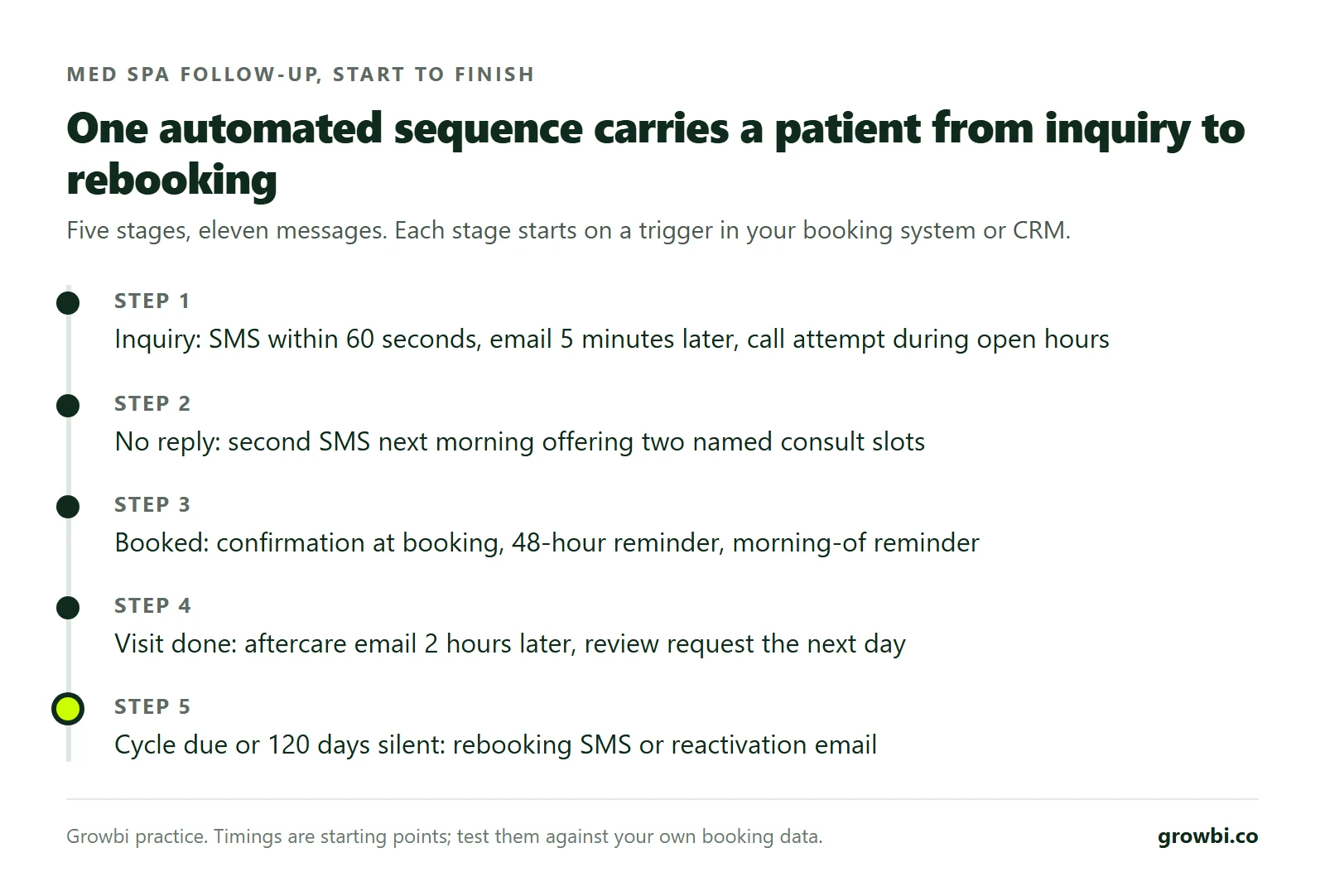
Build the stages in this order. Inquiry and booking messages protect revenue you already paid for, so they come before anything promotional.
Most booking systems and CRMs already include the email automation and two-way texting this needs. Our med spa CRM comparison shows which platforms handle triggers and replies without add-ons.
Copy-ready email and SMS sequences for med spas
Paste these into your booking software and swap the fields in braces. Each message does one job, which keeps texts short and emails easy to scan.
Eleven messages in send order. Timing in each step name.
- Inquiry SMS, within 60 seconds of the form. {Clinic}: Hi {first name}, this is {coordinator}. Thanks for asking about {treatment}. Is a quick call in the next 10 minutes okay? Or book a consult yourself: {booking link}. Reply STOP to opt out.
- Inquiry email, 5 minutes after the form. Subject: Your {treatment} consult with {provider}. Body: Hi {first name}, here is what the consult covers, how long it takes and the price range on our menu: {menu link}. Before-and-after gallery: {gallery link}. Reply with any question and {coordinator} will answer today.
- Follow-up SMS, next morning at 10 a.m. if no reply. {Clinic}: Morning {first name}. {Provider} has two consult times left this week: {Tue 2:30} or {Thu 11:00}. Reply 1 or 2 and it is yours.
- Confirmation SMS, sent the moment the booking is made. {Clinic}: You are booked for {day} at {time}, {address}. Parking: {note}. Reply C to confirm or R to move it.
- Reminder SMS, 48 hours before. {Clinic}: See you {day} at {time}. Prep note from {provider}: {one line}. Need another time? Reply R and we will text you two options.
- Reminder SMS, 3 hours before. {Clinic}: Today at {time} with {provider}. Running late or stuck? Text this number and we will adjust.
- Aftercare email, 2 hours after the visit. Subject: Your aftercare for today. Body: Hi {first name}, three things for the next 48 hours: {step 1}, {step 2}, {step 3}. What is normal and when to call us: {aftercare link}. Questions? Reply here or text {phone}.
- Review request SMS, the day after. {Clinic}: Hi {first name}, how are you feeling after yesterday? If {provider} looked after you well, a two-line review helps others find us: {review link}.
- Rebooking SMS, 10 days before the provider's recommended interval. {Clinic}: Hi {first name}, {provider} suggested a follow-up around {date}. Open times: {Wed 4:00} or {Sat 10:30}. Reply 1 or 2 to hold one.
- Reactivation email, 120 days with no visit. Subject: {first name}, want to pick your plan back up? Body: Your last visit was {treatment} in {month}. {Provider} kept your notes, so the next visit starts where you left off. Times this month: {booking link}.
- Reactivation SMS, 3 days after that email, marketing opt-ins only. {Clinic}: Hi {first name}, {provider} has a {treatment} opening on {day}. Want it? Reply YES. Reply STOP to opt out.
Keep treatment names general in texts that land on a lock screen. A message reading your appointment is safer than one naming a filler or weight loss program.
Each message ends with one action: reply, tap a link or pick a number. Two asks in one text cut replies, so split them across steps.
Speed to lead: the first 5 minutes after an inquiry
An automatic text proves you are awake. It does not replace a person, so pair the 60-second SMS with a call attempt during open hours.
During open hours, have a person call each new lead to answer questions and book the visit. The text opens the conversation; the call closes it.
Outside open hours, the email and next-morning SMS carry the lead until someone calls. Leads who submit at 9 p.m. hear from you by 10 a.m., not three days later.
Reminder timing that protects the show rate
Three messages cover most visits: a confirmation at booking, a reminder 48 hours before, and a short one 3 hours before. More than that trains patients to ignore you.
Add a personal call for first visits and high-ticket treatments. A short confirmation call from a real person catches the patients who would otherwise forget or quietly drop off.
Judge reminders by arrivals, not by sends. Track every lead to the chair and divide arrivals by leads each month to get your lead-to-arrival rate.
If no-shows stay high after three reminders, the fix is rarely a fourth text. Our guide to reducing med spa no-shows covers booking commitments and easier rescheduling.
SMS consent rules under the TCPA
Texting patients is regulated by the Telephone Consumer Protection Act, which the FCC enforces. The rules turn on one question: is the text informational or commercial?
The FCC guide to unwanted robocalls and texts bans autodialed texts to a mobile phone unless the owner gave prior consent. Commercial texts need written consent, while consent for informational texts may be oral.
- Informational: booking confirmations, reminders and aftercare links. Collect consent when the patient books.
- Commercial: promotions, last-minute deals, reactivation offers. Collect written consent, such as an unchecked web form box.
- Opt-outs: the FCC says people may revoke consent at any time and in any reasonable manner, not only by texting STOP.
- Records: store the date, source and wording of every consent in the patient file.
The same FCC page bars telemarketing calls to homes before 8 a.m. and after 9 p.m. As a house rule, we keep promotional texts inside that window too.
State texting laws and health privacy rules add more on top. Our dental email marketing guide walks through HIPAA's marketing definition. Ask your counsel whether your clinic counts as a covered entity before you rely on it.
CAN-SPAM rules for promotional med spa emails
Commercial email falls under the CAN-SPAM Act, enforced by the FTC. Its rules apply to every promotional send, including one-line offers to existing patients.
The FTC CAN-SPAM compliance guide requires honest headers and subject lines, a clear statement that the message is an ad, your valid physical postal address, and a working way to opt out.
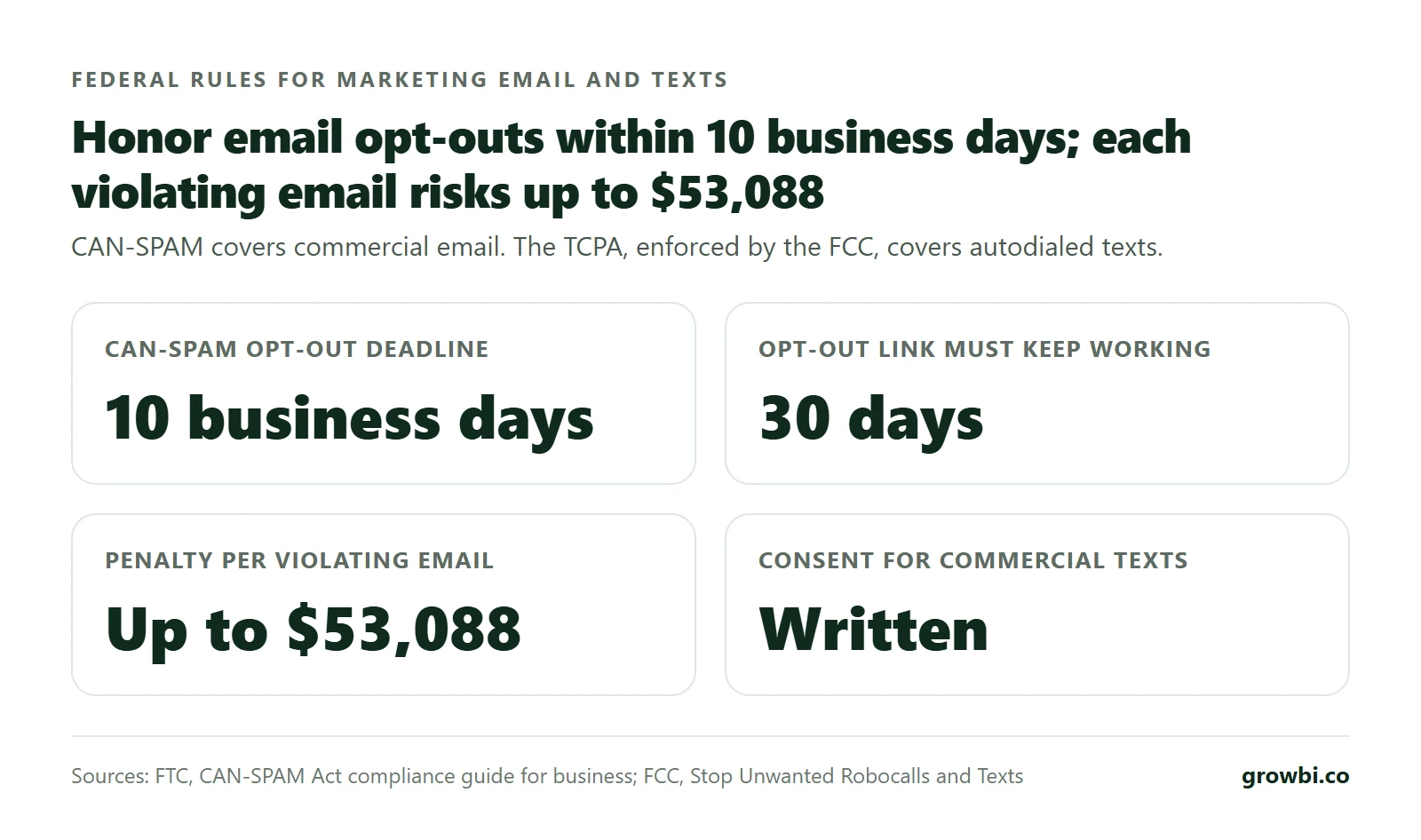
Opt-out requests must be honored within 10 business days, and the opt-out link must keep working for at least 30 days after sending. Each violating email risks penalties of up to $53,088.
Primary purpose decides which rules apply. A pure appointment reminder is transactional, but the FTC reads that category narrowly. Add a promotion to the top of a reminder and the whole email turns commercial.
Hiring an agency or software vendor to send does not move the liability. The FTC says the clinic stays responsible for every message sent on its behalf.
Email or SMS: picking the channel for each message
Use SMS when timing matters and email when the patient needs detail. Forcing everything into one channel buries urgent messages or crams education into a text.
- Inquiry reply, confirmations, reminders. Channel: SMS; Reason: Read in minutes, one-tap reply
- Same-day openings. Channel: SMS, marketing opt-ins only; Reason: Fills a slot before the day ends
- Review request. Channel: SMS; Reason: One short link the day after
- Aftercare instructions. Channel: Email, linked from SMS; Reason: Detail the patient rereads at home
- Treatment education and seasonal offers. Channel: Email; Reason: Room for photos, prices and FAQs
- Membership explainer. Channel: Email; Reason: Terms and monthly numbers need space
Regular patients are your best membership prospects. When the email list shows a patient booking every cycle, send a dedicated membership email. Our membership program guide covers pricing and terms.
Growing an email list that books treatments
A med spa email list grows fastest at the front desk and on the booking form. Every new patient becomes a subscriber if you ask well.
Add two separate, unchecked boxes to intake: one for appointment texts, one for offers by email and text. Separate boxes give you clean consent records and fewer complaints.
Welcome new subscribers with one email that introduces the providers, the treatment menu and how booking works. Skip the discount in that first send, since it trains people to wait for the next one.
Personalized emails beat blasts. Segment by last treatment and visit date so each message matches what the patient had done, and invite social media followers to join through a booking-linked form.
Write subject lines that name the treatment or the provider. A subject such as {Provider} has Saturday openings for {treatment} tells the reader why to open, at the right time in their cycle.
Metrics that show whether your follow-up works
Count booked and arrived patients per sequence. Open rates are a weak signal, and click-through rates only tell you who was curious.
Mailchimp's email benchmarks note that Apple's Mail Privacy Protection affects the accuracy of open rate data. Treat opens as a deliverability check, not a result.
- Reply rate on the 60-second inquiry text.
- Confirmation rate before each visit, from the C replies.
- Lead-to-arrival rate by lead source and by treatment.
- Rebooking rate within each treatment's recommended interval.
- Appointments and revenue from each reactivation send.
Conversion rates from email campaigns only matter when they end in a visit. If you want your own numbers mapped from inquiry to arrival, book a free 15-minute call and bring last month's report.
For the ads, offers and follow-up together as one system, see our med spa marketing service.
FAQs
What is the 80/20 rule for email marketing?
It is a rule of thumb: about 80% of your emails should help the reader, through aftercare, education and provider news, and about 20% should sell. For a med spa list, that means roughly one promotional send for every four useful ones, so patients keep opening each message.
What is the top CRM platform for medspas?
There is no single winner. The right CRM is the one that texts new inquiries within a minute, sends reminders from the booking calendar and logs consent. Compare platforms on two-way texting, trigger options and reporting on arrivals, not only on price per seat.
How often should a med spa email its whole patient list?
Two emails a month plus seasonal announcements is a sensible start for most clinics. Triggered follow-up messages sit outside that count. After each send, check unsubscribes and spam complaints; if both climb, cut frequency or narrow the segment.
Conclusion
Med spa email marketing earns its keep after the inquiry, not in the newsletter. The five stages protect revenue you already paid for: inquiries, bookings, visits, rebookings and lapsed patients.
Set up the inquiry and booking messages first, keep consent records for every text, and judge each sequence by patients who arrive. Then add the rebooking and reactivation emails.
If you want to see where your own patients drop off between inquiry and arrival, book a free 15-minute call and we will map it with you.
Mor Romano
CTO, Growbi
Written and fact checked by Mor Romano, published , last reviewed .
More about Mor RomanoGet this system built for your business
Book a strategy call and we will model a realistic appointment target from your budget, market, and offer.
Keep reading
Med Spa Lead Generation: How to Get Medspa Leads That Book and Show Up
How to Reduce Med Spa No-Shows Without Upfront Deposits
Med Spa CRM: 10 Medical Spa CRMs and Software Platforms Compared
Med Spa Membership Programs: How to Price, Launch and Keep Members

Medical Spa Review Management: What Patients Check and What Google and the FTC Allow
Med Spa Black Friday Deals: Holiday Promotions That Also Fill January