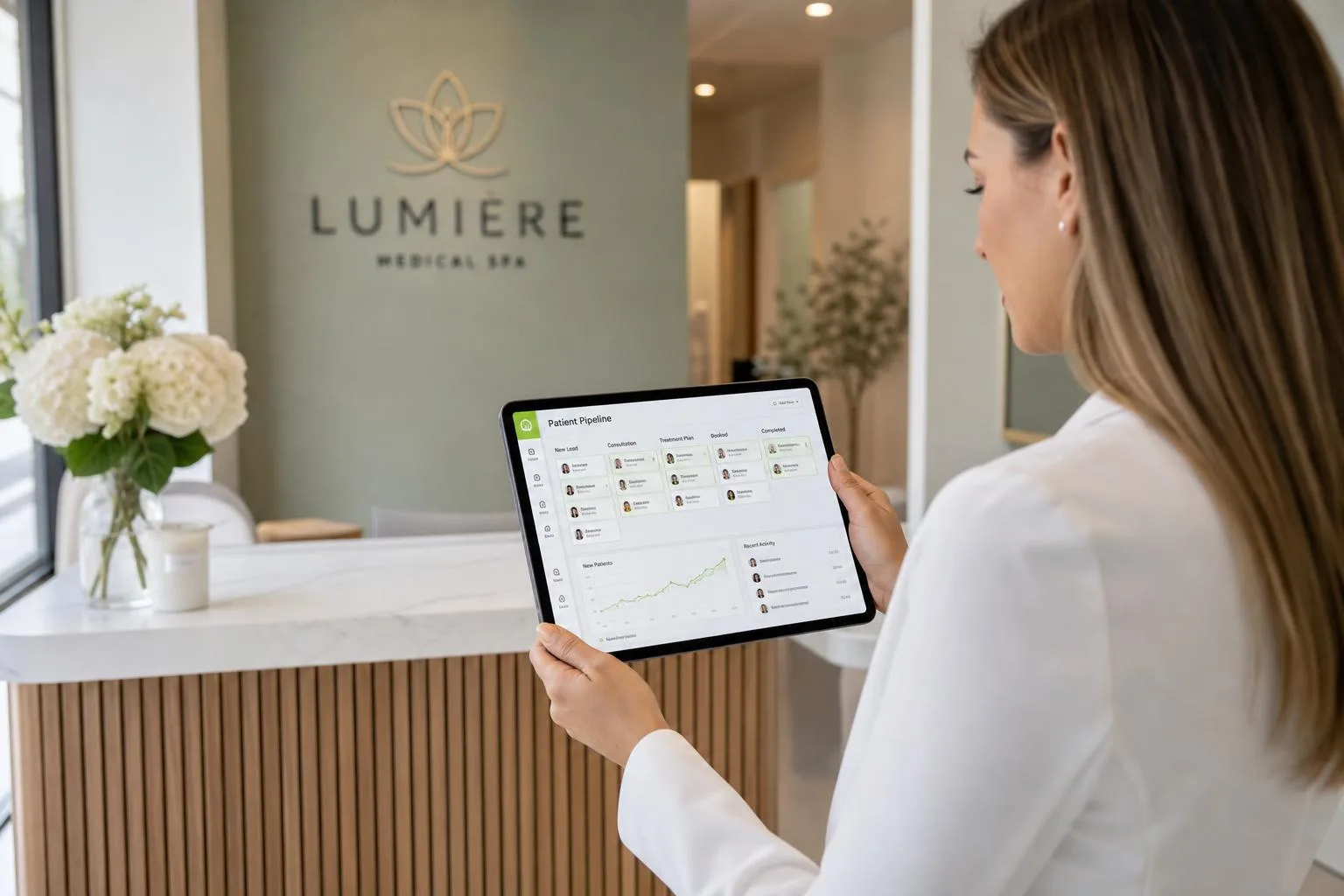
The short answer
A med spa CRM is software that captures leads from ads and your website, automates SMS and email follow-up, tracks your marketing pipeline, and triggers rebooking reminders. It sits between someone clicking your ad and actually showing up for their appointment, so choosing the right platform protects your bookings and ROAS.
On this page
A med spa CRM captures leads from your ads and website, automates follow-up by text and email, tracks your marketing pipeline, and triggers rebooking reminders, all in one system. It's the layer between someone clicking your ad and actually showing up for their appointment.
Choosing the wrong platform means leads slip through, follow-up falls behind, and you can't tell which campaigns actually fill your calendar. This guide breaks down the features that matter, compares the top platforms for 2026, and walks through implementation so you don't lose bookings during the switch.
What is a med spa CRM?
A med spa CRM is software that captures leads, automates follow-up messages, tracks your marketing pipeline, and handles patient rebooking. Think of it as the system that sits between someone clicking your ad and actually showing up for their appointment.
You'll often hear CRM mentioned alongside EMR, which stands for Electronic Medical Record. They're different tools. EMR handles clinical documentation like treatment notes and prescriptions. CRM handles communication and marketing. Some platforms bundle both together, while others work as a layer on top of your existing clinical software.
Here's what a med spa CRM typically handles:
- Lead capture: Pulls in inquiries from ads, web chat, Instagram DMs, and text messages into one place
- Automated follow-up: Sends SMS and email sequences without your front desk lifting a finger
- Pipeline management: Shows you exactly where each lead sits in the booking journey
- Rebooking automation: Triggers reminders for repeat treatments like Botox touch-ups
Why do med spas need a dedicated CRM?
Generic CRMs weren't built for aesthetic practices. They don't account for rebooking cycles on injectables, the urgency of responding to ad leads, or treatment packages that run into thousands of dollars.
The pain points we see over and over again come down to a few core issues:
- Leads go cold: Inquiries from paid ads require follow-up within minutes. A five-minute delay can cut your contact rate dramatically.
- No-shows drain revenue: Without automated confirmations and reminders, practices lose a significant portion of booked appointments.
- Marketing waste: If you can't trace booked appointments back to specific campaigns, you're guessing where to spend.
- Fragmented tools: Juggling separate systems for booking, follow-up, and reporting creates gaps where leads disappear.
A dedicated med spa CRM addresses each of these directly. That said, the tool alone doesn't guarantee results. Execution, creative, and human follow-up still matter just as much.
What are the must-have features in a med spa CRM?
HIPAA compliance and patient data security
Any CRM storing patient contact information or treatment history falls under HIPAA requirements. HIPAA is the federal law protecting patient health information. Look for encryption, role-based access controls, and a signed Business Associate Agreement before storing sensitive data.
Online booking and appointment confirmation
Self-scheduling from your website or ads reduces friction for patients. Automated text and email confirmations, plus reminders 24 hours and 2 hours before the appointment, cut no-shows significantly. Two-way texting lets patients reschedule without calling.
Automated lead follow-up by SMS, email, and calls
Speed-to-lead refers to how quickly you respond to an inquiry. The best CRMs trigger an automated text within seconds of a form submission, then nurture with a sequence of messages until the lead books or opts out. This matters because the first practice to respond often wins the appointment.
Marketing attribution and ROAS reporting
Attribution tracks which ad, campaign, or channel resulted in a booked appointment, not just a lead. ROAS stands for Return on Ad Spend, and it tells you how much revenue you generated for every dollar spent. Without attribution, you're guessing which campaigns actually fill your calendar.
EMR charting and e-prescribe integration
If your practice already uses a clinical EMR, you'll want a CRM that integrates cleanly with it. If you're starting fresh, an all-in-one platform that includes charting and e-prescribe can simplify operations considerably.
Reviews, loyalty, and rebooking automation
Post-visit workflows matter for retention. Automated review requests sent after appointments build your online reputation. Loyalty triggers and rebooking reminders keep patients returning for treatments that require maintenance, like fillers or laser sessions.
Multi-location scalability
Planning to expand? Look for a central dashboard, standardized workflows across locations, and location-level reporting. Setting this up from the start is far easier than retrofitting later.
How do the top med spa CRM platforms compare?
| Platform | Best for | Category | Price tier |
|---|---|---|---|
| Aesthetix CRM | Marketing-focused lead capture | Dedicated med spa CRM | Mid-tier |
| Zenoti | Multi-location enterprise practices | All-in-one operations | Higher-tier |
| Mangomint | Boutique spas wanting modern UX | Booking + light CRM | Mid-tier |
| AestheticsPro | Practices needing EMR + CRM combined | All-in-one med spa software | Mid-tier |
| Boulevard | Premium client experience focus | Booking + client management | Mid-tier |
| Mindbody Booker | Established Mindbody ecosystem users | All-in-one operations | Mid-tier |
| GoHighLevel | DIY practices or agency-supported | Custom automation builder | Lower-tier |
| HubSpot | Larger practices with in-house marketing | General CRM adapted | Varies |
Aesthetix CRM
Aesthetix CRM was built specifically for med spa marketing. It excels at speed-to-lead automation, unified inbox management, and campaign attribution. Practices focused on lead generation and follow-up tend to find the most value here. One limitation: it doesn't include EMR functionality, so you'll still need separate clinical software.
Zenoti
Zenoti is an enterprise platform covering scheduling, POS, inventory, marketing, and reporting at scale. Multi-location med spas benefit most from centralized management across all their sites. The tradeoff is complexity and cost that may overwhelm smaller single-location practices.
Mangomint
Mangomint offers a clean, modern interface with intuitive booking, two-way texting, and membership management. Boutique spas prioritizing client experience often prefer it. Marketing automation is lighter here compared to dedicated CRM platforms, so it works better for practices with simpler follow-up needs.
AestheticsPro
AestheticsPro combines EMR, booking, forms, loyalty, and marketing in one system. Practices wanting a single platform for both clinical and marketing operations find value here. Advanced lead nurturing may require add-ons or integrations depending on your workflow.
Boulevard
Boulevard focuses on premium client experience with elegant booking, detailed client profiles, and integrated payments. High-end aesthetic practices appreciate the polish. Outbound marketing automation isn't the primary focus, so it pairs well with a separate lead generation system.
Mindbody Booker
Booker by Mindbody offers established scheduling and business management with marketplace exposure. Practices already in the Mindbody ecosystem can stay within familiar territory. Marketing automation often requires third-party tools to fill the gaps.
GoHighLevel
GoHighLevel is a white-label automation builder popular with marketing agencies. It offers flexible SMS and email pipelines plus funnel building. The catch: it requires configuration and isn't plug-and-play for practices without technical support or an agency partner.
HubSpot for aesthetic practices
HubSpot provides enterprise-grade CRM with robust reporting and integrations. Larger practices with in-house marketing teams can customize it extensively. It's not built specifically for med spa workflows, so expect setup time and ongoing configuration.
How do you choose the right med spa CRM for your practice?
Before comparing platforms, clarify your priorities. The right CRM depends entirely on your situation.
- All-in-one or layered? Decide if you want EMR, booking, and CRM combined, or a marketing CRM to add to your current stack
- Practice size: Single location versus multi-location changes which platforms fit
- Primary goal: Lead generation versus operational efficiency versus retention
- Budget: Monthly cost plus implementation and training fees
- Integration needs: What existing software does the CRM need to connect with?
How do you implement a med spa CRM without losing bookings?
A rushed migration loses bookings. A structured one keeps the calendar full throughout the switch.
Five steps that protect your pipeline during the switch.
Audit your current lead and patient workflow
Map where leads come from, how they're followed up, and where drop-off happens. This reveals the gaps your new CRM will fill.
Migrate patient data, forms, and templates
Export contacts, intake forms, and communication templates from your current system. Clean the data before importing. Duplicate records and outdated contacts create noise that slows everything down.
Train front desk and provider teams
Schedule hands-on training sessions before go-live. Assign a CRM champion on staff who becomes the internal expert and first point of contact for questions.
Launch automations and test booking flows
Start with core automations: appointment confirmations, no-show follow-up, and review requests. Test the entire flow end-to-end before running paid ads to the new system.
Track show-up rate and cost per appointment
Define KPIs from day one. Monitor show-up rate, cost per booked appointment, and rebooking rate weekly. Adjust automations based on what the data shows.
How does a med spa CRM drive more booked appointments and higher ROAS?
Each CRM capability connects to a measurable outcome. Speed-to-lead automation increases contact rates. Nurturing sequences move hesitant leads toward booking. Attribution tells you which campaigns deserve more budget. Rebooking automation increases lifetime value.
CRM is a tool, though, not a complete solution. The software captures and organizes leads. Creative, targeting, and human follow-up determine whether those leads actually become patients sitting in your treatment room.
Practices that combine strong CRM infrastructure with high-converting ad creative, precise audience targeting, and a dedicated follow-up process consistently see better results. We've seen cost per appointment drop to $20 to $35 and show-up rates climb when the full system works together.
How do you turn your med spa CRM into a full appointment engine with Growbi?
A CRM organizes your pipeline. Growbi fills it with qualified, booked appointments.
We handle the creative, paid ads, lead qualification, and human follow-up so your CRM actually delivers results. Our done-for-you system has generated 100+ qualified appointments in 30 days for med spas, with a performance guarantee: at least 30 new patients in the first month, or you don't pay.
Frequently asked questions
What is the best CRM for a medical spa?
The best CRM depends on your practice size and goals. Aesthetix CRM works well for marketing-focused lead capture, Zenoti suits multi-location operations, and GoHighLevel fits practices with agency support or technical resources. Match the platform to your primary goal, whether that is lead generation, operational efficiency, or retention.
What is the difference between a med spa CRM and general spa software?
Med spa CRMs focus on lead capture, marketing automation, and patient communication. General spa software often prioritizes booking and point-of-sale without advanced follow-up or attribution capabilities. A med spa CRM is built for the speed-to-lead and rebooking cycles that aesthetic practices depend on.
Is a med spa CRM HIPAA compliant by default?
Not always. Verify the vendor offers a signed Business Associate Agreement, encrypted data storage, and role-based access controls before storing any patient information. HIPAA compliance is a requirement for any system handling patient contact or treatment data, and the responsibility is shared between you and the vendor.
How much does a med spa CRM cost per month?
Pricing ranges from around $100 per month for basic platforms to $500 or more for enterprise solutions, depending on features, locations, and user seats. Implementation and training fees add to the total. Compare total cost of ownership, not just the monthly sticker, when budgeting.
Can a med spa CRM replace booking software and EMR?
Some all-in-one platforms combine CRM, booking, and EMR. Others are designed to layer on top of existing clinical and scheduling systems. The right choice depends on your current stack and whether you want to consolidate tools or keep clinical and marketing systems separate.
How long does it take to migrate to a new med spa CRM?
Migration typically takes two to six weeks, depending on data complexity, staff training needs, and the number of automations being configured. Auditing your current workflow first, cleaning data before import, and testing booking flows end-to-end before going live keeps the calendar full during the switch.

Want this built for your clinic?
Book a strategy call and we will model a realistic appointment target from your budget, market, and offer.
Keep reading
Lead Generation Leads for Med Spas: How to Fill Your Calendar With Qualified Appointments

The Medical Spa Owner's Guide to Review Management in 2026
Reduce Med Spa No-Shows: Proven Strategies Without Upfront Deposits
Best Med Spa Marketing Agencies in 2026: An Honest Comparison