Speed to Lead: Why the First 5 Minutes Decide Who Books
 Mor RomanoCTO, Growbi11 min read
Key Takeaways
- Speed to lead is measured from form submission to the first two-way contact, not to an automated email.
- In an audit of 2,241 US companies, Harvard Business Review found 23% never responded to a web lead at all.
- Med spa leads compare several clinics at once, so the first clinic to call usually gets the consultation.
- A 5-minute call, an instant text and a 14-day follow-up cadence fix more bookings than a bigger ad budget.
Speed to lead is the time between a new inquiry and your first real contact. It matters because interest fades fast: Harvard Business Review found companies responding within an hour were nearly seven times as likely to qualify a lead as slower ones. For a med spa, the target is a call and text within 5 minutes.
Table of Contents
A woman fills in your Botox form at 8:40 on a Tuesday night. She also fills in the forms of two other clinics she found on Instagram. The first clinic to call her, while she is still holding her phone, books the consultation, and the other two leave a voicemail she never plays.
Nothing about the losing clinics was worse. Their injectors were just as good and their prices were similar. They were simply 40 minutes late, and in the med spa accounts we audit, that gap between form and first call leaks more bookings than any weak ad.
What Is Speed to Lead?
Speed to lead is the time between a person submitting an inquiry and your business making real, two-way contact with them. A form fill, a missed call, a lead ad, a chat message or an Instagram DM all start the clock.
An automatic confirmation email does not stop it. The clock stops when a person on your team speaks with the lead or the lead replies to a message from you. Measuring anything less flatters the number and hides the problem.
What the Research Says About Lead Response Time
Two studies are quoted more than any others, and they are often mixed up. Both were led by James Oldroyd, and both point the same way.
In The Short Life of Online Sales Leads, published in Harvard Business Review in March 2011, the researchers audited 2,241 US companies by submitting web inquiries and timing the response.
Companies that tried to reach a lead within an hour were nearly seven times as likely to qualify it as those that waited longer, and more than 60 times as likely as companies that waited 24 hours or more.
The earlier Lead Response Management study, run with InsideSales.com, measured minutes rather than hours. It reported that the odds of contacting a lead were 100 times higher when the first call came within 5 minutes instead of 30, and the odds of qualifying it were 21 times higher.
- Harvard Business Review, 2011. What was measured: Response to web inquiries at 2,241 US companies; Headline finding: Under 1 hour: nearly 7x as likely to qualify; over 60x versus waiting 24 hours
- Lead Response Management study, with InsideSales.com. What was measured: Call attempts on web leads across several companies; Headline finding: 5 minutes versus 30: 100x odds of contact, 21x odds of qualifying
Read these numbers as direction, not as a promise. Both studies are more than a decade old, and the second was promoted by a company that sells response software. The exact multipliers will not match your clinic. The direction has held up in every account we have measured: the longer a lead waits, the less likely it is to book.
How Fast Most Businesses Actually Respond
Slower than their owners think. The same Harvard Business Review audit found that only 37% of companies responded within an hour, 24% took more than 24 hours, and 23% never responded at all. Among companies that did respond within 30 days, the average response time was 42 hours.
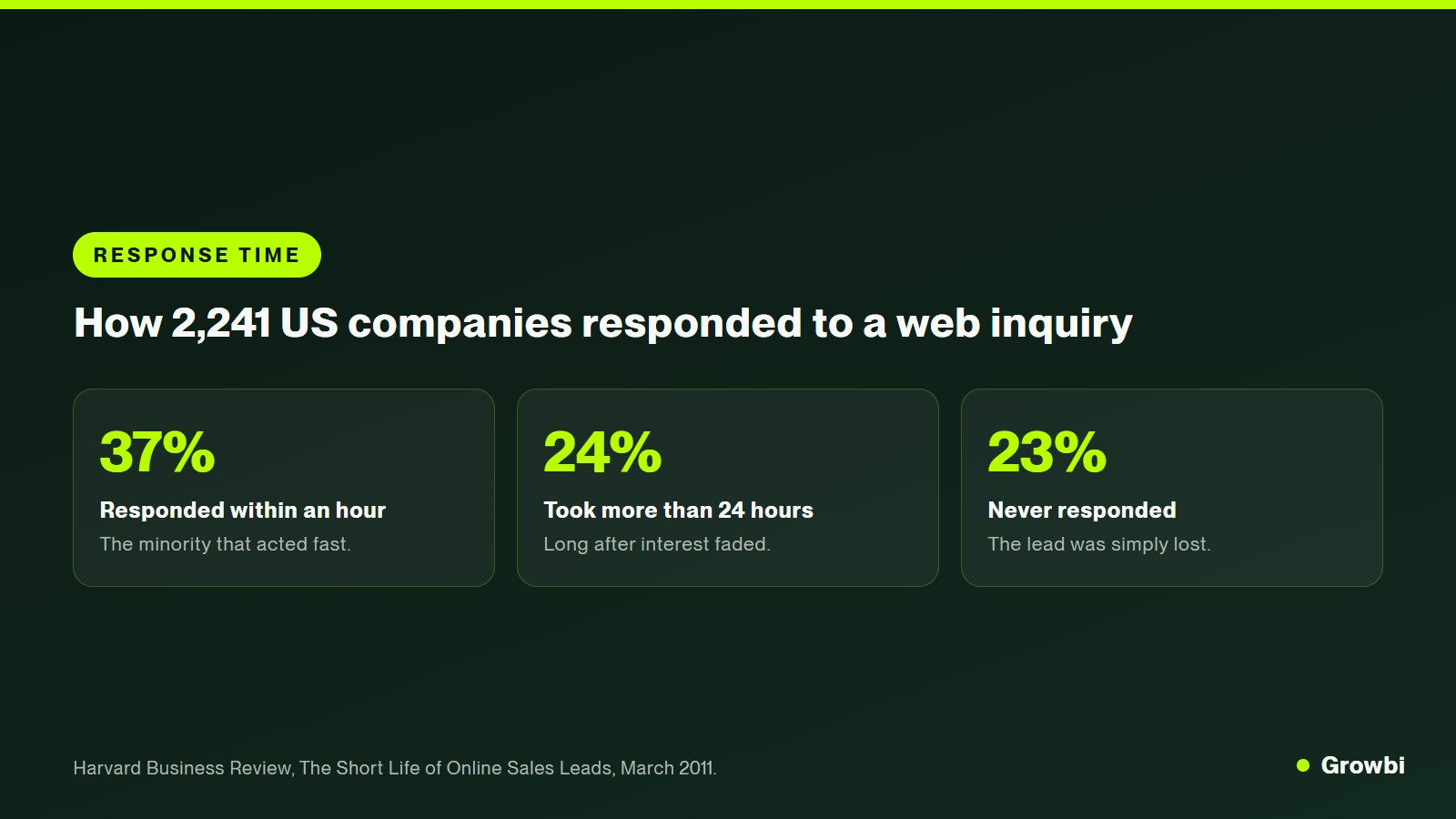
Source: Harvard Business Review, The Short Life of Online Sales Leads (March 2011)
Med spas are not exempt. In clinic audits we regularly see leads that wait until the next morning because the front desk is with patients, and Meta leads that sit in a spreadsheet nobody checks on weekends.
Why Response Time Matters Even More for Med Spas
Aesthetic treatments are a want, not an emergency, and that makes interest fragile. Four things make med spa leads cool faster than most.
- People inquire at several clinics at once. A first-time Botox or filler patient often fills in two or three forms in one evening, and books with whoever calls first.
- Social leads are impulse leads. Someone who tapped a Meta lead ad between videos has much less intent than someone who searched for a treatment, and that intent fades within the hour.
- Many inquiries arrive after hours. Evenings and weekends are when people browse, which is exactly when most front desks are closed.
- Price anxiety grows with time. The longer a lead waits, the more time she spends comparing prices instead of thinking about results.
This is why we judge every med spa campaign on booked and attended appointments, not leads. Our guide to med spa lead generation explains how the lead source and the follow-up work together.
The 5-Minute Follow-Up System
Speed does not come from telling the front desk to try harder. It comes from routing, automation and a clear owner for every lead. This is the sequence we build for clinics.
Each step removes a delay between the form and the first conversation.
- Send every lead to one place instantly. Website forms, Meta lead ads, Google calls and Instagram DMs all land in the same CRM within seconds. No spreadsheets, no inbox forwarding.
- Text within 60 seconds. An automatic text from a real clinic number names the treatment, introduces the coordinator by first name and says a call is coming in the next few minutes.
- Ring a person, not an inbox. The CRM alerts the coordinator on duty by phone and on screen. If nobody picks the lead up in 2 minutes, it goes to a backup person.
- Call within 5 minutes, then call again. If the first call goes unanswered, call again a minute later. Many people answer the second call once they see the same number twice.
- Qualify and book on the same call. Confirm the treatment, ask whether they have had it before and when they want results, then offer two specific times. Do not end the call with a promise to send availability.
- Secure the appointment. Take a card on file or a small redeemable deposit, and send the confirmation with the address, parking and what to expect.
- Run the follow-up cadence for everyone else. Leads you could not reach go into a 14-day sequence of calls and texts, then into a monthly nurture list rather than the trash.
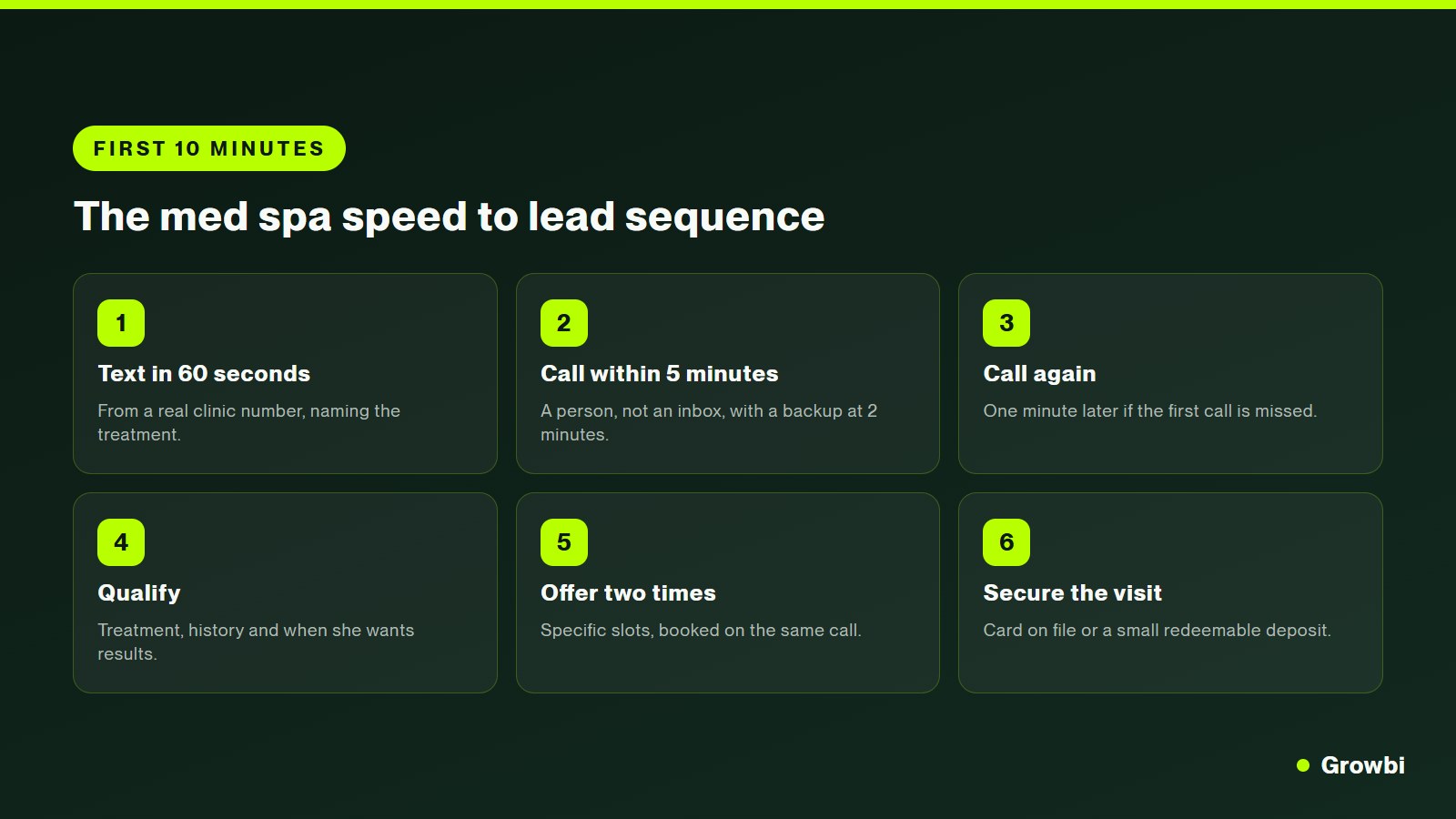
Source: Growbi follow-up process for med spa clients, as described in this article
What to Say on the First Call
The first call has one job: turn interest into a time on the calendar. Keep it under five minutes and follow the same structure every time.
- Connect it to her action. "Hi Sarah, it is Mia from Glow Med Spa, you just asked about lip filler, is now a good moment?"
- Ask two or three questions. What result she wants, whether she has had the treatment before, and when she would like to see results.
- Answer the real question. Usually price, pain or downtime. Give a range and what is included, then move on.
- Offer two specific times. "I have Thursday at 5:30 or Saturday at 11, which is better?" beats "When are you free?"
- Confirm and set expectations. Card on file or deposit, what to bring, and the text confirmation she will get next.
How to Handle Leads That Come In After Hours
Decide on purpose instead of letting the lead wait until morning by default. There are three good options, and most clinics combine two.
- An instant text with a booking link, so the lead can choose a consultation time at 10 pm without waiting for anyone.
- A trained call center or remote coordinator covering evenings and weekends, which is how we run follow-up for many of our clinics.
- A morning-first rule. Overnight leads are the first calls of the day, before any other admin, ideally by 8:30.
If you also run Google Local Services Ads, unanswered calls now cost money too. Our Local Services Ads guide covers the October 2026 rule that bills some missed calls during business hours.
How Many Times to Follow Up Before Giving Up
More times than most front desks do. One call and one voicemail is not follow-up. Spread attempts across different times of day for two weeks, then move the lead to a longer nurture list.
- Minute 1. Action: Automatic text from a clinic number; Why: Confirms she reached a real clinic
- Minutes 2 to 5. Action: Call, then a second call one minute later; Why: Catches her while she is still on her phone
- Hour 1. Action: Personal text from the coordinator; Why: Easier to reply to than a call
- Day 1, evening. Action: Call; Why: Reaches people who work during the day
- Day 2. Action: Text with a specific open time; Why: Gives her an easy yes
- Day 4. Action: Call and short voicemail; Why: Shows persistence without pressure
- Day 7. Action: Text with a before-and-after or FAQ link; Why: Answers the question that stopped her
- Day 14. Action: Final text, then monthly nurture; Why: Keeps the door open without chasing
Write the text messages and email follow-up together, so the tone is consistent. Our med spa email and SMS follow-up guide includes message templates for each stage.
The Legal Rules for Calling and Texting New Leads
You can call and text right away when the person asked to be contacted and you have the right consent. The rules live mainly in the Telephone Consumer Protection Act and the FCC regulations under it, and the details matter most for automated texts.
- Get clear consent on the form. A checkbox or statement saying the person agrees to calls and texts from your clinic about her inquiry, including automated messages, at the number provided.
- Respect calling hours. The FCC rule at 47 CFR 64.1200 bars telephone solicitations to residential subscribers before 8 a.m. or after 9 p.m. in the recipient's local time.
- Honor opt-outs immediately. The FCC's consumer guide on robocalls and texts confirms people can revoke consent in any reasonable way, including replying stop.
- Keep health details out of texts. Confirm times and logistics by text and discuss treatment details on the call.
This is general information, not legal advice. Ask your attorney to review your form language and texting setup before you scale volume.
How to Measure Speed to Lead
Track four numbers every week, by lead source and by coordinator. Use the median rather than the average, because one lead that waited three days hides behind twenty that waited two minutes.
- Median first response time. How to calculate it: Time from inquiry to first two-way contact; Target for a med spa: Under 5 minutes in opening hours
- Contact rate. How to calculate it: Leads reached in conversation divided by total leads; Target for a med spa: Rising every month
- Booking rate by response bucket. How to calculate it: Booked leads divided by leads, split by under 5 minutes, 5 to 60, over 60; Target for a med spa: Highest in the fastest bucket
- Show rate. How to calculate it: Attended appointments divided by booked appointments; Target for a med spa: Stable or rising as speed improves
Booking rate by response bucket is the number that convinces owners. When it shows the fastest leads booking far more often, the case for a call center or a second coordinator makes itself.
The Tools That Help a Clinic Respond Faster
Tools help only when someone owns the process. With that in place, four pieces of software do most of the work.
- A CRM that receives every lead in real time and shows the time since inquiry on each one. Our comparison of med spa CRM platforms covers the main options.
- Instant alerts by phone, not only email, with a backup person when the first owner does not pick up.
- Automated first texts and follow-up sequences that stop the moment the lead replies.
- Booking and reminders in one flow, so the time saved on the first call is not lost to no-shows. See our guide on reducing med spa no-shows.
The Growbi System puts the lead source, every conversation and the appointment in one record, with a queue that shows which lead needs a call right now. That structure is what makes a 5-minute standard possible on busy days.
FAQs
What is speed to lead?
Speed to lead is the time between a person submitting an inquiry, such as a form, lead ad or call, and your business making real two-way contact with them. It stops when someone on your team talks with the lead or the lead replies to you, not when an automated confirmation email is sent.
What is a good lead response time?
For a med spa or any local service business, aim for first contact within 5 minutes during opening hours. Research by Harvard Business Review found companies that responded within an hour were nearly seven times as likely to qualify a lead, and an earlier study with InsideSales.com reported far higher contact odds at 5 minutes than at 30.
Why do med spa leads go cold so fast?
Aesthetic treatments are elective, many people inquire at several clinics in one evening, and social media leads are often impulse decisions. The clinic that calls first answers the price and downtime questions while interest is high. Every hour of waiting gives the lead time to compare prices, lose interest or book elsewhere.
How many times should I follow up with a lead?
Plan for at least six to eight attempts over 14 days, mixing calls and texts at different times of day. Start with a text within a minute and two calls within the first five minutes, then follow up on days 1, 2, 4, 7 and 14 before moving the lead to a monthly nurture list.
Conclusion
Speed to lead decides which clinic a new patient chooses long before your treatments, prices or reviews get a fair hearing. The research is old but consistent, and every account we measure shows the same pattern: fast responses book, slow responses fade.
You do not need a bigger ad budget to fix it. Route every lead to one place, text in a minute, call in five, book on the call and follow up for two weeks.
If you want to know how fast your clinic responds today, book a free strategy call and we will run a timed test inquiry with you.
Get this system built for your business
Book a strategy call and we will model a realistic appointment target from your budget, market, and offer.