Peptide Therapy Ads: What Med Spas Can Advertise in Late 2026
 Mor RomanoCTO, Growbi11 min read
Key Takeaways
- Searches for "peptide therapy near me" grew from 8,100 to 18,100 a month between October 2025 and September 2026.
- The FDA's interim access policy, sent to the White House on October 16, would be enforcement discretion, not approval.
- Meta requires prescription drug advertisers to be authorized, and ChatGPT ads exclude prescription medicines and experimental therapies.
- The safest ads sell a consultation with a licensed provider, not a named peptide or a promised result.
Med spas can market peptide therapy, but not the way most peptide ads online do. Compounded peptides remain unapproved drugs even if the FDA's pending interim policy is adopted, so ads should promote a consultation with a licensed provider, avoid treatment claims, and expect prescription drug restrictions on Meta, Google and ChatGPT.
Table of Contents
Peptides went from a niche wellness topic to one of the most requested services at med spas in less than a year. Clients arrive asking for BPC-157 by name, competitors post peptide menus on Instagram, and owners ask us the same question every week: can we just run ads for this?
Some clinics can market peptide therapy, carefully. But the regulatory picture changed three times in 2026, the ad platforms treat prescription products differently, and the ads that perform best in a feed are often the ones most likely to get an account restricted.
Here is where things stand on October 24, and how to market peptides without betting the ad account on it.
Why Everyone Is Talking About Peptides Right Now
Because demand and regulation both moved fast this year. Search data shows the demand side clearly.
- peptide therapy near me. October 2025: 8,100; September 2026: 18,100; What it signals: Consumers looking for a local provider
- peptide clinic. October 2025: 1,000; September 2026: 1,900; What it signals: Consumers choosing where to go
- med spa peptides. October 2025: 50; September 2026: 140; What it signals: Peptides becoming a med spa category
- peptide ads. October 2025: 30; September 2026: 260 (August); What it signals: Businesses asking how to advertise them
Illegitimate sellers moved even faster. LegitScript, the certification company that ad platforms rely on for health advertisers, reported that online ads for problematic peptides rose 208% in 2024 compared with 2023, as covered by PPC Land in December 2025. Named products included BPC-157, TB-500, Melanotan and PT-141.
That surge is exactly why platforms review peptide ads more strictly than most med spa ads. Your clinic is reviewed in the same queue as research-chemical sellers, so the burden is on your ad to look like what it is: a licensed medical practice offering a consultation.
What the FDA Actually Changed for Peptides in 2026
Three steps, none of which made compounded peptides approved drugs. Understanding the difference matters for every claim you make.
- April 15, 2026. The FDA updated its compounding categories and removed 12 peptides from Category 2, the list of bulk substances that may present significant safety risks, ahead of an advisory committee review.
- July 23 and 24, 2026. The FDA's Pharmacy Compounding Advisory Committee reviewed seven peptides and voted to recommend six of them, BPC-157, KPV, TB-500, MOTS-C, Epitalon and Semax, for the list pharmacies may compound from. The vote is advisory, not binding.
- October 16, 2026. HHS and the FDA sent an interim access policy for compounding certain peptides to the White House for review. Its list and conditions have not been published.
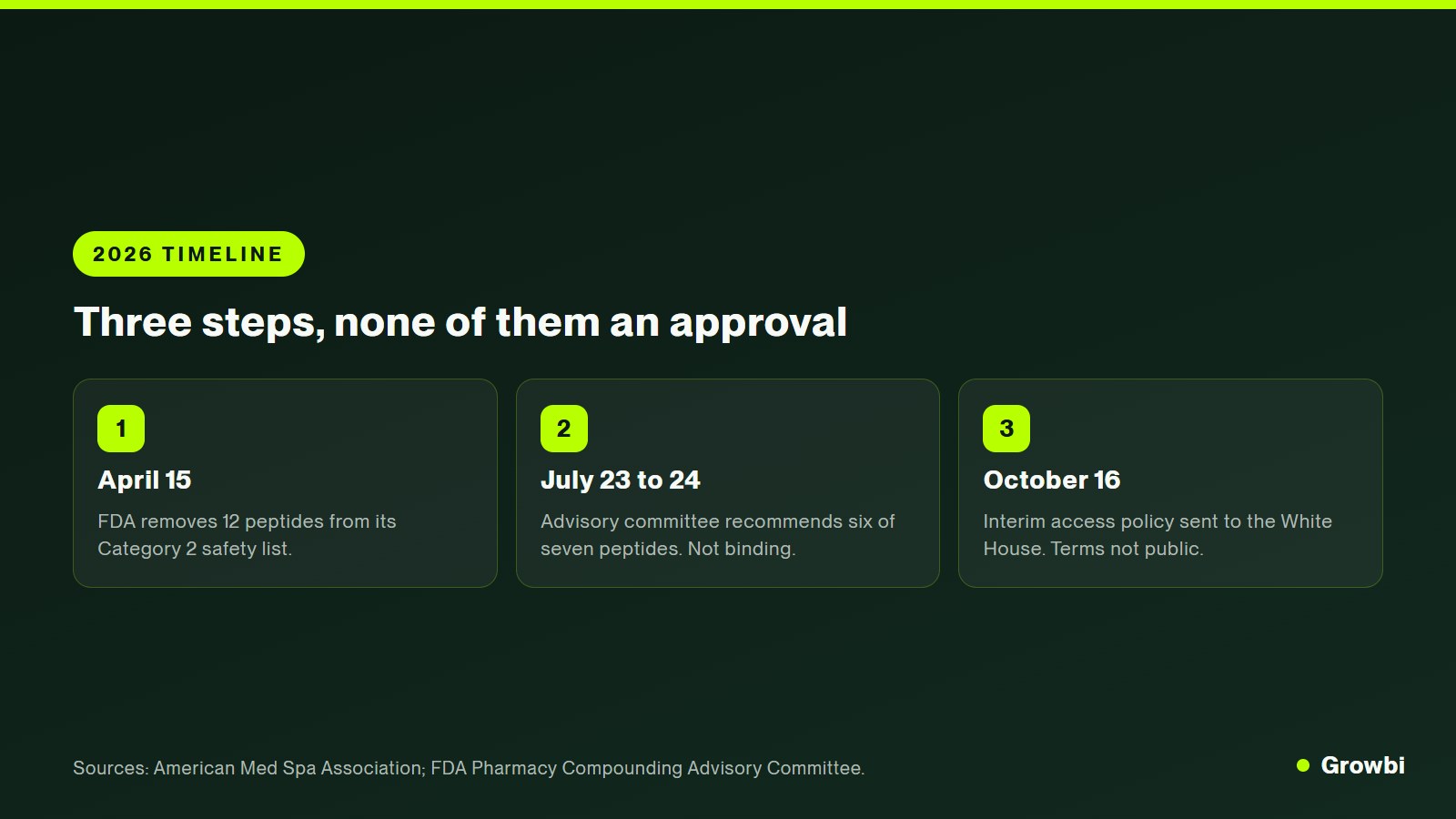
Source: American Med Spa Association; FDA Pharmacy Compounding Advisory Committee, July 2026
The FDA's advisory committee meeting page documents the July review. FDA staff's own briefing materials argued against adding BPC-157, noting a lack of clinical studies establishing safety and effectiveness, which shows how unsettled the science still is.
Why the Interim Access Policy Does Not Mean Peptides Are Approved
It does not, and this is the point most marketing gets wrong. The American Med Spa Association put it in four words: enforcement discretion is not approval.
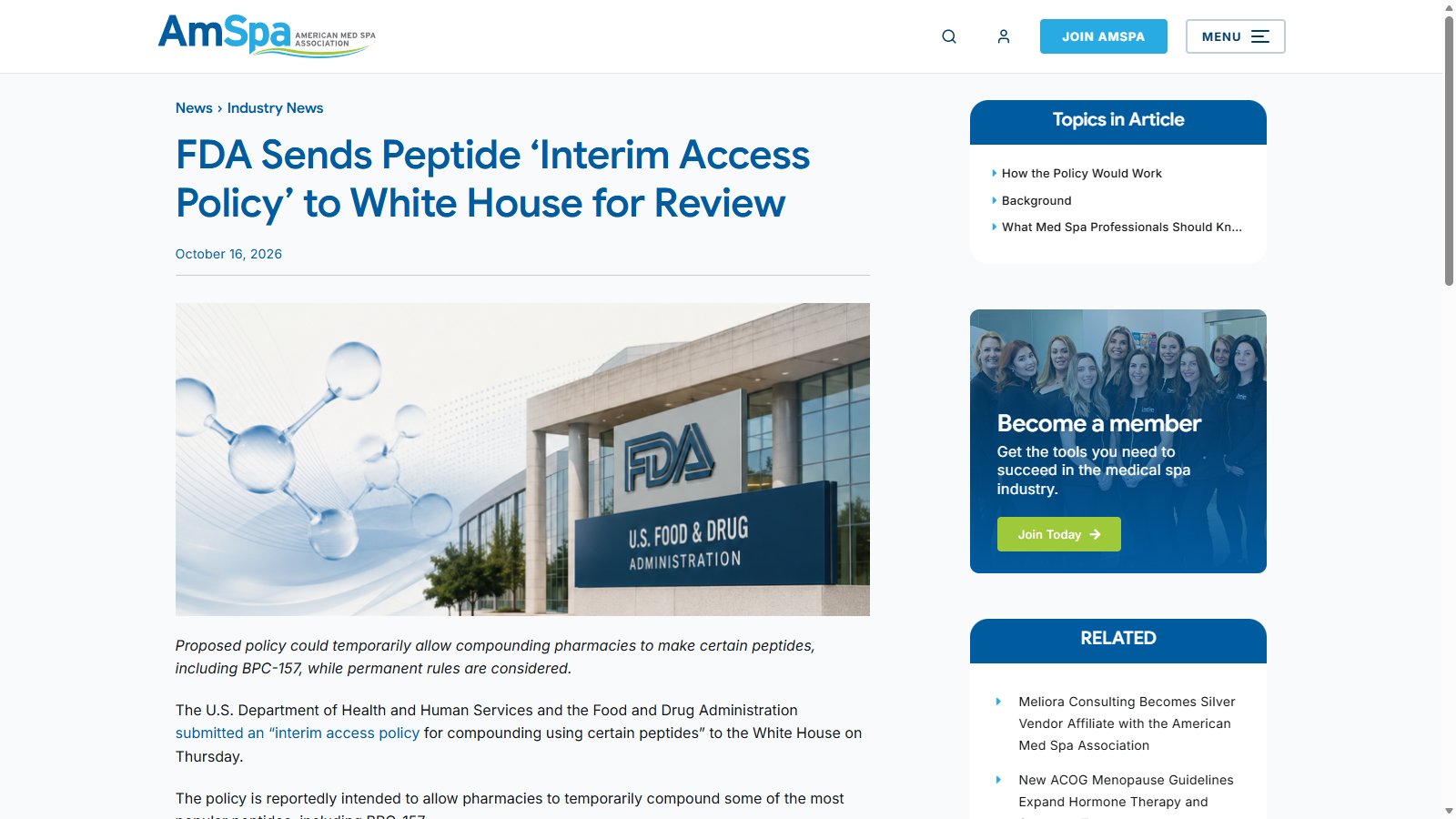
According to AmSpa's analysis, the policy would let the FDA choose not to act against qualifying pharmacies that compound certain peptides while permanent rules are developed. The peptides would remain unapproved drugs, state law would still govern prescribing and supervision, and AmSpa advises clinics to limit marketing claims because most evidence comes from animal studies.
What that means for your ads. Even in the best case, you will be advertising an unapproved compounded drug prescribed by your provider. Ads that describe peptides as approved, proven or safe, or that promise recovery, fat loss or anti-aging results, are making claims the regulators and the platforms have not accepted.
What Meta, Google and ChatGPT Allow for Peptide Ads
All three treat prescription products as restricted, and none has a special lane for compounded peptides. The table summarizes the published rules as of October 2026.
- Meta. Prescription products: Allowed only for authorized advertisers; telehealth and online pharmacies need LegitScript certification; 18+ targeting in eligible countries; What it means for a med spa: An ad promoting a prescription peptide needs authorization; educational content does not
- Google Ads. Prescription products: Healthcare and medicines policy restricts prescription drugs and bans unapproved pharmaceuticals and supplements; What it means for a med spa: Naming unapproved substances risks disapproval; promote the consultation instead
- ChatGPT ads. Prescription products: Prescription medicines, telehealth and experimental or investigational therapies are not allowed; What it means for a med spa: Peptide therapy cannot be advertised there at present
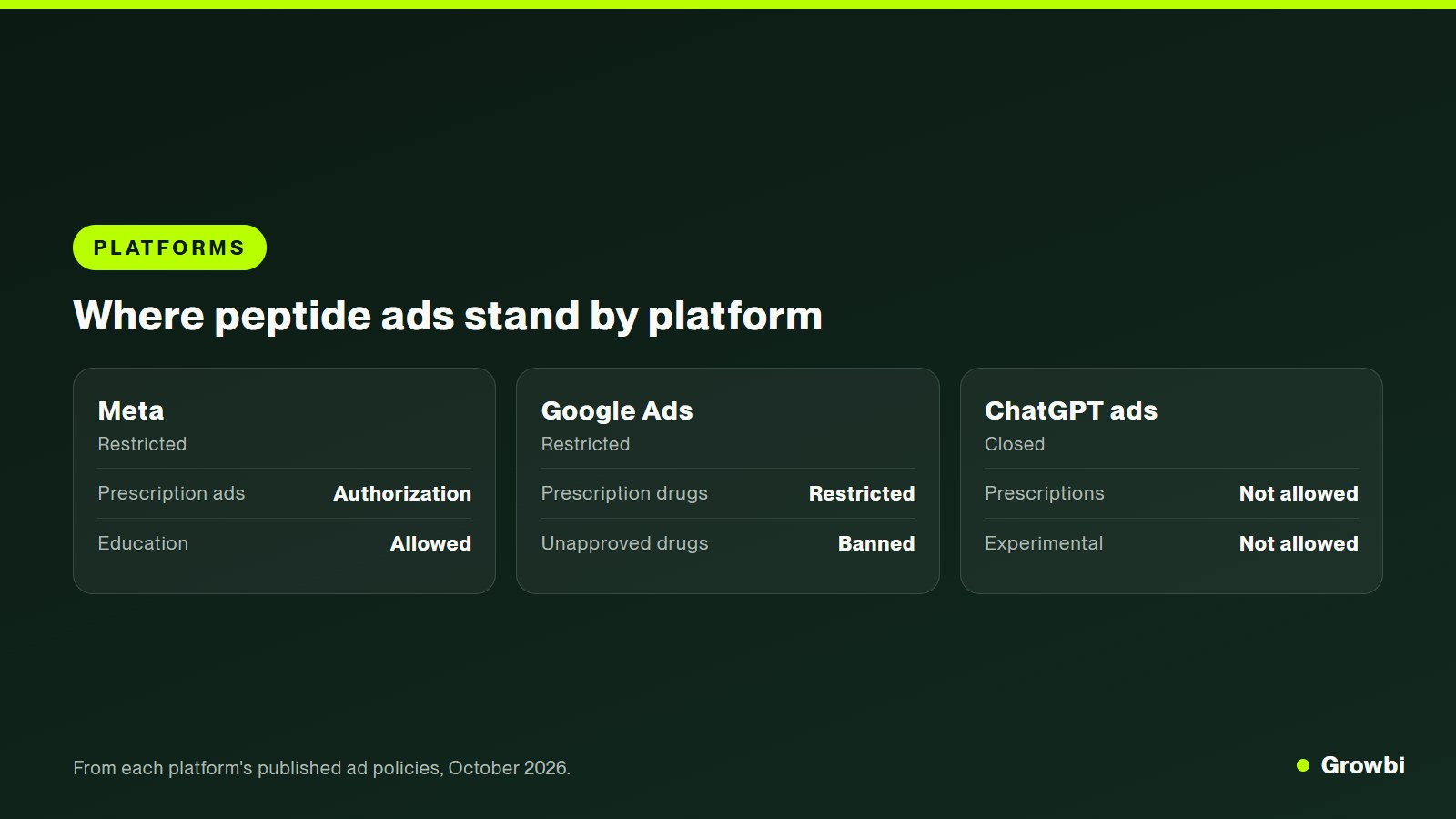
Source: Meta Transparency Center; Google Ads policy help; OpenAI Ad policies
Meta's drugs and pharmaceuticals policy allows prescription drug ads only from authorized advertisers, requires a disclaimer to consult a licensed professional, and bans unsafe substances at Meta's discretion. It also states that educational content about prescription drugs does not need written authorization.
OpenAI is the most explicit. Its ad policies exclude prescription medicines, telehealth and experimental or investigational therapies, so a peptide campaign is not possible there today. Our guide to advertising on ChatGPT covers the full eligibility table for clinics.
The Peptide Claims a Med Spa Should Never Make
Any claim you cannot prove. With peptides, that covers most of what competitors are posting.
The FTC's Health Products Compliance Guidance says health-related claims must be backed by competent and reliable scientific evidence, generally high-quality human clinical trials. For most peptides, that evidence does not exist yet.
- Talk to our provider about whether peptide therapy fits your goals. Riskier wording: BPC-157 heals injuries fast
- Physician-supervised wellness consultations. Riskier wording: FDA-approved peptides
- Learn what the research does and does not show. Riskier wording: Clinically proven anti-aging
- Personalized plans after a medical evaluation. Riskier wording: Lose 20 pounds with peptides
- Available after consultation, when appropriate. Riskier wording: Buy peptides online, ships today
- Do not call any compounded peptide FDA-approved, even if the interim policy is adopted.
- Do not name specific peptides in ad headlines. Named unapproved substances are what review systems look for, and the name adds a drug claim to your ad.
- Do not promise outcomes such as healing, fat loss, muscle gain or reversed aging.
- Do not use before-and-after images for peptide therapy.
- Do not sell online without an evaluation. That moves you into telehealth and pharmacy rules.
How to Market Peptide Therapy Instead
Lead with the consultation and the provider, not the molecule. The decision to prescribe belongs to a licensed clinician after an evaluation, so that is what your marketing should sell.
Start with compliance, then build demand among people who already know you.
- Confirm the clinical setup first. A licensed prescriber, appropriate supervision under your state's rules and a properly licensed compounding pharmacy. AmSpa publishes a supplier verification checklist for this.
- Build one honest education page. Explain what peptides are, what the research does and does not show, who is a candidate and that a medical evaluation comes first. Link it from every ad.
- Market to existing clients first. Email, SMS and in-clinic conversations with people who already trust you carry far less platform risk than cold ads.
- Run ads for the wellness consultation. Promote a physician-supervised wellness or longevity consultation, with peptides as one possible outcome rather than the headline.
- Keep a separate campaign and account hygiene. Do not mix peptide messaging into your core injectables campaigns, so a disapproval does not take down the ads that pay the bills.
- Track consultations to treatment. Measure how many consultations lead to a plan, and whether those patients return, before scaling spend.
Existing clients are the easiest audience by far. Our guide to med spa email and SMS follow-up shows how to introduce a new service to people who already book with you.
If you run a membership, a consultation credit for members is a natural way to introduce peptides without a public promotion. Our guide to med spa membership programs covers how to structure member benefits.
How Your Front Desk Should Answer Peptide Questions
Most peptide demand will not come from ads at all. It will come from clients asking at checkout, in DMs and on the phone, and the answer your team gives is part of your marketing.
A front desk coordinator should never recommend a specific peptide, quote outcomes or explain dosing. Their job is to route interest to the provider, consistently and in plain language.
- Acknowledge the interest. "A lot of clients are asking about peptides, and it is a good question to bring to our provider."
- Explain the process. "Our provider starts with a medical evaluation and only recommends peptide therapy when it is appropriate for you."
- Book the consultation. Offer two specific times for a wellness consultation, the same way you would for any other treatment.
- Avoid product talk. No names, no promises, no comparisons with what a friend bought online.
- Log the request in the CRM with the source, so you can measure how much peptide interest comes from existing clients versus ads.
Write this as a short script, train every coordinator on it and use the same wording in DMs. Consistent answers protect the clinic and make the consultation feel like the natural next step.
What to Watch for Next
- The interim access policy text. Which peptides it covers and what conditions pharmacies must meet will shape what clinics can offer.
- FDA decisions on the advisory committee votes. A formal addition to the 503A bulks list would require rulemaking, which takes much longer.
- State medical board guidance on prescribing and delegation, which still governs your clinic regardless of federal policy.
- Platform policy updates. Meta's own ad terms change on October 30, as covered in our guide to Meta's new ad terms.
Until those details land, AmSpa's guidance holds: nothing has changed yet. Clinics that build their peptide offering carefully now, with the right prescriber, the right pharmacy and honest education, will be ready to market it with confidence when the rules are clearer. Clinics that rushed out named-peptide ads may find their ad accounts restricted by then.
If you already run Meta ads, review our guide to Meta ads compliance for med spas before launching any new service. The same principles that keep injectable ads approved apply to peptides, only more strictly.
FAQs
Can med spas advertise peptide therapy?
Med spas can market peptide therapy carefully, but prescription peptides are restricted on every major ad platform. Meta requires authorization for prescription drug ads, Google restricts prescription and unapproved pharmaceuticals, and ChatGPT ads exclude prescription medicines entirely. The safest ads promote a consultation with a licensed provider and avoid naming peptides or promising results.
Are peptides FDA approved now?
No. In 2026 the FDA removed 12 peptides from its Category 2 safety list, an advisory committee recommended six for compounding, and an interim access policy went to the White House on October 16. None of these steps approves a compounded peptide. The American Med Spa Association notes that enforcement discretion is not approval.
What is the FDA peptide interim access policy?
It is a proposed policy, sent by HHS and the FDA to the White House for review on October 16, 2026, under which the FDA would use enforcement discretion and not act against qualifying pharmacies compounding certain peptides while permanent rules are developed. Its list of peptides and conditions has not been published, and the peptides would remain unapproved drugs.
Can I run Facebook ads for BPC-157?
Ads that promote a prescription drug on Meta require advertiser authorization, and Meta bans substances it considers unsafe at its discretion. BPC-157 is an unapproved compounded peptide, so a named product ad carries a high risk of rejection. Educational content and ads for a medical consultation are far safer approaches for a licensed clinic.
Conclusion
Peptide therapy is one of the fastest-growing requests at med spas, and the FDA's 2026 moves have made it even more visible. But every step so far, from the April category change to the October interim policy, stops short of approval, and the ad platforms still treat prescription peptides as restricted.
The clinics that win here will market the consultation and the provider, keep claims within the evidence, and protect their core ad accounts while the rules settle. That approach is slower than a viral peptide menu, and it is the one that still works next year.
If you want your peptide offer, landing page and ads reviewed before launch, book a free strategy call and we will go through them with you.
Get this system built for your business
Book a strategy call and we will model a realistic appointment target from your budget, market, and offer.
Keep reading

Med Spa Meta Ads Compliance: Health and Wellness Restrictions and Legitimate Workarounds
Should Local Businesses Advertise on ChatGPT? Costs and Rules

Weight Loss Program Marketing for Med Spas: How to Fill Consults

Med Spa Membership Programs: How to Price, Launch and Keep Members