Meta's October 30 Ad Terms: What Local Businesses Must Check
 Mor RomanoCTO, Growbi10 min read
Key Takeaways
- Product browsing turns on for existing ads on October 28, 2026, unless you opt out in Meta's notice or per ad.
- The updated terms take effect October 30, 2026, and continued business use counts as acceptance.
- After backlash, Meta removed the word "train" from the crawling clause, but crawling of linked websites remains.
- Robots.txt still controls Meta's AI crawlers, so decide now which ones may read your site.
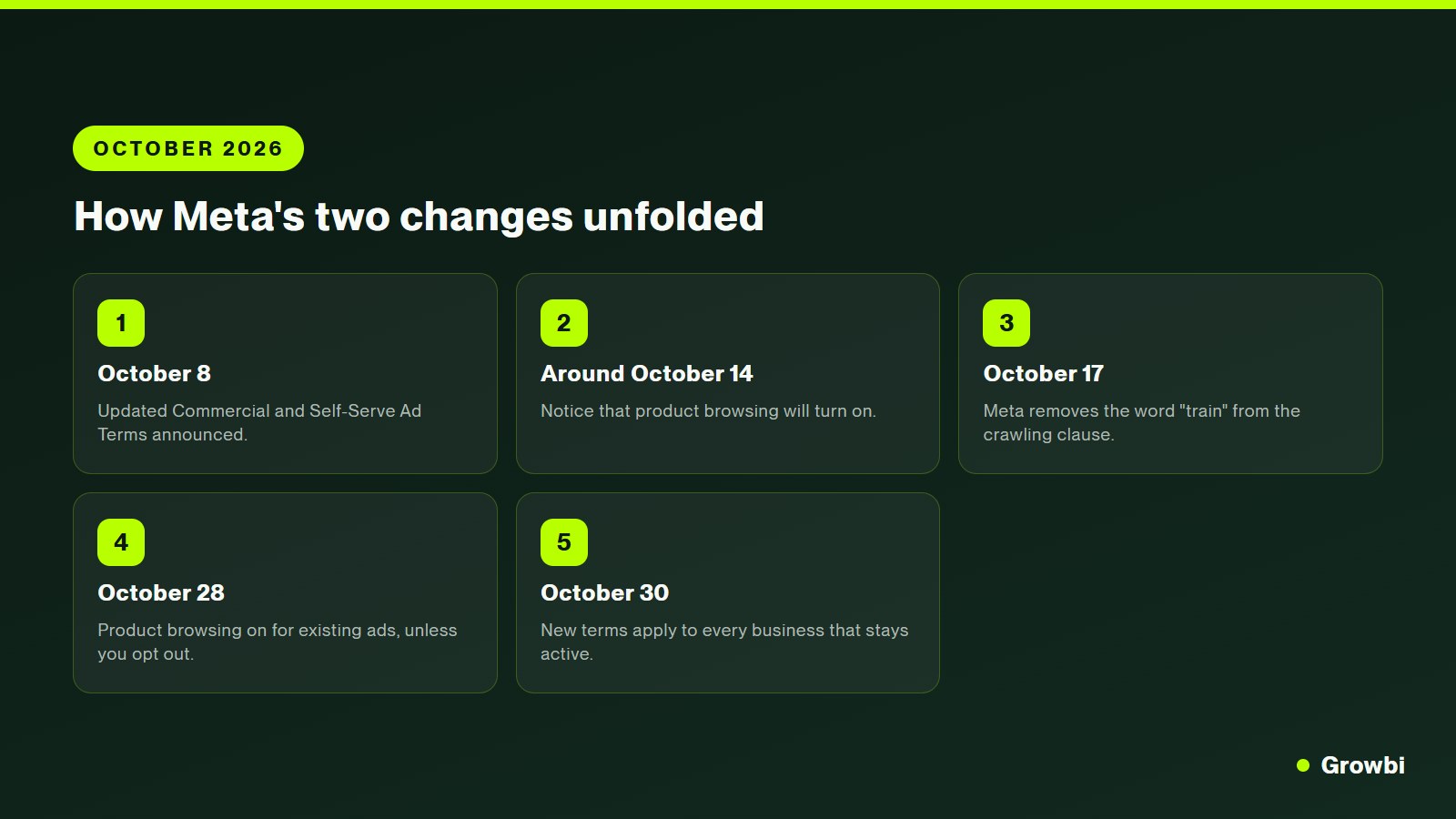
Two Meta changes land this month. On October 28, product browsing turns on for existing Facebook and Instagram ads unless you opt out. On October 30, updated Commercial Terms and Self-Serve Ad Terms apply to every business that keeps using Meta, including a website crawling clause. There is no opt-out except stopping business use.
Table of Contents
If you run Facebook or Instagram ads for a clinic or a local service business, two notices have probably landed in your Ads Manager this month. Most owners clicked past them. One changes what happens when someone taps your ad, and the other changes the legal terms you accept just by keeping your campaigns live.
Neither change is a crisis. Both are worth ten minutes before the end of October, because the defaults were set by Meta, not by you, and the deadline arrives whether you read the notice or not.
What is changing on Meta in October 2026?
Two separate changes with two separate dates. They are often mixed up in coverage, so it helps to keep them apart.
| Product browsing default | Updated Commercial and Self-Serve Ad Terms | |
|---|---|---|
| Date | October 28, 2026 | October 30, 2026 |
| What it affects | What people see after tapping existing ads | The contract for every business use of Meta |
| Default | On, unless you opt out | Accepted by continued use |
| Can you opt out? | Yes, in the notice or per ad | Only by stopping business use of Meta |
| Who should care most | Advertisers sending traffic to a booking page | Any business with a website linked to Meta |
What is product browsing and why does October 28 matter?
Product browsing is an Advantage+ creative feature that can show people an in-app experience with product information and personalized suggestions after they tap an ad, before or instead of your website. Until now it was optional and advertisers switched it on themselves.
According to the notice reproduced by PPC Land, Meta will turn it on for existing Facebook and Instagram ads on October 28, 2026, unless advertisers opt out first. Meta's supporting claim is that businesses saw 3% more conversions on average in an experiment with about 117,700 advertisers between August 6 and August 21, 2026.
Should a clinic or service business opt out of product browsing?
For most appointment-based businesses, we would at least turn it off until you have tested it. The feature was built around products and catalogs, and the 3% figure came from verticals such as e-commerce, consumer goods and retail.
A med spa, dental office or contractor usually sends paid traffic to one page with one job: book a consultation or an inspection. Anything that inserts a screen between the ad and that page can cut the booking rate, and it can also break tracking that depends on the visitor landing on your site.
- Opt out if your ads point to a booking page, a quiz or a qualifying form on your website.
- Keep it on if you sell products online with a catalog connected to Meta, and test it against a control.
- Test it deliberately if you are unsure: duplicate one ad, enable product browsing on the copy only, and compare cost per booked appointment, not clicks.
How do you opt out of product browsing?
Do this before October 28, then confirm on a live ad afterwards.
Find the notice in Ads Manager
Look for Meta's notice about product browsing in existing ads and use its opt-out button. Note which ad accounts it applies to.
Check each active ad's settings
Open the ad, go to Advantage+ creative enhancements and the destination settings, and confirm product browsing is off where you do not want it.
Repeat for every ad account
Agencies and multi-location businesses often run several accounts. An opt-out in one is not proof of an opt-out in all.
Verify after October 28
Tap your own live ads on a phone and confirm they open your website, then check that bookings and conversions are still recorded.
Watch the numbers for two weeks
Compare booking rate and cost per appointment against the two weeks before the change, by campaign.
What changes in Meta's terms on October 30?
Meta announced updated Commercial Terms and Self-Serve Ad Terms on October 8, 2026, effective October 30. Meta's own terms page carries a banner confirming the October 30 date, and the terms state that continuing to use Meta's products for business purposes after an update means you agree to it.
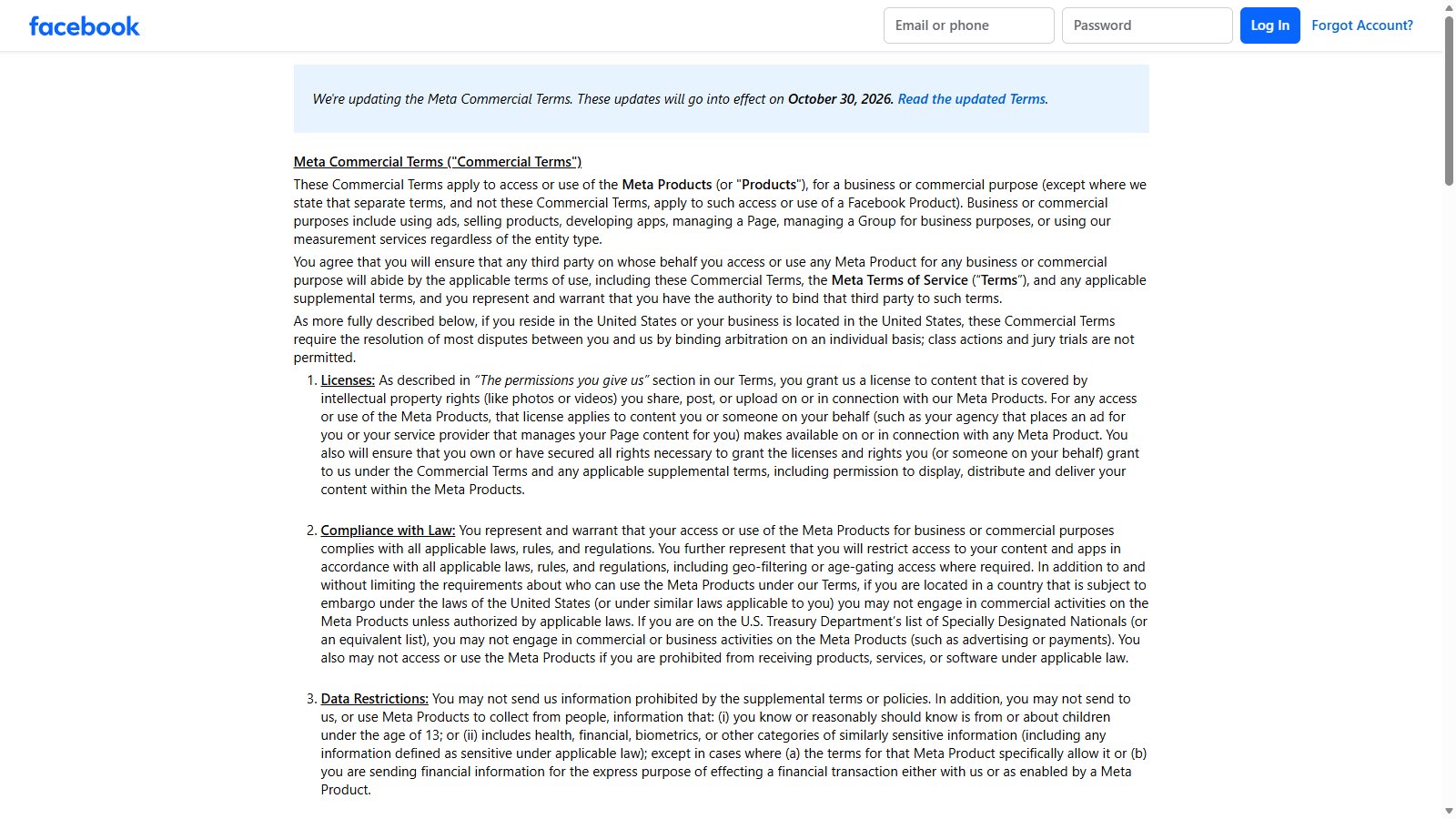
Coverage of the update highlights several changes. Search Engine Journal's analysis reports that the current Commercial Terms, dated March 2024, have no crawling clause, and that the new version reaches any business use of Meta's products, including managing a Facebook Page, not only buying ads.
- Acceptance by continued use. There is no separate opt-in. Keeping your ads or business tools active after October 30 counts as agreement.
- Website crawling. Meta and its agents may use automated tools to access and revisit websites linked to your business products.
- Tests. Meta's ad terms already allow it to run tests from time to time that can affect campaign performance.
- AI features. The revision adds a section on AI features, and coverage reports advertisers stay responsible for ads that Meta's automated tools help create.
Did Meta really reserve the right to train AI on your website?
It did at first, then it narrowed the wording within nine days.
The first version described using crawled content to develop, improve, research and train Meta's products, which Nieman Lab reported legal experts read as broad enough to cover news sites.
Meta's spokesperson Andy Stone called that reading false and said the update is about pulling accurate product information. On October 17, The Next Web reported that Meta had removed the word "train" and limited the crawling language to its ads and business products.
Two caveats remain. The News/Media Alliance pointed out that training is no longer listed but is not expressly banned, and that the terms do not mention robots.txt. A UK-English preview was also reported to still show the original sentence two days later, so check the version shown in your own account.
What does the AI section mean for Advantage+ creative?
It means you own the output even when Meta's tools wrote it. Advantage+ creative can generate text variations, expand images, add music and turn static images into video, and the October update makes that responsibility explicit.
For most retailers that is a minor point. For a clinic, a misplaced claim such as "permanent results" or "pain-free" in an auto-generated headline can break Meta's health policies or advertising law, and the advertiser answers for it, not the tool.
- Review every enhancement before it runs, especially generated text and backgrounds.
- Switch off text generation for treatments where wording is regulated, and write those headlines yourself.
- Keep AI labels and metadata intact on AI-generated images and video rather than stripping them in editing tools.
- Save a copy of what ran, so you can show what a customer actually saw if a claim is ever questioned.
How do you control which Meta crawlers can read your site?
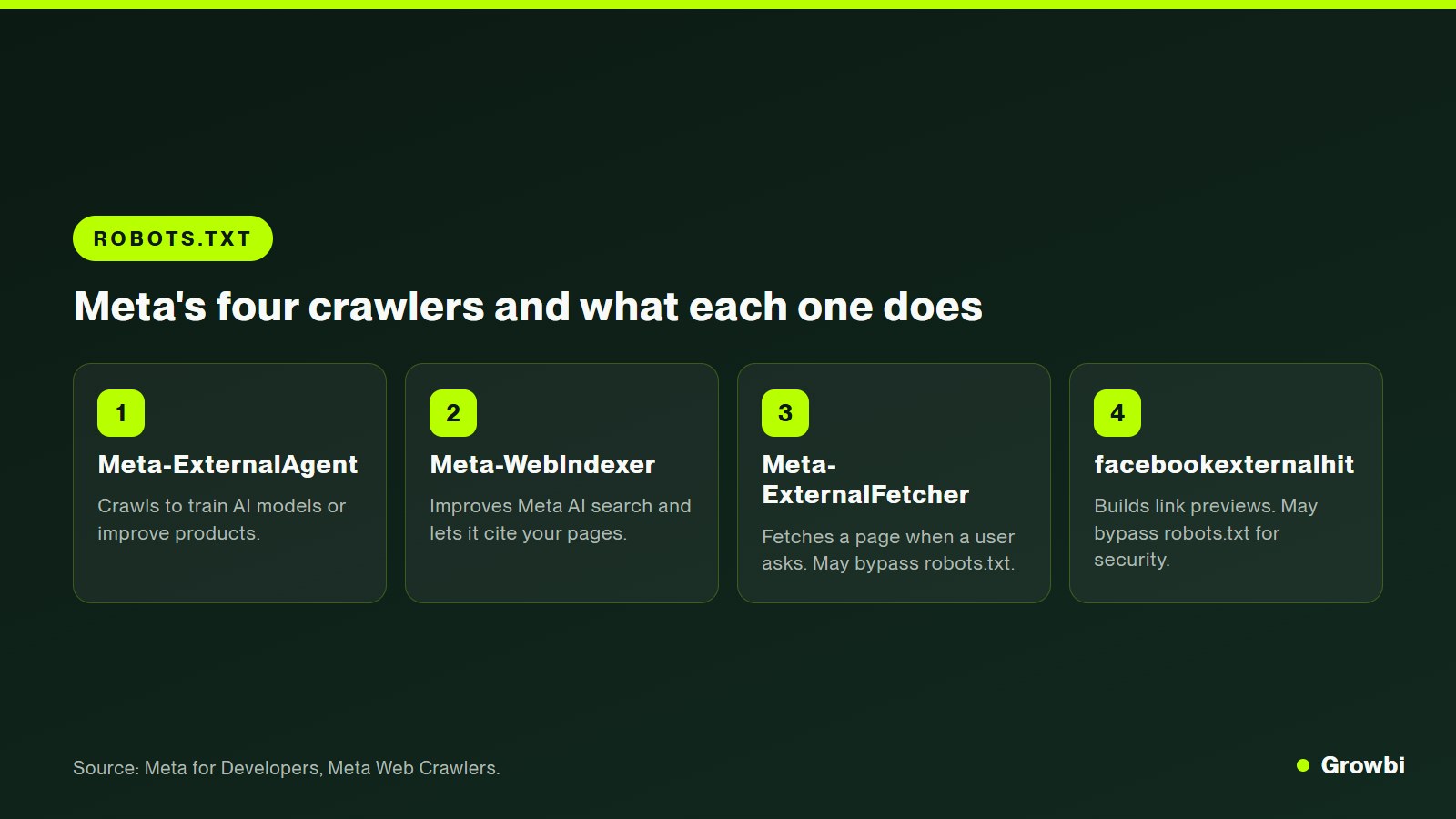
Meta says content owners can still manage access through robots.txt, and its crawler documentation lists separate bots with separate jobs. That lets you make a deliberate choice instead of an all-or-nothing one.
| Crawler | What it does | Follows robots.txt? |
|---|---|---|
| Meta-ExternalAgent | Crawls to train foundation AI models or improve products | Meta gives disallow instructions for it |
| Meta-WebIndexer | Improves Meta AI search results and lets Meta cite and link your content | Meta recommends configuring it in robots.txt |
| Meta-ExternalFetcher | Fetches a page when a user asks an AI feature to | May bypass robots.txt |
| facebookexternalhit | Builds link previews for content shared on Meta apps | May bypass robots.txt for security checks |
A sensible default for a local business is to block Meta-ExternalAgent if you do not want your pages used to train AI, and to allow Meta-WebIndexer so Meta AI can cite and link to you. The details are in Meta's web crawler documentation, and Meta notes robots.txt can be cached for up to 24 hours.
OpenAI draws the same line for ChatGPT, with one crawler for search and another for training. The principle is identical: separate the bots that train models from the bots that make you visible in AI answers.
What should a clinic or local business do before October 30?
- Decide on product browsing for every active ad, and opt out where ads point to booking pages.
- Read the terms shown in your own account, especially the AI features and crawling sections.
- Update robots.txt with a deliberate rule for each Meta crawler.
- Keep sensitive information off public pages. Anything on a page linked to your business can be crawled, so patient stories, prices you do not want indexed and staff details belong behind a login or off the site.
- Review AI-generated creative before it runs. You remain responsible for what your ads say, including text and images produced by Meta's tools.
- Note the date in your reporting. Mark October 28 in your dashboards so any change in booking rate is easy to trace.
Health and aesthetics advertisers have extra reasons to review AI-generated creative, since claims about results are already restricted. Our guide to Meta ads compliance for med spas covers what Meta allows in that category.
What does a Meta account built on booking pages look like?
Predire Champlain is a clinic that had never run paid ads before working with us. Its account was built around one offer and one booking flow, and every lead was tracked to an actual arrival, which is exactly the kind of setup a silent change in ad destination could disrupt.
Case study
Predire Champlain
- Situation
- A clinic with no paid advertising history, no pixel data, no creative library and no health-related interest targeting available on Meta.
- Strategy
- One treatment offer instead of the full menu, continuous creative testing, a focused booking flow and every lead tracked from form to arrival.
Outcomes
- 392 leads in August at a $16 cost per lead from $6,272 in spend
- 163 patients booked and arrived, a 41.6% lead-to-arrival rate
- $38.48 cost per patient in the chair
An account like this depends on people reaching the booking page the ad promised. That is why we check destination settings after every Meta default change, and why we judge results on arrivals rather than clicks.
Do these changes make Meta a worse channel for local businesses?
No. Meta remains one of the strongest channels for creating demand for treatments and services people are not yet searching for. These changes are a reminder that defaults are set for Meta's goals, and your settings should be set for yours.
Instagram in particular keeps growing as the place people discover clinics and local brands. Our guide to finding Instagram marketing services that deliver covers what good creative and posting look like there.
And if you are hiring outside help to manage it all, read how to find the right social media marketing agency before you sign, so the agency is judged on bookings rather than reach.
If you are weighing Meta against search, our comparison of Meta and Google ads for med spas explains where each channel earns its budget.
Whatever the mix, measure it end to end. The Growbi System tracks every lead from ad to appointment, so a change like this shows up in the numbers within days instead of months.
FAQs
When do Meta's new ad terms take effect?
Meta's updated Commercial Terms and Self-Serve Ad Terms take effect on October 30, 2026. Meta announced them on October 8, and its terms page shows the October 30 date. Continuing to use Meta's products for business purposes after that date, including running ads or managing a business Page, counts as accepting the updated terms.
Can I opt out of Meta's new terms?
There is no partial opt-out. The terms state that continued business use of Meta's products after an update means you agree to it, so the only way to reject them is to stop using Meta for business purposes. You can still control some practical effects, such as which Meta crawlers may access your website through robots.txt.
What is Meta product browsing?
Product browsing is an Advantage+ creative feature that can show people an in-app experience with product information and personalized suggestions after they tap an ad, before or instead of the advertiser's website. It was optional, but Meta is turning it on for existing Facebook and Instagram ads on October 28, 2026, unless advertisers opt out.
Should I turn off product browsing for my clinic's ads?
If your ads send people to a booking page, quiz or qualifying form, turning it off until you have tested it is the safer choice. Meta's 3% conversion figure came from verticals such as e-commerce and retail. Test it on a duplicate ad and compare cost per booked appointment before leaving it on across your account.
Conclusion
October brings two Meta changes that are easy to miss: product browsing switching on for existing ads on October 28, and updated terms that apply to every business user on October 30, accepted simply by staying active.
Neither is a reason to leave Meta. Both are reasons to take ten minutes now: check product browsing on every ad that points to a booking page, read the terms in your own account, and set robots.txt rules for Meta's crawlers on purpose.
If you want a second pair of eyes before the deadline, book a free strategy call and we will review your Meta accounts with you.
Get this system built for your business
Book a strategy call and we will model a realistic appointment target from your budget, market, and offer.
Keep reading

Med Spa Meta Ads Compliance: Health and Wellness Restrictions and Legitimate Workarounds
Med Spa Advertising: Google Ads vs Meta Ads for Med Spas, Costs Compared

Beyond the Buzz: Finding Instagram Marketing Services That Deliver

Beyond 'Top Lists': Finding the Right Social Media Marketing Agency