How to Choose a Healthcare Marketing Agency That Books Patients, Not Just Leads
 Mor RomanoCTO, Growbi11 min read
The short answer
The right healthcare marketing agency is the one that reports on booked appointments and patients who actually arrive, not impressions or form fills. Match the agency type to your practice, ask how they track every lead to the schedule, confirm how they handle patient data and tracking pixels, and insist that you own the ad accounts.
On this page
Search for a healthcare marketing agency and you get directories ranked by headcount, awards and client logos. Those lists answer the wrong question for a practice.
A med spa, dental office or specialty clinic needs to know one thing: which agency will put more of the right patients on the schedule, at a cost that leaves margin.
This guide is written from the practice side. It covers what these agencies do, the four kinds you will meet, the questions that separate them, what HIPAA and tracking pixels mean for your ads, how pricing works, and what real results look like.
What does a healthcare marketing agency do?
A full-service healthcare marketing agency covers some or all of these services.
- Paid media. Google Ads for people searching a treatment or provider, Meta ads for demand creation and retargeting. For most practices it is the fastest way to reach new patients.
- Website design and landing pages. Pages built for one service with one booking step, plus the technical setup that keeps tracking compliant.
- SEO and content marketing. Service pages, location pages and articles that rank over months and build trust before the first call.
- Social media and creative. Video and photo content for ads and organic channels, ideally shot in your practice with your providers.
- Reviews and reputation. Systems that turn happy patients into verified reviews on Google and other platforms.
- Lead handling and patient engagement. Speed to lead, follow-up by text and phone, reminders that cut no-shows, and a CRM that shows every lead's status.
- Reporting. Spend, leads, booked appointments, arrivals and revenue in one place.
The four kinds of healthcare marketing agencies
A lot of bad agency fits come from hiring the wrong type rather than a bad agency. Hospital systems, medtech companies and private practices buy marketing for different reasons.
| Agency type | Built for | How they report | Warning sign for a practice |
|---|---|---|---|
| Enterprise healthcare branding | Hospital systems, health networks | Brand awareness, reach, campaign recall | No talk of booked appointments or cost per patient |
| B2B healthcare and medtech | Device makers, pharma, health tech | Pipeline, demos, sales cycles | Case studies are all about selling to hospitals |
| Generalist digital agency | Many industries, healthcare one of them | Clicks, leads, cost per lead | Templates reused from e-commerce or software clients |
| Practice-growth specialist | Med spas, dental, clinics, home-visit services | Booked appointments, arrivals, revenue | Promises a fixed number of patients without seeing your data |
For a private practice, the last row is usually the right starting point. Growbi is in that group: our work for med spas and dental practices is measured on appointments that show up, which is why our reporting starts at the schedule and works backward to the ad.
Where to find healthcare marketing agency candidates
Directories such as Clutch and Digital Agency Network, and ranked lists published by agencies themselves, are useful for building a long list. Treat them as a starting point, not a verdict: rankings often reflect review volume, company size or who wrote the list.
Pull 5 to 8 names that serve practices like yours, cut anyone whose case studies are mostly hospital, pharma or medtech work, then run the remaining 3 through the seven questions below.
What should I look for in a healthcare marketing agency?
Ask every agency the same questions and compare the answers side by side.
What do you report on every week?
The right answer includes booked appointments, show rate and cost per arrived patient. Impressions and clicks are supporting numbers, not the scoreboard. Our own clients are usually live within 7 to 10 business days, so ask when the first weekly patient report will arrive.
Who owns the ad accounts, pixels and data?
You should. Ask to be the owner of the Google Ads and Meta business accounts from day one, with the agency as a partner.
How do you handle leads after the form?
Ask how fast leads are contacted, by whom, and how no-shows are followed up. A lead called within 10 minutes is a different lead from one called the next day.
How do you keep tracking compliant on our site?
Ask which pages carry pixels, what is excluded from patient forms and portals, and whether they will sign a business associate agreement (BAA) when their work touches patient data.
Who makes the creative?
In our experience, stock photos and generic templates underperform in healthcare. Ask who films, who writes and how often new ads launch.
Can we see results with numbers?
Look for case studies with spend, leads, appointments and cost per patient from practices like yours, not only percentages.
What does the contract lock in?
Check notice periods, minimum terms and what happens to your accounts and content if you leave.
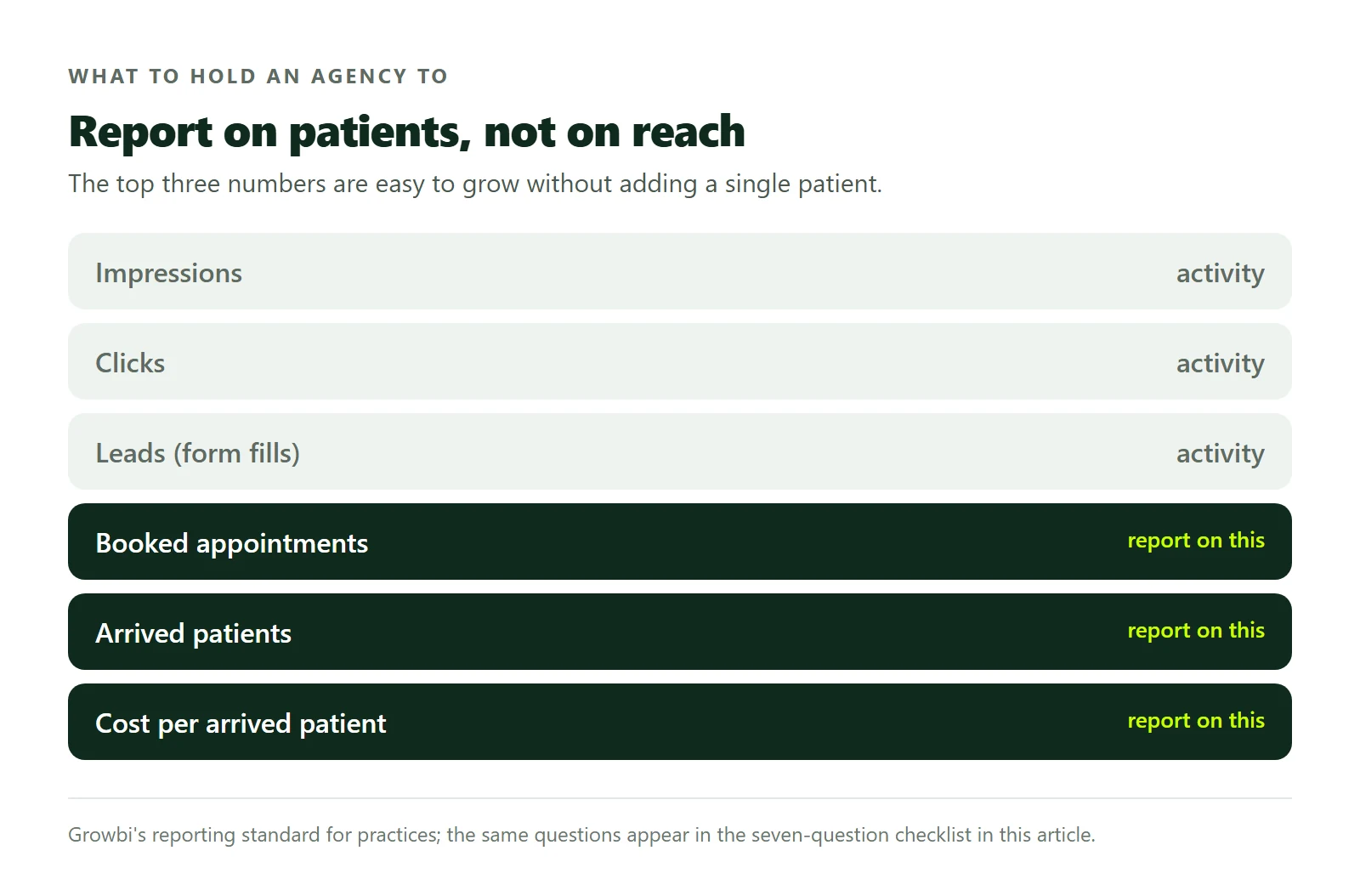
If an agency cannot answer the first question with patient numbers, the rest of the conversation rarely matters. We wrote a longer version of this test for dental practices in track production, not leads.
Do healthcare marketing agencies need to follow HIPAA?
The short answer: if your practice is a HIPAA covered entity and the agency creates, receives, maintains or transmits protected health information for you, the agency is a business associate and should sign a business associate agreement (BAA).
A practice that does not bill insurance electronically may not be a covered entity, but state health-privacy laws can still apply. Confirm your situation with counsel.
Any agency that touches your website tracking, forms or patient follow-up is working close to patient data, so compliance belongs in the scope. This is not legal advice, and your counsel should make the final call, but there are three things a practice owner should know before hiring anyone.
Tracking pixels on patient pages
The HHS Office for Civil Rights issued a bulletin in December 2022, revised it in March 2024, on online tracking technologies such as tracking pixels and analytics tags on healthcare websites.
On June 20, 2024, the U.S. District Court for the Northern District of Texas vacated one part of it, the so-called proscribed combination of an IP address and a visit to an unauthenticated public webpage, as summarized by Hall Render.
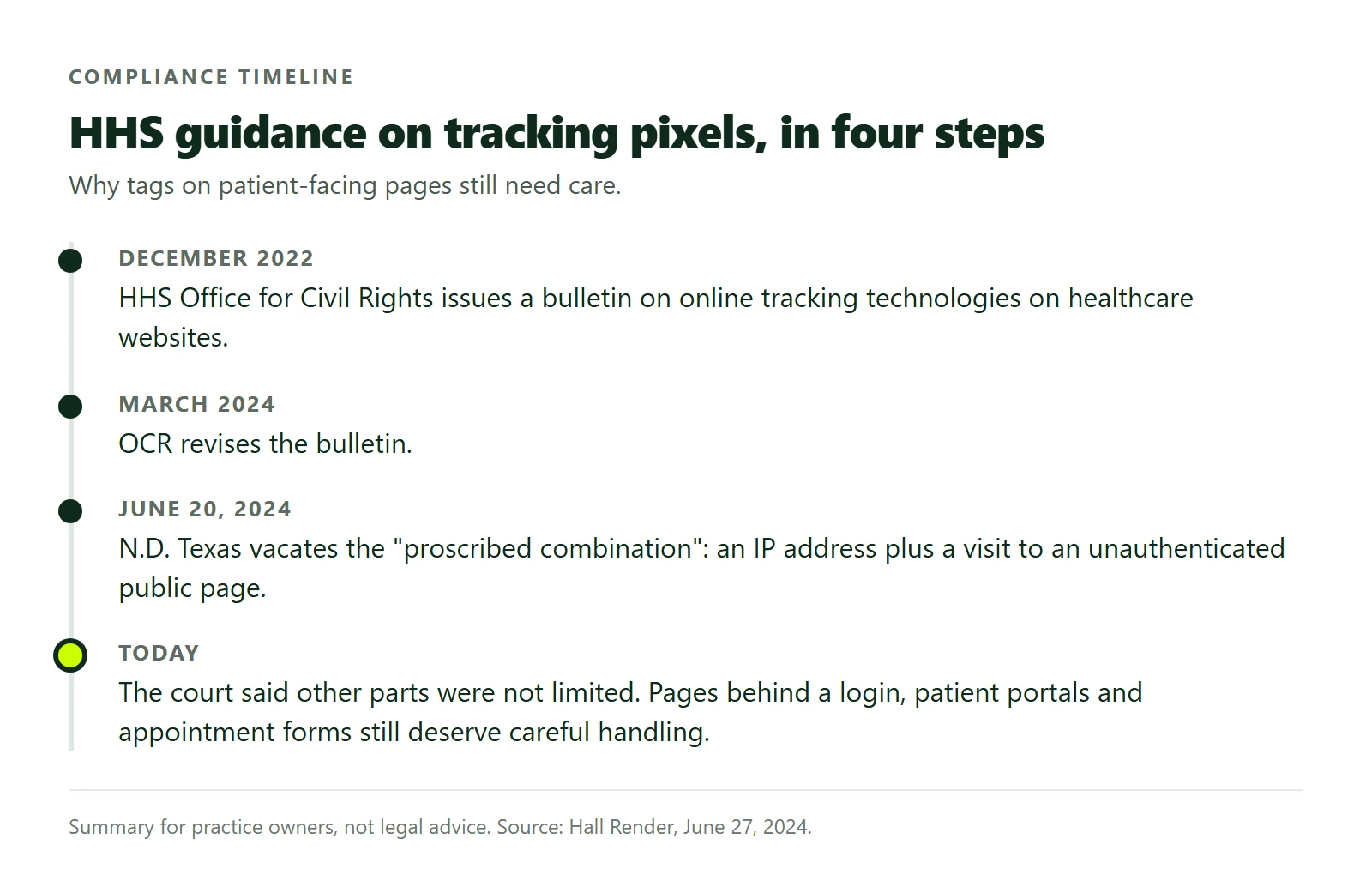
The court said the vacatur was not meant to limit the bulletin's other parts, so pages behind a login, patient portals and appointment forms still deserve careful handling.
Patient data in forms, calls and the CRM
Lead forms, call recordings and CRMs can hold health details. Ask the agency what they collect, where it is stored, who can see it, and whether they sign a business associate agreement (BAA) when their work involves it.
Ad platform rules for health advertisers
Meta limits how health and wellness advertisers can target and optimize, and some claims are not allowed in ads at all. We cover what this means in practice in our guide to Meta ads compliance for med spas.
How much does a healthcare marketing agency cost?
Pricing comes in three main models: a monthly retainer for a defined scope, a percentage of ad spend, or a performance component tied to an agreed outcome. Each one needs the same scrutiny: what is included, how results are verified, and who owns the work.
Ad spend is always on top of the agency fee, and the fee says little on its own. What matters is the cost per arrived patient once both are added together.
As a reference point, Growbi works with practices ready to invest at least $3,000 a month in ad spend, because below that a campaign rarely produces enough data to optimize week to week. For a breakdown of fee structures, see med spa marketing agency fees and what agency cost really includes.
What results should a practice expect?
Ask for numbers you can check, from the full funnel. Here is one from our own work. Predire Champlain, a non-surgical face and neck lift practice, had never run paid ads.
In August, twelve months in, the account delivered 392 leads at a $16 cost per lead from $6,272 in Meta spend. 163 of those leads booked and arrived, a 41.6% lead-to-arrival rate, or $38.48 per patient in the chair.
The figures are in the Predire Champlain case study and in our press release on the account.
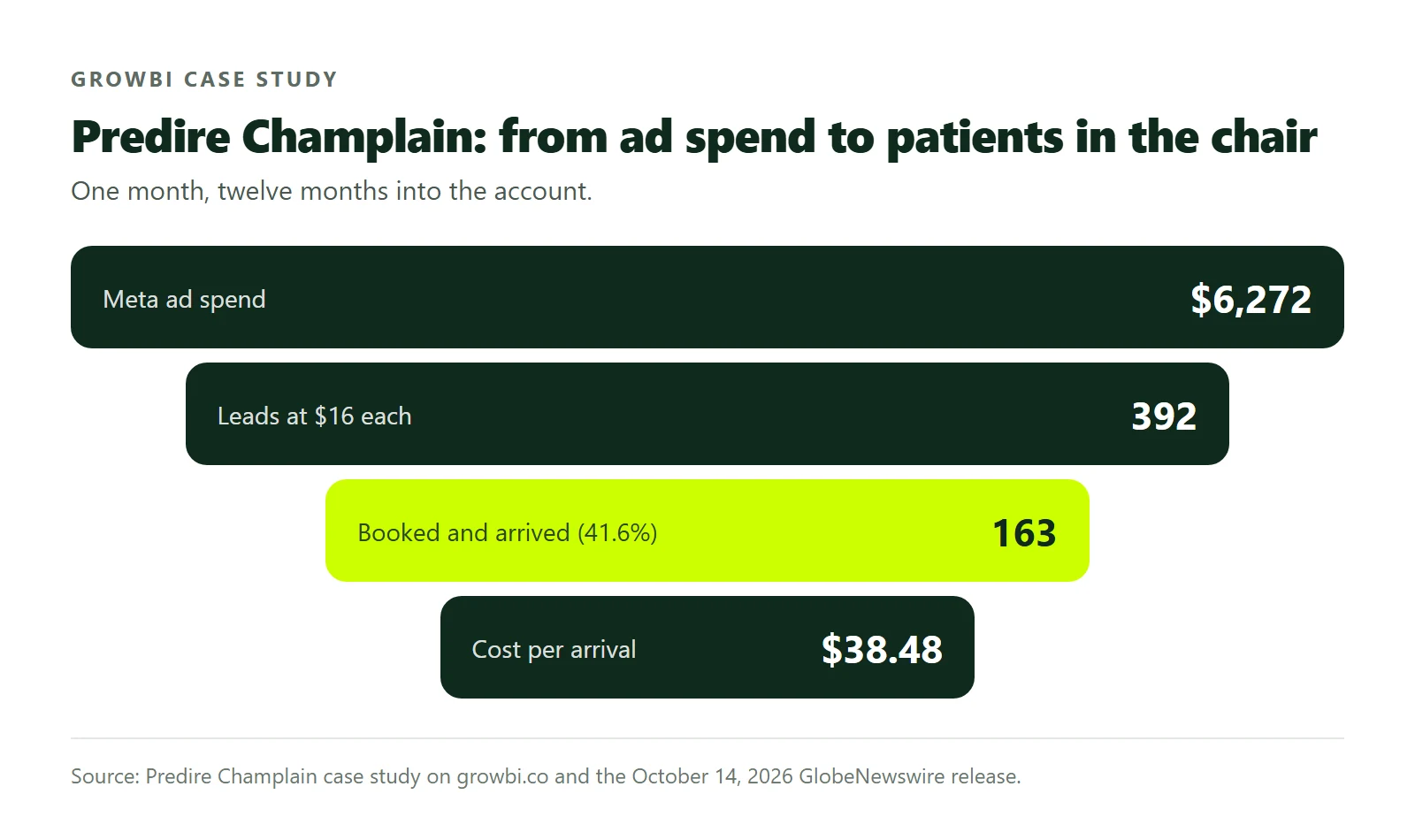
The numbers measure arrivals, not leads. That is the standard to hold any healthcare marketing agency to, including us.
Red flags when comparing medical marketing proposals
Once you have three proposals on the table, the differences show up in what they leave out. These are the patterns we see most often when practices bring us proposals from other agencies to compare.
- Services listed, no patient metric. SEO, social, paid media and content are listed, but nothing says how many appointments the plan should produce or how that will be measured.
- Ad budget, no follow-up plan. The proposal spends on ads but never mentions who calls new leads, how fast, or how no-shows are recovered.
- Reporting built on reach. Monthly decks full of impressions, clicks and followers, and no line for booked or arrived patients.
- The agency owns the accounts. A marketing partner who keeps admin access to your ad accounts, pixels or CRM makes it expensive to leave.
- Generic creative. Stock photos and the same ad templates used for every client. In healthcare, patients book with people, so real providers and real rooms win.
- No word on reviews. In our experience, verified reviews are frequently what tips a patient between two practices, and a plan that builds trust only through ads is missing half the funnel.
A good medical marketing partner will answer these directly. If a proposal survives this list, ask for one reference from a practice of your size and type, and call them.
Should a practice hire an agency or build an in-house team?
An in-house marketer makes sense once you have steady demand, an established creative process and enough volume to keep one person busy full time. Before that, an agency gives you a team of paid media, creative and tracking specialists often for less than one senior hire.
Many practices end up with a hybrid: a front desk or coordinator who owns follow-up in house, and an agency running acquisition and reporting.
Whichever route you choose, keep the scoreboard the same: booked appointments, arrivals and cost per patient. If you want to see how that looks for your practice, our team will map your current funnel on a free 15-minute call.
Frequently asked questions
What does a healthcare marketing agency do?
It runs some or all of paid media, website and landing pages, SEO and content, social media and creative, reviews, lead follow-up and reporting. For a practice, the job is to turn ad spend into booked appointments and arrived patients.
How much does a healthcare marketing agency cost?
Fees come as a retainer, a percentage of ad spend or a performance component, with ad spend on top. Compare agencies on cost per arrived patient, not on the fee alone. Growbi works with practices investing at least $3,000 a month in ads.
What should I look for in a healthcare marketing agency?
Weekly reporting on booked appointments and arrivals, your ownership of ad accounts and data, a clear plan for lead follow-up, compliant tracking, in-house creative, case studies with real numbers and fair contract terms.
Do healthcare marketing agencies need to follow HIPAA?
If your practice is a HIPAA covered entity and the agency handles protected health information for you, the agency is a business associate and should sign a BAA. A June 20, 2024 court ruling vacated part of the HHS tracking bulletin, but pages behind a login and appointment forms still need care. Confirm the details with your counsel.
Should a practice hire an agency or an in-house marketer?
Agencies fit practices that need paid media, creative and tracking skills without hiring several people. In-house works once demand and volume are steady. A common hybrid keeps follow-up in house and acquisition with an agency.
Want this built for your clinic?
Book a strategy call and we will model a realistic appointment target from your budget, market, and offer.