Med Spa Marketing Plan: A 90-Day Launch and a 12-Month Calendar

Key Takeaways
- Set the marketing budget as a share of revenue first; AmSpa reports an average of about 7%.
- Fix tracking, booking and follow-up before adding spend, or extra traffic only creates more lost inquiries.
- Launch one or two hero treatments over 90 days, then cut what does not book and scale what does.
- Plan the year from search demand: gift cards peak in December and May, skin and body treatments in spring.
A med spa marketing plan sets a budget as a share of revenue, fixes tracking and follow-up first, launches search and social campaigns for one or two hero treatments over 90 days, then runs the year from a month-by-month calendar. Every month it is judged on cost per arrived patient, not on leads or clicks.
Most med spa owners have a channel list, not a plan: post on Instagram, run some Google Ads, send a newsletter when there is time.
A real marketing strategy answers four things in writing: what you will spend, what you will sell, in which order you will launch it, and which numbers decide next month's budget. This one covers all four, plus a 12-month calendar you can copy.
What goes into a one-page med spa marketing plan
Keep the plan to one page so the team actually uses it. It needs six lines, each with a number or a name next to it.
- Budget: a monthly figure tied to revenue, split by channel.
- Hero treatments: one or two services with margin, open capacity and repeat potential.
- Offer: what a first-time patient gets, and what they are offered at visit two.
- Channels: where the budget goes first, and what gets added once bookings are steady.
- Calendar: what you lead with each month of the year.
- Scoreboard: the five numbers reviewed every month, with an owner for each.
Setting the budget as a share of revenue
Start with the budget, because it decides how many channels you can run well. AmSpa's figure is a sensible anchor.
According to AmSpa's guidance on marketing spend, a medical spa invests about 7% of revenue in marketing on average, with budgets across the aesthetic industry ranging from 2% to 15%.
Applied to AmSpa's average annual revenue of $1,398,833, 7% comes to about $97,900 a year, or roughly $8,160 a month. Use your own revenue, and stay near the top of the range in a launch year.
Most clinics spend far less. A Growth99 report summarized by AmSpa found that 52% of med spa practices invest under $2,500 a month in marketing, which rarely funds more than one channel properly.
Fix tracking, booking and follow-up first
Ads only amplify what already happens to an inquiry. If calls go to voicemail and forms wait a day, more traffic means more lost patients.
- Tracking: every call, form and online booking records its source.
- Booking: a patient can pick a real slot on a phone without calling.
- Speed to lead: new inquiries get a reply within minutes during open hours.
- Follow-up: unbooked consultations get a set text and email sequence.
- Service pages: one page per hero treatment, with price ranges and a booking button.
Each item has a full guide on the blog. Build the sequence with our med spa email and SMS follow-up templates, and protect booked visits with the reminder timing in reducing med spa no-shows.
The 90-day launch sequence
Launch in three 30-day phases and finish each one before starting the next. Ad platforms need weeks of conversion data before results settle.
Three phases, each with one job.
- Days 1 to 30: measure and build. Record your baseline: monthly bookings, show rate and cost per arrived patient. Pick the hero treatments, build their pages and write the follow-up messages.
- Days 31 to 60: launch search, then Meta. Start Google search on treatment and near me terms in your real service area. Add Meta campaigns in week six with three or four creative angles per treatment.
- Days 61 to 90: cut, scale, retain. Pause what fills forms but not chairs, move budget to what books, and add rebooking reminders, review requests and a membership offer for returning patients.
Ninety days is enough to judge an offer. By the end of the third phase you know which treatments and offers book patients at a cost you can sustain.
Choosing channels for the first year
Put most of the paid advertising budget on the channel closest to existing demand, which is usually Google search. Add paid social once search books reliably.
WordStream's 2026 Google Ads benchmarks, from over 13,000 campaigns run between April 2025 and March 2026, put Beauty & Personal Care at a $4.62 average cost per click, a 10.35% conversion rate and $39.25 per lead.
A lead is not yet a patient, so treat those as reference points. How to split money between platforms is covered in our Google Ads vs Meta comparison for med spas, and Meta's health ad rules in med spa Meta ads compliance.
The free channels belong in the plan too. Online reviews and your Google Business Profile carry the map results, as laid out in our guide to med spa SEO, and social media works best as proof of real results, not as the main source of bookings.
What search data says about seasonal demand
Demand for aesthetic treatments follows the calendar, and Google search volume shows the pattern clearly. We pulled US monthly searches for common treatments in October 2026.
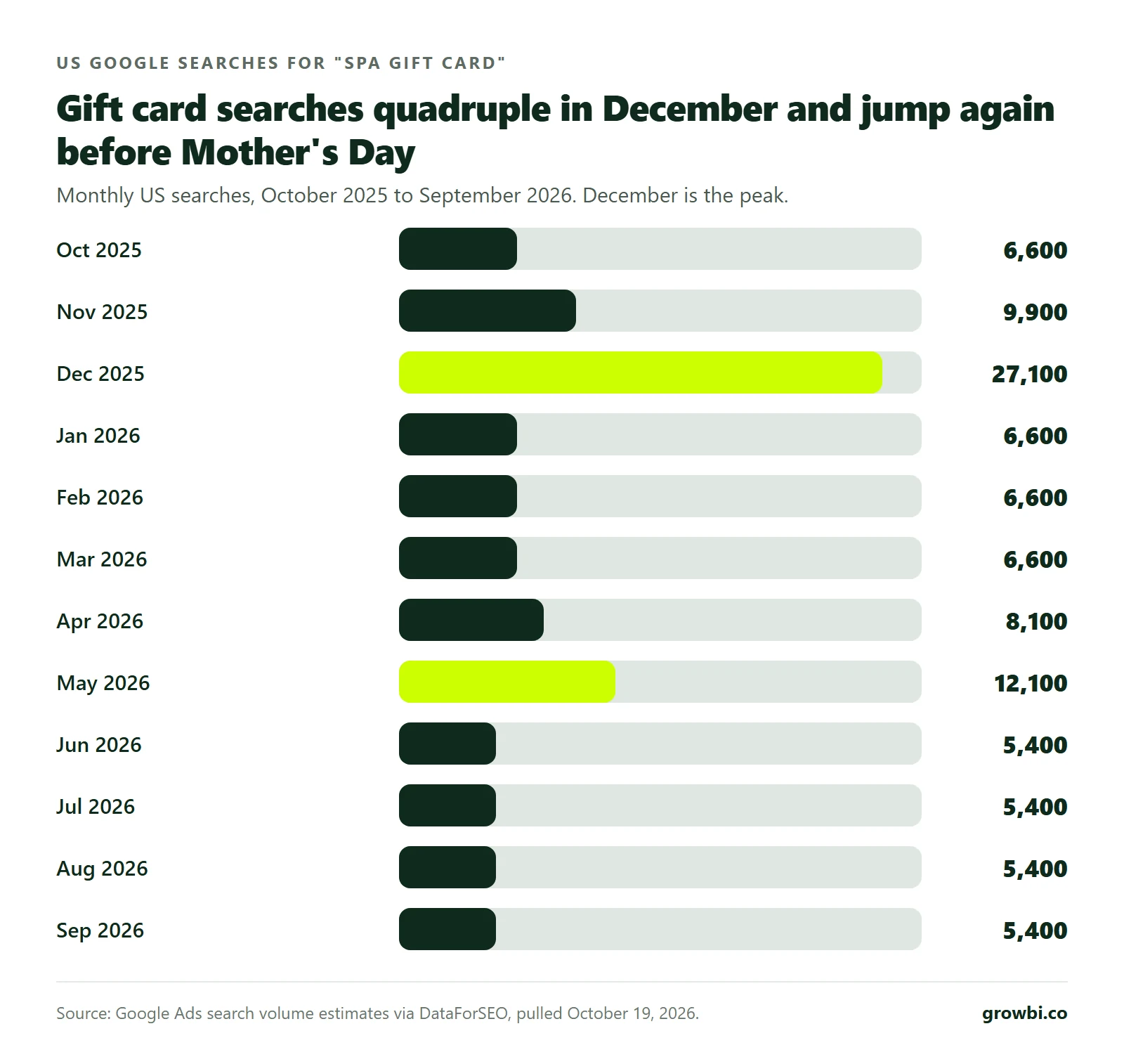
Searches for "spa gift card" went from 6,600 in October 2025 to 27,100 in December, about four times higher. The second peak came in May 2026 at 12,100, ahead of Mother's Day. Gift card ads only need to stand out for those few weeks.
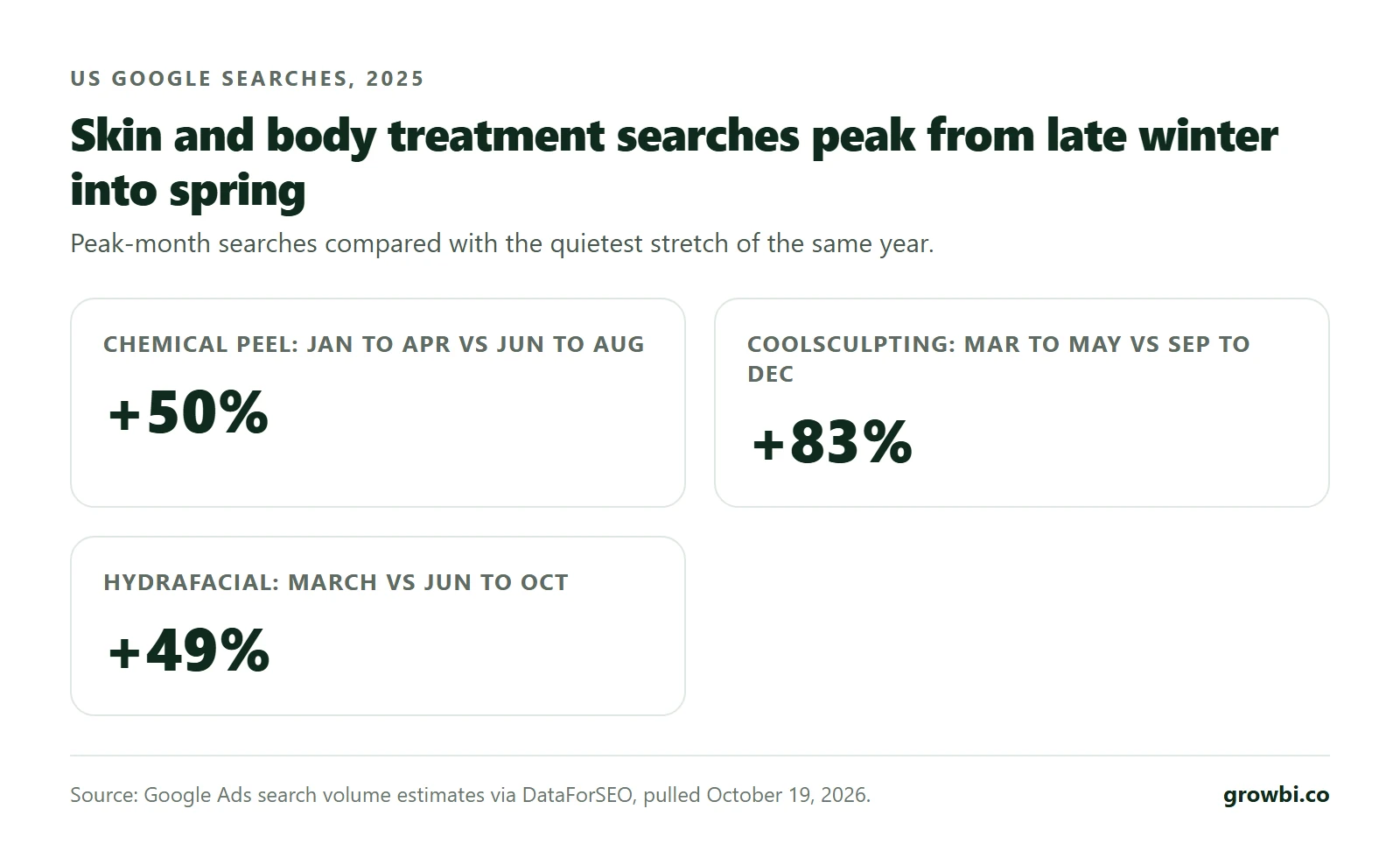
Treatment searches lean toward late winter and spring. Chemical peel searches ran 90,500 a month from January to April 2025 against 60,500 in summer, and CoolSculpting hit 60,500 in spring against 33,100 in the fall.
These are Google's rounded estimates, so use them for timing, not forecasts. Your own booking history by month is the better guide once you have a year of it.
A 12-month med spa marketing calendar
Use this calendar as the year-long half of the plan. Each month names the offer to lead with, where the budget goes and one retention task.
- January. Lead with: Skin reset: peels, facials, membership launch; Channel focus: Search on peel and facial terms; Retention task: Book gift card holders before cards sit unused
- February. Lead with: Peel series, Valentine's injectables; Channel focus: Meta retargeting of January site visitors; Retention task: Follow up unbooked January consultations
- March. Lead with: Body contouring consults, HydraFacial; Channel focus: Meta lead campaigns for body treatments; Retention task: Review request after every visit
- April. Lead with: Pre-summer skin and body plans; Channel focus: Raise budget on the best January to March ads; Retention task: Package completion reminders
- May. Lead with: Mother's Day gift cards; Channel focus: Email, SMS and Meta gift card ads; Retention task: Offer gift card redeemers a second visit
- June. Lead with: Injectables before weddings and travel; Channel focus: Search on injectable terms; Retention task: Membership offer at second visits
- July. Lead with: Maintenance facials and injectables; Channel focus: Lower spend, retargeting only; Retention task: Win back patients not seen in 90 days
- August. Lead with: Back-to-routine skin plans; Channel focus: Email and SMS to past patients; Retention task: Pre-book fall laser series
- September. Lead with: Laser and resurfacing season; Channel focus: Search on laser and resurfacing terms; Retention task: Rebook summer injectable patients
- October. Lead with: Laser series, pre-holiday injectables; Channel focus: Search and Meta for holiday appointments; Retention task: Pre-book December appointments
- November. Lead with: Black Friday gift cards and bundles; Channel focus: Email, SMS and Meta gift card ads; Retention task: Ask happy patients for referrals
- December. Lead with: Gift cards, last-minute holiday injectables; Channel focus: Gift card ads in the first three weeks; Retention task: Plan the January membership push
Laser and resurfacing sit in fall and winter because patients avoid sun more easily then. Gift cards anchor May and November to December, matching the search peaks above, and email marketing to past patients does most of the selling.
January is the natural month to push memberships, since gift card buyers and new-year patients are already booking. Our guide to med spa membership programs covers how to price the tiers.
The weekly marketing rhythm
A calendar sets the month; a weekly rhythm makes sure it happens. Give each task a day and an owner.
- Monday: review last week's arrived patients by source and the spend behind them.
- Tuesday: publish one post answering a question patients ask in consultations.
- Wednesday: send review requests to last week's patients.
- Thursday: publish one piece of provider, treatment room or process content.
- Friday: follow up every consultation that did not book.
The monthly review that sets next month's budget
Once a month, look at five numbers and move money based on them. Lead counts alone will point the budget the wrong way.
- Cost per arrived patient by channel and campaign.
- Lead-to-arrival rate, which shows whether follow-up is working.
- Consultation-to-treatment rate, which shows what happens in the room.
- New versus returning revenue, the early warning for retention.
- Membership and package take-up, next quarter's baseline.
Arrivals beat leads as the deciding number. A cheap lead who never shows up costs more than a pricier lead who sits in the chair, and only cost per arrived patient reveals the difference.
End each review by stopping one thing that is not working. If you would like help building the scoreboard, book a free 15-minute call and bring last month's numbers.
FAQs
How long does a med spa marketing plan take to show results?
Search campaigns usually show bookings first, within the first month of spend. Plan on about 90 days to learn which treatments and offers book at a cost you can sustain. Reviews, SEO and retention build more slowly and keep paying off over several quarters.
Should a new med spa use the same marketing plan?
The structure is the same, but a new clinic has no baseline and no reviews yet. Spend near the top of AmSpa's 2% to 15% range, lead with one entry offer, and start collecting reviews from the first week. Our guide on how to open a med spa covers the pre-launch steps.
How often should a med spa post on social media?
Two or three times a week on one main platform is enough if it stays consistent. Show providers, the treatment room and real questions from consultations. Organic posts support paid campaigns and reviews; they rarely fill the calendar on their own.
Conclusion
A med spa marketing plan is a budget, an order of operations and a calendar, judged every month on cost per arrived patient. Without those three, a channel list just spends money in a different order.
Set the budget from revenue, fix the booking path, run the 90-day launch, then let the 12-month calendar carry you through gift card season, laser season and the summer slowdown.
If you want a second set of eyes on your plan before you spend more, book a free 15-minute call and we will map your budget and calendar against your own numbers.
Mor Romano
CTO, Growbi
Written and fact checked by Mor Romano, published , last reviewed .
More about Mor RomanoGet this system built for your business
Book a strategy call and we will model a realistic appointment target from your budget, market, and offer.
Keep reading
Med Spa Advertising: Channels, Costs and Compliant Ad Examples
Med Spa Membership Programs: How to Price, Launch and Keep Members
Med Spa Email and SMS Follow-Up That Cuts No-Shows
How to Open a Med Spa: What You Need, State Rules and a Startup Checklist
Med Spa Black Friday Deals: Holiday Promotions That Also Fill January

Weight Loss Program Marketing for Med Spas: How to Fill Consults