Performance Max for Local Service Businesses: When It Works

Key Takeaways
- Performance Max (PMax) is one goal-based campaign that bids across all of Google's inventory, so its results depend almost entirely on the conversions you feed it.
- Start local accounts with Search and add PMax once you can send qualified leads or booked jobs back to Google, not just form fills.
- Since 2025, PMax has search terms reporting, channel reporting, campaign-level negative keywords and lists, brand exclusions, and age and device controls.
- Local Services Ads are moving into Google Ads as Performance Max campaigns with pay-per-lead goals, still shown only on Search and Maps.
- Google asks for at least 6 weeks before judging a new PMax campaign, so budget for the learning period and change little while it runs.
Performance Max is a Google Ads campaign that uses Google AI to show your ads across Search, Maps, YouTube, Display, Gmail and Discover from one campaign. For a local service business it works once you track booked jobs and run Search beside it. Without that data, it tends to buy cheap, junk leads.
If you run a med spa, dental practice or home service company, someone has probably told you to "just turn on Performance Max." The cost per lead often looks great in month one.
Sometimes that number is real. Often it is padded with brand searches and bot form fills. This guide covers when PMax earns its place, what changed in 2025 and 2026, and how to make it chase booked jobs.
What Is Performance Max?
Performance Max is a goal-based Google Ads campaign that reaches all of Google's ad inventory from one campaign: Search, Maps, YouTube, Display, Gmail and Discover.
Instead of choosing keywords and placements, you give it four inputs, as Google's About Performance Max campaigns page lays out: conversion goals, creative assets, audience signals and a budget. Smart Bidding then decides where each dollar goes, auction by auction.
- Conversion goals: what counts as success, such as calls, forms or booked jobs.
- Asset groups: headlines, images, videos and a landing page, mixed into ads for every channel.
- Audience signals: hints such as your customer list. They guide learning but do not limit targeting.
- Budget and safety settings: a daily budget plus brand and placement exclusions.
One rule decides how it lives next to your Search campaigns. When a search matches an exact match keyword in a Search campaign, that Search campaign serves first; PMax search themes carry the same priority as phrase and broad match keywords.
When Performance Max Helps a Local Business and When Search Is Better
For local services, PMax is a second campaign, not a first one. Search shows every term you pay for and sends each service to its own page.
Search is the better buy when:
- Your budget is modest and cannot absorb weeks of learning on YouTube and Display.
- You only track calls and form fills, with no way to tell Google which leads paid.
- A few searches carry the business, such as "emergency plumber," and you want to bid on them directly.
- You advertise housing or health services, where some PMax targeting is off limits.
PMax earns a place when:
- Search is already profitable and has run out of keywords worth buying.
- You can send booked jobs or qualified leads back to Google.
- You have real photos and at least one short video, not stock images.
- You want Maps and YouTube reach in your service area from one campaign.
The best public PMax data for local services comes from SearchLight, which tracks contractors' leads and revenue. Its January 2026 HVAC and plumbing benchmark covers 816 contractors and $14.9 million in Google Ads spend.
PMax leads cost $72 against $149 for non-branded Search, but only 32.2% of PMax leads booked, the lowest rate of the three campaign types. Even so, PMax came out at $447 per paying customer, against $804 for non-branded Search and $104 for branded Search.
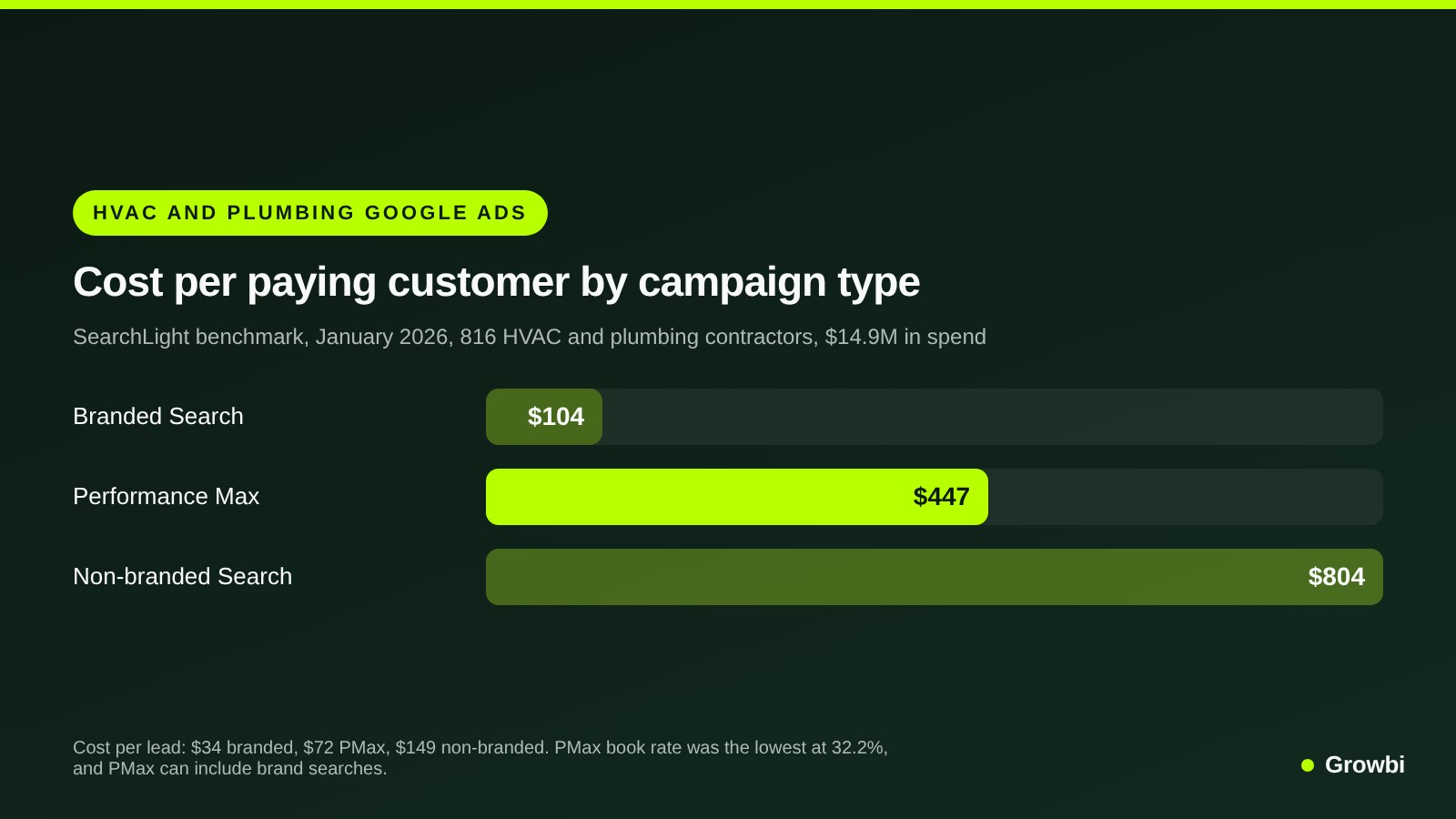
Source: SearchLight, What Is a Good Cost Per Lead for HVAC Google Ads? (2026 Benchmarks)
One caution: in its Q1 2026 plumbing benchmark, SearchLight notes it could not separate branded from non-branded PMax, so part of the cheap result may come from people already searching your name.
For a trade-by-trade campaign plan, see our HVAC PPC guide.
The 2025 and 2026 Performance Max Changes That Matter
The old complaint was that PMax is a black box. Since January 2025, Google has added the visibility and controls local advertisers asked for.
- Campaign-level negative keywords (January 2025). Rolled out to all advertisers, per Google's January 2025 announcement. They apply to Search and Shopping only, not YouTube or Display.
- Search terms insights source column (January 2025). Shows whether a query came from PMax's own targeting or your search themes.
- Full search terms reporting (April 2025). The same detail Search campaigns get.
- Channel performance reporting (May 2025). A beta launched at Google Marketing Live that splits results by Search, YouTube, Display, Gmail, Discover, Search partners and Maps.
- Negative keyword lists, more search themes, age and device controls (August 2025). Google's August 2025 Performance Max update added shared negative keyword lists, raised search themes from 25 to 50 per asset group, made age and device targeting fully available and opened a gender controls beta.
- Brand exclusions. Block searches for your brand name, misspellings and related brands on Search and Shopping. Google prefers them to negative keywords for brand traffic.
- Channel prioritization and budget allocation (October 2026). Set Display and Search partners as low priority with a cap on their share of daily budget. Rolling out over the coming months.
That last change matters most for lead quality. Per Google's October 14, 2026 announcement, PMax keeps Search, YouTube, Maps, Gmail and Discover together as "Google channels," so you can cap Search partners and Display, but not YouTube on its own.
Pro tip: Before you use the new caps, put the channel performance report next to your CRM for the same weeks. Cap the channel that spends without producing booked jobs, not simply the one with the highest cost per lead.
Targeting Rules for Housing and Health Advertisers
New controls do not mean every business can use them. Google's personalized advertising policy bars housing advertisers in the US and Canada from targeting by age, gender, parental status, marital status or ZIP code.
Health is a sensitive interest category under the same policy. Ads that fall into it cannot use advertiser-curated audiences such as Customer Match or your own data segments, which removes customer lists as an audience signal for any clinic whose ads fall into that category. Our guide to Google Ads for real estate agents covers the housing side in detail.
How Local Services Ads Are Becoming Performance Max
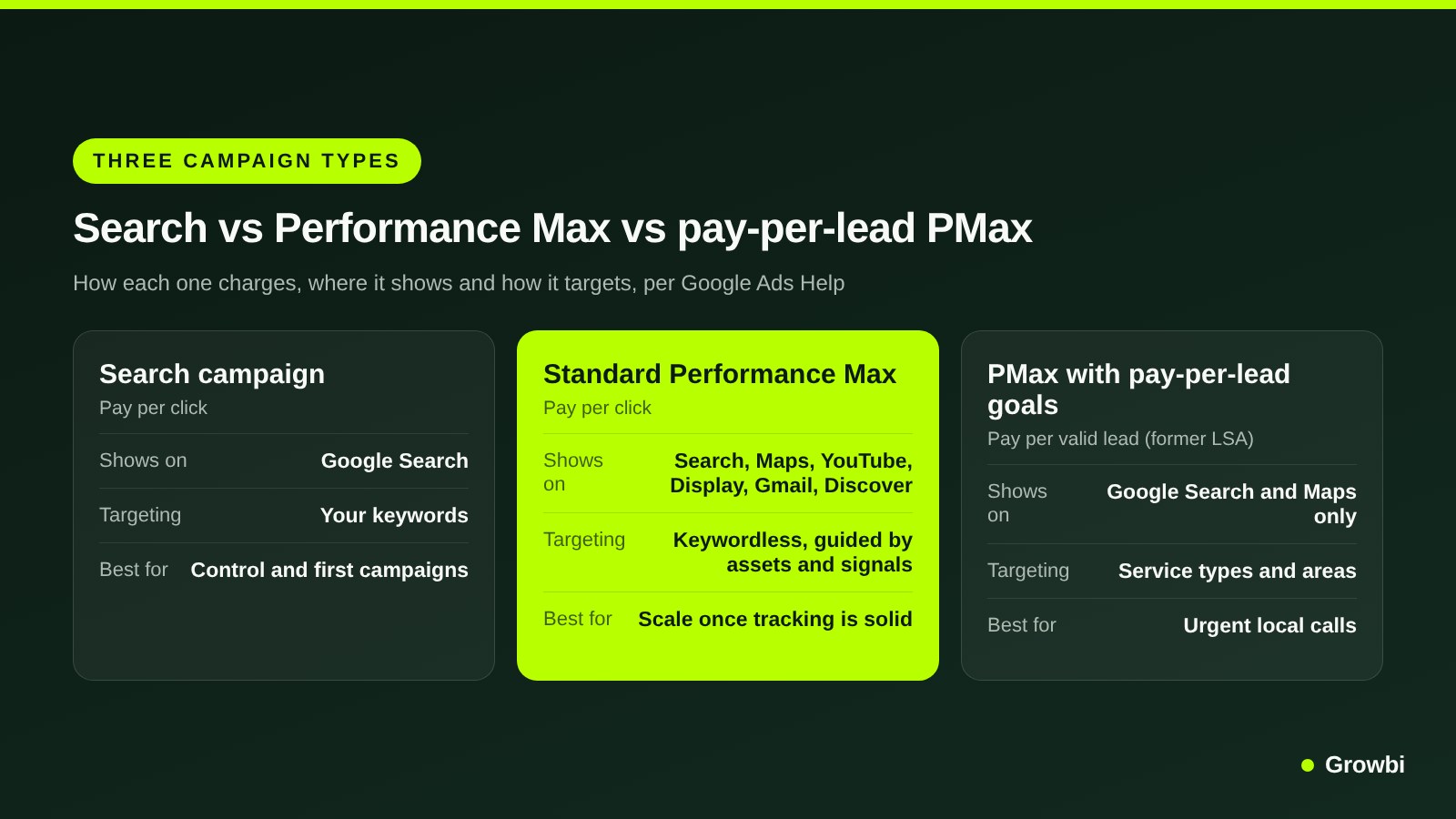
Google is moving Local Services Ads into Google Ads as a special Performance Max campaign type with pay-per-lead goals. The first US phase began in August 2026 with select home service trades, broader groups follow in late 2026, and non-US accounts in 2027.
This is not the same product as a standard PMax campaign. Google's Local Services Ads transition guide spells out the differences:
- What you pay for: valid leads such as calls and messages, not clicks.
- Where it shows: only Google Search and Google Maps, in the same positions as before, never YouTube or Display.
- Targeting: still keywordless, based on your service types, service areas and Google Business Profile.
- Budgets: your weekly budget is divided by 7 into a daily average, and monthly spend is capped at 30.4 times that figure.
- Bidding: manual bidding and per-vertical target CPA go away. To bid differently for plumbing and HVAC, you need separate campaigns.
- History: lead history carries over, past performance reports do not, so save them before your migration date.
Your former LSA campaign and any standard PMax campaign will sit in the same account, so set conversion goals carefully to avoid counting one lead twice. New pay-per-lead campaigns still start at g.co/localservices for now.
Ranking, lead credits and missed-call charges are covered in our full guide to Google Local Services Ads.
How to Build Asset Groups for a Local Service Business
Build one asset group per service line, each with its own landing page. A single "everything we do" asset group lets Google send a water heater searcher to an ad about drain cleaning.
- HVAC company: AC repair, furnace and heat pump replacement, maintenance plans.
- Dental practice: implants, clear aligners, emergency dentist, new patient exams.
- Med spa: injectables, laser hair removal, body contouring, memberships.
Google's Performance Max optimization tips ask for at least 15 headlines, 5 descriptions, 7 images (3 landscape, 3 square, 1 portrait) and at least 1 video in each asset group. Skip the video and Google may auto-generate one from your images.
Write specific headlines you can stand behind. For AC repair that means "Same-Day AC Repair in Phoenix," "Upfront Price Before We Start" and "Licensed Techs, Real Reviews," not "Quality HVAC Solutions."
Then set the guardrails before launch:
- Search themes: up to 50 per asset group, written the way customers search, such as "ac not cooling" or "ac repair near me."
- Final URL expansion: turn it off, or exclude blog and careers pages.
- Location: target people in or regularly in your service area, not people interested in it.
- Brand exclusions: add your business name and run brand terms in a small Search campaign instead.
- Negative keywords: jobs, salary, training, DIY, free and parts for a contractor; school and assistant jobs for a dentist.
Pro tip: Seed each asset group's search themes with the converting terms from your matching Search ad group, and add your past customer list as the audience signal where your category allows it. PMax then starts learning from searches and people you already know book.
Feed It Booked Jobs, Not Form Fills
This step decides whether PMax works. It optimizes toward whatever you call a conversion, including on channels where nobody typed a search.
If the only conversion is a form submission, bots and low-intent visitors teach it the wrong lesson. In a Search Engine Land column on PMax for lead generation, Menachem Ani describes how spam form fills count as wins, so the campaign hunts for more of the same traffic, a loop that is hard to escape without offline conversion data.
Google's own Performance Max best practices for lead generation agree: optimize to deeper funnel actions such as "Qualified Lead" or "Converted Lead," and bid toward one funnel stage. For a local business:
- Track every lead source: ad calls, website calls, forms and chat.
- Count calls only after a real conversation, for example 60 seconds or longer.
- Mark outcomes in your CRM: qualified, booked, completed, with the job value where you have it.
- Send those outcomes back to Google with enhanced conversions for leads, Google's upgraded offline conversion import, through the Data Manager or a CRM integration.
- Make the booked job or qualified lead the primary goal, and keep raw form fills secondary.
One technical note: since June 15, 2026, Google routes these uploads through the Data Manager API and blocks them in the Google Ads API, so older custom integrations may need rebuilding.
Tracking only helps if someone answers, which is why we pair it with a speed to lead process.
Performance Max Budgets and the Learning Period
Google's general guidance is to run a new Performance Max campaign for at least 6 weeks before judging it, and to avoid frequent changes to budget, bid strategy or status in that window because they can reset learning.
Its lead generation page says 1 to 2 weeks, or up to 6 weeks for low conversion volume. Most local businesses are low volume, so plan on 6.
- Bid strategy: start with Maximize conversions. Add a target cost per lead once you have data, set close to the most you would pay.
- Conversion volume: for value-based bidding, Google suggests a goal with at least 15 conversions in 30 days. If booked jobs are rarer, use qualified leads.
- Budget: Google's setup panel suggests low, medium and high daily budgets, the low one being the minimum. SearchLight's median plumbing PMax adopter spent $1,856 a month on it in Q1 2026, on top of Search.
- After big changes: allow another 1 to 2 weeks, or one full conversion cycle.
A simple way to size it: multiply the conversions you need for learning by what one costs. If a qualified lead costs you about $150 on Search, 15 of them a month is about $2,250. Our breakdown of Google Ads costs has 2026 cost per lead benchmarks by industry to plug in.
Warning Signs of Junk Leads From Performance Max
Check these weekly for the first two months. Any one means PMax is optimizing toward the wrong thing.
- Leads up, bookings flat in your CRM.
- Nonsense forms: gibberish names, fake numbers, repeated emails, sales pitches.
- Leads from outside your service area, a sign location is set to interest rather than presence.
- Display or Search partners taking a big share of spend in the channel report with few booked jobs.
- Search terms you would never buy: jobs, DIY, suppliers or competitors.
- Your brand name topping the search terms, so PMax is claiming customers who already knew you.
- Paid clicks landing on blog posts or careers pages, caused by final URL expansion.
Google's fixes: qualifying questions, reCAPTCHA and server-side validation on forms, placement exclusions, and presence-only location targeting. Add brand exclusions, negative keyword lists and a Display budget cap once channel controls reach your account.
Pro tip: Every Monday, mark last week's junk PMax leads in your CRM and make sure none of them reach the booked-job upload. If the junk shares a pattern, such as one email domain or a repeated phone number, block that pattern at the form too.
If junk persists after six weeks of clean tracking, pause PMax and move the budget back to Search. Our dental Google Ads guide applies the same discipline to implant campaigns.
FAQs
What is a Performance Max campaign?
Performance Max is a goal-based Google Ads campaign that shows ads across Search, Maps, YouTube, Display, Gmail and Discover from a single campaign. You provide conversion goals, creative assets, audience signals and a budget, and Google's Smart Bidding decides where each ad runs. Exact match keywords in Search campaigns still take priority over it.
Is Performance Max worth it for a small local business?
It can be, once a Search campaign is profitable and you can send qualified leads or booked jobs back to Google. SearchLight's January 2026 data put Performance Max at $447 per paying HVAC or plumbing customer against $804 for non-branded Search. Without offline conversion data, PMax tends to chase cheap form fills, including spam.
Can you add negative keywords to Performance Max?
Yes. Campaign-level negative keywords rolled out to all advertisers in January 2025, and shared negative keyword lists followed in August 2025. They only apply to Search and Shopping inventory, not YouTube or Display. For your own brand name, Google recommends brand exclusions instead, because they also block misspellings and variants.
How long is the Performance Max learning period?
Google recommends running a new Performance Max campaign for at least 6 weeks before judging it. Its lead generation guidance says at least 1 to 2 weeks to exit learning, and up to 6 weeks for low conversion volume, which describes most local businesses. Avoid changing budget, bidding or status during that time.
Are Local Services Ads moving to Performance Max?
Yes. Google is migrating Local Services Ads into Google Ads as Performance Max campaigns with pay-per-lead goals, starting with select US home service trades in August 2026, broader groups in late 2026 and non-US accounts in 2027. You still pay per lead, ads still show only on Search and Maps, and weekly budgets become daily averages.
How many Performance Max campaigns should a local business have?
Usually one, with one asset group per service line, each pointing to its own landing page. Split into separate campaigns only when services need different budgets or cost-per-lead targets, such as emergency repair versus replacement, or when you run distinct locations. Fewer campaigns pool conversion data, which shortens learning.
Conclusion
Performance Max is not a shortcut for local service businesses. It is a powerful second campaign that works when Search is already profitable, when your asset groups match real services, and when Google learns from booked jobs instead of form fills.
The 2025 and 2026 changes give you far more control than PMax had at launch. Use them from day one, give the campaign six weeks, and judge it on cost per booked job. Our paid ads management is built around that number.
If you want a second opinion on whether PMax fits your account, book a free 15-minute call and bring last month's leads and booked jobs.
Get this system built for your business
Book a strategy call and we will model a realistic appointment target from your budget, market, and offer.
Keep reading
Google Local Services Ads: Cost per Lead, Ranking Factors and Setup
How Much Do Google Ads Cost for a Local Business in 2026?
Google Ads for Real Estate Agents: Costs, Rules and Campaign Setup
HVAC PPC: How to Run Google Ads, LSA and Meta for HVAC Calls
Google Ads for Plumbers: Emergency Calls, Costs and Campaign Setup

Dental Google Ads: How to Run Campaigns That Book Patients