Facebook Ads for Small Business: How Local Services Get Booked Leads

Key Takeaways
- Use the Leads objective and choose the conversion location deliberately: instant forms for volume, website for quality, messages or calls when someone can answer right away.
- Advantage+ audience is the default; your hard limits are location, minimum age, excluded custom audiences and language, so one ad set usually beats many.
- Meta says an ad set usually exits learning after about 50 results in a week, which is why small budgets should not be split.
- Financing, housing and employment ads need a Special Ad Category, and cosmetic treatments must target people 18 and older.
- Measure cost per booked customer by marking each lead in a CRM or sheet; Meta's CRM-based optimization needs about 200 leads a month.
Facebook ads work for a small local business when you use the Leads objective, pick where the lead happens (instant form, website, messages or calls), keep one broad ad set with location and age controls, show real work in the creative, give the ad set enough budget to exit learning and judge it on booked customers.
Facebook and Instagram ads do a different job from Google. Nobody opens Instagram looking for a plumber or a dentist, so Meta ads reach people before they search, with an offer good enough to make them raise their hand.
That makes setup decisions matter more, not less. Choose the wrong objective or the wrong form and you get a list of names who do not remember asking. Choose well and Meta can fill a calendar at a lower cost per lead than search.
This guide covers the setup for a local service business: objective, where the lead happens, audiences, creative, the rules that apply to your category, budget and the learning phase, and how to measure booked customers. Costs and contractor-specific offers have their own guides, linked where they fit.
Choose the Leads Objective, Then Where the Lead Happens
Meta Ads Manager has six campaign objectives: Awareness, Traffic, Engagement, Leads, App promotion and Sales. For a business that wants calls, forms or booked appointments, Leads is the one to start with.
In Meta's objective guide, Leads is described as collecting leads via messages, phone calls or signups. Traffic optimizes for clicks, not for people likely to contact you, so it tends to bring visitors who leave.
The real decision is the conversion location, which tells Meta where the lead should happen. Meta's list of conversion locations for the Leads objective includes website, instant forms, website and instant forms, Messenger, Instagram, WhatsApp, calls, and website and calls.
- Instant forms for simple, repeat services where volume matters, such as cleanings, consultations or seasonal tune-ups.
- Website for bigger-ticket jobs where you want people to see your work, reviews and process before they ask.
- Messenger or Instagram when your team can reply within minutes during business hours.
- Calls when the job is urgent and someone always answers the phone.
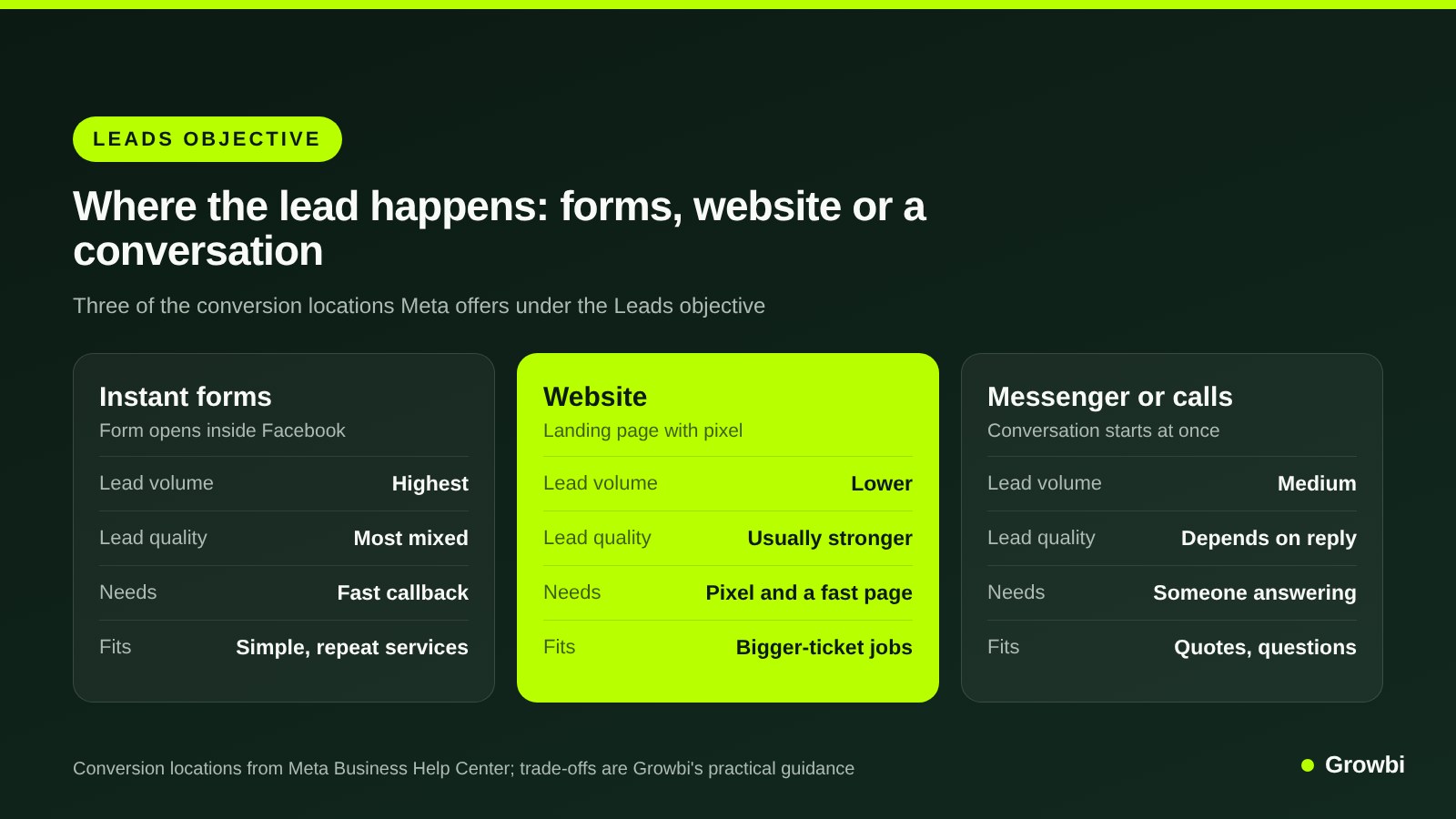
Source: Meta Business Help Center, conversion locations by objective
Instant Forms vs Your Website
Instant forms open inside Facebook or Instagram with the person's name and phone already filled in. That is why they produce the most leads, and why some of those leads forget they submitted anything.
- Pick the Higher Intent form type, which adds a review screen before submitting.
- Ask two or three qualifying questions, such as which service, which ZIP code and when they want it done.
- Say what happens next on the thank-you screen: "We will call you within 15 minutes from this number."
- Connect the form to your CRM or email so leads do not sit in Ads Manager for a day.
Our guide to Facebook ads for contractors goes deeper on form types and qualifying questions for home services.
A website lead costs more but usually arrives better informed. It also needs the Meta Pixel on the page, ideally backed by the Conversions API, so Meta can see which clicks turned into form submissions and optimize toward them.
Pro tip: Before you spend a dollar on an instant form, send a test lead through Meta's Lead Ads Testing Tool and confirm it lands in your CRM or inbox with every answer intact. Repeat the test after any change to the form or the integration.
A practical way to choose: start with a Higher Intent instant form, call ten leads, and if fewer than half remember asking or fit your service area, test the website version.
Set Up Audiences Under Meta's Current Options
Targeting on Meta has changed more than any other part of the platform. Most of the interest stacking that worked a few years ago now has little effect.
New ad sets default to Advantage+ audience. As Jon Loomer's Advantage+ audience guide explains, only four settings are hard limits: locations, minimum age, excluded custom audiences and language. Age maximum, gender and interests are suggestions Meta can go beyond.
- Location: your service area by city, ZIP code or a pin with a radius, set to people living in or recently in that area.
- Minimum age: 18 for most services, higher if your customers are homeowners or the treatment requires it.
- Exclusions: current customers and recent leads, uploaded as a custom audience, so you do not pay to reach them again.
- Suggestions: past customers or website visitors, useful mainly when the pixel and account are new.
Loomer also recommends one ad set per campaign in most cases, since several broad ad sets end up competing for the same people and each learns more slowly. For a small business, that means one campaign, one ad set and three to five ads.
Pro tip: Refresh the excluded customers and recent leads audience every month, or connect it to your CRM so it updates itself. A stale exclusion list keeps spending money on people who already called you.
Creative That Gets Local Customers to Respond
On Meta, the ad itself does most of the targeting. The picture, the first line and the offer decide who stops scrolling.
- Show real people and real work: your team, your van, your treatment room, a finished job. Phone video is fine.
- Lead with a concrete offer: a free estimate this week, a first-visit price, a seasonal tune-up with a date.
- Name the place: "Homeowners in Mesa" or "Now booking in South Austin" tells locals it is for them.
- Give one clear next step that matches the conversion location: Get Quote, Send Message or Call Now.
Pro tip: Put the town and the offer in the first line of the primary text. The feed shows only the opening of your copy before See more, so anything you need a local to read belongs above that cut.
Watch one policy in particular. Meta's personal attributes policy bans ads that imply you know someone's personal attributes or medical information. "Struggling with your stubborn belly fat?" breaks it; "Body contouring appointments open this week in Tempe" does not.
Refresh creative when results slip, not on a fixed calendar. Adding new ads to a working ad set is safer than rebuilding it, which restarts learning.
Special Ad Categories and Health Rules
Some local businesses must declare a Special Ad Category before Meta will run their ads. Getting this wrong is the most common reason a new account gets rejected.
According to Meta's Special Ad Category guide, the categories cover employment, housing, financial products and services, and social issues, elections or politics. Financial products and services has been required since January 21, 2025 for advertisers in or targeting the US.
For housing, employment and financial ads, Meta removes or limits age, gender, ZIP code, exclusion targeting, lookalike and saved audiences, and expands radius targeting around cities and pins. That matters for:
- Contractors advertising financing or monthly payments, which falls under financial products and services.
- Real estate agents, whose listing and seller ads fall under housing; see our guide to real estate Facebook ads.
- Any business recruiting staff, whose job ads fall under employment and belong in a separate campaign.
Med spas and many clinics are not a Special Ad Category, but they face Meta's health and wellness policy. Ads for cosmetic procedures such as injectables, fillers, laser and microneedling must target people 18 or older and cannot attack someone's appearance.
Our med spa Meta ads compliance guide covers before-and-after images, prescription drug names and the workarounds that stay within the rules.
Budget for the Learning Phase
Every new ad set starts in a learning phase while Meta works out who responds. Results are unstable and usually more expensive during it.
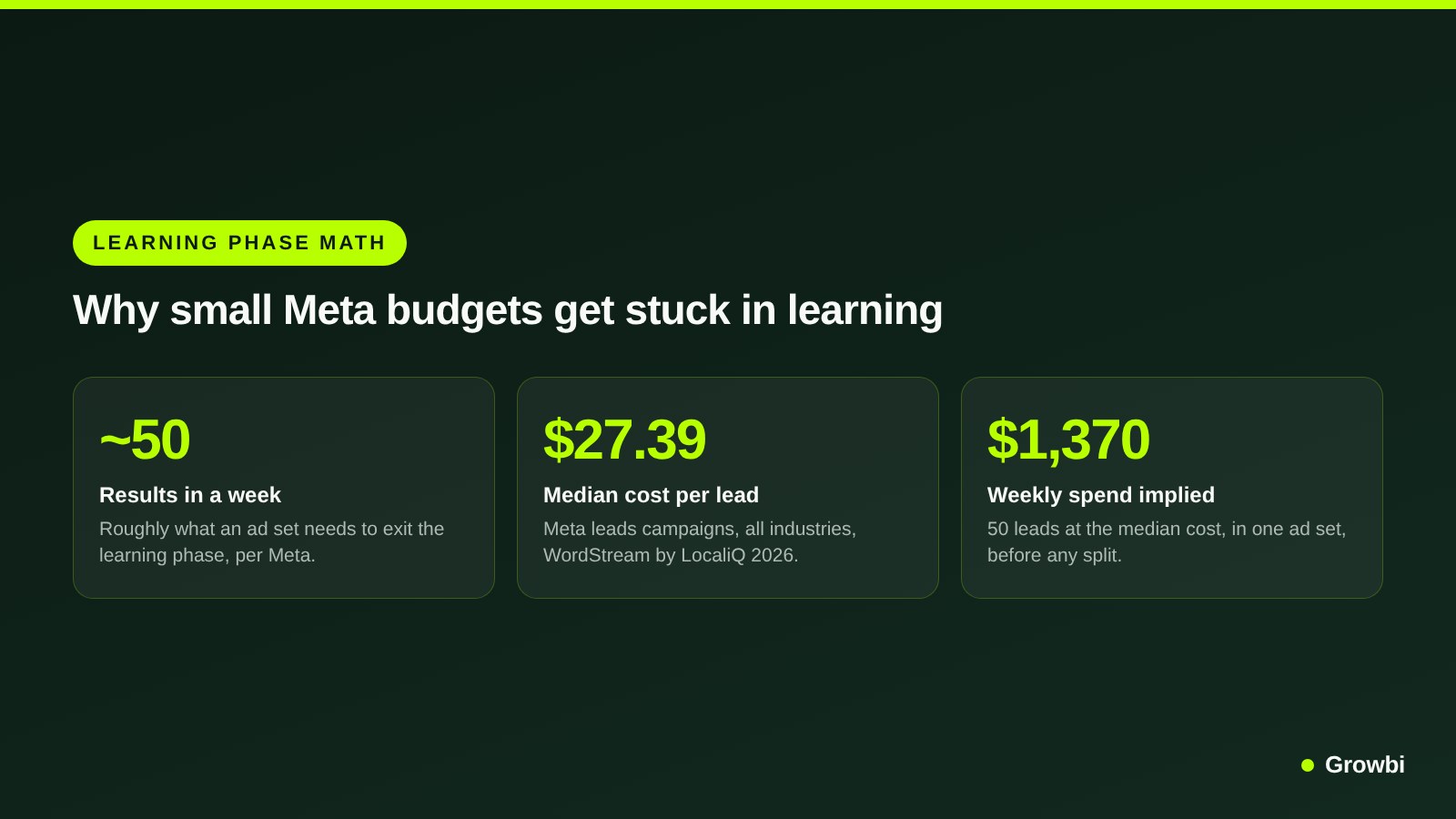
Meta's learning phase guide says ad sets usually exit learning after about 50 results in the week after the last significant edit. Editing during learning resets it, and an ad set that cannot get enough results shows "Learning limited."
Run the math with a real benchmark. WordStream's 2026 Facebook ads benchmarks put the median cost per lead for leads campaigns at $27.39 across industries. Fifty leads at that price is about $1,370 a week in one ad set.
Most small businesses spend less than that, and that is fine, as long as they do not make it worse. Keep one ad set, avoid edits for the first week, and change budget in modest steps rather than daily.
If your budget cannot exit learning on leads, you can still run a learning-limited campaign profitably; you just judge it on booked customers over a month instead of on Meta's daily numbers. For real budgets by trade, see our guide to Facebook ads cost.
Measure Booked Customers, Not Leads
Ads Manager reports leads. Your bank account reports customers. The gap between the two is where most small Meta budgets disappear.
- Get every lead into one place within minutes: a CRM, a shared inbox or at least a sheet.
- Call fast. Our guide to speed to lead explains why the first few minutes decide whether a form lead books.
- Mark each lead's outcome: reached, booked, showed, paid, and the job value.
- Divide spend by booked customers each month, per campaign and per conversion location.
- Cut what does not book, even if Ads Manager shows it as your cheapest lead source.
Meta can also optimize for leads that convert, if you feed it outcomes. Its CRM integration guide says the Conversion Leads performance goal works only with instant forms, and suits businesses with at least 200 leads a month, daily data uploads and a sales stage reached within 28 days.
Most small businesses do not hit 200 leads a month yet. Until you do, the manual scorecard above is what tells you whether Meta is working. Clinics can make it easier with a booking system that tags the lead source, as covered in our review of med spa CRM platforms.
When Meta Ads Fit Next to Google
Meta and Google are not rivals in a local budget. They catch people at different moments.
Google catches people who already know they need you, and our guide to Google Ads for small business covers that setup. Meta reaches people before they search, which suits elective services, seasonal offers and anything that sells on a visual result.
If you can only fund one, urgent trades usually start with Google and elective services with Meta. The dental version of that decision is in our comparison of Google Ads vs Facebook ads for dentists.
FAQs
How do I advertise my business on Facebook?
Create a Facebook Page and a Meta Business account, then open Ads Manager. Choose the Leads objective, pick where the lead happens (instant form, website, messages or calls), set your service area and minimum age, and upload three to five ads showing real work with a clear offer. Install the Meta Pixel first if you will send people to your website.
Are Facebook ads worth it for a small business?
They are worth it when your cost per booked customer is lower than what a customer earns you. WordStream's 2026 benchmarks put the median cost per lead for Meta leads campaigns at $27.39, but instant form leads need fast follow-up to book. Track which leads book before deciding.
Is $1 a day enough for Facebook ads?
Not for a local service business that wants leads. Meta says an ad set usually needs about 50 results in a week to exit the learning phase, and at a typical cost per lead that takes far more than $1 a day. A tiny budget can boost a post, but it will not produce enough leads to judge whether ads book customers.
What is the best Facebook ad objective for a local business?
The Leads objective, for most service businesses. Meta describes it as collecting leads through messages, phone calls or signups. Then choose the conversion location: instant forms for volume, your website for better-informed leads, or Messenger and calls when someone can answer immediately. Avoid Traffic, which optimizes for clicks rather than contacts.
How long does the Facebook ads learning phase last?
Until the ad set delivers stably, which Meta says usually happens after about 50 results in the week after the last significant edit. Editing the ad set, its budget or its ads during that time can restart learning. Small budgets may stay learning limited, so judge them on booked customers over a month instead.
Conclusion
Facebook ads work for small local businesses when the setup matches how people respond on Meta: the Leads objective, a deliberate choice of form, website, messages or calls, one broad ad set with the right controls, creative that shows real work and passes policy, and enough patience for learning.
The number that decides whether to keep going is cost per booked customer. Track it from the first week. If you want Meta and Google run together and judged on that number, our paid ads management is built for local service businesses.
Not sure your setup is right? Book a free 15-minute call and bring last month's Meta leads and how many of them booked.
Get this system built for your business
Book a strategy call and we will model a realistic appointment target from your budget, market, and offer.
Keep reading
Facebook Ads for Contractors: What Actually Works in 2026
Google Ads for Small Business: A Setup Guide for Local Services

Med Spa Meta Ads Compliance: Health and Wellness Restrictions and Legitimate Workarounds
Real Estate Facebook Ads: What Works Under Meta's Housing Rules
Google Ads vs Facebook Ads for Dentists: Cost, Intent and When to Use Each
Speed to Lead: Why the First 5 Minutes Decide Who Books