How Much Do Facebook Ads Cost for a Local Business in 2026?

Key Takeaways
- The 2026 median Facebook cost per lead is $27.39, but dentists pay $61.56, beauty $50.91 and home improvement $42.95, per WordStream by LocaliQ.
- Clicks are cheap on Meta: $0.60 for traffic campaigns and $1.80 for lead campaigns, about a third of Google's $5.42 average.
- Meta's price per ad rose 14% worldwide and 23% in the US and Canada in Q3 2026, and November is usually the most expensive month for impressions.
- Most local ad sets never reach Meta's 50 results a week, so run fewer ad sets with more budget each.
- Judge Meta on cost per booked customer: the same $2,000 can mean $182 or $333 per booked patient depending on how fast your team calls back.
Facebook ads cost a median $27.39 per lead and $0.60 per traffic click in 2026, per WordStream by LocaliQ, but local service leads run higher: $42.95 for home improvement, $50.91 for beauty and $61.56 for dentists. Buying 30 leads a month takes roughly $1,290 to $1,850 in ad spend, before management.
Meta does not sell ads at a fixed price. Every time someone opens Facebook or Instagram, an auction decides whose ad they see, and what you pay depends on your audience, your offer, your creative and the time of year.
This guide gives you the 2026 numbers instead: cost per lead by industry, what impressions and clicks cost, why prices jump in the fourth quarter, realistic budgets, fees, and the number that decides whether Meta is worth it.
If you are weighing Meta against search, read this next to our guide to Google Ads costs. The two platforms charge for very different things, and the comparison only works at the level of a booked customer.
Facebook Ads Cost per Lead by Industry in 2026
The most current public benchmark is WordStream and LocaliQ's annual Facebook report, published in September 2026. Its lead data covers 452 US campaigns using the leads objective between April 2025 and June 2026, and its averages are medians, so a few extreme accounts do not skew them.
In WordStream's 2026 Facebook ads benchmarks, the median cost per lead across all industries is $27.39, down less than 1% from the year before. The three categories with the highest cost per lead are exactly the ones local service businesses sit in:
- Dentists & Dental Services: $61.56 per lead, $5.70 per click, 6.07% conversion rate.
- Beauty & Personal Care (the closest category to most med spa services): $50.91 per lead, $2.97 per click, 5.63% conversion rate.
- Home & Home Improvement (HVAC, plumbing, roofing, remodeling): $42.95 per lead, $2.18 per click, 5.32% conversion rate.
- Physicians & Surgeons: $32.14 per lead, $1.68 per click.
- Real Estate: $13.74 per lead, $1.27 per click, 9.95% conversion rate.
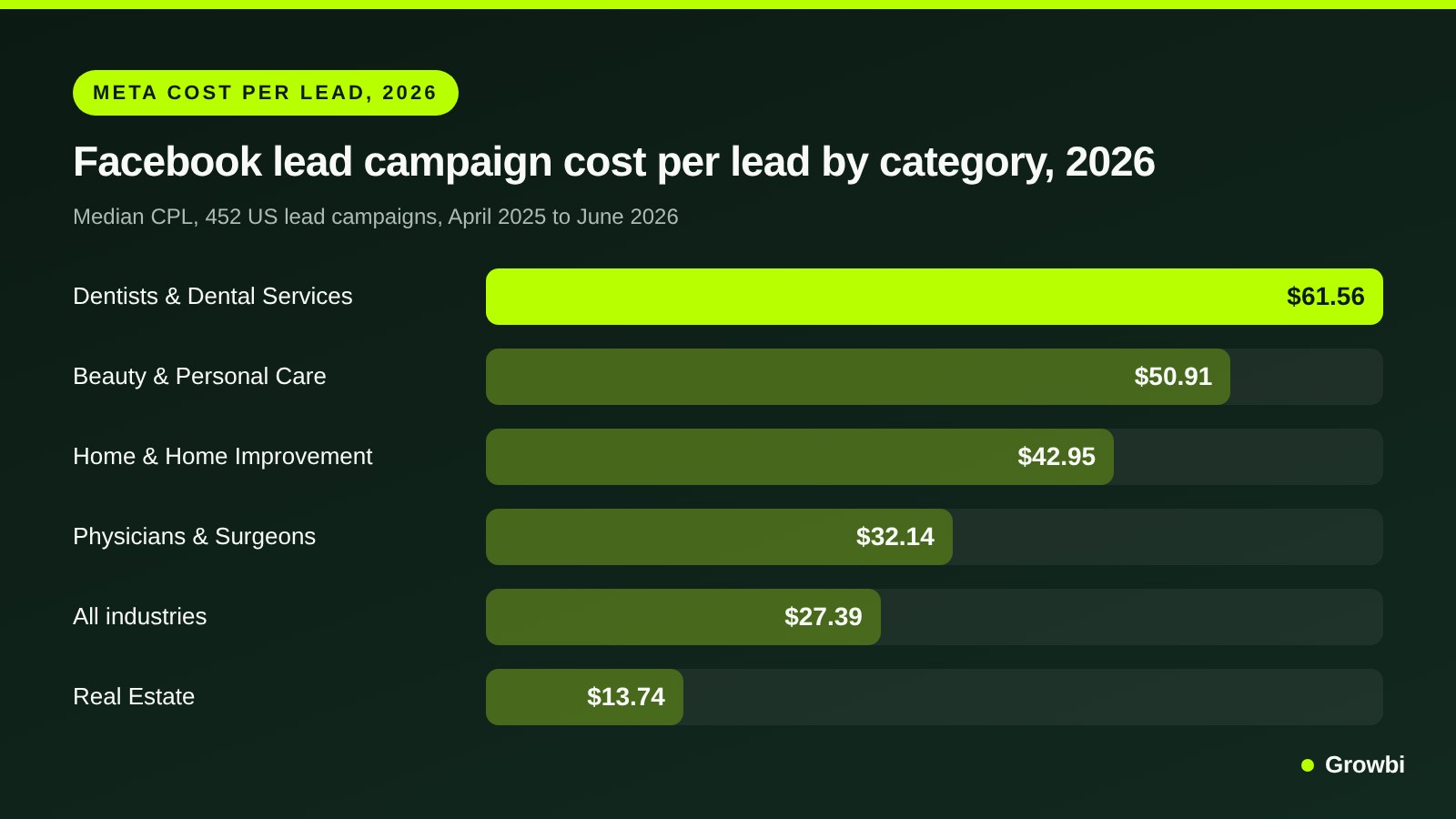
Two trends matter for planning. Dental lead clicks got 41.72% cheaper year over year, while home improvement cost per lead rose 4.10%.
Compare that with Google, where WordStream's search data puts home improvement at $90.92 per lead. Meta leads cost about half as much, but they are colder: the person filled in a form while scrolling, not while searching for help. Our Facebook ads guide for contractors covers the offers and forms that keep those leads warm.
What Facebook Ads Cost per Click and per 1,000 Impressions
Meta reports three prices, and each tells you something different.
- CPM, cost per 1,000 impressions: the raw price of reach. It moves with competition for your audience and the season.
- CPC, cost per click: $0.60 median for traffic campaigns and $1.80 for lead campaigns in 2026, per WordStream. Lead campaigns pay more per click because Meta shows them to people more likely to fill in a form.
- Cost per lead or result: what you pay for the action you optimize for. For a local business this is the only one of the three that belongs in a budget.
For impressions, the largest public dataset we found comes from Superads, which tracks more than $3 billion in Meta spend. Its US CPM benchmark put the median US cost per 1,000 impressions at an average of $23.42 over its most recent 13-month window, ranging from a low of $20.24 in July 2026 to a high of $27.47 in November 2025.
That is why cheap reach can still produce expensive leads. Dental lead campaigns pay a median $5.70 per click, nearly ten times the $0.60 traffic median, and only about 6% of those clicks become leads.
Pro tip: Save a column preset in Ads Manager with CPM, link click-through rate and cost per lead side by side. When cost per lead rises, it shows whether the auction got pricier (CPM up) or the ad stopped working (click-through down), and each needs a different fix.
Why Meta Ad Prices Rise in the Fourth Quarter
Meta ad prices are climbing in 2026, and the holidays push them higher still.
Meta's third-quarter 2026 results, as reported by PPC Land from the earnings release and presentation, show the average price per ad up 14% worldwide and 23% in the US and Canada, while ad impressions grew only 10% and 8%. In plain terms, Meta is showing a few more ads and charging a lot more for each one.
Seasonality stacks on top of that. Retailers flood the auction from late November through December, and a dentist or roofer bids for the same eyeballs. In Superads' US data, November 2025 had the sharpest monthly jump of the year, up $4.62 in median CPM.
- Expect higher CPMs from mid-November to late December, so judge holiday weeks against last year's holiday weeks, not against October.
- Lead with an offer people act on now, such as year-end benefits, gift cards or a pre-winter tune-up, so a higher CPM still produces leads.
- Do not slash budgets mid-campaign: large changes can send ad sets back into learning, which costs more than riding out a pricey week.
Pro tip: Build and submit your holiday ads in late October, before prices climb, so review delays and fixes happen in a cheaper week. When the offer goes live you only switch ads on, rather than building in the most expensive weeks of the year.
Med spas usually do the opposite of pulling back and lean into holiday packages. Our guide to med spa Black Friday deals shows how to structure those offers so they also fill January.
What Drives Your Facebook Ad Costs
Your bid is only one input, and on Meta it is often not the biggest one.
Meta's help page on ad auctions says the winning ad has the highest total value, subject to a price floor, and that total value combines your bid, the estimated chance that this person engages or converts, and ad quality, judged in part from people viewing or hiding the ad. A more relevant ad can beat a higher bid.
- Audience size and competition. A 5-mile radius around one clinic has fewer people and more competition per person than a whole metro, which usually pushes CPM up.
- Creative. Plain, specific video or photos from your own business, with the price or offer stated, tend to earn better engagement than stock images, which lowers what you pay for the same result.
- Objective. Optimizing for leads costs more per click than optimizing for traffic, but far less per lead, because Meta shows the ad to people likely to fill in the form.
- Conversion data. If the Meta pixel and Conversions API send a weak or wrong event, automated bidding chases the wrong people and cost per result rises.
- Learning. New ad sets and significant edits start a learning phase in which results are less stable and cost per result is usually higher.
Rules That Raise Costs for Housing and Health Ads
Some categories pay for compliance with a wider, less precise audience.
Real estate ads must run in Meta's housing special ad category. Meta's audience rules for special ad categories say US advertisers cannot target by ZIP code, cannot exclude locations, must include all genders and ages 18 to 65+, and lose lookalike audiences, while city or pin targeting is expanded to a 15-mile radius.
That wider net means more impressions on people who will never sell a home in your farm area. Our guide to real estate Facebook ads shows how agents make creative do the targeting instead.
Med spas face a different limit. Meta's health and wellness policy requires ads for cosmetic procedures, including injectables, fillers, peels and laser treatments, to target people 18 or older, and bans copy that attacks someone's appearance.
Our med spa Meta ads compliance guide lists what else to keep out of ads and pixel data.
Realistic Monthly Facebook Ad Budgets
Work out your budget from leads, not from a round number. Leads you want per month, times your expected cost per lead, equals your monthly ad spend.
At the 2026 benchmark cost per lead, 30 leads a month, enough to judge one campaign, costs about:
- Real estate agent: 30 leads at $13.74 is about $410 a month, or $14 a day.
- Home service company: 30 leads at $42.95 is about $1,290 a month, or $42 a day.
- Med spa: 30 leads at $50.91 is about $1,530 a month, or $50 a day.
- Dental practice: 30 leads at $61.56 is about $1,850 a month, or $61 a day.
There is a catch most owners never hear about. Meta's learning phase help page says ad sets usually exit learning after about 50 results in the week after the last significant edit. At $42.95 a lead, 50 leads a week costs about $2,150 a week, far more than most local businesses spend.
So most local ad sets stay in learning or show "Learning limited." The fix is structural: one campaign, one or two ad sets covering your whole service area, three to five ads rotating inside them, and no edits for at least a week. Splitting a $1,500 budget across six audiences guarantees that none of them learns.
Pro tip: On a small budget, leave the bid strategy on highest volume for the first month instead of setting a cost per result goal. A cost goal set before the ad set has any history tends to hold back delivery, and you end the month with too few leads to judge anything.
A $500 month is enough to test an offer, but not to judge Meta. At the home improvement benchmark it buys about 11 leads, and at the dental benchmark about 8.
Cost per Booked Customer, Not Cost per Lead
A Meta lead is a name and a phone number from someone who was scrolling. Many never answer, and some do not remember filling in the form.
Here is a worked example for a dental practice spending $2,000 a month at the benchmark $61.56 per lead. That buys about 32 leads. If the front desk books 35% of them, that is 11 new patients at about $182 each. If it books 20%, it is 6 patients at about $333 each.
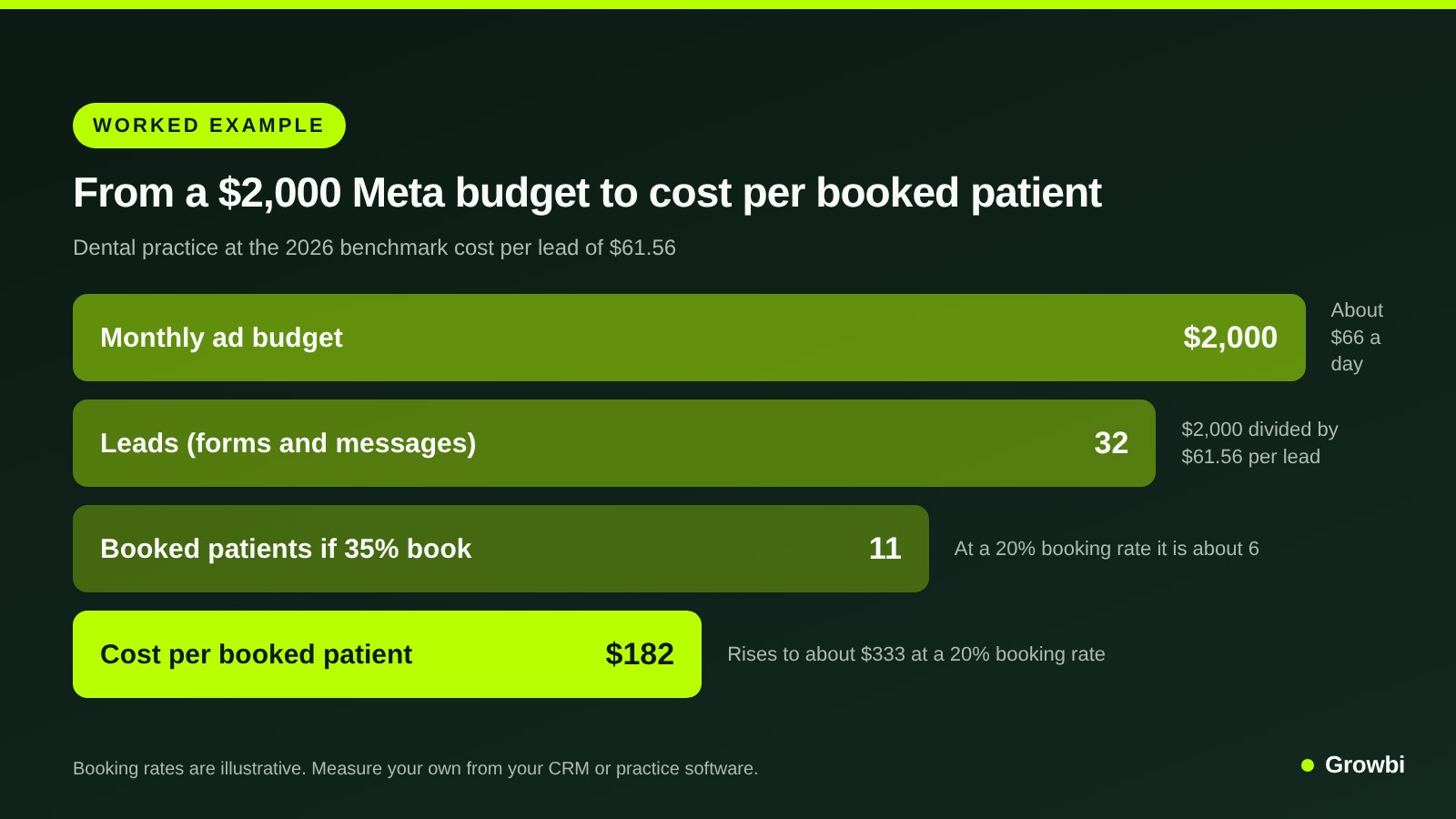
Source: Cost per lead from WordStream by LocaliQ, Facebook Ads Benchmarks 2026; booking rates illustrative
The difference between those two outcomes is not Meta. It is how fast and how often your team calls. Our guide to speed to lead covers the five-minute callback and text sequence that moves the booking rate most.
Set your target cost per booked customer from what a customer is worth. For dental practices, our comparison of Google Ads vs Facebook Ads for dentists runs the same math one step further, to attended patients and accepted treatment.
- Track every lead to an outcome in your CRM or practice software: booked, showed, sold.
- Send booked or sold customers back to Meta through the Conversions API, so delivery learns from customers, not form fills.
- Add a qualifying question to instant forms, such as the service needed or the timeline, to trade a little volume for better leads.
Facebook Ads Management Fees
Ad spend goes to Meta. Management, creative and tracking are separate costs.
Few agencies publish prices. One that does, WebFX, lists its Facebook advertising packages at $1,975 for the first month, then $975 or 15% of ad spend a month, whichever is greater, for budgets between $1,000 and $30,000. Treat that as one data point, not a market average.
- Creative is the hidden cost on Meta. Ads wear out with the same local audience, so budget for new photos or short videos every few weeks.
- Small budgets: on $1,000 a month in spend, a $975 fee nearly doubles your cost per lead, so do the math per booked customer before signing.
- Ownership: the ad account, pixel and page should be in your business's name.
The fee models are the same as on Google: flat, percentage of spend, or both. Our breakdown of Google Ads costs covers what each model rewards and which questions to ask before you sign.
FAQs
How much do Facebook ads cost per month?
There is no minimum beyond $1 a day, but a useful monthly budget buys about 30 leads. At 2026 benchmark costs that is roughly $410 for a real estate agent, $1,290 for a home service company, $1,530 for a med spa and $1,850 for a dental practice, before management fees and creative.
Is $500 enough for Facebook ads?
It is enough to test one offer, not to judge the channel. At WordStream's 2026 benchmarks, $500 buys about 11 home improvement leads or 8 dental leads. That is too few to tell a weak ad from a weak follow-up process, so plan a larger budget once a test shows the offer works.
How much does Facebook charge per 1,000 views?
Facebook charges by auction, so cost per 1,000 impressions (CPM) varies by audience and season. Superads' US data put the median at an average of $23.42 over its latest 13-month window, from a low of $20.24 in July 2026 to a high of $27.47 in November 2025.
Are Facebook ads cheaper than Google Ads?
Per click and per lead, yes. WordStream's 2026 data shows a $1.80 median click on Facebook lead campaigns against $5.42 on Google, and $42.95 per home improvement lead on Meta against $90.92 on Google. Meta leads are less ready to buy, though, so compare cost per booked customer, not cost per lead.
Is it worth paying for Facebook ads?
It is worth it when your cost per booked customer is lower than what a customer earns you. Meta works well for planned services with a clear offer, such as cosmetic treatments, replacements and remodels. It fails when leads wait hours for a callback, because cold leads go colder fast.
What is a good cost per lead on Facebook?
Start from the 2026 medians: $13.74 for real estate, $42.95 for home improvement, $50.91 for beauty and $61.56 for dentists, per WordStream by LocaliQ. A good cost per lead is one that still gives you a profitable cost per booked customer after your real booking rate, which you measure in your CRM.
Conclusion
Facebook ads cost local businesses roughly $43 to $62 per lead in 2026, about half of what the same lead costs on Google, with prices rising into the fourth quarter. A realistic test budget buys about 30 leads a month, which for most of our industries means $1,290 to $1,850 in ad spend.
Whether that is cheap depends on what happens next. Run fewer ad sets, feed Meta your booked customers, call every lead within minutes, and judge the channel on cost per booked customer. Our paid ads management is built around that number.
If you want Meta and Google budgets worked out for your business and city, book a free 15-minute call and bring last month's leads and bookings.
Get this system built for your business
Book a strategy call and we will model a realistic appointment target from your budget, market, and offer.
Keep reading
How Much Do Google Ads Cost for a Local Business in 2026?
Facebook Ads for Contractors: What Actually Works in 2026
Google Ads vs Facebook Ads for Dentists: Cost, Intent and When to Use Each
Med Spa Advertising: Channels, Costs and Compliant Ad Examples
Real Estate Facebook Ads: What Works Under Meta's Housing Rules
Speed to Lead: Why the First 5 Minutes Decide Who Books