Google Ads vs Facebook for Dentists: The Real Patient Acquisition Myth
 Mor RomanoCTO, Growbi9 min read
The short answer
Google Ads and Facebook ads are not competitors for dentists, they cover different stages of the same patient journey. Google captures existing demand from people searching for a dentist right now. Meta creates demand for elective treatment and retargets undecided visitors. Practices that run both, with shared tracking, book more patients per dollar.
On this page
This guide is for dental practice owners who keep being asked to pick a side: Google Ads or Facebook ads. The premise of that question is wrong, and choosing one channel is usually what keeps a schedule half full.
Below is how each platform behaves in a dental account, where each one fails on its own, and the operating model that turns the two into a single patient acquisition system with one set of numbers.
Why is the Google Ads vs Facebook debate the wrong question?
The question echoes through practice owner groups and study clubs every month. Which channel is better for new patients, search or social? For years it has been framed as an either or decision, as if one platform has to lose for the other to deserve budget.
That framing produces fragmented strategies. Budget swings between channels every quarter, learning phases restart, and nobody can say which campaign produced last month's implant case.
The platforms are collaborators, not competitors. Google answers a patient who already decided they need a dentist. Meta reaches a patient who has not decided anything yet. A practice needs both, because both types of patient exist in every catchment area.
What kind of patients do Google Ads actually bring in?
Google Ads excel at capturing existing demand. When someone has a broken tooth on a Sunday, or has finally decided to price implants, they open a search engine. Queries like emergency dentist near me or dental implants cost carry unmistakable intent.
These people are comparing providers, not learning about a treatment. Being present at the top of that result page, with a page that matches the query and a phone number that gets answered, is most of the job.
The limitation is volume. In a single location catchment, the number of people searching high intent dental keywords each month is finite. Once you own that demand, extra budget only raises your cost per click, it does not create more searches.
What role do Facebook and Instagram ads play for a practice?
Meta ads work upstream. Many patients do not know they want clear aligners, whitening, or a full smile makeover until they see a result that looks like the outcome they quietly want. Nobody searches for a treatment they have not considered.
Meta Ads Manager lets you reach a defined local audience by geography, age, and interest, then repeat that message often enough to build familiarity. That familiarity is what makes a consultation request feel low risk.
Meta is also the strongest retargeting surface you have. Most people who visit a treatment page leave without booking. Bringing them back with a specific reminder, on the platform where they spend idle time, is far cheaper than buying a new click.
The myth that Meta is only for brand building is as limiting as the myth that search is only for direct response. Both narrow views leave qualified patients on the table.
How do the two channels compare side by side?
| Dimension | Google Ads | Meta ads |
|---|---|---|
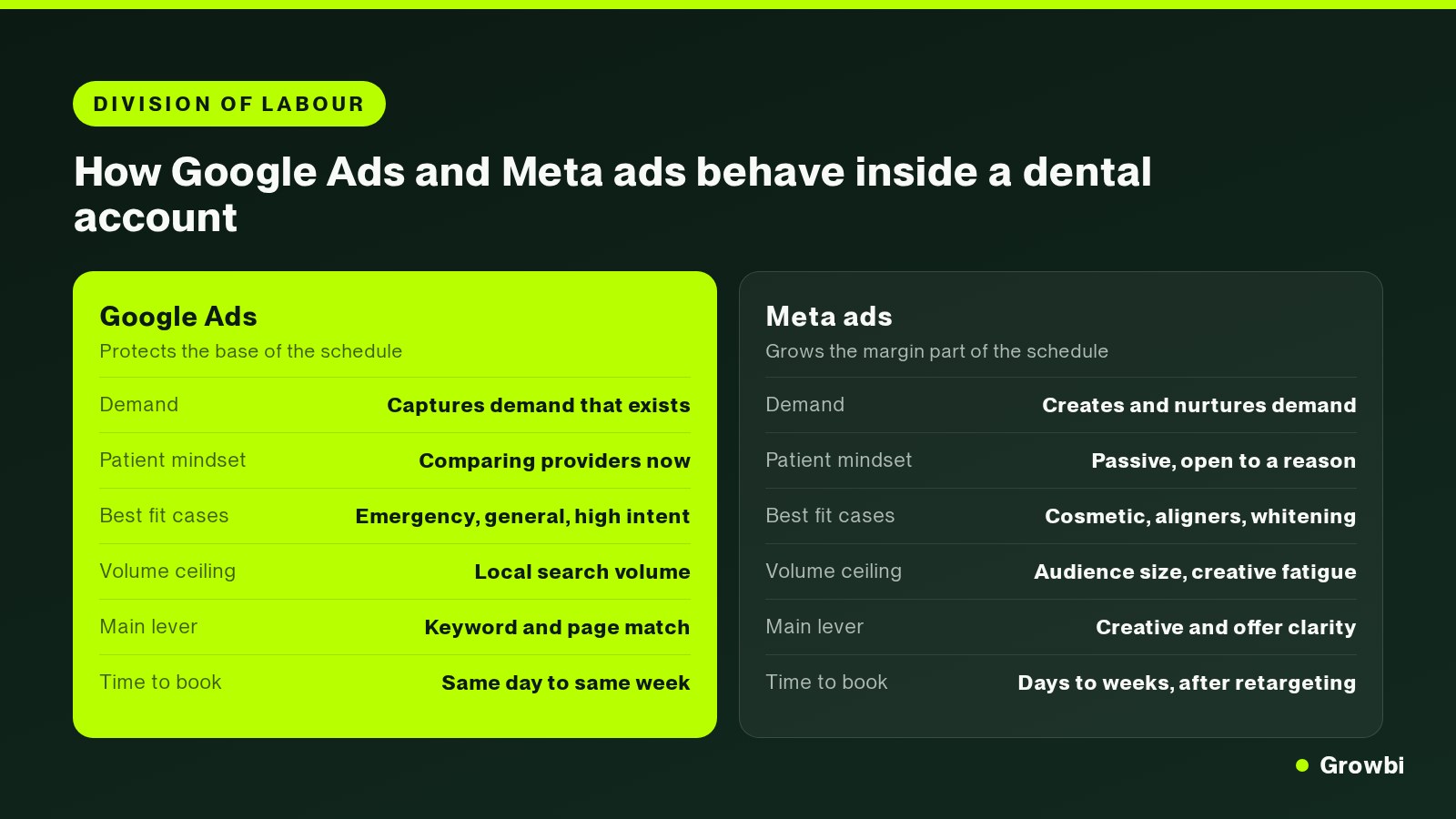
| Demand | Captures demand that already exists | Creates and nurtures new demand |
| Patient mindset | Actively comparing providers now | Passive, open to a reason to act |
| Best fit cases | Emergency, general, high intent treatment searches | Cosmetic, aligners, whitening, hygiene reactivation |
| Volume ceiling | Capped by local search volume | Capped by audience size and creative fatigue |
| Main lever | Keyword and landing page match | Creative and offer clarity |
| Typical time to book | Same day to same week | Days to weeks, often after retargeting |
Read that table as a division of labor, not a scorecard. Search protects the base of the schedule. Social grows the part of the schedule that carries the margin.
What happens when a practice runs only one channel?
The most common pattern is a practice that has run search only for years. Emergency and general appointments are steady, the account looks healthy, and yet the cosmetic chairs sit empty because nobody upstream is being told those treatments exist.
The opposite pattern is a practice that runs social only. Inquiry volume looks impressive, the front desk is busy, and show rates are poor because many of those inquiries were curious rather than committed, with no follow up structure behind them.
How do you run Google and Meta as one system?
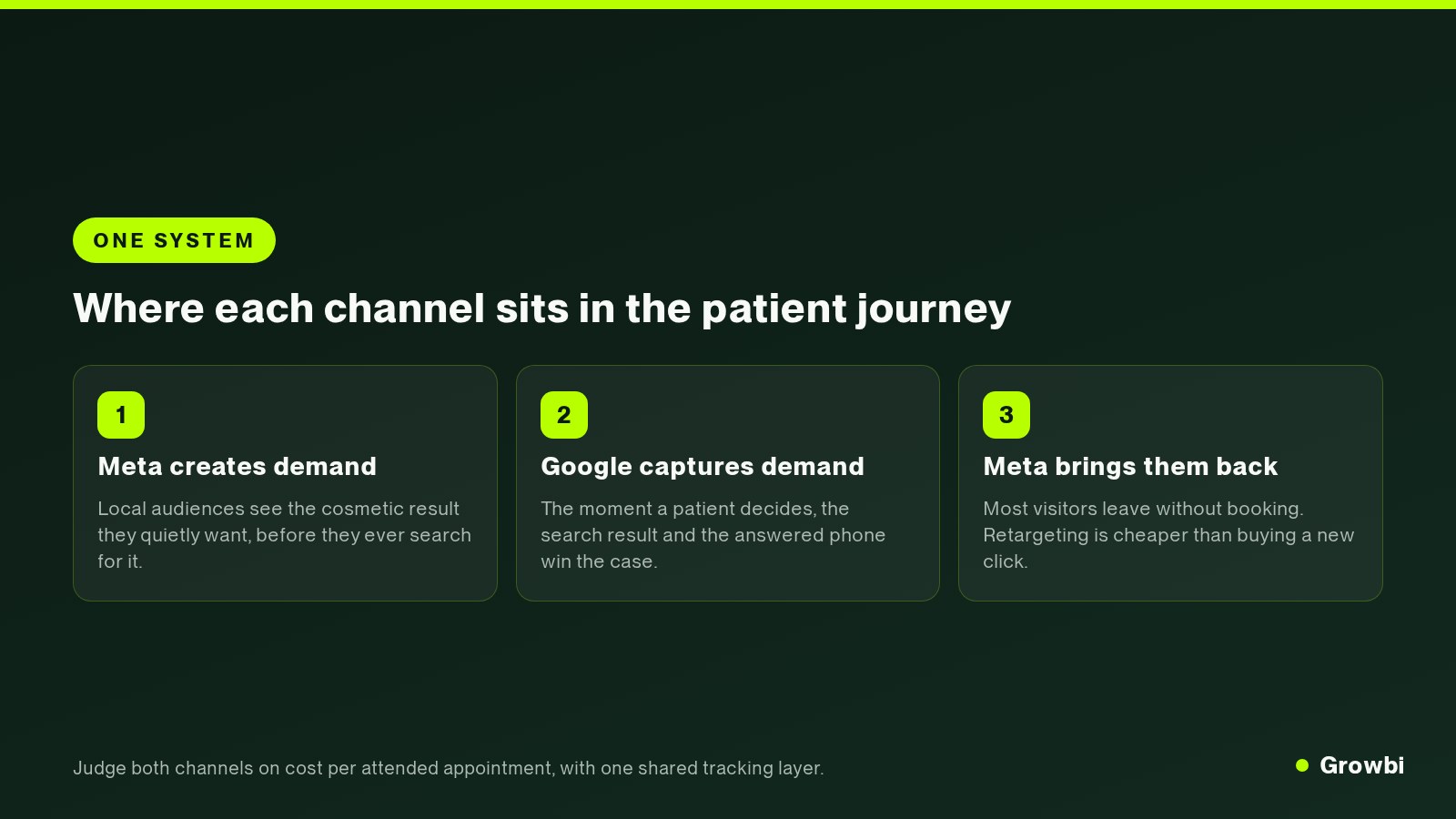
The sequence matters. Each step makes the next one measurable, so you are never guessing which channel earned the appointment.
Audit the current acquisition picture
Map where today's new patients actually come from, by treatment type. You need to know which parts of the schedule are demand capture and which are demand creation before you set any budget.
Fix tracking before spend
Install conversion tracking, call tracking, and form attribution across both platforms, with the same appointment definition on each. Without this the comparison is opinion.
Own high intent search first
Cover emergency, branded, and high intent treatment queries with tight ad groups and a matching landing page. This is the cheapest revenue in the account, so it goes first.
Add Meta for elective demand
Run local campaigns for the treatments search will never fill, with consented before and after style proof and a clear next step. Refresh creative before it fatigues, not after performance drops.
Bridge the two with retargeting
Retarget search visitors on Meta and social visitors on search. Most patients need several touches, and this is where a large share of the recovered bookings come from.
Review on attended appointments weekly
Judge both channels on cost per attended appointment and production, then move budget toward whichever channel still has headroom at an acceptable cost.
How should the budget be split between the two?
There is no universal ratio, and any agency quoting one has not looked at your schedule. The split follows two things: how much unclaimed high intent search exists in your area, and how much of your target revenue depends on elective treatment.
A practical starting order is to fund high intent search to the point where you are no longer losing impression share on the queries that matter, then put incremental budget into Meta for elective demand and retargeting.
From there the split should move every month based on cost per attended appointment. When search cost per appointment rises as you add budget, that channel is saturated and the next dollar belongs on social.
Which metrics prove the combined strategy is working?
Cost per lead is the metric that hides the most. It rewards cheap inquiries and punishes the channel that produced a considered cosmetic patient. Replace it with cost per attended appointment and production per channel.
Track show rate separately by channel too. Social inquiries usually need a stronger confirmation sequence than search inquiries, and a low show rate is a follow up problem, not proof the channel failed.
Finally, look at assisted conversions. When a patient first meets you on Instagram and later searches your practice name, a last click view will hand all the credit to search and quietly starve the campaign that started the journey.
What does the integrated approach change for the practice?
Running both channels with one tracking layer turns marketing from a monthly argument into a system you can plan around. You know which channel fills which part of the schedule, and which lever to pull when a given week looks light.
That is the real answer to Google Ads vs Facebook ads for dentists. The question was never which platform wins, it is which job each platform is doing in your practice, and whether anyone is measuring it honestly.
Frequently asked questions
Is Google Ads always better than Facebook ads for dentists?
No, that is a myth. Google Ads capture patients who are already searching for a dentist, which suits emergency and high intent treatment inquiries. Facebook and Instagram ads build awareness, promote elective treatment, and retarget undecided visitors. Most practices need both, because both patient types exist in every catchment area.
Which channel should a dental practice start with?
Usually high intent search, because it captures demand that already exists and converts fastest. Once you stop losing impression share on emergency and treatment queries, extra search budget only raises your cost per click, and the next dollar produces more when it goes into Meta for elective demand and retargeting.
What kind of new patients do Google Ads attract for a dental practice?
Patients with immediate intent. They are searching for an emergency appointment, a specific procedure such as implants, or a general dentist nearby, and they are comparing providers rather than learning about treatment. These inquiries often book within the same day or week if your phones are answered.
What role do Facebook ads play in acquiring new dental patients?
Demand creation and nurturing. Meta introduces your practice to local people who fit your ideal patient profile but are not searching yet, which is how cosmetic and aligner cases get started. It is also the most cost effective place to retarget people who visited a treatment page and left without booking.
How should the budget be split between Google and Meta?
There is no fixed ratio. Fund high intent search until you are no longer missing the queries that matter, then move incremental budget to Meta for elective treatment and retargeting. After that, shift spend monthly toward whichever channel still delivers an acceptable cost per attended appointment.
How do I measure which channel produced a patient?
Use one appointment definition across both platforms, with conversion tracking, call tracking, and form attribution feeding the same report. Then judge each channel on cost per attended appointment and production, and review assisted conversions so social does not lose credit for journeys that finish on a branded search.
Do Facebook ads work for high value dental treatments?
Yes, when the creative shows consented proof and the funnel expects a longer decision. Implants, veneers, and aligners are considered purchases, so the inquiry usually needs several follow up contacts before a consultation is attended. Practices that stop after two calls lose cases they already paid to generate.
Want this built for your clinic?
Book a strategy call and we will model a realistic appointment target from your budget, market, and offer.