Dental Patient Acquisition Cost: How to Calculate and Lower It

Key Takeaways
- Divide every marketing cost, including fees and software, by new patients who attended, not by leads or bookings.
- WordStream's 2026 benchmarks put the median dental Google Ads cost per lead at $72.97, but a lead is not a patient.
- Cost per started treatment is often many times cost per lead, so set targets by treatment value.
- Fix call answering, online booking and show rates before you raise the ad budget.
Dental patient acquisition cost is total marketing spend for a period, including ad spend, agency fees and software, divided by the new patients who attended in that period. Judge it against patient lifetime value, not the first visit, because a cheap lead can still become an expensive patient.
Acquisition cost decides whether you can afford to grow. Get the formula wrong and you will starve a channel that works or keep paying for one that does not.
Most practices calculate it from what the ad platform reports: cost per lead. That number stops before the expensive part, which is turning a lead into a patient who sits in the chair.
This guide shows the full formula, a worked example built on published benchmarks, and the levers that bring the number down fastest.
How to calculate dental patient acquisition cost
Divide your total marketing investment for a period by the new patients who actually attended in that same period.
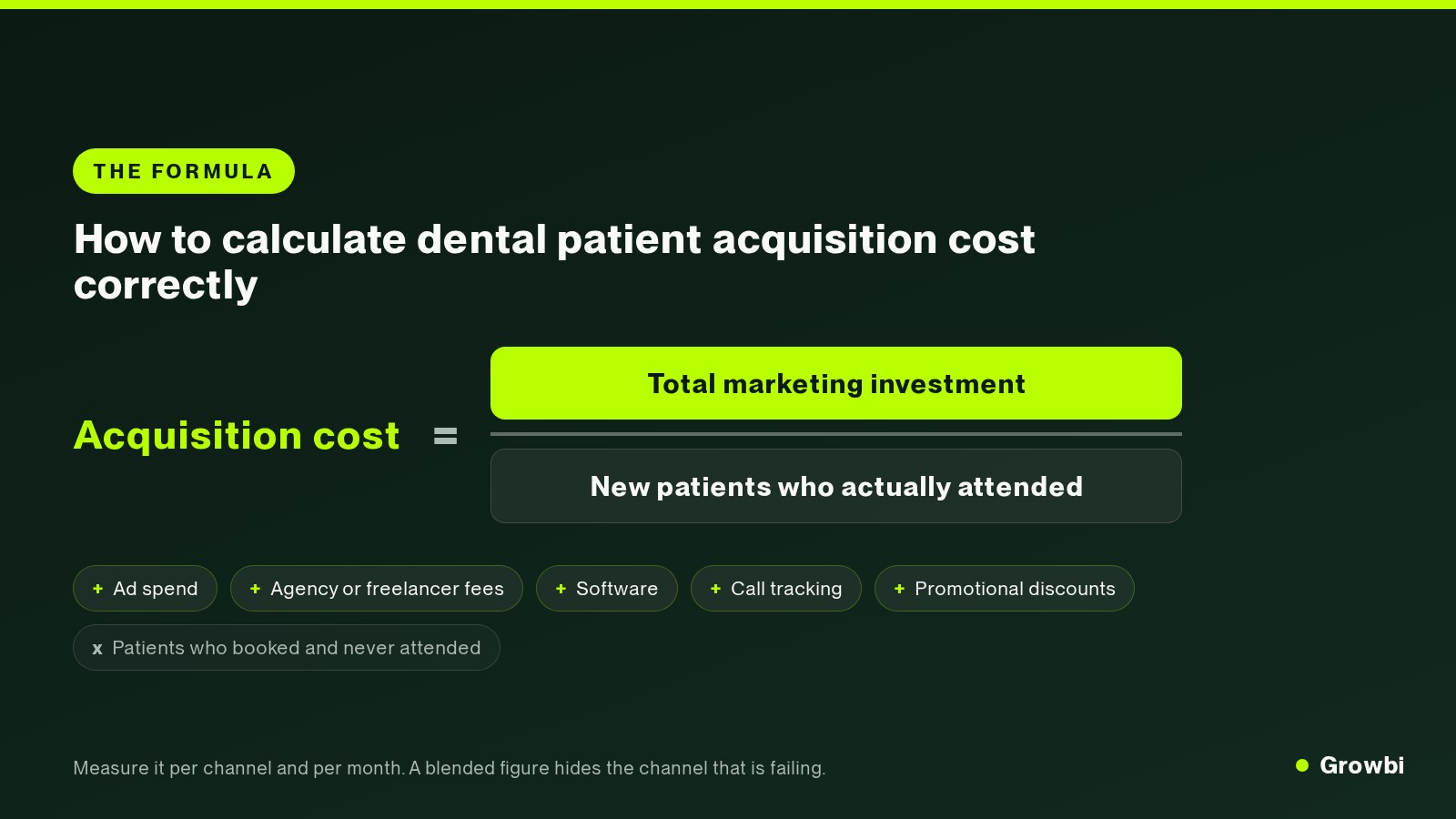
Total means everything: ad spend on every platform, agency or freelancer fees, software, call tracking and the value of any new patient discount. Attended means the patient sat in the chair, not that they booked.
- Ad spend on every platform. Include it?: Yes; Why: The most visible cost, rarely the only one
- Agency or freelancer fees. Include it?: Yes; Why: Required to produce the patient
- Call tracking, booking and review software. Include it?: Yes, the marketing share; Why: These tools exist to convert demand
- New patient discounts and free offers. Include it?: Yes, the value given away; Why: A marketing cost paid in the chair
- Staff time spent on marketing. Include it?: Optional; Why: Fine if you count it the same way monthly
- Clinical cost of treatment. Include it?: No; Why: That belongs in your profit margin
Measure it per channel as well as in total. A blended figure hides the channel that is failing, and the patient journey from a Google search looks very different from one that starts with an Instagram ad.
Cost per lead vs. cost per attended patient
Ad platforms report cost per lead. A lead is a call, form or booking request, and plenty of them never become patients.
WordStream's 2026 Google Ads benchmarks, based on 13,474 US search campaigns from April 2025 to March 2026, put the median for dentists and dental services at $8.00 per click, a 10.67% conversion rate and $72.97 per lead.
Between that lead and an attended patient there are three drop-off points: nobody reaches the lead, the person does not book, or they book and do not show. Each one raises your real cost.
- Leads: calls, forms and booking requests, by channel.
- Contacted: leads your team actually reached.
- Booked: leads with an appointment on the calendar.
- Attended: new patients who sat in the chair. This is the number that goes in the formula.
If half your leads end up in the chair, your cost per attended patient is double your cost per lead. If only a quarter do, it is four times as high.
A worked example with published benchmarks
Here is the formula applied to a general practice spending $3,000 a month on Google Ads at WordStream's median cost per lead.
- Leads at $72.97. Count: 41; Ad spend only ($3,000): $73 each; All costs ($4,800): $117 each
- Booked (50%, assumed). Count: 20; Ad spend only ($3,000): $150 each; All costs ($4,800): $240 each
- Attended (77% show rate). Count: 15; Ad spend only ($3,000): $200 each; All costs ($4,800): $320 each
The $4,800 adds an assumed $1,500 agency fee and $300 of call tracking and booking software to the ad spend. The 77% show rate is an assumption, so swap in your own.
The ad platform says $73 a lead. The practice actually paid $320 for each new patient who walked in, 4.4 times the reported number.
Now raise the show rate by five points to 82%. Twenty booked patients become 16 attended, and the cost per patient drops to $300 without a dollar of extra spend.
Comparing acquisition cost with lifetime value
Compare acquisition cost with what a patient is worth over several years, not with the revenue from the first visit.
A general dentistry patient who comes back twice a year and accepts some restorative or cosmetic dentistry along the way is worth a multiple of their first cleaning. Practices that judge acquisition against that first hygiene visit underinvest in growth.
Recall is the biggest driver. The CDC's National Center for Health Statistics reports that 66.7% of US adults had a dental exam or cleaning in the past year (2025 data). Our guide to dental patient retention covers how to keep yours in that group.
- Find yearly revenue per active patient. Take the last 12 months of collections from active patients in your practice management software and divide by the number of active patients.
- Measure how long patients stay. Look at patients who joined three or more years ago and count how many years they stayed active. Use your own data, not a national figure.
- Multiply and apply your margin. Yearly revenue times years retained gives lifetime revenue. Multiply by your profit margin to get lifetime profit per patient.
- Set a ceiling. Keep acquisition cost well below that lifetime profit. How far below depends on how quickly you need the money back.
Patient communication and patient satisfaction feed straight into that number. Every year a patient stays, and every referral they send, lowers what that new patient really cost you.
What is a good dental patient acquisition cost?
A good acquisition cost sits comfortably below the lifetime profit of the patients it brings in, and stays stable or falls over time.
There is no reliable national figure for cost per attended dental patient. Published numbers mix hygiene patients, implant cases and cosmetic work across very different cities, so a single average misleads more than it helps.
Set targets by treatment instead. A hygiene patient worth a few hundred dollars a year needs a low acquisition cost; an implant or full-arch patient worth thousands of dollars can carry a much higher cost per started treatment and still pay back.
Six levers that lower acquisition cost
These levers convert demand you already pay for. Most cost less than a budget increase and move patient growth faster.
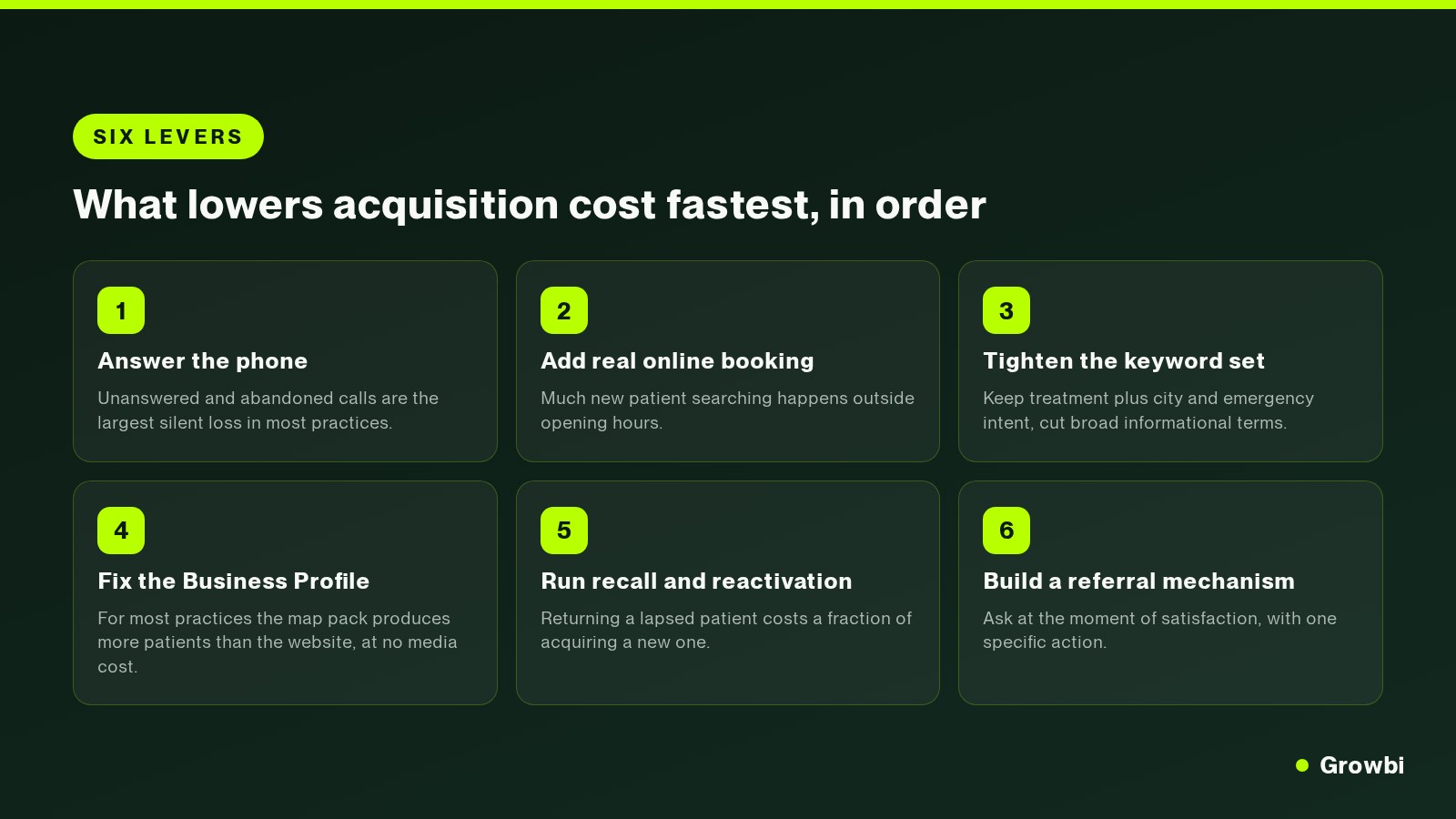
- Answer the phone. The front desk is where paid leads are won or lost. Listen to a week of call recordings before you spend another dollar on ads.
- Add real online booking. Patients who are ready to book at 9 p.m. will not wait for a callback the next morning. Offer actual open slots.
- Tighten the keyword set. Keep emergency dentist and treatment plus city searches, which convert, and cut broad informational terms. Our dental Google Ads guide shows the structure.
- Fix the Google Business Profile. The map pack for dentist near me searches sends calls with no cost per click. Our dental SEO plan covers what to fix first.
- Run recall and reactivation. A lapsed patient you bring back adds revenue without a new acquisition cost.
- Build a referral mechanism. Ask at the moment of satisfaction, with one specific action such as a link to share. Building trust with existing patients is the cheapest channel you have.
Speed matters most for paid leads. Call every lead back within five minutes and send automated SMS reminders before each visit, so booked consultations actually show up.
Where dental practices waste marketing money
Most waste is invisible in the ad platform, because it happens after the click or before anyone measures it.
- Paying for brand-name clicks that would have arrived through organic search anyway.
- Discount offers that attract single-visit patients who never return for recall.
- Sending ads to a homepage instead of a treatment page with a booking button.
- No call tracking, so every phone booking is unattributed and every budget decision is a guess.
Each of these raises cost per attended patient while cost per lead looks fine, which is why practices that only watch leads keep funding them.
Tracking acquisition cost every month
One sheet with six columns per channel is enough: cost, leads, booked, attended, started treatment and cost per attended patient.
Record each new patient's source at booking and check it against call tracking. Compare three-month rolling averages, so one slow month does not trigger a bad decision about practice growth.
If your agency reports only clicks and leads, ask for the attended column. Our dental marketing reporting is built around attended appointments, and our guide on tracking production, not leads lists what to ask for.
Setting up the sheet takes an afternoon. If you would rather build it together, book a free 15-minute call and bring last month's spend and new patient count.
FAQs
How much does a dental lead cost from Google Ads?
WordStream's 2026 benchmarks, based on US search campaigns from April 2025 to March 2026, put the median cost per lead for dentists and dental services at $72.97. Your cost per attended patient will be higher, because some leads never book and some booked patients do not show.
Should I count agency fees in acquisition cost?
Yes. Leaving out management fees, software and call tracking makes the figure look better and leads to poor budget decisions. In the worked example above, fees and software raise the cost per attended patient from $200 to $320.
How can a dental practice get more new patients without more ad spend?
Answer more calls, add real-time online booking, complete the Google Business Profile, run recall and reactivation, and ask satisfied patients for referrals. Each of these converts demand you already generate, so new patients arrive without a bigger media budget.
Conclusion
Dental patient acquisition cost is total marketing spend divided by new patients who attended. Anything less complete, like cost per lead, flatters the channel and hides where patients drop out.
Measure it per channel every month, compare it with lifetime value rather than the first visit, and fix answering, booking and show rates before you add budget. Those levers cost less than more ad spend and work on every channel at once.
If you want your own cost per attended patient by channel, book a free 15-minute call and we will calculate it with you from last month's numbers.
Mor Romano
CTO, Growbi
Written and fact checked by Mor Romano, published , last reviewed .
More about Mor RomanoGet this system built for your business
Book a strategy call and we will model a realistic appointment target from your budget, market, and offer.
Keep reading

Dental Google Ads: How to Run Campaigns That Book Patients

Dental SEO for Small Practices: A Local Plan for Three Chairs or Fewer

A 90-Day Dental Practice Growth Plan
Dental Implant Marketing: The Paid Ads Playbook for Full-Arch Cases

Google Ads vs Facebook Ads for Dentists: Cost, Intent and When to Use Each

Dental Marketing Budget: What 30 New Patients a Month Really Costs