Dental Marketing Budget: What 30 New Patients a Month Really Costs


Key Takeaways
- Set the budget backward: 30 arrived patients divided by your show rate and booking rate gives the leads you need.
- At $72.97 per dental search lead, 87 leads and about $6,350 a month produce 30 arrived patients with fast follow-up.
- Slow follow-up nearly doubles the spend for the same 30 patients, so fix booking and reminders before raising the budget.
A dental marketing budget for 30 new patients a month starts from cost per arrived patient, not a round number. Multiply that cost by 30. With LocaliQ's 2026 dental search benchmark of $72.97 per lead and the booking and show rates in Growbi's dental accounts, that comes to about $6,350 a month in ad spend.
Most dental practices set a marketing budget the same way: pick a round number, run ads, and hope the new patient count follows. When it does not, the standard fix is to spend more, which buys more of the same problem.
This guide sets the budget the other way around. It starts from 30 arrived patients and works back to leads and dollars, using a published 2026 benchmark and the booking and show rates measured in Growbi's dental accounts.
Why a round-number budget misses the target
A budget is an input. New patients are the output, and three rates sit between them: cost per lead, booking rate and show rate.
Change any one of those rates and the same $5,000 produces a very different patient count. A practice that books 45% of its leads gets 1.5 times the patients of one that books 30%, from identical ads.
That is why two practices in the same city, on the same platform, report very different results for the same spend. The budget was never the variable that mattered most.
Work backward from 30 arrived patients
Start from the number of patients you want in the chair and divide your way back to the leads you need to buy.
Five steps, each one a single calculation.
- Pick the goal in arrived patients. 30 people who sit in the chair, not 30 form fills or 30 phone calls.
- Divide by your show rate. If 77% of booked patients arrive, you need 30 / 0.77 = 39 booked appointments.
- Divide by your booking rate. If 45% of leads book, you need 39 / 0.45 = 87 leads.
- Multiply by cost per lead. 87 leads times your cost per lead is your monthly ad spend. Use your own history, or a benchmark until you have one.
- Add fees and check the value. Add agency and software fees, then compare the full cost per arrived patient with what a new patient is worth to you.
Your own rates beat any benchmark. If you do not track booked and arrived patients by source yet, our guide to dental patient acquisition cost shows how to set that up.
A worked example with 2026 dental benchmarks
Without your own history, a published benchmark is the next best input for cost per lead.
LocaliQ's 2026 search advertising benchmarks put Dentists and Dental Services at $8.00 per click, a 10.67% conversion rate and $72.97 per lead. The all-industry average is $66.69 per lead, so dental search runs above average.
For booking and show rates, we use what Growbi's dental accounts measured: about 45% of leads booked a consultation and 76% to 78% of those arrived. We round the show rate to 77%.
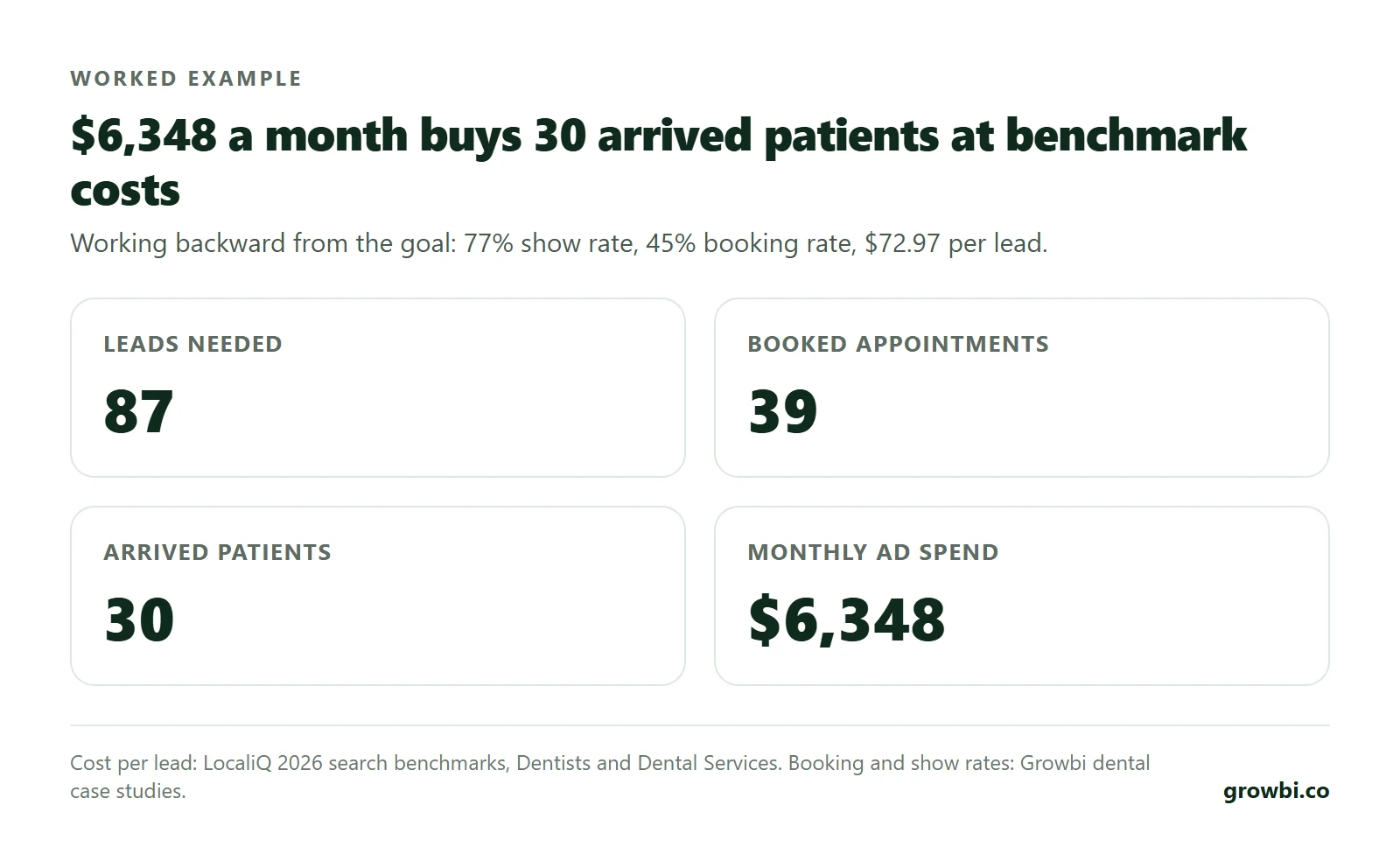
So 87 leads at $72.97 cost $6,348 a month, or $211.60 per arrived patient. That is ad spend only, before agency fees, software or staff time.
Follow-up changes the budget more than ad prices
The booking and show rates in the worked example assume fast follow-up: a callback within five minutes and text reminders before the visit.
Run the same math with slower follow-up. At a 30% booking rate and a 60% show rate, both our assumptions, 30 arrived patients need 50 booked appointments and 167 leads.
At $72.97 per lead that is $12,186 a month, nearly double the $6,348 from the fast version. The ads, the clicks and the cost per lead did not change; only the front desk did.
Before raising a budget, check booking rate and show rate by source. Our guide on why a dental marketing agency should track production covers the reports that make this visible.
Splitting the budget between Google and Meta
Google Search catches patients who already want a dentist. Meta reaches people who have not started looking yet.
For emergency visits, new patient exams and other urgent needs, start on Google Search. For implants, Invisalign and cosmetic offers with financing, Meta ads with a free consultation offer fill the calendar well.
Many practices run both: Google Search for patients already looking and Meta for prospecting and retargeting. For the full comparison, read Google Ads vs Facebook ads for dentists.
Turning a monthly budget into a Google Ads daily budget
Google Ads asks for an average daily budget, so divide the monthly number by 30.4, the figure Google itself uses.
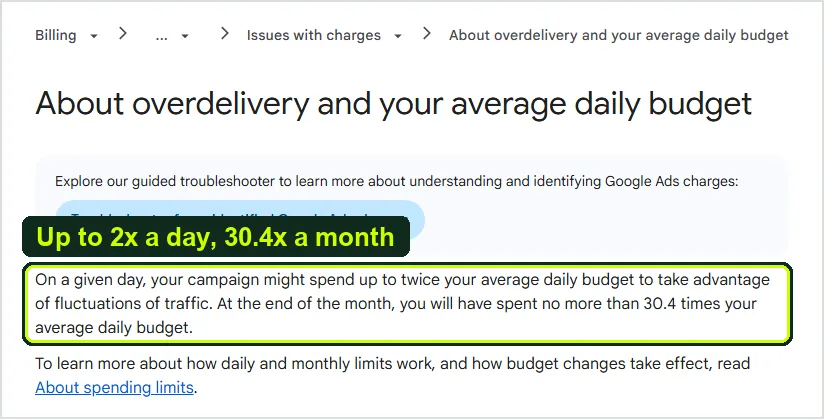
Source: Google Ads Help: About overdelivery and your average daily budget
Google's help page on daily budgets says a campaign might spend up to twice its average daily budget on a given day, but no more than 30.4 times it over the month.
For the $6,348 example, that is a daily budget of about $209. Expect busy days near $418 and quiet days well below $209; the monthly total still lands at or under $6,348.
Agency fees and the full cost per patient
Ad spend is only part of the bill. Agency fees, call tracking and booking software belong in the cost per patient too.
Take an example agency fee of $2,000 a month on top of $6,348 in ads. The full cost becomes $8,348, or $278.27 per arrived patient instead of $211.60.
Compare agencies on that full number. A cheaper fee with weak follow-up loses to a higher fee that books and confirms patients, as the $12,186 slow-follow-up scenario shows.
How to tell if the budget is paying off
Compare your full cost per arrived patient with what a new patient is worth to your practice over the first year.
Use your own numbers: average first-year production per new patient, times the share who accept treatment. If that value sits several times above your full cost per arrived patient, the budget is working and has room to grow.
Review leads, booked, arrived and cost for each source every month. Our dental marketing services are built around that report, and if you want this math for your practice, book a free 15-minute call.
FAQs
What percentage of revenue should a dental practice spend on marketing?
A percentage of revenue is a rough starting point at best, because it ignores how many patients you need and what each one costs you. Set the budget from your patient goal and cost per arrived patient, then check the total against your revenue.
How many leads does a dental practice need for 30 new patients?
About 87 a month at a 45% booking rate and a 77% show rate, the rates measured in Growbi's dental accounts. With slower follow-up, at 30% booked and 60% shown, the number rises to 167 leads.
How long before a new dental ad budget shows results?
Look at booked appointments in the first 30 days and cost per arrived patient over the first 90 days, a fair period to judge a new budget.
Conclusion
A dental marketing budget is not a guess. It is 30 arrived patients divided by your show rate and booking rate, multiplied by what a lead costs you.
With a 2026 benchmark of $72.97 per lead and fast follow-up, that math lands near $6,350 a month in ad spend. With slow follow-up it nearly doubles, which is why booking and reminders come before a bigger budget.
If you want the numbers for your own practice, book a free 15-minute call. We will run your cost per lead, booking rate and show rate and tell you what 30 new patients a month would cost.
Mor Romano
CTO, Growbi
Written and fact checked by Mor Romano, published , last reviewed .
More about Mor RomanoGet this system built for your business
Book a strategy call and we will model a realistic appointment target from your budget, market, and offer.