A 90-Day Dental Practice Growth Plan


Key Takeaways
- Fix missed calls, slow booking and weak reminders before buying traffic, or paid demand leaks out at the same points.
- ADA Health Policy Institute data shows one-third of dentists report insufficient patient volume, so the pressure to grow is widespread.
- Run one or two campaigns in month two, each tied to a single treatment, so you can tell what worked.
- Decide at day 60 with four numbers: attended new patients, cost per attended patient, show rate and acceptance rate.
A 90-day dental practice growth plan fixes conversion before it adds demand. Days 1 to 30 repair call handling, online booking, reminders and the Google Business Profile. Days 31 to 60 launch one or two search campaigns and treatment pages. Days 61 to 90 scale only what produced attended new patients.
Most practices start dental practice growth work by buying traffic. That sends new patients into the same leaks that were already losing them: unanswered calls, no online booking and reminders nobody reads.
This plan runs in the opposite order. Conversion first, demand second, scale third. Each 30-day phase has a short task list and one number that tells you whether it worked.
It assumes a single location, a modest budget and an office manager who can spend a few hours a week on it. Larger groups can run the same order per location.
Why dental practice growth stalls
The pressure to grow is real, and it does not come from marketing alone. Costs are rising faster than what patients spend on dental care.
ADA News, reporting the ADA Health Policy Institute's fourth-quarter 2025 survey, says one-third of dentists have reported insufficient patient volume. More than one-third plan to drop some insurance networks, and about 40% plan to add staff.
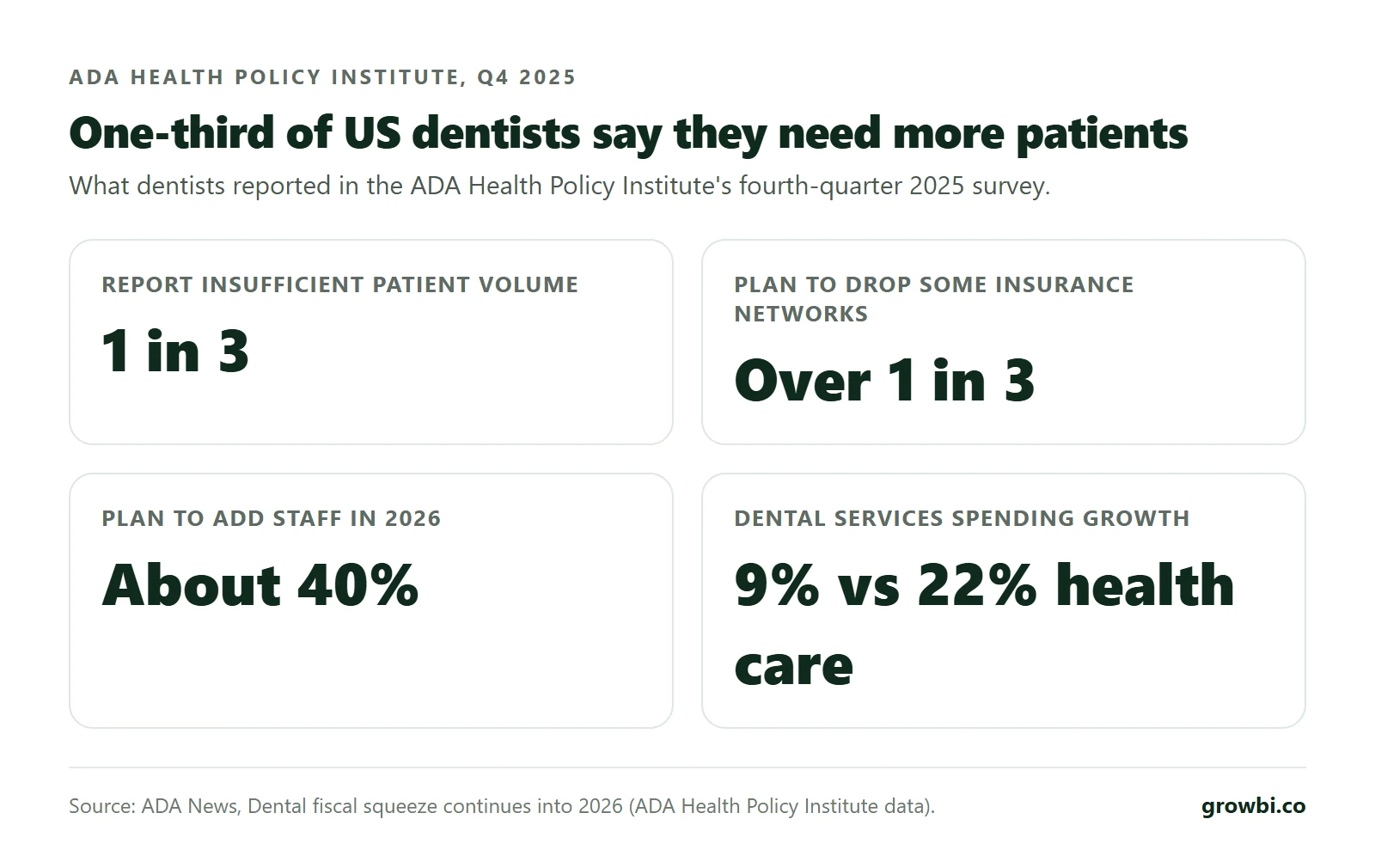
The same report compares spending growth: 9% for dental services against 22% for overall health care. Equipment and supply expenses rose 5% since the start of 2025.
Leaving insurance networks changes how patients choose. Fee-for-service patients compare practices on convenience, reviews and trust, so this plan spends its first month on conversion and patient satisfaction, not on ads.
The 90-day plan at a glance
Each phase has one job and one number to watch. Do not start a phase until the one before it is mostly done.
- Days 1 to 30. Focus: Fix conversion; Key tasks: Call audit, online booking, Business Profile, reminders, tracking, reviews; Number to watch: Call answer rate and show rate
- Days 31 to 60. Focus: Create demand; Key tasks: Search ads on one treatment, treatment pages, reactivation, referral ask; Number to watch: Cost per attended new patient
- Days 61 to 90. Focus: Scale; Key tasks: Raise proven budgets, add a second treatment, monthly recall; Number to watch: Attended new patients per month
The order matters more than the task list. If your front desk answers 7 of 10 new patient calls, every ad dollar you add also buys 3 rings that go nowhere.
Days 1 to 30: fix conversion before you buy demand
Month one costs little and changes the most. Every task here makes the ads you launch in month two cheaper per attended patient.
Audit one week of calls
Pull a week of inbound calls from your phone system. Count unanswered calls, abandoned calls and calls that ended without anyone offering a time.
Then listen to 10 new patient calls. Note whether the team asks how the caller found you and offers two specific appointment slots instead of asking when they are free.
Add real-time online booking
Put live online booking on every page of the site and in your Google Business Profile, so people searching after hours can book without calling.
Complete the profile while you are there: primary category, dental services list, hours, photos and the booking link. Our dental SEO plan for small practices covers each field.
Set up reminders and tracking
Send a confirmation at booking, a reminder 48 hours before and a text on the morning of the visit, each with a one-tap reschedule link.
Add call tracking and source tags on every form. Without them, month two produces leads you cannot trace to a campaign, and the day 60 decision becomes a guess.
Start the review engine
Reviews belong in month one because they take time to build. Ask every patient at checkout, by text, with a direct link to your review form.
BrightLocal's Local Consumer Review Survey 2026 found 74% of consumers look for reviews written in the last three months, and 47% won't use a business with fewer than 20 reviews.
Days 31 to 60: create new patient demand
With the leaks fixed, add demand you can measure. One or two campaigns, each tied to a treatment and its own landing page.
Launch search ads on one high-value treatment
Start Google Search ads on emergency care plus one treatment you want more of, such as implants. Send each ad group to a page about that treatment only.
Review the search terms report weekly and add negative keywords. The dental Google Ads guide shows the account structure we use for a first campaign.
Publish treatment pages
Write one page per treatment you want to sell. Cover what it involves, price guidance or financing, consented before-and-after photos and the questions potential patients ask before calling.
Reactivate patients you already have
Your records hold patients who have not been in for 12 to 24 months. A recall campaign to them costs almost nothing and fills hygiene gaps while ads ramp up.
The pool is large. The CDC's National Center for Health Statistics reports that 66.7% of US adults had a dental exam or cleaning in the past year (2025 data), so about a third did not.
Add a referral ask to the post-visit message at the same time. Ask right after a good visit, while the experience is fresh, and make the next step one tap.
Days 61 to 90: scale what produced attended patients
At day 60, read the numbers before you change anything. Each pattern below points to a different fix, and only one of them is more budget.
- Cost per attended patient below target. What it means: The campaign works; Action: Raise budget on that campaign only
- Many leads, few attended visits. What it means: Booking or reminders leak; Action: Fix follow-up before spending more
- Visits high, acceptance low. What it means: Treatment presentation issue; Action: Review case presentation and financing
- One treatment clearly outperforms. What it means: Demand is proven; Action: Add a second page and keyword set
- Recall booked visits. What it means: Cheap, repeatable patients; Action: Make reactivation monthly
- Scale the proven campaign. Raise spend in steps of about 20% a week on the campaign with a known cost per attended patient, rather than launching new ones.
- Add the second treatment. Expand into the next highest-value service with its own page, ad group and tracking.
- Make recall automatic. Run reactivation every month instead of as a one-off push. Our guide to dental patient retention covers recall timing.
- Keep reviews flowing. Keep the checkout request, reply to every review and watch your local map ranking for the treatments you advertise.
- Review four numbers monthly. Attended new patients, cost per attended patient, show rate and acceptance rate, from the same report every month.
The four numbers that decide your next move
Leads and clicks are inputs. These four numbers tell you whether the plan produces dental practice growth or just activity.
Attended new patients per month. Cost per attended patient, meaning ad spend plus fees divided by new patients who showed up. Show rate, attended divided by booked. Acceptance rate, treatments started divided by plans presented.
Show rate is the number most practices never measure. A short screening form, a confirmation call and reminders before each visit are what protect it.
Whether you run Dentrix, Eaglesoft or Open Dental, the better system is the one your office manager exports from on the same day every month. Consistency beats a fancier dashboard.
To set a budget from a new patient target, our 30 new patient budget guide works backward from cost per attended patient. If you want these numbers worked out for your practice, book a free 15-minute call.
Who owns each part of the plan
Plans stall when everyone assumes someone else is watching the numbers. Give each task an owner before day 1.
- Practice owner: sets the new patient target and approves the budget.
- Office manager: call audit, reminders, review requests and the monthly report.
- Front desk team members: answering, booking and asking every new patient how they found you.
- Marketing partner: ads, landing pages, tracking and reporting on attended patients.
If you use an agency, agree up front that reports show attended patients by channel, not leads. Here is why an agency should track production, not leads.
Mistakes that stall growth in the first 90 days
Most stalled plans fail on sequence, not effort. These are the four mistakes we see most when reviewing dental practices' ad accounts.
- Rebuilding the whole website before fixing booking and call handling.
- Splitting a small budget across four campaigns, so none gets enough data to judge.
- Adding a new channel, often social media, every time a month underperforms.
- Judging SEO at day 90, when it needs six to twelve months to compound.
Social media still has a job in this plan: showing real patients, team members and results that support your reviews. It just should not carry the new patient target in the first quarter.
For more channel ideas once the basics work, see how to get more dental patients.
Growth that patient care can keep up with
A growth strategy only works if the clinical side can absorb it. More new patients mean more hygiene slots, more treatment presentations and longer days.
Before scaling past day 90, check chair capacity, hygiene recall load and which dental services are most in demand locally. If one specialty, such as implants or orthodontics, leads, build around it.
Business growth that outruns patient care shows up fast in reviews. Read every new review as feedback on capacity, and slow ad spend before wait times slip past what patients will accept.
FAQs
How long does it take to grow a dental practice?
Conversion fixes show up within weeks because they change what happens to calls you already get. Paid campaigns need 30 to 60 days of data before you can judge them. SEO compounds over six to twelve months, so plan on about a year for the full picture.
Should a dental practice invest in SEO or ads first?
Ads first for filling the schedule now, SEO in parallel because it takes months to build. Practices that judge SEO on 90-day results tend to drop it just before it starts producing calls.
What show-up rate should a practice expect for new patient consultations?
Measure your own baseline first, then track it every month. Fast callbacks and reminders are the main levers, so if your show rate is low or falling, fix reminders and confirmation calls before raising ad spend.
Conclusion
Dental practice growth in 90 days comes from sequence. Fix calls, booking and reminders first, add one or two measurable campaigns second, and scale only what produced attended patients.
Keep the scoreboard small: attended new patients, cost per attended patient, show rate and acceptance rate. If a number moves the wrong way, fix that step before you spend more.
If you want a second pair of eyes on your numbers, book a free 15-minute call and we will map your current cost per attended patient and the first step of your 90-day plan.
Mor Romano
CTO, Growbi
Written and fact checked by Mor Romano, published , last reviewed .
More about Mor RomanoGet this system built for your business
Book a strategy call and we will model a realistic appointment target from your budget, market, and offer.
Keep reading

Dental Patient Acquisition Cost: How to Calculate and Lower It

Dental SEO for Small Practices: A Local Plan for Three Chairs or Fewer

Dental Google Ads: How to Run Campaigns That Book Patients

Dental Patient Retention: How to Keep Patients Coming Back on Recall

Cosmetic Dentistry Marketing Agency: How to Choose One for Invisalign and Cosmetic Cases
Dental Marketing Agency: Why Yours Should Track Production, Not Leads