Dental Patient Retention: How to Keep Patients Coming Back on Recall


Key Takeaways
- Count a patient as retained only when they attend their next recall visit, not because they still sit in your software.
- Booking the next appointment at checkout gives every later reminder an appointment to protect.
- In one controlled dental clinic study, patients sent a text reminder arrived on time 79.2% of the time, against 35.5% without one.
- Uninsured adults visit a dentist far less often than privately insured adults, so cash-pay patients need a clear yearly price.
Dental patient retention is the share of active patients who return for their next recall visit on schedule. Raise it by booking the next visit before patients leave, sending reminders with a one-tap reschedule link, following up unscheduled treatment and calling overdue patients within weeks. Measure it monthly from your own records, not industry averages.
Retention losses are quiet. Nobody complains; they simply never rebook, and eighteen months later the hygiene schedule has gaps that new patient ads have to fill at full price.
This guide shows how to measure retention with your own data, who slips away and why, and the routines that keep dental patients coming back for years.
Every number below comes from a named public source, and each formula works with any practice management system.
What dental patient retention measures
Retention measures whether patients come back when they are due, not whether their names are still in your software. That difference changes the number a lot.
In most dental practices, the software calls a patient active if they were seen in the last 18 or 24 months. Pick one window, write it down and use it every month, or the trend line means nothing.
Recall guidance explains why the window matters. NICE guidance on dental recall sets review intervals between 3 and 24 months for adults, based on each patient's risk, and calls intervals longer than 24 months undesirable for the dentist-patient relationship.
So a patient 26 months past their last visit is not a slow returner. For planning purposes they have left, and they belong on a win-back list rather than in your active count.
How to calculate your retention rate
The simplest version compares patients who were due for recall in a period with those who actually attended. Run it on the same day every month.
- Recall retention rate. Formula: Due patients who attended ÷ patients due; What it tells you: Whether recall works at all
- Pre-book rate. Formula: Patients leaving with a next visit ÷ patients seen; What it tells you: Whether checkout does its job
- Second-visit rate. Formula: New patients with a second visit ÷ new patients; What it tells you: Whether the first visit built trust
- Overdue count. Formula: Active patients past their recall date; What it tells you: The size of your win-back list
A worked example: 400 patients were due for recall in March and 292 of them attended by the end of April. That is a 73% recall retention rate, and 108 patients now need a call.
Give late attenders a fixed grace period, such as 60 days, so the figure does not jump around. Split it by hygienist too; a gap between two clinicians points to a coaching issue, not a system one.
Who drops out of routine dental care
Lapsed patients are not random. National data shows dental coverage is one of the clearest predictors of who keeps coming back.
The CDC reports that 66.7% of U.S. adults had a dental exam or cleaning in the past year, which leaves about one adult in three outside routine care.
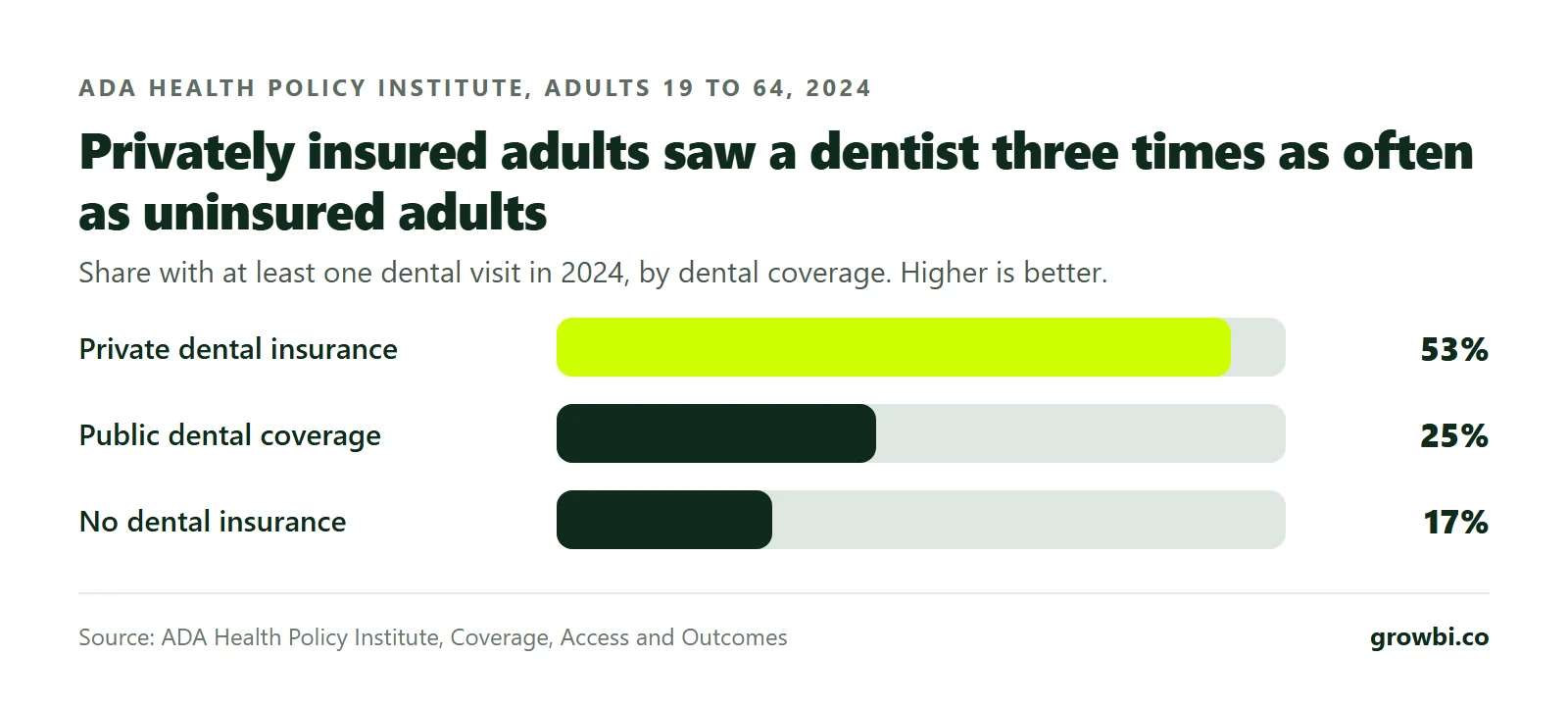
The ADA Health Policy Institute found that among adults aged 19 to 64, 53% with private dental insurance had at least one dental visit in 2024, against 25% with public coverage and 17% with no dental insurance.
For a dental practice, that points at your uninsured and cash-pay patients as the group most likely to drift. An in-house membership plan with one clear yearly price gives them a reason to keep their recall slot.
Inside the office, the reasons are simpler. Nobody booked the next visit, a treatment estimate arrived as a surprise, or the first appointment felt rushed and patients feel like a number.
Book the next visit before the patient stands up
In our experience, pre-booking moves retention more than any other habit, because a reminder only works when there is an appointment to remind someone about.
Make it the default at checkout, not a question. We'll see you in six months, mornings or afternoons? gets a very different answer from Do you want to book your next cleaning?
Patients who will not commit to a date still go on a recall list with a due month. Track the pre-book rate weekly by team member and coach the front desk on the script, not the outcome.
Reminders that patients act on
Text reminders cost almost nothing, and at least one controlled dental study found a large effect on whether patients arrived on time.
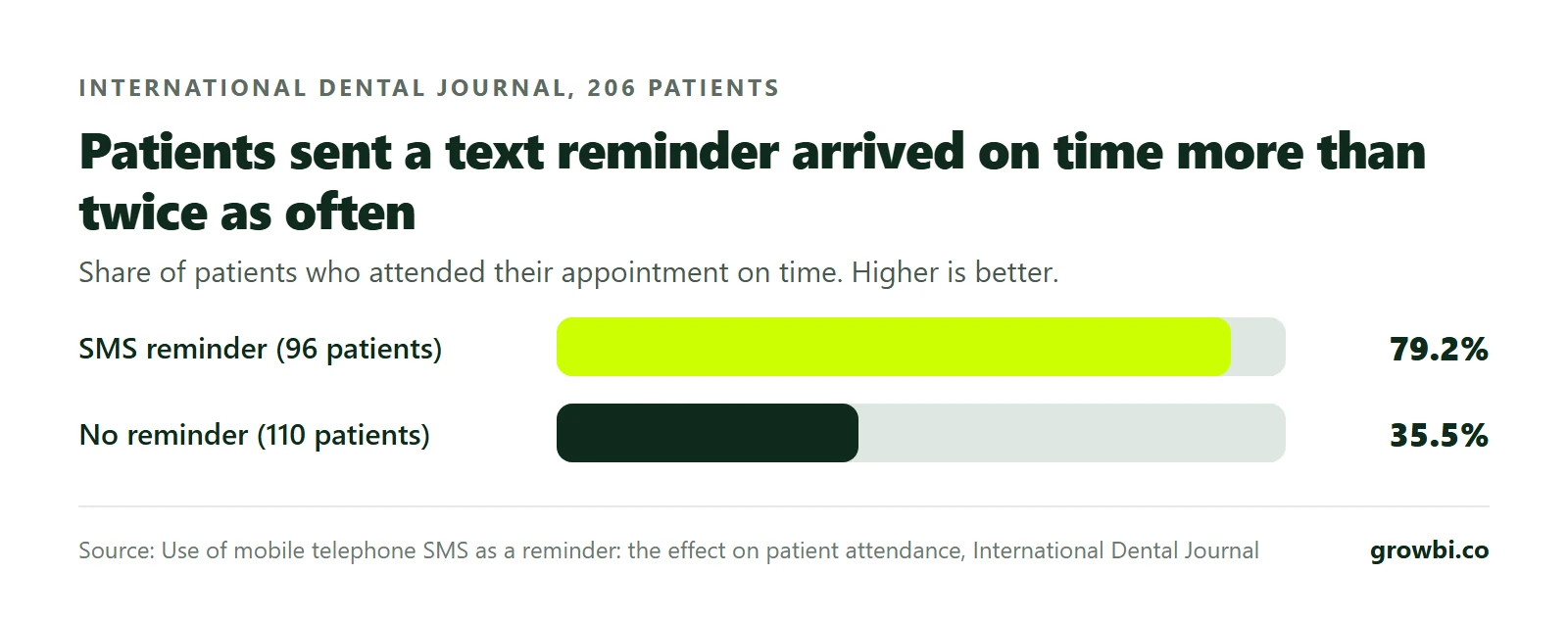
In a study in the International Dental Journal, patients at an Indian dental teaching clinic who received an SMS reminder arrived on time 79.2% of the time, against 35.5% of patients who got no reminder.
That clinic is not a U.S. private practice, and one study does not set your target. It does show how much attendance depends on a nudge, which is why reminders belong in every recall system.
A workable ladder: email a week out, text two days out, text on the morning of the visit. Each message carries a one-tap link to confirm or move the appointment, so a conflict becomes a reschedule instead of a no-show.
Keep reminders about logistics: date, time, address and link. Leave out the procedure and the condition, because family members see phones too. HHS guidance treats messages about a patient's own care differently from marketing, which has stricter consent rules.
Treatment plans that never got scheduled
Every diagnosed crown, filling or implant plan that was never booked is a retention problem in disguise. That patient trusted you enough to come in.
Pull a monthly report of unscheduled treatment and give one person the job of calling through it. Lead with the clinical reason, then cost and financing, in that order.
Cost is the objection we hear most, so have the estimate, the insurance portion and a monthly payment option ready before the call. Patients who leave confused about money rarely come back to ask.
Winning back patients who already left
Patients past their recall date fall into three groups, and each one needs a different message. Sort them before you send anything.
- Up to 6 months overdue: a friendly reminder with a booking link, followed by one phone call.
- 6 to 18 months overdue: a check-in that mentions the gap without blame, plus any new hours or services.
- More than 18 months away: a short note asking whether they still want to be your patient, with an easy way to say no.
The third group answers a question your software cannot: who has moved, switched dentists or wants off the list. Removing them keeps your active count and your retention rate honest.
Our dental email marketing guide has recall and reactivation sequences ready to copy for each group, along with the consent rules that apply to promotional messages.
What a retained patient is worth against a new one
Retaining patients costs less than finding them because you already paid to win each one once.
Paid ads charge you for every new booked consultation before anyone sits in a chair. A recall visit you keep costs a text message and a phone call.
That gap is why new patient ads pay off far better when patients stay. Our guide to dental patient acquisition cost shows how to set acquisition spend against what a patient brings in over several years.
Retention and acquisition run as one system. We report dental marketing results to attended appointments for this reason, and our guide on how to get more dental patients shows where recall fits in the wider growth plan.
FAQs
How long does a dentist keep you as a patient?
Many practice systems treat a patient as active for 18 to 24 months after the last visit, then mark them inactive. That window lines up with NICE guidance, which sets 24 months as the longest recall interval for adults. After that, a practice treats the patient as lapsed until they book again.
What is a good dental patient retention rate?
There is no reliable public benchmark, and figures quoted online rarely show their source. Compare yourself with your own last 12 months instead. If your recall retention rate, pre-book rate and second-visit rate all rise quarter over quarter, retention is improving.
Why do patients switch dentists?
Mostly for practical reasons: they moved, their insurance changed, the office was hard to book, or a bill surprised them. A short call or survey to lapsed patients tells you which reason applies to your practice, and the answer points to the fix.
Conclusion
Dental patient retention is decided in small moments: checkout, the reminder, and the call after a treatment plan goes quiet.
Measure recall retention, pre-book rate and second-visit rate every month, and work the overdue list before those patients become lapsed ones.
If you want help putting a number on your overdue patients, book a free 15-minute call. We will size the list and show which follow-up to run first.
Mor Romano
CTO, Growbi
Written and fact checked by Mor Romano, published , last reviewed .
More about Mor RomanoGet this system built for your business
Book a strategy call and we will model a realistic appointment target from your budget, market, and offer.
Keep reading

Dental Email Marketing: Recall, Reactivation and Treatment Follow-Up

Dental Patient Acquisition Cost: How to Calculate and Lower It

How to Get More Dental Patients: A Channel-by-Channel Breakdown

Use It or Lose It Dental Benefits: How to Fill Your Year-End Schedule
Google Business Profile Optimization: The Dental Practice Checklist

A 90-Day Dental Practice Growth Plan