How to Get More Dental Patients: A Channel-by-Channel Breakdown
 Mor RomanoCTO, Growbi11 min read
To get more dental patients, first capture the demand you already generate: answer calls, add online booking, and complete your Google Business Profile. Then add local SEO and paid search, then recall and reactivation, then referrals and social. Fixing conversion before adding traffic is what makes the budget work.
On this page
Practices usually ask for more patients when the real problem is leakage. Before adding traffic, find out how many enquiries you already lose to unanswered calls, forms nobody replies to, and patients who booked and never came.
Fix conversion before adding traffic
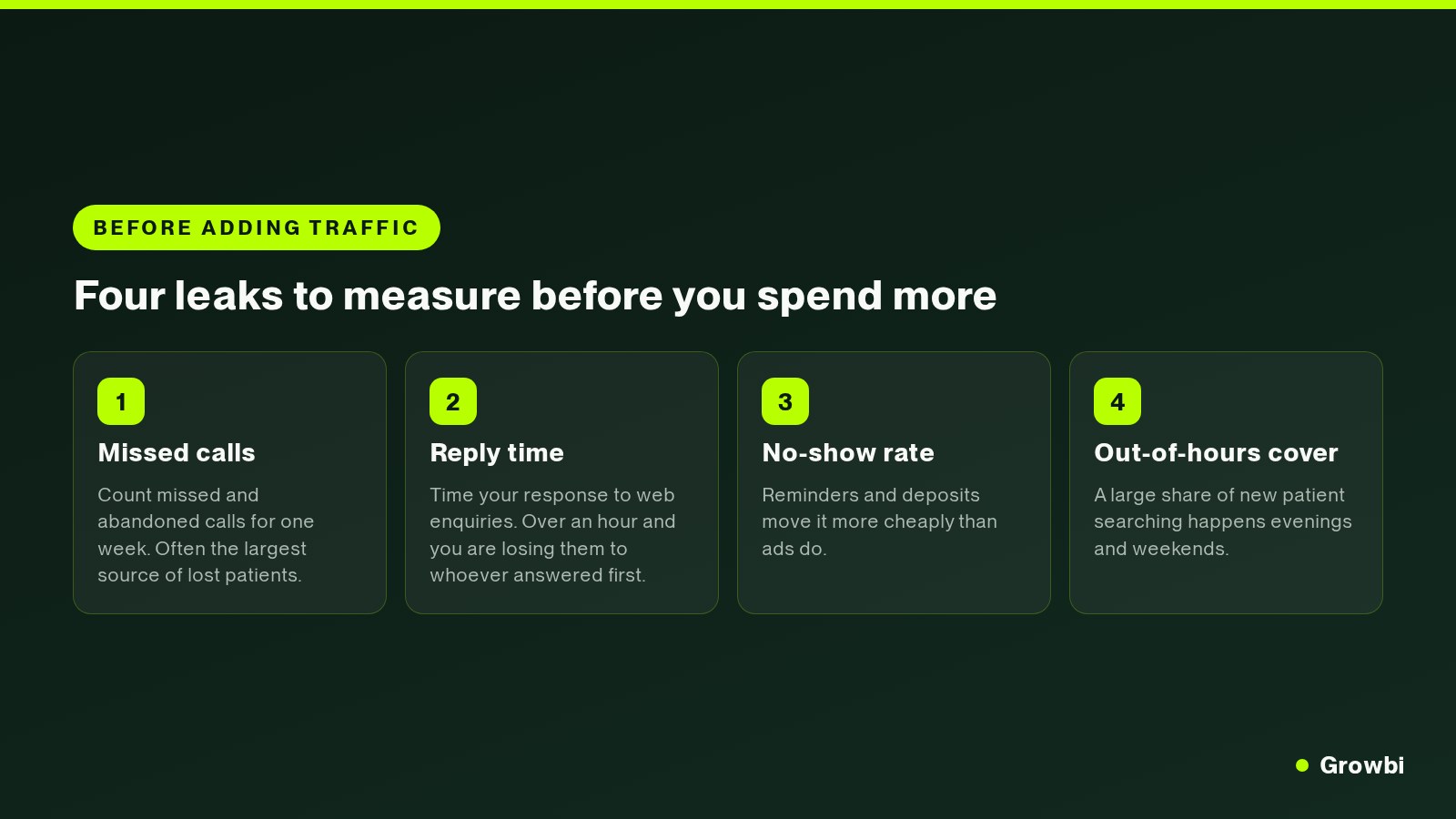
- Count missed and abandoned calls for one week. In many practices this is the single largest source of lost patients.
- Time your response to web enquiries. Anything over an hour is losing patients to the practice that answered first.
- Measure your no-show rate. Reminders and deposits move it more cheaply than ads do.
- Check evening and weekend coverage, when a large share of new patient searching happens.
Channel comparison
| Channel | Speed | Cost profile | Best for |
|---|---|---|---|
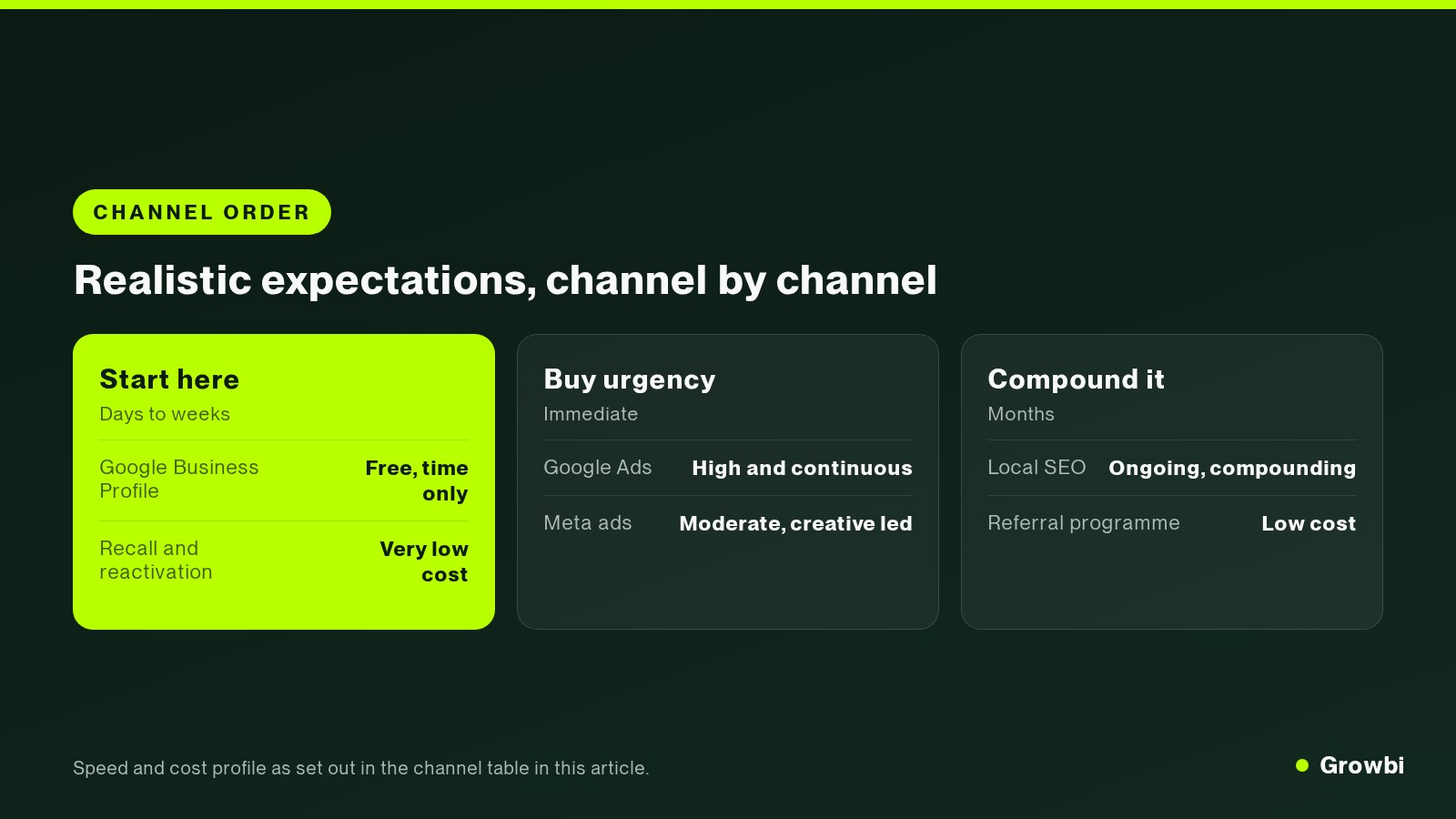
| Google Business Profile | Days to weeks | Free, time only | Every practice, highest priority |
| Local SEO | 3 to 9 months | Ongoing, compounding | Sustainable new patient flow |
| Google Ads | Immediate | High and continuous | Filling gaps now, high-value treatments |
| Recall and reactivation | Weeks | Very low | Fastest revenue from existing lists |
| Referral programme | Months | Low | Loyal patient bases |
| Meta ads | Weeks | Moderate | Cosmetic, aligners, awareness |
| Community and partnerships | Months | Low, time heavy | New practices in small markets |
The order to tackle them
Weeks 1 to 2, plug the leaks
Call handling, response times, online booking, reminder system. This costs almost nothing and lifts every channel that follows.
Weeks 2 to 4, own the map
Complete the Google Business Profile, correct categories, photos, hours, services, and start a weekly review request habit.
Weeks 3 to 6, mine your own list
Run reactivation on lapsed patients and clear the backlog of unaccepted treatment plans.
Weeks 4 to 8, build the pages
One page per priority treatment, with local relevance, FAQs, and booking. This is the foundation for both SEO and ads.
Weeks 6 to 12, buy the urgent searches
A tight Google Ads account on treatment plus city and emergency terms, pointed at the new pages.
Ongoing, compound trust
Reviews weekly, video and social monthly, referrals asked for at the moment of satisfaction.
Signals your growth problem is not marketing
- You are fully booked but revenue is flat. That is a treatment mix and pricing question, not a patient volume one.
- New patients arrive but do not return. Retention, not acquisition, is the constraint.
- Treatment plans are presented and rarely accepted. The gap is in the consultation, not the ad.
- The diary looks full but chairs sit empty. No-shows are eating the growth you already paid for.
Frequently asked questions
What is the fastest way to get more dental patients?
Reactivating lapsed patients and improving call handling are usually the fastest, because both convert demand you already own. Paid search is the fastest way to add new demand, but it costs continuously.
How much should a dental practice spend on marketing?
It depends on whether you are growing, maintaining, or opening. The more useful discipline is measuring cost per attended new patient against patient lifetime value, then investing where that ratio holds.
How long does dental SEO take to bring patients?
Google Business Profile improvements can show within weeks. Broader local SEO usually takes three to nine months depending on competition and your starting authority.
Do dental new patient specials work?
They fill the diary quickly but often attract single-visit patients who do not return for recall. If you run one, measure how many of those patients attend a second appointment before repeating it.
Want this built for your clinic?
Book a strategy call and we will model a realistic appointment target from your budget, market, and offer.