Use It or Lose It Dental Benefits: How to Fill Your Year-End Schedule


Key Takeaways
- Most dental plans reset on December 31, but some use another plan year, so verify before messaging.
- 73% of PPO enrollees have a $1,500+ annual maximum and only 2.9% reach it, per NADP.
- Contact patients with diagnosed but unscheduled treatment first, then overdue hygiene patients, then FSA holders.
- The ADA Code bans misleading ads, hidden copay waivers and wrong treatment dates on claims.
- On Meta, write about the deadline, not the viewer's insurance, to avoid personal attribute rejections.
"Use it or lose it" means most dental plans give each patient an annual maximum that resets when the benefit year ends, usually December 31, and unused dollars do not carry over. Deductibles reset too. For a practice, that makes November and December the best time to contact patients with unscheduled treatment or overdue cleanings.
Patients search for this every fall and mostly find short practice posts telling them to book before the year ends. Few explain the exceptions, and none explain how a practice should run the campaign.
This guide does both: first the insurance and tax facts your team will be asked about, checked against the ADA, the National Association of Dental Plans and the IRS, then the playbook for who to contact, when, through which channels, with what words, and within which rules.
What Use It or Lose It Means for Dental Insurance
Dental plans pay up to a fixed amount per person per benefit year, called the annual maximum. When the year ends, the counter returns to zero and whatever the patient did not use is gone.
The ADA's consumer site MouthHealthy says many plans have a December 31 deadline and unused benefits do not roll over for most plans, but some plans end at a different time of year. Its guide to using dental benefits before they expire tells patients to check their plan document or ask their employer.
The size of what is left on the table is real. The National Association of Dental Plans reports in its 2025 plan design highlights that 73% of dental PPO enrollees have an annual maximum of $1,500 or more, while only 2.9% of group PPO enrollees reached their maximum.
- Annual maximum resets. A patient who used part of a $1,500 maximum this year starts at $1,500 again in the new benefit year, and the unused part does not add on, unless the plan has a rollover feature.
- Deductible resets. The patient pays the deductible again in the new benefit year. NADP reports that only 3% of PPO enrollees have a deductible of $100 or more, and $50 to $99 is the most common range in large group PPOs.
- Some plans roll over part of it. NADP reports that 42% of PPO enrollees have an annual maximum rollover that carries some unused dollars into the next year, so "you will lose it all" is not true for every patient.
- Not every plan is a calendar year. Some employers run a plan year that starts in another month, so the deadline for those patients is not December 31.
FSA and HSA Deadlines Patients Ask About
Your front desk will hear "I also have money in my FSA" every December. The rules for flexible spending accounts and health savings accounts are different, and mixing them up can cost the patient money.
- FSA money is use it or lose it. Unspent health FSA funds are forfeited at the end of the plan year, unless the employer offers a grace period of up to two and a half months or a carryover. IRS Publication 969 allows one or the other, not both.
- 2026 FSA limits. IRS Revenue Procedure 2025-32 sets the 2026 health FSA contribution limit at $3,400 and the maximum carryover into 2027 at $680. Employers can set a lower carryover.
- HSA money does not expire. A health savings account balance stays with the patient year to year, so there is no December deadline to spend it.
- 2026 HSA limits. IRS Revenue Procedure 2025-19 sets 2026 HSA contribution limits at $4,400 for self-only coverage and $8,750 for family coverage.
- Cosmetic work usually does not qualify. MouthHealthy notes that most FSAs cannot be used for cosmetic services such as whitening or veneers.
The practical point: patients with FSA money have a real deadline, often the same December 31, while HSA holders do not. Read the details in IRS Publication 969 before training your team, and tell patients to confirm their own plan with their employer or administrator.
Why the Year-End Window Is Short
Patients only think about this for about three months. US searches for "use it or lose it dental benefits" average 90 a month, but they reached 390 in both October and November 2025 and fell to 10 a month from January to July 2026, according to Google Ads data from DataForSEO.
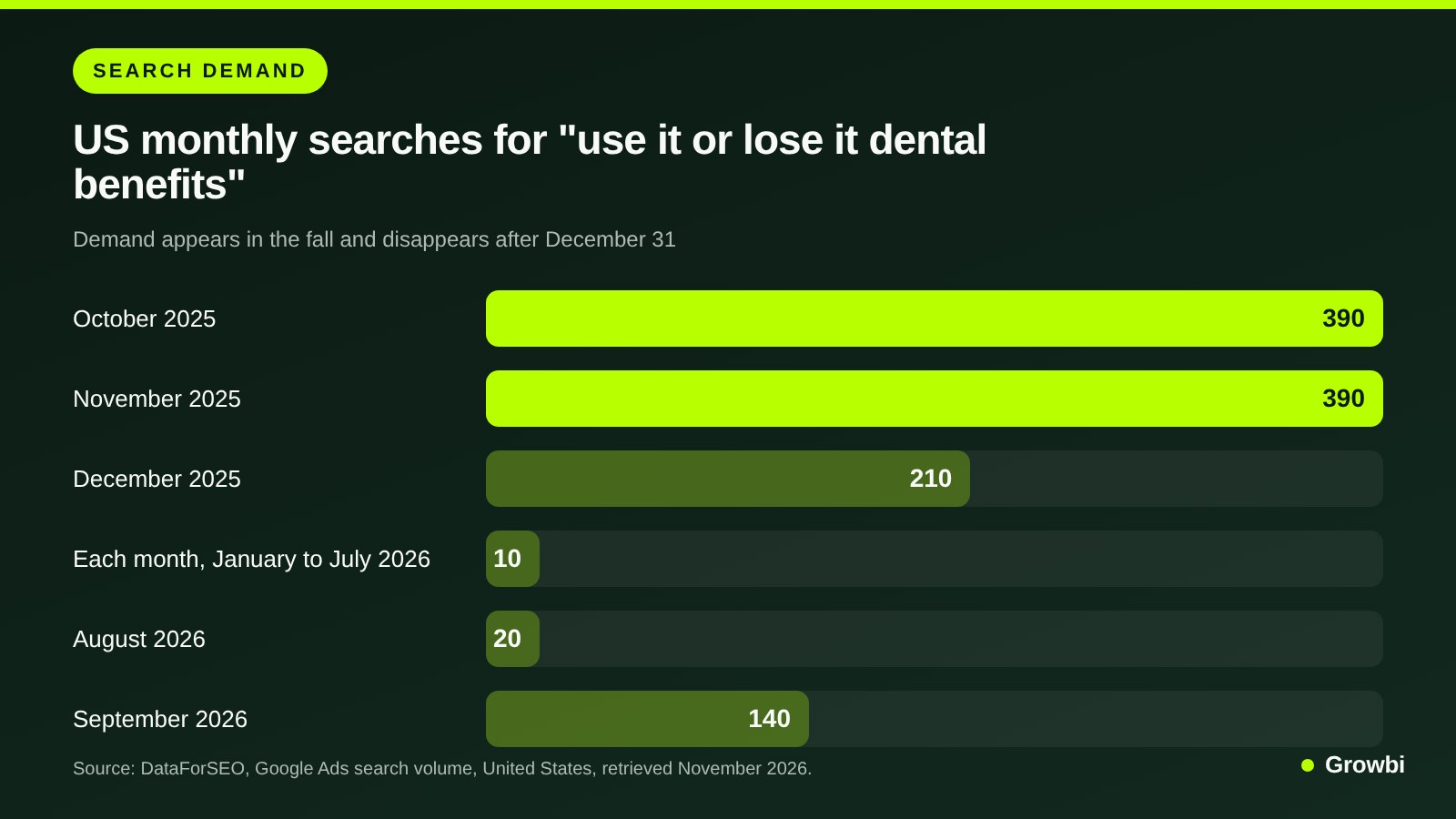
Source: DataForSEO, Google Ads search volume, United States, retrieved November 2026
Holidays cut working days in the same weeks. Start outreach in early November and you have six to seven weeks of chair time to fill. Start on December 10 and you have two.
Who to Contact First
Rank patients by what is already diagnosed and how much benefit they have left, then work down.
- Unscheduled treatment plans. Patients who were diagnosed this year and never booked crowns, fillings, periodontal treatment or other covered care. They already trust you and the need is documented.
- Patients mid-treatment. Anyone who started a multi-visit procedure and could finish a covered phase before the benefit year ends.
- Overdue hygiene. Patients who skipped their second covered cleaning or exam this year. Preventive care is often covered in full, and the visit often uncovers treatment.
- Patients who met their deductible. Their out-of-pocket cost for more covered work this year is lower than it will be in January.
- FSA holders. Patients who mentioned an FSA or paid with an FSA card this year and may have funds that expire.
Before any message goes out, run insurance verification on the top of the list. Remaining maximum, frequency limits and plan year differ by patient, and a message that promises benefits the patient does not have creates a billing complaint in January.
Pro tip: Add a short chart note for each verified patient with the remaining maximum, the plan year end date and the date you checked. Whoever sends the message or takes the reply call then quotes the same verified figure.
Your practice management system can export both lists as unscheduled treatment and overdue recall reports. Our guide to dental patient retention covers the recall system that keeps them short all year.
The Year-End Outreach Calendar
The campaign works best as a sequence, with each list contacted before the next, and the most valuable patients reached while you still have open time.
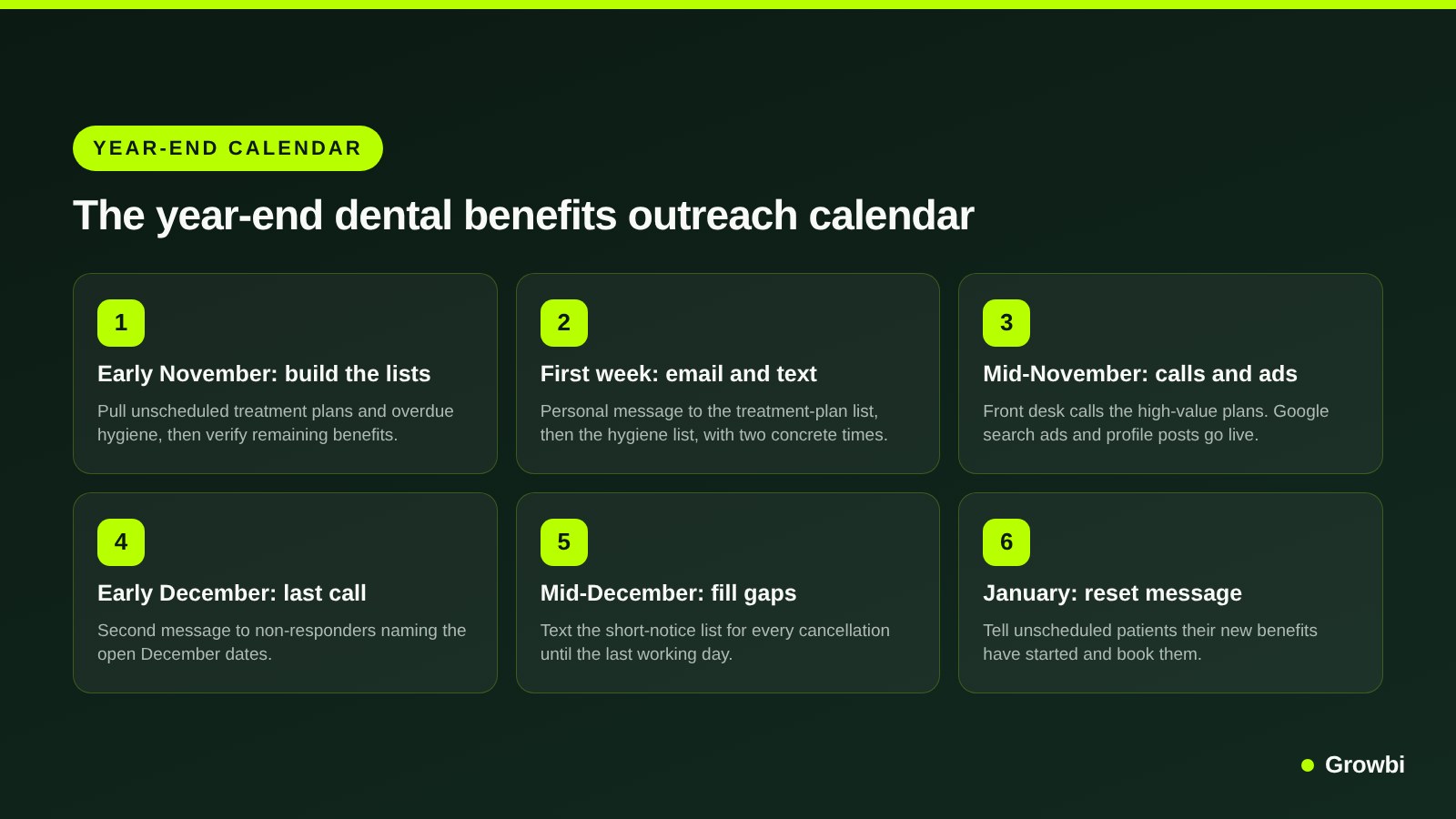
- Early November: pull the lists, verify benefits and block chair time.
- First week: email and text the treatment-plan list, then the hygiene list.
- Mid-November: call treatment-plan patients who did not reply, and launch search ads and profile posts.
- Early December: message non-responders again with the open dates left.
- Mid-December: text a short-notice list whenever a slot opens.
- January: tell everyone who did not book that new benefits have started.
What to Say in Recall Emails and Texts
Write like the office, not like an ad. The best year-end messages are short, name the reason, and offer a specific next step.
Treatment plan email or text: "Hi Maria, this is Dr. Lee's office. Dr. Lee recommended a crown on your upper left tooth in June. Many dental plans reset on January 1, so if you want to use this year's benefits, we have openings on November 18 and December 2. Reply or call to book."
Hygiene text: "Hi James, it's Riverside Dental. You are due for your cleaning and exam. If your plan year ends December 31, booking before then uses this year's coverage. Tap here to pick a time."
- Say "many plans", not "your plan", unless you have verified that patient's benefits. Then you can be specific about the amount left.
- Offer two concrete times instead of "call us to schedule".
- Mention the FSA deadline only as a reminder to check with the administrator.
- Keep each text short and include an opt-out.
Pro tip: Give the front desk one answer for "How much do I have left?" when benefits are not verified yet: "Let me check that with your plan and call you back today with the exact amount." It keeps every number your team quotes tied to a real verification.
Under HIPAA, a practice describing its own health-related services to its own patients is generally not "marketing" that needs written authorization. HHS explains this in its FAQ on describing a covered entity's own services. Texts still need the patient's consent to be texted, and treatment details belong in a secure message, not a public channel.
Send email through your practice platform with segments for each list. Our dental email marketing guide covers list hygiene, subject lines and automation that make these sends land in the inbox.
Using Google and Meta to Reach New Patients With Benefits
Existing patients come first because they are cheaper to book. Paid channels are for patients who have benefits but no dentist, or have not seen theirs in years.
- Google Search ads. Bid on searches such as "dentist accepting new patients" and send clicks to a page listing the plans you accept and December availability.
- Google Business Profile. Post about year-end appointments and set holiday hours before closures.
- Meta ads. A short deadline message to people nearby, linking to real open times.
Keep year-end campaigns separate from always-on ones so you can stop them on December 31 and judge them alone. Our dental Google Ads guide covers budget and keyword structure.
Pro tip: Set an end date of December 31 on each year-end campaign when you build it, and draft the January "new benefits" version at the same time, so no deadline ad keeps running after plans reset.
For the map listing, our Google Business Profile optimization checklist explains posts, hours and attributes.
If you are deciding where the extra budget goes, we compare the two platforms in Google Ads vs Facebook ads for dentists.
Write Meta ads about the calendar, not the viewer. Meta's privacy violations and personal attributes policy bans ads that assert or imply personal attributes, including implying knowledge of a person's financial information. "Many dental plans reset January 1, book before the holidays" is safer than "You still have unused dental benefits".
What Dental Advertising Rules Say About Mentioning Insurance
You can talk about insurance in ads and recall messages. The rules are about honesty, and the year-end rush is when practices are most tempted to bend them.
The ADA Principles of Ethics and Code of Professional Conduct, in its section on veracity, says any dentist may advertise, but not in a way that is false or misleading in any material respect. These advisory opinions matter most for a benefits campaign:
- 5.F.2, omitted facts. An ad must not leave out a fact needed to keep it from misleading, so do not imply every plan resets December 31 or that treatment will be free.
- 5.B.1, waived copays. Accepting the insurer's payment as payment in full without telling the insurer the patient's share will not be collected is overbilling.
- 5.B.4, treatment dates. Reporting incorrect treatment dates to get a patient benefits is a false representation. A crown seated on January 6 is not December care.
- 5.B.6, unnecessary services. Recommending unnecessary services is unethical, so offer only diagnosed treatment.
State dental boards have their own advertising rules, and some are stricter than the ADA Code, so check your board before running public ads that mention insurance, discounts or free services.
Keeping the Schedule Full After January 1
The reset works for you, too. Every patient who did not book in December now has a fresh annual maximum, so send the same lists a "new benefits" message in January.
Before each patient leaves in December, book their next hygiene visit in the new year. Our guide on how to get more dental patients covers the year-round channels that keep demand from depending on one deadline.
FAQs
Do unused dental benefits roll over to the next year?
Usually not. Most dental plans reset the annual maximum when the benefit year ends, often December 31, and unused dollars are lost. Some PPO plans include an annual maximum rollover that carries part of the unused amount forward. The National Association of Dental Plans reports that 42% of PPO enrollees have this feature, so check your plan document.
When do dental insurance benefits reset?
Most dental benefits reset on January 1 because the plan follows the calendar year. Some employer plans use a different plan year, for example starting July 1, and reset on that date instead. Your plan document, your employer's benefits team or the phone number on your insurance card can confirm the exact date for your plan.
Does the dental deductible reset every year?
Yes. The deductible applies once per benefit year, so it resets with the annual maximum, usually on January 1. Dental deductibles are typically small. The National Association of Dental Plans reports that only 3% of PPO enrollees have a deductible of $100 or more, so patients who already met theirs pay less for more covered care before the reset.
What happens to unused FSA money for dental work?
Health FSA money left at the end of the plan year is forfeited, unless your employer offers a grace period of up to two and a half months or a carryover, but not both. For plan years starting in 2026 the IRS allows up to $680 to carry into 2027. Most FSAs do not cover cosmetic work such as whitening or veneers.
Do HSA funds expire at the end of the year?
No. A health savings account belongs to you and the balance carries over from year to year, so there is no December deadline to spend it. You can use it for qualified dental care at any time. For 2026, the IRS limits HSA contributions to $4,400 for self-only coverage and $8,750 for family coverage.
Can a dentist advertise use it or lose it dental benefits?
Yes, as long as the message is accurate. The ADA Code of Professional Conduct allows advertising that is not false or misleading in any material respect. Practices should not imply every plan resets on December 31, promise free treatment, waive copays without telling the insurer, or date treatment in December when it happens in January. State dental boards may add rules.
Conclusion
Use it or lose it dental benefits are a predictable, once-a-year chance to fill November and December with care patients already need. Most plans reset on December 31, few patients reach their annual maximum, and FSA balances add a second deadline for some of them.
Start with patients who have diagnosed treatment, verify benefits before you promise anything, and keep every message and ad accurate under the ADA Code and Meta's rules. Then turn the January reset into the next campaign.
If you want help building the lists, messages and ads for your practice before the window closes, book a free 15-minute call and we will map it out with you.
Get this system built for your business
Book a strategy call and we will model a realistic appointment target from your budget, market, and offer.
Keep reading

Dental Patient Retention: How to Keep Patients Coming Back on Recall

Dental Email Marketing: Recall, Reactivation and Treatment Follow-Up
Dental Google Ads: How to Run Campaigns That Book Patients
How to Get More Dental Patients: A Channel-by-Channel Breakdown
Google Business Profile Optimization: The Dental Practice Checklist