Real Estate Facebook Ads: What Works Under Meta's Housing Rules
 Mor RomanoCTO, Growbi11 min read
Key Takeaways
- Housing ads in the US must declare the Housing special ad category, required since December 2019.
- Locations must cover at least a 15-mile radius, ZIP codes and exclusions are not allowed, and lookalikes are unavailable.
- Ad copy must follow the Fair Housing Act too, so describe the property, never the ideal buyer.
- With targeting limited, the offer, the creative, your own contact lists and a 5-minute follow-up decide results.
Real estate Facebook ads must run in Meta's Housing special ad category in the US. That means no ZIP code, age or gender targeting, a minimum 15-mile radius, no lookalikes and no exclusions. Ads still work, but performance now comes from the offer, the creative, first-party custom audiences and fast follow-up rather than from narrow targeting.
Table of Contents
Most real estate Facebook ad advice online still tells agents to target first-time buyers aged 25 to 35 in three ZIP codes. None of that has been possible for years. Meta's Housing category removed those options, and agents who keep chasing them end up with rejected ads or campaigns that spend without producing appointments.
The agents getting results have adapted. They accept that targeting is broad, and they win on what is left: a sharp offer, creative that makes the right person stop, their own contact lists and a phone call within minutes. Here is exactly what the rules allow in 2026 and how to build around them.
Why Real Estate Facebook Ads Have Special Rules
Because housing is protected by the Fair Housing Act, and ad targeting can exclude people by protected characteristics without anyone intending it. Meta introduced special ad categories for housing, employment and credit in the US in 2019.
In 2022 the US Department of Justice and Meta reached a settlement under the Fair Housing Act, the department's first case challenging algorithmic bias under that law.
Meta agreed to stop using its Special Ad Audience tool for housing ads and to build a Variance Reduction System that adjusts delivery so the people who see a housing ad better reflect the eligible audience. Meta denied liability as part of the settlement.
The Targeting Allowed in Meta's Housing Category
Less than most agents expect, and the list is short enough to memorize.
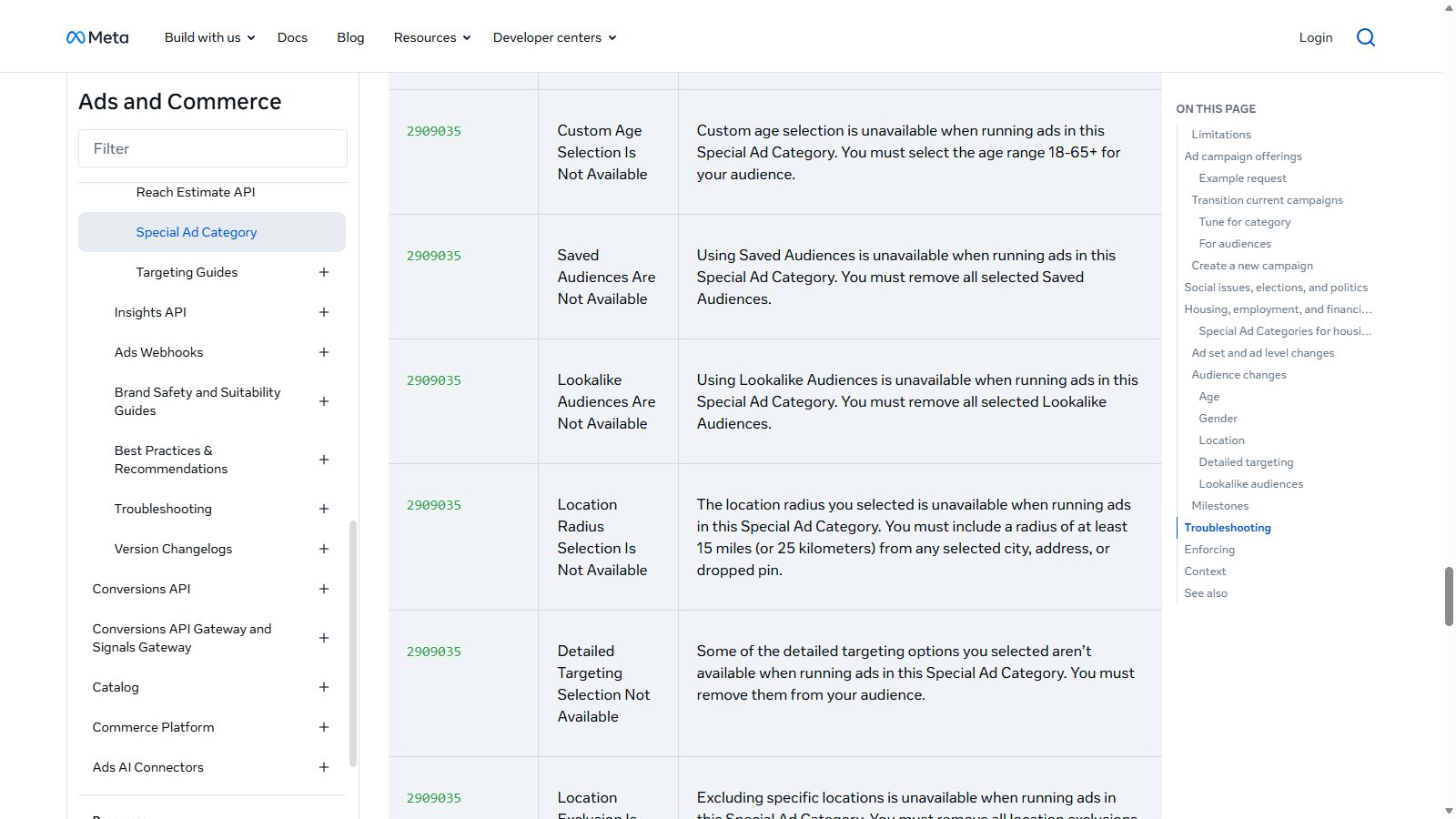
Meta's Special Ad Categories documentation lists the restrictions for Housing ads, which have been required for US advertisers and US audiences since December 4, 2019.
- Age. Allowed in Housing?: No narrowing; Detail: Generally fixed to 18 to 65+
- Gender. Allowed in Housing?: No; Detail: All genders
- ZIP codes. Allowed in Housing?: No; Detail: The ZIP location type is not supported
- Location radius. Allowed in Housing?: Yes, with a minimum; Detail: At least 15 miles around any city, address or pin in the US and Canada
- Location exclusions. Allowed in Housing?: No; Detail: Cannot exclude areas
- Detailed targeting. Allowed in Housing?: Limited; Detail: No behaviors or demographics; interests only from an approved list
- Targeting exclusions. Allowed in Housing?: No; Detail: No interest or detailed targeting exclusions
- Lookalike audiences. Allowed in Housing?: No; Detail: Unavailable in Housing
- Custom audiences. Allowed in Housing?: Yes; Detail: Allowed; customer lists must be eligible for special ad category campaigns
Declare Housing even when you are not sure. Listing ads, open house ads, home valuation ads and most agent brand ads promote housing opportunities. Declaring the category up front is far better than having ads rejected or an account restricted for running housing ads without it.
Why Real Estate Facebook Ads Still Work With These Limits
They do, but the job of the ad has changed. When you cannot pick the audience, the creative picks it for you. A video walkthrough of a $750,000 home in a specific town will stop the people interested in that kind of home, and scroll past almost everyone else.
That shifts effort away from audience settings and toward four things you fully control. In the accounts we run for agents, these decide whether a campaign books appointments or just collects form fills.
- The offer: a reason to raise a hand today, such as a home value report, a private list of new listings or a buyer consultation.
- The creative: real homes, real neighborhoods and the agent on camera, rather than stock photos of keys and handshakes.
- Your own data: custom audiences from your past clients, website visitors and video viewers.
- The follow-up: a call within minutes, because a Facebook lead forgets they filled in the form surprisingly quickly.
The Real Estate Ad Types That Produce the Best Leads
Different offers attract people at different moments. Run at least two so you are not dependent on one type of lead.
- Home valuation offer. Who raises a hand: Owners curious about selling; Lead quality: Mixed; many are early; Best follow-up: Deliver the value report fast, then a call
- Just listed video tour. Who raises a hand: Active buyers in that price range; Lead quality: High for that property; Best follow-up: Call to book a showing
- New listings alert. Who raises a hand: Buyers starting their search; Lead quality: Medium, longer cycle; Best follow-up: Text sequence and weekly listings
- Open house promotion. Who raises a hand: Local buyers and curious neighbors; Lead quality: Medium; Best follow-up: Sign-in follow-up the same day
- Just sold story. Who raises a hand: Neighbors thinking about selling; Lead quality: Medium to high; Best follow-up: Offer a valuation of their home
- Agent intro video. Who raises a hand: People choosing an agent; Lead quality: Builds trust for retargeting; Best follow-up: Retarget viewers with an offer
For creative ideas that follow these formats, our collection of real estate ad examples shows what strong listing and seller ads look like.
How to Build a Real Estate Facebook Ad Campaign Step by Step
Set up tracking and follow-up before the first dollar is spent.
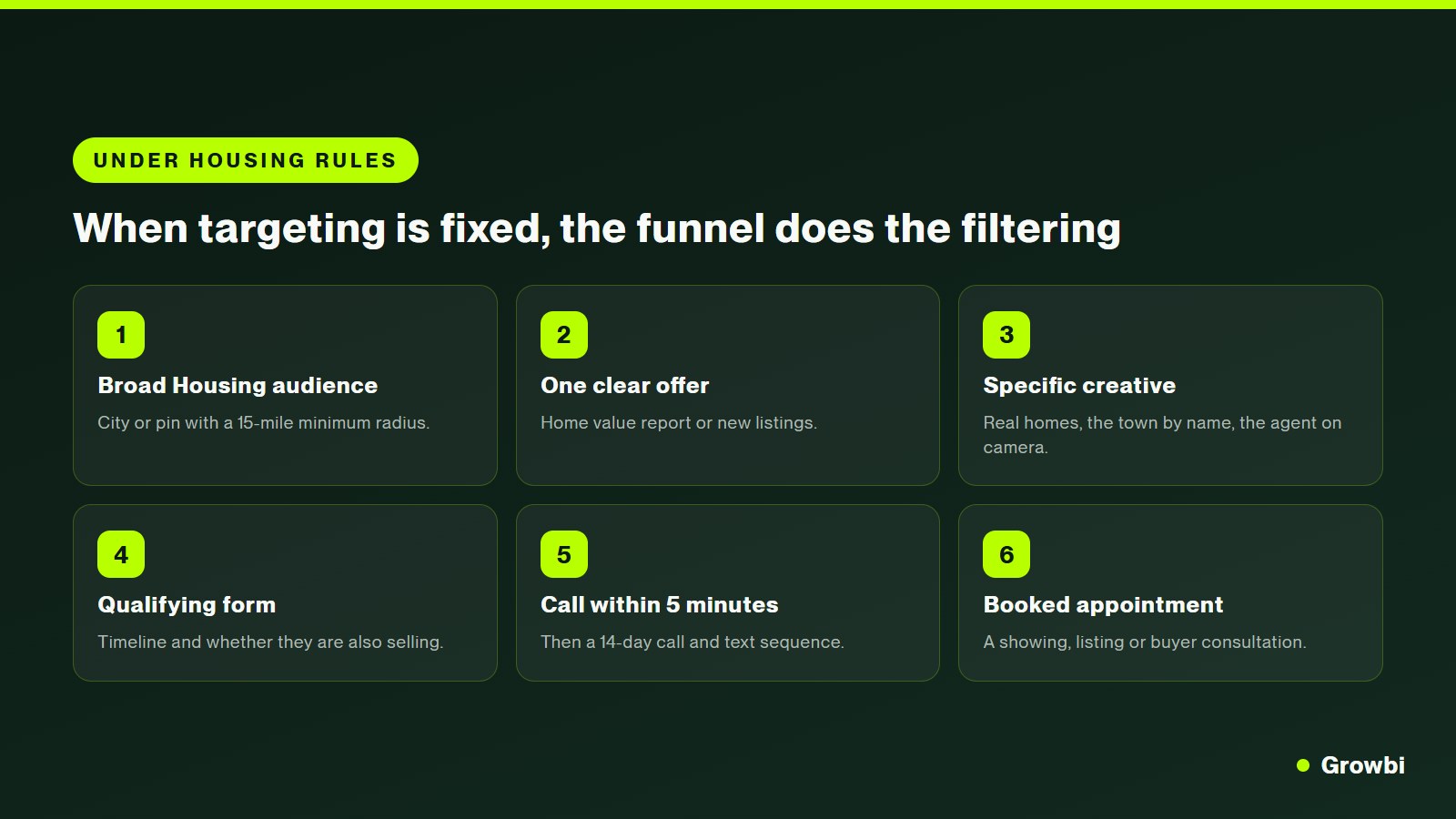
- Declare the Housing special ad category. Select Housing at campaign level for any ad about listings, home sales, rentals, valuations or agent services.
- Set location by city or pin with a 15-mile radius. Center the radius on the market you serve. Accept that it will be wider than your farm area and let the creative do the filtering.
- Upload your own audiences. Past clients, your sphere and website visitors as custom audiences, checked for eligibility in special ad category campaigns.
- Pick one offer per campaign. Home valuation for sellers or new listings for buyers. Mixing them confuses both the people and the algorithm.
- Make creative that names the place and the price range. Real homes, the neighborhood by name and you on camera. Specific creative attracts specific people.
- Ask two qualifying questions in the form. Timeline and whether they are also selling or need financing. It filters casual browsers and gives your call an opening.
- Call every lead within 5 minutes. Then follow a 14-day call and text sequence for anyone you cannot reach, and move the rest into a monthly listings email.
Why Video Matters More Than Ever for Real Estate Ads
Because video is now your targeting. With age, ZIP and lookalikes gone, the first three seconds of a reel decide who keeps watching, and Meta's delivery learns from the people who watch.
- Open on the hook, not the logo. The kitchen, the view or the price range in the first frame.
- Name the place on screen. A town or neighborhood name filters viewers better than any setting you can no longer use.
- Put the agent on camera. People hire a person. A 20-second walk-and-talk builds more trust than a polished slideshow.
- Shoot vertically for Reels and Stories, with captions, since most people watch with the sound off.
- Retarget viewers. People who watched most of a video are a custom audience you can show your offer to next.
Instagram is where much of this video gets watched, and the creative skills carry across both apps. Our guide to finding Instagram marketing services that deliver covers what good video production and posting look like.
How to Measure Whether Real Estate Facebook Ads Are Working
Cost per lead is the number Ads Manager shows first, and the least useful one for an agent. A $9 home valuation lead who never answers costs more than a $40 buyer lead who books a showing.
- Cost per lead. What it tells you: How efficiently the ad gets a hand raised; Where to track it: Ads Manager
- Contact rate. What it tells you: Whether follow-up is fast enough; Where to track it: CRM call and text log
- Cost per appointment. What it tells you: Whether leads are real buyers or sellers; Where to track it: CRM with lead source
- Appointments to signed clients. What it tells you: Lead quality by offer; Where to track it: CRM pipeline
- Closings and commission per ad dollar. What it tells you: The only number that pays; Where to track it: CRM and transaction records
Real estate cycles are long, so judge each offer over months, not days. A home valuation campaign may look weak in the first month and produce listings in the sixth. The Growbi System keeps the original ad source on every contact so those late closings are credited to the campaign that started them.
What You Can Say in a Real Estate Ad Under Fair Housing Rules
Meta's rules cover who sees the ad. The Fair Housing Act also covers what the ad says, and that applies on every platform. Describe the property and its features, not the kind of person who should live there.
HUD's regulation on discriminatory advertisements prohibits ads that indicate a preference, limitation or discrimination based on a protected characteristic, including words, phrases and the choice of models.
- 3 bedrooms, fenced yard, near two parks. Riskier wording: Perfect for a young family
- Single-level home, no stairs. Riskier wording: Ideal for retirees
- Walking distance to the train station. Riskier wording: Great for young professionals
- Quiet street with mature trees. Riskier wording: Exclusive neighborhood
- 10 minutes from three schools. Riskier wording: Near the best church in town
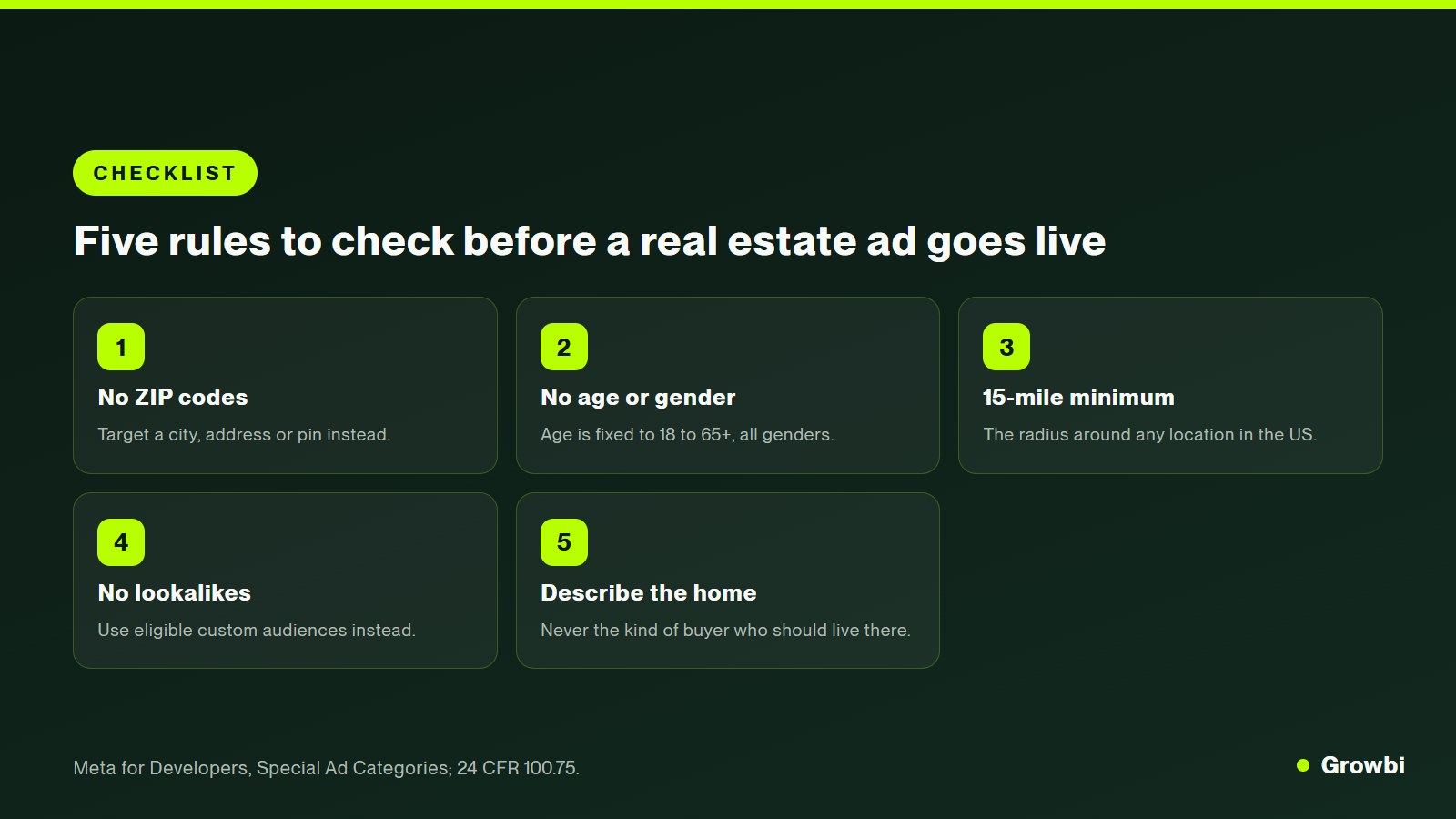
Source: Meta for Developers, Special Ad Categories; 24 CFR 100.75
This is general information, not legal advice. Your brokerage likely has advertising guidelines, and your broker or attorney should review templates you plan to reuse.
How to Follow Up on Facebook Real Estate Leads
Fast, and more than once. Facebook leads often come from people who tapped a form while scrolling, so the window to reach them while they remember is short.
- Text within one minute with your name, the property or offer they asked about and a note that you will call shortly.
- Call within 5 minutes, and call again a minute later if there is no answer.
- Deliver what you promised first. If they asked for a home value, send it, then ask about their plans.
- Book a specific next step: a showing, a listing consultation or a buyer meeting, with a time on the call.
- Keep everyone else warm with new listings and market updates for months, because many real estate leads move later.
The research on response time is consistent across industries. Our speed to lead guide covers the studies and the exact call and text cadence.
The Mistakes That Get Real Estate Ads Rejected or Wasted
- Skipping the Housing declaration, which risks rejected ads and account restrictions.
- Trying to rebuild narrow targeting with tricks such as tiny custom audiences or interest stacks, instead of letting creative filter.
- Describing people instead of homes in copy, images or video.
- Sending every lead to a CRM and waiting, instead of calling within minutes.
- Judging campaigns on cost per lead rather than appointments, signed listings and closings.
If you are deciding whether to run this yourself or hire help, our guide to the best real estate lead generation agency compares the main options.
Before any agency call, read the questions to ask a real estate marketing agency, so you know who owns the ad account, the data and the leads.
FAQs
Do real estate ads on Facebook have to use the Housing category?
Yes, in the United States. Meta requires advertisers to declare the Housing special ad category for ads about housing opportunities, including listings, rentals, home sales and related services. The requirement has applied to US advertisers and US audiences since December 4, 2019, and to Canada and Europe from later dates.
Can I target ZIP codes with real estate Facebook ads?
No. Meta's Housing category does not support ZIP code targeting. You can target a city, an address or a dropped pin, but the location must include at least a 15-mile radius in the US and Canada. Location exclusions are also not supported, so you cannot carve areas out of that radius.
Can I use lookalike audiences for real estate ads?
No. Lookalike audiences are unavailable in Meta's Housing category, and Meta agreed in its 2022 settlement with the Department of Justice to stop using its Special Ad Audience tool for housing ads. Custom audiences built from your own data, such as past clients and website visitors, are still allowed if they are eligible.
What is the best Facebook ad for real estate agents?
There is no single best ad, but two offers consistently produce leads: a home valuation offer for owners thinking about selling and a video tour of a specific listing for active buyers. Pair each with real local footage, the agent on camera, a short qualifying form and a phone call within five minutes.
Conclusion
Real estate Facebook ads did not stop working when Meta introduced the Housing category. They stopped working the old way. ZIP codes, age brackets and lookalikes are gone, and the 15-mile radius is the floor.
What remains is fully in your control: one clear offer, creative that names the place and the price range, your own client lists and a phone call within five minutes. Keep the copy about the home, never about the buyer, and the campaigns stay compliant as well as effective.
If you want your real estate campaigns judged on appointments instead of leads, book a free strategy call and we will review them with you.
Get this system built for your business
Book a strategy call and we will model a realistic appointment target from your budget, market, and offer.
Keep reading

Real Estate Ads That Book Seller and Buyer Appointments: 10 Examples and Templates

The 'Best' Real Estate Lead Generation Agency: A Myth Debunked by Cost per Closing

Beyond Leads: Smart Questions to Ask a Real Estate Marketing Agency Before You Sign

Speed to Lead: Why the First 5 Minutes Decide Who Books