Real Estate Ads That Book Seller and Buyer Appointments: 10 Examples and Templates
 Mor RomanoCTO, Growbi12 min read
The short answer
Real estate ads that produce appointments pair one specific offer, such as a home valuation, a private showing or a buyer consult, with a local hook and a short booking step. On Facebook and Instagram they run under the Housing special ad category, so the creative has to find the right people because narrow targeting is off the table.
On this page
Search for real estate ads and you get galleries: glossy kitchens, drone shots, "Just Listed" banners. They look good in a portfolio.
Most of them would struggle in an ad account, because a pretty listing photo with "Call me today" gives a seller no reason to act this week and gives a buyer nothing to book.
This guide is the working version. Ten real estate ad examples, each written as a template with the goal, the hook, the copy and the next step.
Before the examples, two sets of rules that most inspiration lists skip and that decide how you reach your target audience in every agent ad you run: Meta's Housing special ad category and the Fair Housing Act's advertising clause.
After the examples, how to build the ad step by step and how to tell which ones are worth the ad spend.
What makes a real estate ad produce appointments instead of likes?
Every real estate ad that books meetings has the same four parts. Strip one out and the ad still collects clicks, but the calendar stays empty.
- A local signal in the first line or the first 2 seconds of video. The neighborhood name, a street everyone knows, a price band that fits the area. This replaces the narrow targeting you are not allowed to use.
- One offer with a clear payoff. "See what your home would sell for at this month's prices" beats "Thinking of selling?" because it promises something specific in exchange for contact information.
- Proof that fits the offer. A recent sale on the same street, a short clip of you walking a comparable home, a review from a seller in the area. Generic awards do little.
- A booking step, not a homepage. A landing page with one form and a calendar, or a Meta instant form that ends in a scheduled call. Every extra click between the ad and the appointment loses people.
Visually appealing creative matters, but it is the cost of entry. Real estate marketing that works treats the photo or the short video as the hook and puts the effort into the offer and the next step.
That is the difference between ads that capture attention for 3 seconds and ads that turn a scroller into a listing appointment.
What Meta's Housing special ad category means for real estate ads
Any ad on Facebook or Instagram that promotes a home for sale or rent, a home valuation, or real estate services has to be declared under the Housing special ad category.
According to Jon Loomer's guide to Meta special ad categories, that declaration changes targeting in five ways (the guide was last updated in March 2025, so confirm against Meta's current rules when you set up the campaign):
- Location targeting must include all areas within a 15-mile radius of any location.
- No targeting by ZIP code.
- Age is fixed to 18 to 65+.
- Gender is fixed to all genders.
- Lookalike audiences are unavailable.
- Some detailed targeting options disappear, and you cannot exclude detailed targeting.
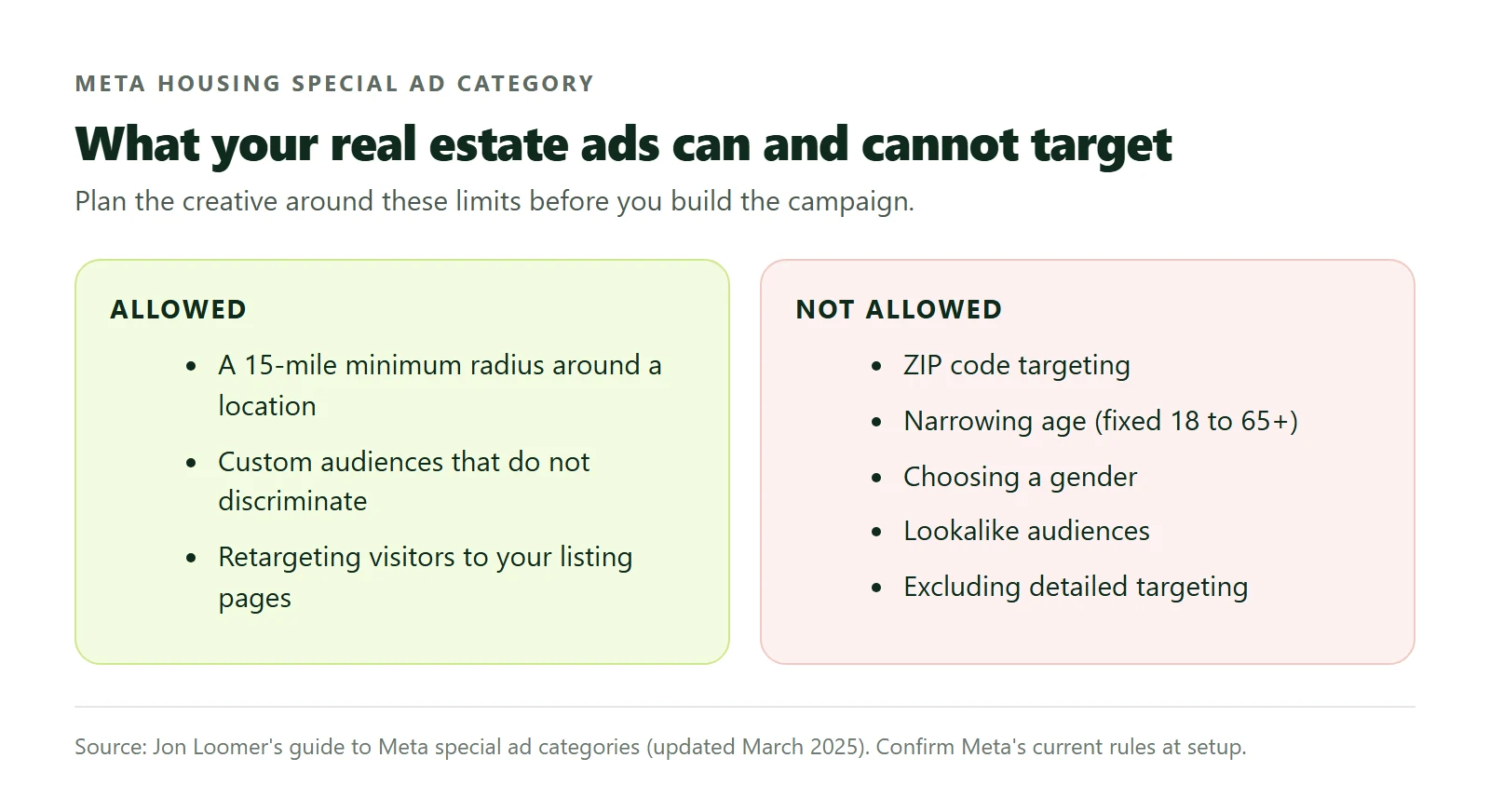
Some detailed targeting options disappear and you cannot exclude detailed targeting.
Skip the declaration and the ad gets rejected, or the account gets flagged. So plan every real estate ad as if the audience is everyone within 15 miles of a point on the map.
| What you might plan | Allowed under Housing? | What to do instead |
|---|---|---|
| Target 2 or 3 ZIP codes around a listing | No | Pick the area's center point, accept the 15-mile radius, name the neighborhood in the first line |
| Reach homeowners aged 45 to 65 for seller ads | No, age is 18 to 65+ | Write a hook only an owner cares about: equity, a recent sale nearby, a move-up timeline |
| Lookalike of past clients | No | Use your past-client list as a custom audience, checked so it does not discriminate |
| Exclude renters or first-time buyers | No exclusions in detailed targeting | Let the offer filter: a valuation ad attracts owners, a down-payment guide attracts buyers |
| Retarget people who visited a listing page | Yes, with custom audiences | Show the next step: book a private showing or get the full disclosure pack |
What words are not allowed in real estate advertising?
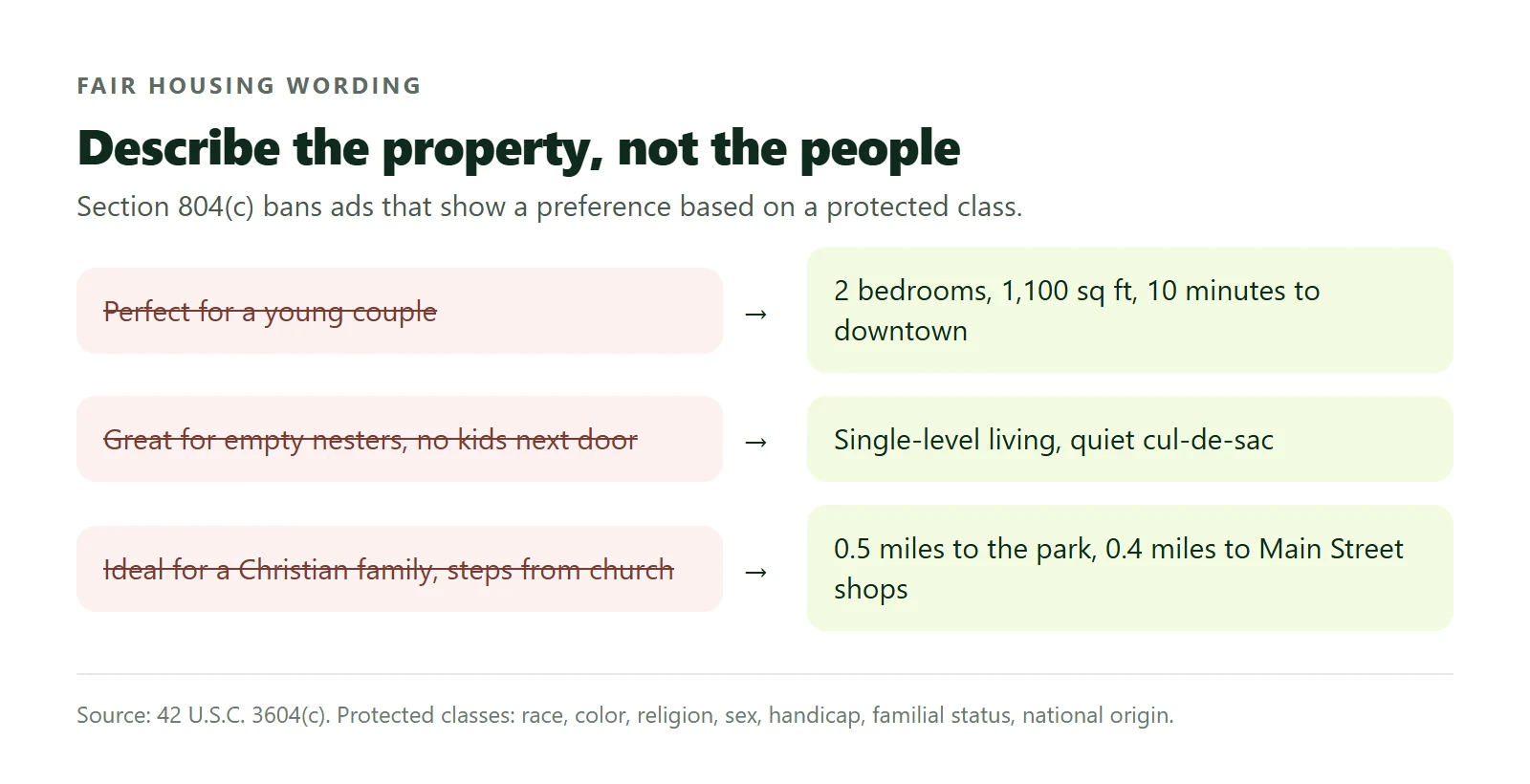
Section 804(c) of the Fair Housing Act, codified at 42 U.S.C. 3604(c), makes it unlawful to publish any advertisement for the sale or rental of a dwelling that indicates a preference, limitation, or discrimination based on race, color, religion, sex, handicap, familial status, or national origin.
It applies to anyone who makes, prints or publishes the ad, including the agent who writes it.
The working rule is short: describe the property and the location, never the people you want living in it. HUD's 1995 guidance on advertising, summarized by Oregon REALTORS, treats physical descriptions such as "master bedroom" and "mother-in-law suite" and location facts such as "walking distance to bus stop" as acceptable.
The Houston Association of REALTORS began encouraging members to use "primary bedroom" in its MLS around June 2020, and that is the safer default today.
| Instead of | Why it is a problem | Write |
|---|---|---|
| Perfect for a young couple | Familial status and age signals | 2 bedrooms, 1,100 sq ft, 10 minutes to downtown |
| Great for empty nesters, no kids next door | Familial status | Single-level living, quiet cul-de-sac |
| Ideal for a Christian family, steps from church | Religion | 0.5 miles to the park, 0.4 miles to Main Street shops |
| Not suitable for wheelchairs | Handicap | 3 steps to the entrance, all bedrooms upstairs |
| Perfect for a single professional | Familial status | Open-plan loft with a home office nook |
Two traps show up in ad accounts more than in listing copy. The first is the image: a stock photo of one type of family on every buyer ad sends the same signal as words would. Rotate real photos of the home and the area.
The second is AI-written copy, which drifts into lifestyle language about who the home suits. Read every line with the seven protected classes in mind before it goes live.
10 real estate ad examples by goal
These are templates written for this guide, not screenshots of other agents' campaigns. Swap in your neighborhood, numbers and proof. Each one has a single goal and ends in a booking step.
1. The home valuation ad (seller leads)
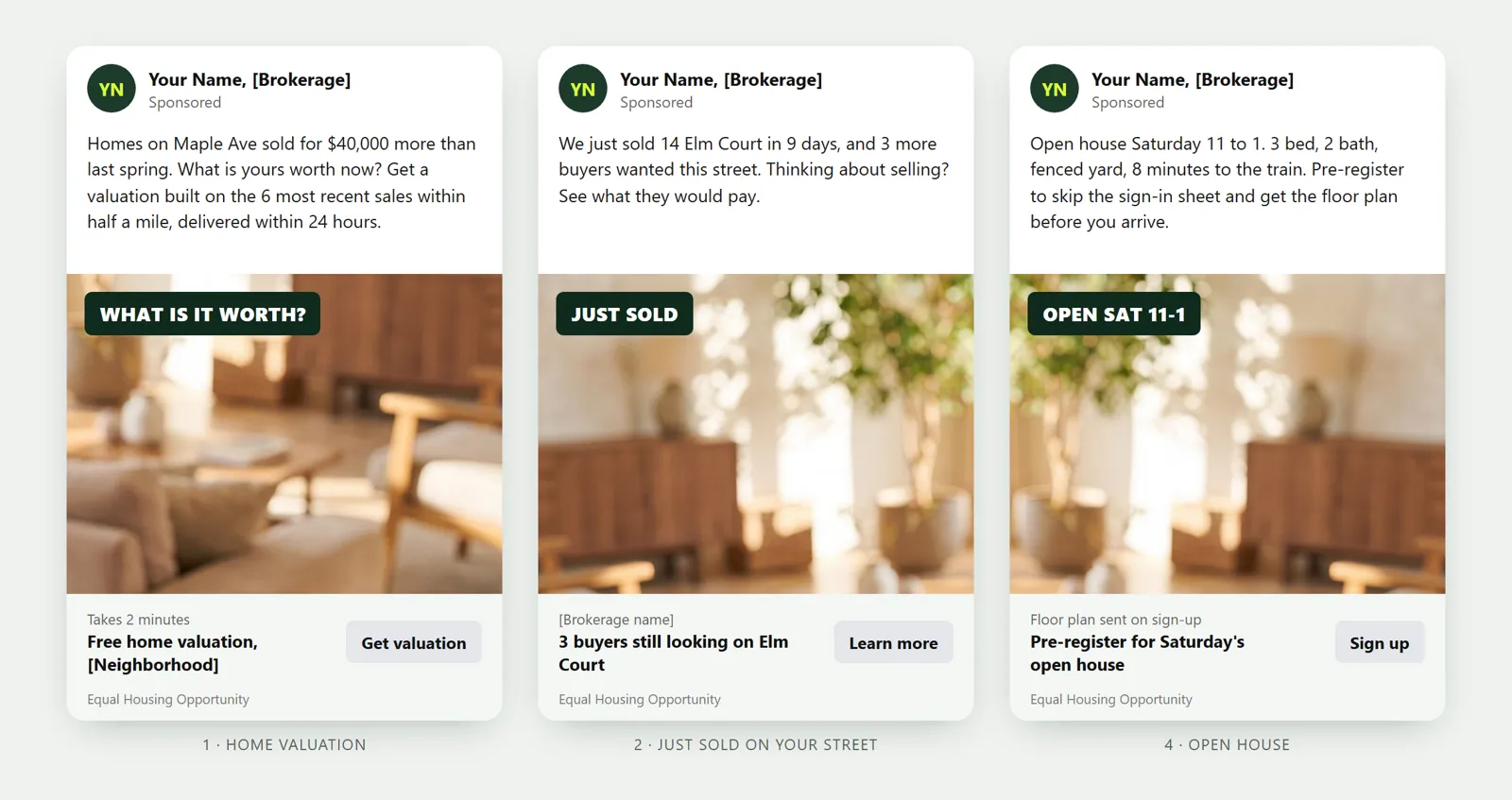
Goal: listing appointments. Hook: "Homes on [Street] sold for $40,000 more than last spring. What is yours worth now?" Copy: "Get a valuation built on the 6 most recent sales within half a mile of your home, not an online estimate.
Takes 2 minutes to request, delivered within 24 hours." Next step: a short form (address, timeline, phone), then a calendar to book a 15-minute call to walk through the number. Why it works: it trades something the owner actually wants for contact information, and the timeline question tells you who is moving this year.
2. The "just sold on your street" ad
Goal: seller leads near a fresh sale. Hook: a 10-second clip outside the sold home. Copy: "We just sold 14 Elm Court in 9 days. We had 3 more buyers who wanted this street.
If you have thought about selling, see what they would pay." Next step: the same valuation form as example 1. Why it works: the proof is local and current, and the unmatched buyers give the owner a reason to talk now.
Run it as a retargeting and broad-area ad for 2 to 3 weeks after each closing, then retire it.
3. The market update short video
Goal: warm audience for later seller ads. Hook: "3 numbers every [Neighborhood] homeowner should know this month." Copy: median sale price, days on market and active listings, read out in under 45 seconds, from your own MLS pull. Next step: "Want these numbers for your exact street?
Book a 15-minute call." Why it works: people who watch most of a 45-second market video are a better retargeting pool than anyone a cold valuation ad reaches, and the Housing rules allow retargeting through custom audiences.
4. The open house ad
Goal: sign-ins that become buyer consults. Hook: the strongest room, shot vertically, with the date on screen. Copy: "Open house Saturday 11 to 1. 3 bed, 2 bath, fenced yard, 8 minutes to the train.
Pre-register to skip the sign-in sheet and get the floor plan before you arrive." Next step: pre-registration form that asks if they need to sell first. Why it works: pre-registration turns anonymous open houses into named contacts, and the sell-first question finds the double-sided deals.
5. The listing walkthrough or virtual tour ad
Goal: private showing requests on one listing. Hook: open on the feature buyers search for in that price band, not on the front door. Copy: "Walk the whole home in 60 seconds.
If it fits, book a private showing this week, slots open Tuesday to Sunday." Next step: a showing request with 3 time options. Why it works: a short video or virtual tour pre-qualifies on layout and finish, so the showings you book are with people who already like the home.
Keep the property listings ad specific to one home; carousel ads with 10 listings rarely book anything.
6. The luxury properties private preview
Goal: high-intent buyers for a listing over your market's median. Hook: "Before it hits the portals." Copy: "A private preview of a 5-bedroom home on 2 acres, 20 minutes from the city.
Full film and disclosure pack on request." Next step: a request form that books a 20-minute call before any showing. Why it works: luxury properties sell on access and discretion. Asking for the call first filters out the curious and gives the seller's agent a qualified list.
7. The first-time buyer consult
Goal: buyer consultations. Hook: "What your budget buys in [City] right now." Copy: "A 20-minute call with a local agent and a lender: your real budget, the 3 neighborhoods that fit it, and what to offer in this market." Next step: calendar booking with two qualifying questions, timeline and pre-approval status.
Why it works: it answers the question first-time buyers are stuck on, and the qualifying questions protect your calendar.
Keep payment amounts out of the ad itself: stating a monthly payment is a Truth in Lending trigger term that requires the lender's down payment, terms and APR disclosures, so leave the numbers for the call.
8. The relocation guide
Goal: out-of-area buyers months before they move. Hook: "Moving to [City] in the next 6 months?" Copy: "A 12-page guide to the 5 neighborhoods relocating buyers ask us about, with commute times, price ranges and school district links." Next step: download, then a 2-email sequence that offers a video call.
Why it works: relocation buyers start researching long before they search for an agent.
Describe neighborhoods by commute, price and amenities, never by who lives there.
9. The Google search ad for sellers
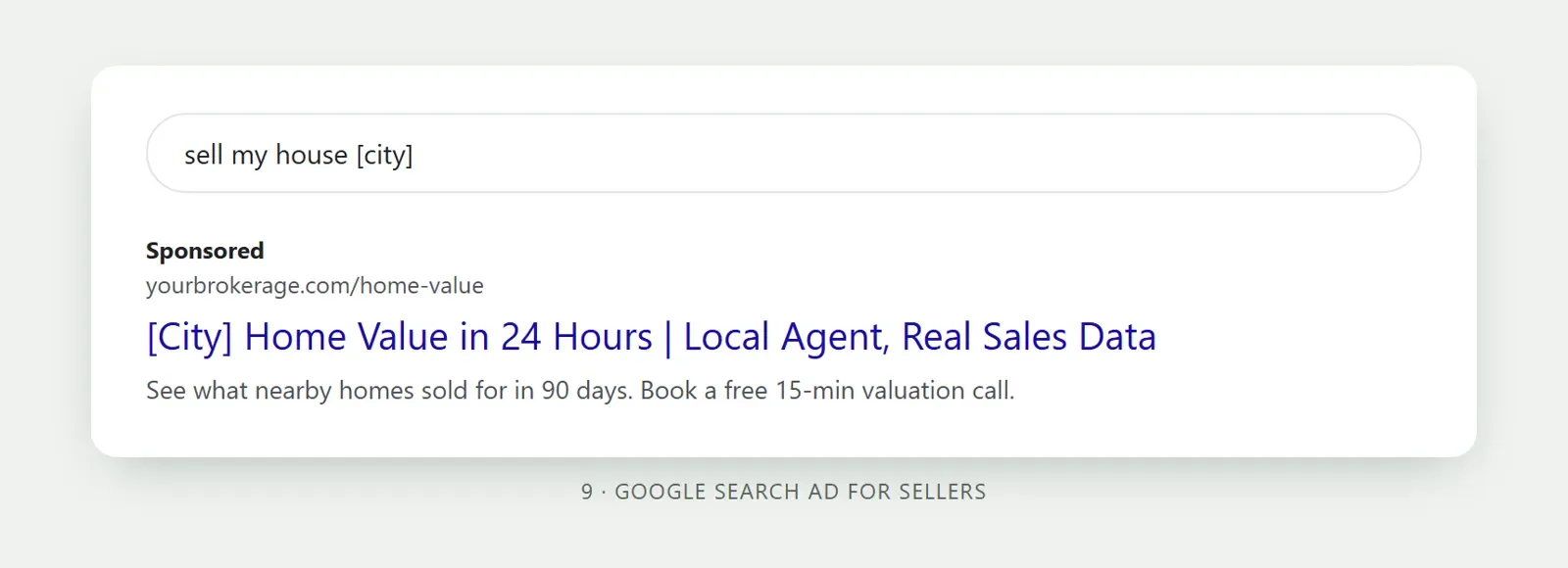
Goal: sellers already searching. Keywords: "sell my house [city]", "home value [neighborhood]", "realtor near me". Headlines: "[City] Home Value in 24 Hours" and "Local Agent, Real Sales Data", each inside Google's 30-character limit. Description: "See what nearby homes sold for in 90 days. Book a free 15-min valuation call." (77 characters, under the 90 limit).
For city names longer than 5 letters, use "Home Value in 24 Hours" alone to stay inside 30 Next step: the same valuation landing page. Why it works: search catches intent that social has to create, and the landing page is shared, so you compare channels on the same booking rate.
Google restricts housing ad targeting in the US as well, so check which audience options its housing policy leaves you before building the campaign.
10. The retargeting ad for unfinished forms
Goal: recover people who started a valuation and left. Audience: visitors to the valuation page in the last 14 days who did not submit. Copy: "Your valuation is one step away.
Here are the 3 recent sales we will base it on." Next step: back to the form, prefilled where the platform allows. Why it works: in the seller campaigns we run, this tends to be the cheapest appointment, because the person already told you they are curious about selling.
How to create ads for real estate, step by step
Use this order every time. When we audit agent ad accounts, the wasted ad spend usually traces back to starting with the creative.
Pick one goal
Listing appointments, buyer consults or showings for one property. One campaign per goal, so the numbers stay readable.
Write the offer before the ad
A valuation, a private preview, a buyer consult. If you cannot say what the person gets in 10 words, the ad will not book anything.
Build the booking step
A landing page with one form, the contact information you need and nothing more, and a calendar for a 15-minute call. Test it on your phone before launch.
Shoot the hook
A short video of 15 to 45 seconds on location, or one strong photo with the neighborhood name in the first line. Make 3 versions of the first 2 seconds.
Set up the campaign under Housing
Declare the special ad category, set the center point and accept the 15-mile radius, and start with a budget you can hold for 30 days.
Measure on booked appointments
After 2 weeks, compare ads on cost per booked appointment and show rate, not cost per lead. Cut the bottom third, write 3 new hooks for the winner.
If you want the booking side of this done for you, our real estate marketing services build the offer, the ads and the booking flow as one system and report on appointments, not leads.
What must a real estate ad include?
- Your brokerage name, as your state's licensing rules require. Most states have advertising rules for licensees; check yours before the first ad goes live.
- A truthful price or no price. "From $499,000" only if a home in the ad sells at that number.
- The offer and the next step, in plain words: "Book a 15-minute valuation call."
- A location cue that a local recognizes, written as geography, never as a description of residents.
- The Equal Housing Opportunity logo or statement, which many brokerages add to every ad and landing page as standard practice.
- The Housing special ad category declaration on every Facebook and Instagram campaign that promotes homes or real estate services.
How much ad spend to start with, and what to measure
There is no universal number, so here is how we set a starting point. Take the one goal you picked, decide how many appointments a month would make it worth running, and fund the campaign for 30 days at a level that buys enough clicks to learn from.
For a single-agent seller campaign we would usually start between $30 and $50 a day on the valuation ad, with a smaller retargeting budget beside it, then move money toward whichever ad books appointments at the lowest cost. Treat those figures as a starting rule of thumb, not a benchmark.
| Metric | What it tells you | Warning sign |
|---|---|---|
| Cost per lead | How cheaply the ad collects names | Low cost per lead with almost no booked calls: the offer attracts browsers |
| Booking rate | Share of leads who book the call | Under a third: the form or follow-up is too slow or asks too little |
| Show rate | Share of booked calls that happen | Many no-shows: add a reminder and a confirmation text |
| Cost per booked appointment | Ad spend divided by appointments held | The number to compare ads and channels on |
We wrote a full method for this in how to track cost per booked appointment. The short version: tag every lead with the ad it came from, record when it books and when it shows, and divide spend by appointments held. That one number tells you more than any engagement report.
Do direct mail and open houses still belong in the plan?
Yes, when they point to the same offer. A "just sold" postcard to the 200 homes around a closing, with a QR code to the same valuation page as your social media ads, gives you one funnel and one set of numbers.
The same goes for open houses: pre-registration from the ad, a sign-in that asks about timeline, and a follow-up that books the consult within 48 hours. Direct mail and open houses work best as two more doors into the same booking step.
A marketing strategy for a real estate business does not need 20 ad formats. It needs 2 or 3 of the templates above, running under the right category, with copy that passes a Fair Housing read and a booking step that turns interest into a meeting.
If you are comparing partners to run that for you, start with the questions to ask a real estate marketing agency and why lead volume is the wrong way to judge one.
Frequently asked questions
What are some effective ads for real estate agents?
The ones with one offer and a booking step: a home valuation ad for sellers, a "just sold on your street" ad after each closing, an open house ad with pre-registration, a short listing walkthrough that books private showings, and a retargeting ad for people who started a valuation form and left.
How do you create ads for real estate?
Pick one goal, write the offer, build a landing page with one form and a calendar, shoot a short local hook, set the campaign up under Meta's Housing special ad category, and after 2 weeks keep the ads with the lowest cost per booked appointment.
What words are not allowed in real estate advertising?
Any wording that shows a preference based on race, color, religion, sex, handicap, familial status or national origin, such as "perfect for a young couple", "no kids" or "ideal for a Christian family". Describe the property and its location instead of the people you want living there.
Can real estate ads on Facebook target a ZIP code?
No. Under the Housing special ad category, location targeting includes everything within a 15-mile radius of the point you choose, ZIP code targeting is unavailable, age is fixed to 18 to 65+ and gender to all. Put the neighborhood in the ad copy instead.
How much should an agent spend on real estate ads?
Enough to run one campaign for 30 days and learn which ad books appointments. For a single-agent seller campaign we would start around $30 to $50 a day plus a small retargeting budget, then shift spend to the ad with the lowest cost per booked appointment.
Want this built for your clinic?
Book a strategy call and we will model a realistic appointment target from your budget, market, and offer.