How Much Do Google Ads Cost for a Local Business in 2026?

Key Takeaways
- The 2026 median cost per click is $5.42 across industries, $8.33 for home services and $8.00 for dentists, per WordStream by LocaliQ.
- High-intent local terms cost far more than the averages: Google's top-of-page bids for "emergency plumber" run from about $24 to $110.
- Set your budget from leads, not clicks: target leads per month times your expected cost per lead, then judge it on cost per booked job.
- Local Services Ads charge per lead, about $63 for home services in September 2026, and work best next to a Search campaign.
- Management usually adds a flat fee, a percentage of spend, or both, so budget for fees and tracking on top of ad spend.
Google Ads cost $5.42 per click on average in 2026, and $8.00 to $8.33 for dentists and home services, per WordStream by LocaliQ. A first budget that buys 30 leads a month runs about $1,200 to $2,700 in ad spend for most local service businesses, before management. Judge it on cost per booked job.
There is no price list for Google Ads. You set the budget, you bid in an auction for every search, and the price of a click moves with your trade, your city, the season and how good your ads are.
That is why most answers to this question stop at "it depends." This guide gives you the numbers instead: 2026 click and lead costs for the industries we work with, what high-intent local keywords cost, realistic monthly budgets, what management adds, and how to set a first budget you can actually judge.
One rule runs through all of it. A cheap click is worth nothing if it never becomes a booked job, so we work backward from the job, not forward from the click.
Google Ads Cost per Click by Industry in 2026
The most useful public benchmark is the annual report from WordStream and LocaliQ. It covers 13,474 US search campaigns that ran between April 2025 and March 2026, and its averages are medians, so a few extreme accounts do not skew them.
In WordStream's 2026 Google Ads benchmarks, the average cost per click across all industries is $5.42 and the average cost per lead is $66.69. Home and home improvement has the second highest click cost of all 23 categories.
- Home & Home Improvement (HVAC, plumbing, roofing, contractors): $8.33 per click, 8.05% conversion rate, $90.92 per lead.
- Dentists & Dental Services: $8.00 per click, 10.67% conversion rate, $72.97 per lead.
- Health & Fitness: $6.17 per click, $67.36 per lead.
- Physicians & Surgeons: $4.76 per click, $40.04 per lead.
- Beauty & Personal Care (the closest category to many med spa services): $4.62 per click, 10.35% conversion rate, $39.25 per lead.
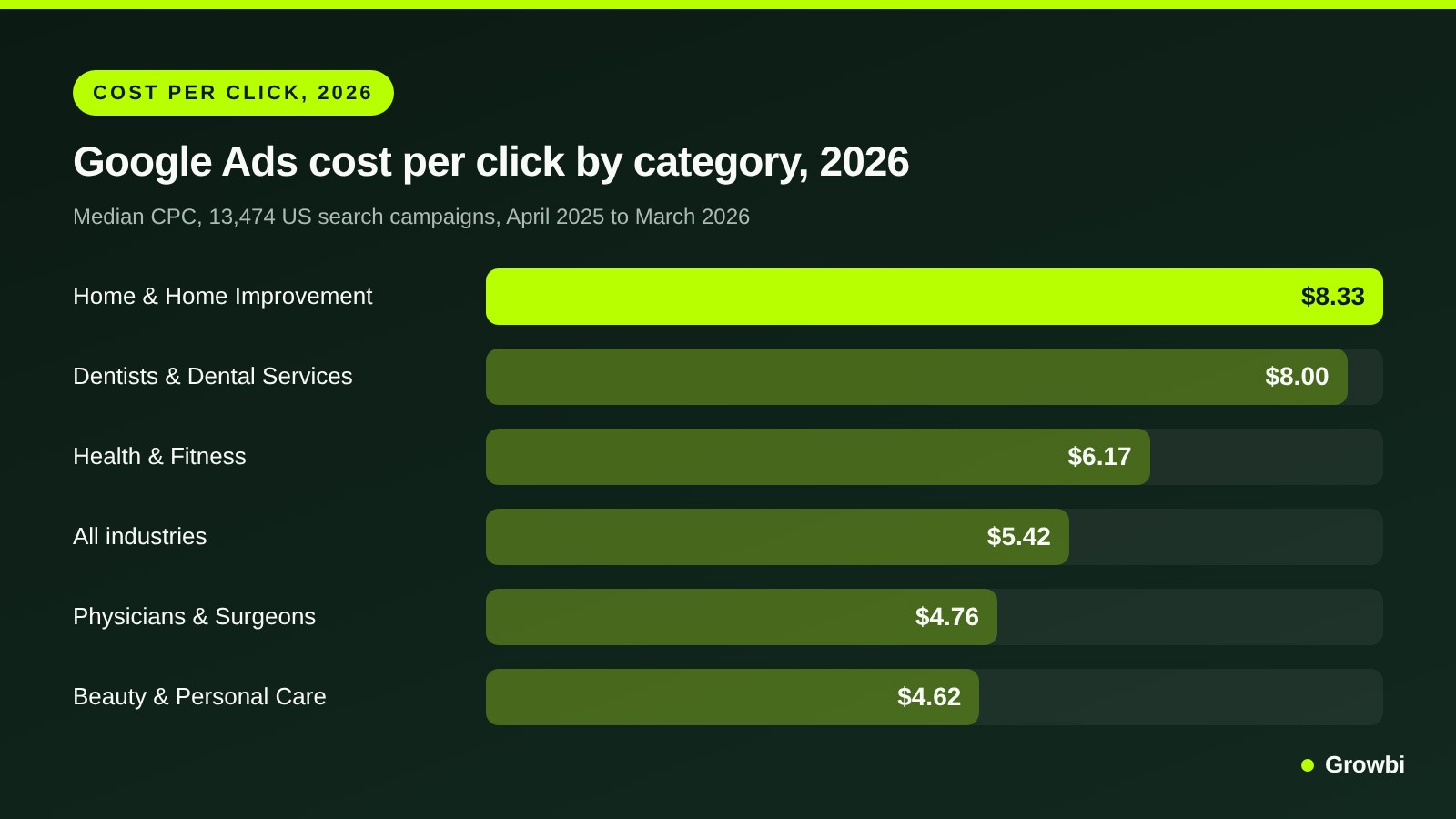
Two cautions. These are broad categories, so a roofer and a handyman sit in the same bucket, and a med spa selling laser hair removal is not the same as a salon. And legal services, the most expensive category at $9.87 per click and $131.63 per lead, is a different market that we leave out here.
What High-Intent Local Keywords Cost
Averages blend cheap and expensive searches. The searches that bring a phone call today, such as "emergency plumber" or "ac repair near me," cost well above the category average.
Google's Keyword Planner shows a top-of-page bid range for each term: roughly what advertisers paid to appear above the organic results. We pulled US national figures through DataForSEO in October 2026, covering searches up to September 2026.
- Emergency plumber: $24.42 to $110.00 per click.
- Plumber near me: $12.22 to $82.33.
- AC repair near me: $15.00 to $100.95.
- HVAC repair near me: $13.48 to $100.00.
- Roof repair near me: $14.59 to $69.26.
- Roof replacement: $14.41 to $70.74.
- Dental implants near me: $10.46 to $50.20.
- Dentist near me: $4.87 to $22.92.
- Laser hair removal near me: $3.39 to $59.09.
- Med spa near me: $2.23 to $13.09.
The gap between "dentist near me" and "dental implants near me" is the whole story: the more a job is worth, the more competitors will pay for the click. Our dental Google Ads guide shows how to split those searches into separate campaigns so implant bids do not eat the general budget.
These are national ranges. A dense metro with ten well-funded competitors will sit at the top of the range, a small town near the bottom.
Pro tip: Before you set a budget, open Keyword Planner, change the location from the whole country to your own service area, and note the top-of-page range for your five most valuable keywords. That local range, not the national one, is what your daily budget has to cover for a few clicks a day.
Realistic Monthly Google Ads Budgets for Local Businesses
Start from the leads you need, not from a round number. The formula is simple: leads you want per month, times your expected cost per lead, equals your monthly ad spend.
Using the 2026 benchmark cost per lead and a target of 30 leads a month, our rule of thumb for the volume one campaign needs before you can judge it, the starting budgets look like this:
- Med spa: 30 leads at $39.25 is about $1,180 a month, or $39 a day.
- Dental practice: 30 leads at $72.97 is about $2,190 a month, or $72 a day.
- HVAC, plumbing or roofing company: 30 leads at $90.92 is about $2,730 a month, or $90 a day.
Expect your first months to run above benchmark while the account learns, and add a separate budget for each extra service line or city you want to cover.
Google bills against an average daily budget. Its help page on overdelivery explains that a campaign can spend up to twice its daily budget on a busy day, but no more than 30.4 times the daily budget over a month. So a $100 daily budget means about $3,040 a month, not $100 every day.
Pro tip: Do not cut the daily budget after one expensive day. Google evens spend out across the month, so we check spend against the monthly figure once a week and leave any budget change in place for at least a week before judging it.
Cost per Lead vs Cost per Booked Job
A lead is a call or a form. It is not a customer. Some callers want a price and hang up, some never answer your callback, and some book and do not show.
Here is a worked example for a home service company spending $3,000 a month at the benchmark cost per lead. The budget buys about 33 leads. If your office books 40% of them, that is about 13 jobs at roughly $227 each. If it books 20%, you get about 7 jobs at roughly $455 each.
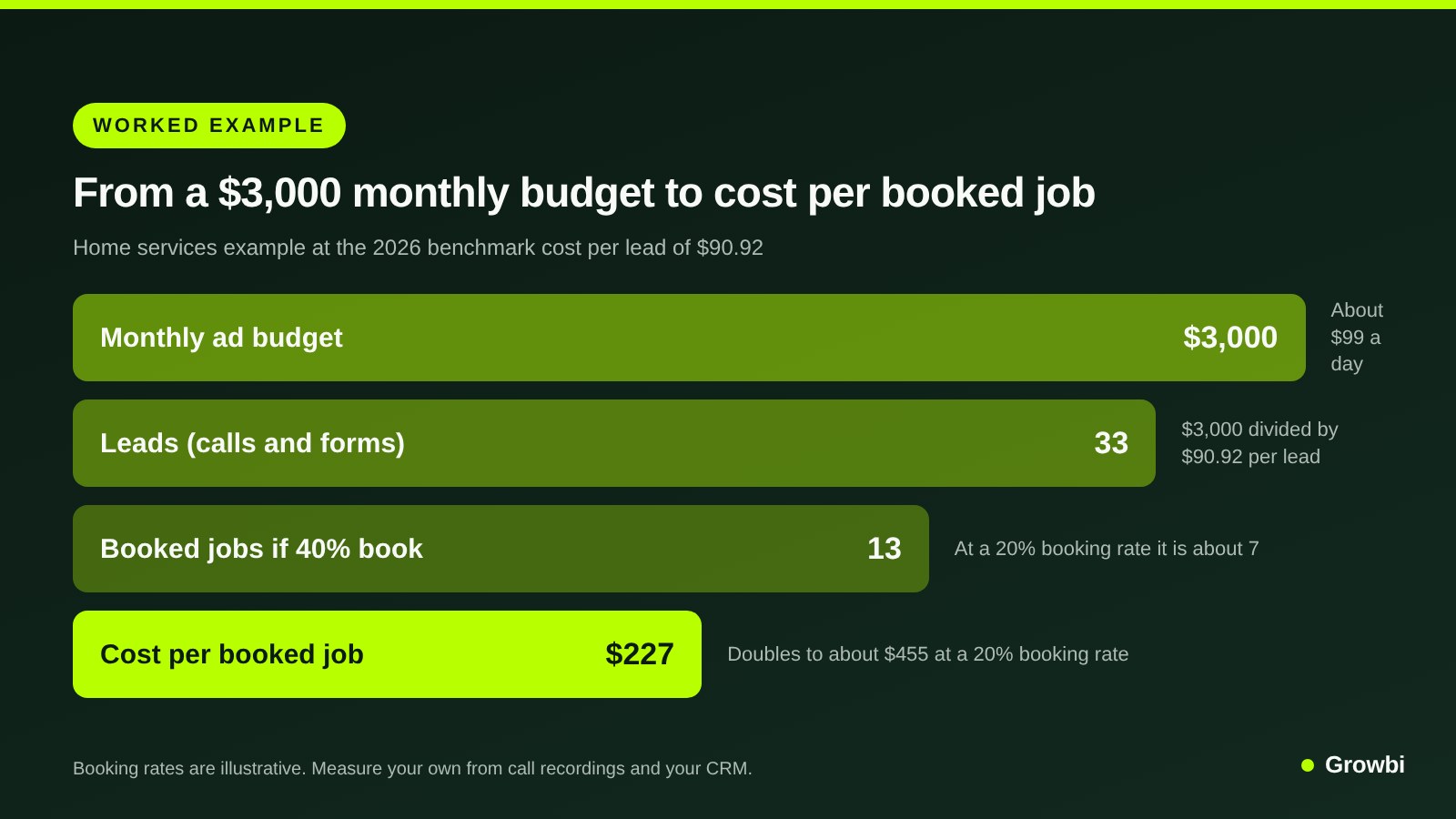
Source: Cost per lead from WordStream by LocaliQ, Google Ads Benchmarks 2026; booking rates illustrative
Same ads, same clicks, double the cost per job, and the difference is decided by the phone, not by Google. Our guide to speed to lead covers the follow-up habits that move the booking rate most.
So set a target cost per booked job from your numbers: average ticket, gross margin and how often a customer comes back. A $227 job cost is excellent for a $9,000 roof and painful for a $150 drain clearing.
Dental practices run the same math one step further, to an attended patient and a started treatment. The full calculation is in our guide to dental patient acquisition cost.
Local Services Ads vs Search Ads Pricing
Local Services Ads work differently. You pay per valid lead, not per click, and the ad sits above the regular search ads with a Google Verified badge.
Google publishes no cost-per-lead figure, so tracker data is the best guide. Vendasta's October 2026 guide compiles SearchLight's September 2026 benchmark at $62.88 per home services lead, with HVAC at $60.66 and plumbing at $67.05, and roofing between $79 and $106.87 depending on the tracker.
- Budget mechanics: you set a weekly budget, and the monthly cap is the weekly budget times 30.4 divided by 7.
- Recommended floor: Google suggests funding at least 10 leads a week, which at $62.88 is about $629 a week.
- Missed calls: since October 1, 2026, a missed business-hours call where the caller waits more than 20 seconds can be billed.
- Control: no keywords, no ad copy and no landing page, so you cannot steer budget toward your most profitable jobs.
In practice, most home service companies run both: Local Services Ads for urgent calls, Search for high-ticket installs and specific offers. Our full guide to Google Local Services Ads covers ranking, the move into Performance Max and lead credits.
What Drives Google Ads Costs Up or Down
You rarely pay your full bid, and the bid is only one part of the price.
According to Google's actual cost-per-click definition, you pay just enough to beat the Ad Rank of the advertiser below you, and Ad Rank combines your bid with ad quality, including expected clickthrough rate, ad relevance and landing page experience.
That gives you levers beyond the bid. These are the ones that move cost most in local accounts:
- Intent and job value. Emergency and replacement searches cost the most because each job is worth the most.
- Competition in your city. The same keyword usually costs more in a dense metro with many bidders than in a small town.
- Season. Searches for "ac repair near me" ran from 110,000 in November 2025 to 368,000 in September 2026, and more searchers bring more bidders.
- Ad position. Google notes that ads above the results usually cost more per click than ads below them.
- Quality. A specific ad that lands on a matching service page lowers what you pay for the same position.
- Wasted searches. Without negative keywords, you pay for job seekers, DIY questions and people looking for free help.
- Schedule and radius. Running ads at hours nobody answers, or miles outside your service area, raises cost per booked job without adding work you can take.
Start every account with a negative keyword list. For a plumber that means terms like jobs, salary, training, how to, DIY, parts, wholesale and free, and for a dentist terms like assistant jobs, school and free clinic.
Pro tip: Save those negatives as a shared negative keyword list under Tools and attach it to every campaign on the day you create it. A new campaign then starts clean instead of paying again for searches you already blocked elsewhere.
Rules That Change Costs for Med Spas and Dentists
Healthcare ads carry extra limits, and they change which searches you can buy.
Google's healthcare and medicines policy restricts prescription drug terms in ads, landing pages and keywords, and neurotoxins such as Botox are prescription drugs.
That pushes med spa campaigns toward treatment and clinic language, such as wrinkle relaxer, injectables or lip filler, which narrows the keyword list. Our comparison of Meta vs Google for med spas explains when Search is still the better place to spend.
Google Ads Management Fees and Other Costs
Ad spend goes to Google. Management is a separate line, and it varies more than click costs do.
In a Search Engine Journal column on PPC management pricing, Navah Hopkins lists the common models: a flat fee of $500 to $2,500 a month plus 5% to 15% of spend, a flat rate of $2,500 to $10,000 a month, or performance pricing per lead.
- Percentage of spend rewards the manager for raising your budget, not for lowering cost per job, which is why many agencies have moved away from it.
- Pay per lead often means the agency owns the account, so you lose the data if you leave.
- Small budgets: the same column suggests that under $2,500 a month in spend, fees can take too large a share, and managing in-house or with automation may make more sense.
- Other costs: call tracking, landing pages, a CRM and the time of whoever answers the leads.
Whoever runs it, insist that the Google Ads account is in your name and that reports show cost per booked job. Our checklist for choosing a Google Ads agency for home services lists the questions to ask before you sign.
How to Set Your First Google Ads Budget
Use this order. It takes an afternoon and gives you a budget you can defend after 60 days.
- Pick one service and one area. The job you most want more of, in the zip codes you serve fastest.
- Write down what a booked job is worth and the most you would pay to win one.
- Estimate cost per lead from the benchmarks above, then add a margin for the learning period.
- Multiply by 30 leads for the monthly budget, and divide by 30.4 for the daily budget.
- Set up tracking before launch: calls from the ad, calls from the site, forms and booked jobs fed back from your CRM.
- Run 60 days, adding negative keywords every week from the search terms report.
- Judge on cost per booked job, then add budget only to campaigns that beat your target.
For contractors who want to see how this connects to lead sources beyond Google, our HVAC leads guide compares paid, shared and organic leads on the same scoreboard.
FAQs
How much does Google Ads cost per month?
There is no fixed price. A practical starting point is 30 leads times your expected cost per lead: about $1,180 for a med spa, $2,190 for a dental practice and $2,730 for a home service company at 2026 benchmark costs. Management fees come on top.
How much does Google Ads cost per click?
The 2026 median is $5.42 per click across industries, according to WordStream by LocaliQ. Home and home improvement averages $8.33 and dentists $8.00. High-intent local searches cost more: Google's top-of-page bid range for "emergency plumber" runs from about $24 to $110 nationally, and "ac repair near me" from $15 to about $101.
Is $10 a day enough for Google Ads?
Usually not for a local service business. $10 a day is about $304 a month. At the $8.33 home services click average and an 8.05% conversion rate, that buys roughly 36 clicks and three leads a month, too few to judge a campaign. It can work for one narrow, low-cost service in a small market.
How are Google Ads charged?
Search ads charge per click, and you often pay less than your maximum bid, just enough to beat the next advertiser's Ad Rank. Google bills against an average daily budget, can spend up to twice that on a busy day, and caps monthly spend at 30.4 times the daily budget. Local Services Ads charge per valid lead instead.
What is a good conversion rate for Google Ads?
The 2026 median across industries is 8.18%, according to WordStream by LocaliQ. Home and home improvement averages 8.05%, dentists 10.67% and beauty and personal care 10.35%. A conversion is a call or form, not a customer, so also track how many of those leads become booked jobs or attended patients.
Is it worth paying for Google Ads?
It is worth it when your cost per booked job is lower than what a job earns you. Google Ads reaches people searching for your service right now, which suits urgent and high-ticket work. It fails when tracking stops at clicks, landing pages are generic or calls go unanswered, because then you pay for leads that never book.
Conclusion
Google Ads cost local businesses $5 to $8 per click on average in 2026, and much more for emergency and high-ticket searches. A realistic first budget buys about 30 leads a month, which for most of our industries means $1,200 to $2,700 in ad spend before management.
The click price matters less than what happens after it. Track every call and form to a booked job, answer fast, and add budget only where cost per booked job beats your target. Our paid ads management is built around that number.
If you want a budget worked out for your trade and city, book a free 15-minute call and bring last month's leads and booked jobs.
Get this system built for your business
Book a strategy call and we will model a realistic appointment target from your budget, market, and offer.
Keep reading
Dental Google Ads: How to Run Campaigns That Book Patients
Google Local Services Ads: Cost, Setup and How to Rank Higher
Best Google Ads Agency for Home Services

Med Spa Advertising: Channels, Costs and Compliant Ad Examples
Speed to Lead: Why the First 5 Minutes Decide Who Books