Google Ads for Real Estate Agents: Costs, Rules and Campaign Setup

Key Takeaways
- Google's housing policy in the US bans ZIP code, age, gender, parental status and marital status targeting, but radius and city targeting still work.
- Seller searches are where agents win: "how much is my house worth" averages $7.45 a click, while "sell my house" averages $153.81, likely because cash buyers bid on it too.
- LocaliQ's 2026 benchmarks put the median cost per lead for residential agents at $157.59, with a 1.29% conversion rate.
- Start with Search, not Performance Max, and add negatives for rentals, jobs, licensing courses and cash offers from day one.
- Judge the account on appointments and signed clients, not on leads, because buyers take a median of 10 weeks to search.
Google Ads for real estate agents works best as a Search campaign aimed at sellers, such as home value and listing agent searches, plus a smaller buyer campaign. US housing ads cannot target by ZIP code, age, gender, parental or marital status. Agents paid a median $157.59 per search lead in LocaliQ's 2026 data, so follow-up decides profit.
Most agents who try Google Ads give up within three months. The pattern is familiar: a campaign aimed at "homes for sale" searches, a link to an IDX search page, a few hundred clicks from people who were already on Zillow, and no appointments.
Google is still the place where sellers type "how much is my house worth" and "listing agent near me". The agents who make it work treat it as a seller channel first, accept the housing rules, and call every lead within minutes.
Here is how to set it up, what it costs as of November 2026 and what a good result looks like.
Google's Housing Ad Rules for US Agents
Housing is one of Google's "access to opportunities" categories in the US and Canada, alongside employment and consumer finance. Any ad for listings, agent services or home valuations falls into it.
Google's personalized advertising policy lists what that removes. In the US and Canada, housing ads cannot target or exclude people using these options:
- Age and gender. All demographic settings must be left open.
- Parental status and marital status. No targeting "parents" or "married couples".
- ZIP codes. The ZIP location type is not allowed for housing ads.
What remains is still workable. City, county and radius targeting are allowed, and Google's minimum radius for housing is just 1 kilometer, far tighter than the 15-mile minimum Meta imposes. Predefined Google audiences such as in-market segments can be used, minus the banned demographics.
One trap is new. Google added age targeting and a gender beta to Performance Max in August 2025, per its Performance Max update. Those controls exist in the interface, but a US housing campaign that uses them breaks the policy.
Pro tip: Before launch, open the audience and demographic settings of every campaign and confirm age, gender and parental status are all left open, and turn off auto-apply recommendations so no automated change adds targeting your housing campaign cannot use.
The Fair Housing Act also governs the words. HUD's rule on discriminatory advertisements bans ads that show a preference for a type of buyer, so write "3 bedrooms near two parks", never "perfect for young families".
If you also advertise on Facebook and Instagram, our guide to real estate Facebook ads covers the same wording rules and Meta's stricter Housing targeting.
Why Google Ads Works Best for Seller Leads
Buyers search for homes on Google, but they click portals. A search like "homes for sale near me" gets about 368,000 US searches a month and averages $1.00 a click in Google Ads data from DataForSEO, which tells you advertisers do not value it much. Those searchers want listings, and Zillow and Realtor.com have more of them than you do.
Sellers behave differently. They want a person, a price and a plan, and they search for exactly that.
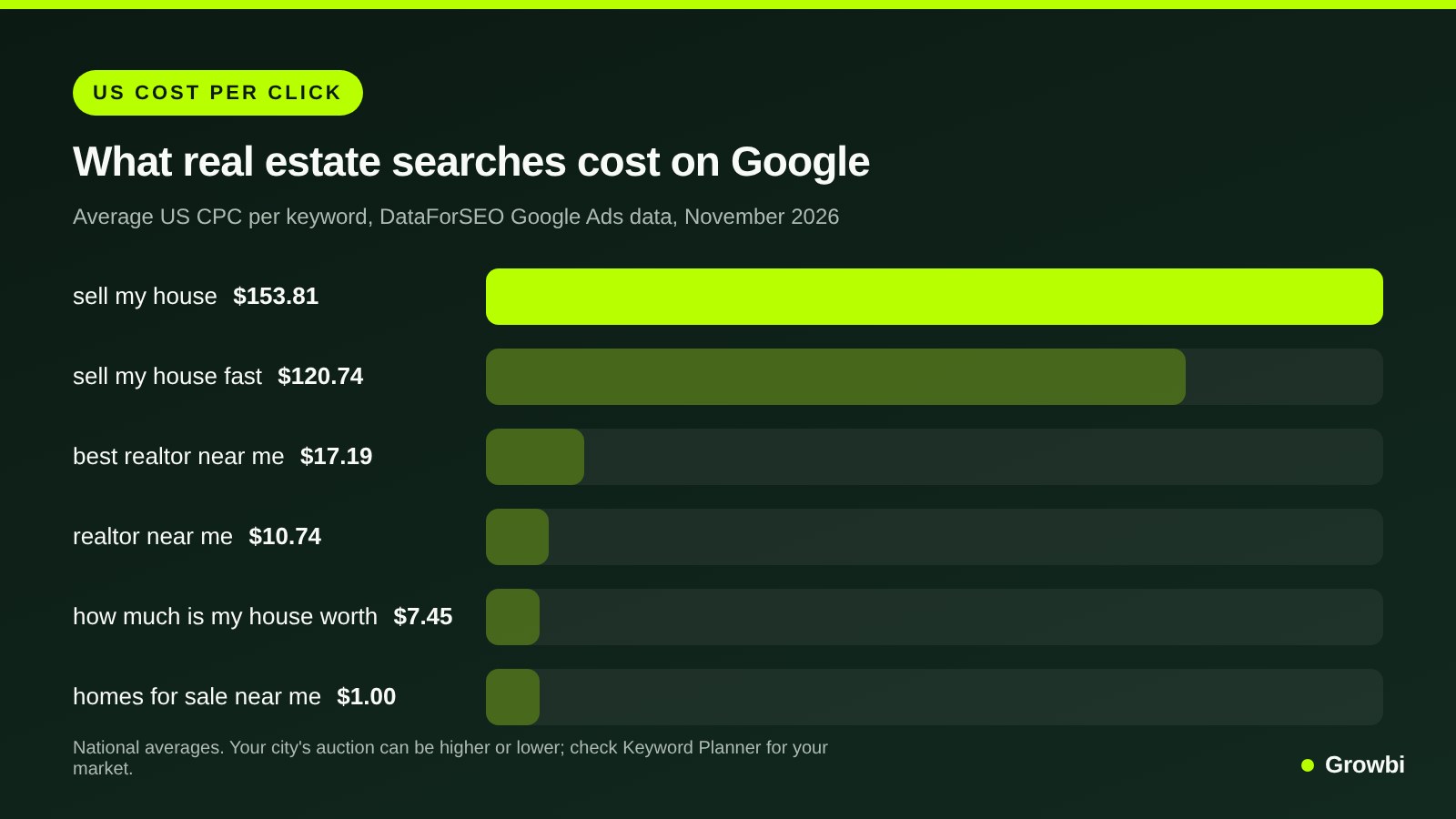
Source: DataForSEO, Google Ads search volume and CPC, United States, November 2026
Two things stand out. "How much is my house worth" has 22,200 monthly US searches at an average $7.45 a click, which makes home value searches the best entry point for most agents.
"Sell my house" averages $153.81 a click, likely because cash buyers and investors bid on it too, and "sell my house fast" at $120.74 is mostly their audience.
Agent searches sit in between. "Realtor near me" draws 90,500 searches a month at $10.74, and "best realtor near me" 14,800 at $17.19. These are worth bidding on, but many come from buyers and renters, so the negatives below matter.
How to Structure the Campaigns
Three Search campaigns, each with its own budget, so the expensive one never starves the profitable one.
- Seller campaign (60 to 70% of budget). Home value, listing agent and "sell my house with a realtor" searches, sent to a valuation landing page.
- Agent campaign (20 to 30%). "Realtor near me", "real estate agent [city]" and "buyers agent [city]", sent to a page about you with a consultation booking.
- Brand campaign (5 to 10%). Your name and team name, so portals and competitors cannot take the click when someone looks you up.
Location targeting is by city, county or radius around your market. Set it to "presence", meaning people in or regularly in the area, unless you serve many relocation buyers, in which case add a separate small campaign for searches that name your city from outside it.
These splits are a starting point, not a rule. Move budget toward whichever campaign produces the lowest cost per appointment after the first 60 days.
Keywords and Negative Keywords for Real Estate
Use phrase and exact match while the account is young. Broad match can work later, once conversion tracking is feeding Smart Bidding real appointments rather than every form fill.
Seller keywords
- "what is my home worth [city]" and "home value [city]"
- "listing agent [city]" and "listing agent near me"
- "sell my house with a realtor" and "best agent to sell my house"
- "how much can I sell my house for"
Agent and buyer keywords
- "realtor [city]" and "real estate agent [neighborhood]"
- "buyers agent [city]"
- "[city] relocation realtor"
- "new construction realtor [city]"
Negative keywords to add on day one
- Rentals: rent, rental, apartment, lease, landlord, section 8.
- Careers: jobs, salary, license, course, exam, school, how to become.
- Investor intent: cash, we buy houses, as is, cash offer, foreclosure.
- Other services: property management, appraisal, mortgage calculator, Zillow login.
- Free tools you are not: Zestimate, Redfin estimate, county assessor.
Review the search terms report every week for the first two months. Real estate searches attract more unrelated traffic than almost any local service, and the negatives list is where most of the savings come from.
Pro tip: Put the day-one negatives in one shared negative keyword list and apply it to all three campaigns, then add your own name as a negative in the seller and agent campaigns so brand searches land only in the brand campaign.
Ad Copy Examples That Follow the Rules
Responsive search ads give you up to 15 headlines of 30 characters. Write about the home, the market and you, never about the ideal buyer.
- Seller headline set: "Austin Home Value in 24 Hours", "Local Agent, Real Sales Data", "No Algorithm Guesswork", "Book a Free Pricing Review".
- Seller description: "Get a price based on homes that sold on your street this year, prepared by a licensed local agent. No obligation."
- Agent headline set: "Austin Realtor, 12 Years Local", "Buyer and Seller Representation", "Talk to an Agent Today".
- Avoid: "Perfect for Growing Families", "Ideal for Retirees", "Exclusive Neighborhood". These describe people, which HUD treats as a preference.
Add call assets, location assets linked to your Google Business Profile and sitelinks to your recent sales. For more creative angles across channels, see our collection of real estate ad examples.
Search vs Performance Max for Real Estate
Start with Search. You choose the keywords, see every search term and control the landing page for each intent, which is what a small budget needs.
Performance Max is less of a black box than it was. Google now offers search terms reporting and campaign-level negative keyword lists for it, though the negatives apply only to Search and Shopping inventory, not YouTube or Display.
It still spends across YouTube, Display, Gmail and Maps, and it learns from conversions. With a few leads a month it rarely has enough signal. Consider it only once Search produces 30 or more tracked appointments a month and you want more reach.
Local Services Ads are a separate option worth testing next to Search. Google rolled out Home Listings in Local Services Ads to all 50 states in June 2026, showing property details in the ad, and you pay per lead rather than per click.
Our guide to Google Local Services Ads explains how the pay-per-lead model, rankings and lead disputes work.
What Google Ads Costs Real Estate Agents
Clicks are cheaper than most agents expect. Leads are not.
LocaliQ's 2026 real estate search advertising benchmarks, based on 894 US campaigns from April 2025 to March 2026, put the median cost per click for residential agents at $3.19 and the conversion rate at 1.29%. The median cost per lead for that group was $157.59, against $102.51 for real estate overall.
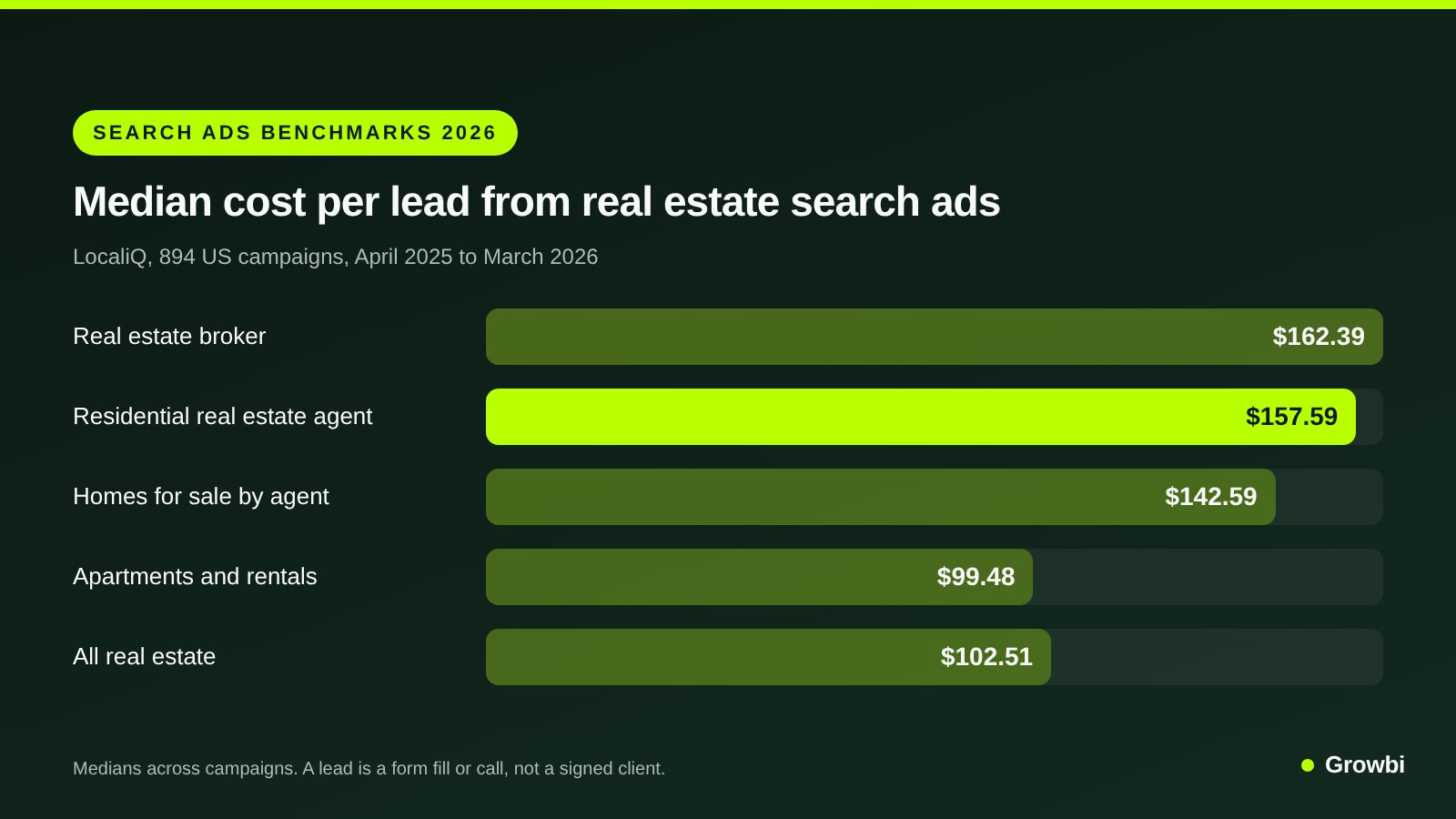
Source: LocaliQ, 2026 Real Estate Search Advertising Benchmarks
Those are medians across many markets and setups, so treat them as a reality check rather than a forecast. At $157.59 per lead, a $2,000 monthly budget buys roughly 12 to 13 leads.
That is also why "$10 a day" rarely works. At a $3.19 click, $300 a month buys about 94 clicks, and at a 1.29% conversion rate that is about one lead a month, too few to learn anything or train Smart Bidding.
- Test budget: enough for at least 10 to 15 leads a month in one market, which on the LocaliQ medians means roughly $1,500 to $2,500.
- Test length: 90 days minimum, because sellers often list months after their first search.
- Break-even math: divide your monthly spend by your average commission per closing. That is how many closings a year the ads must produce to pay.
If an agency manages the account, its fee comes on top of ad spend. Our guide to the best real estate lead generation agency compares agencies, lead platforms and pay-at-closing networks on cost.
Landing Pages That Turn Clicks Into Appointments
Never send seller traffic to your home page or an IDX search. Each campaign gets one page with one job.
- Seller page: a short address form, a promise you can keep ("a price review from a local agent within 24 hours"), three recent sales with prices and a click-to-call button.
- Agent page: your photo, years in the market, recent sales, reviews and a calendar to book a 15-minute call.
- On both: a fast mobile load, your license number and brokerage as required in your state, and a phone number tracked separately from your business card number.
Track calls of 60 seconds or longer, form submissions and booked appointments as separate conversions. Then import appointments from your CRM as the primary goal, so Google optimizes for meetings instead of form fills.
Lead Follow-Up Decides the Return
A Google lead is someone who searched today, but they have usually contacted more than one agent. Being first matters, and the National Association of REALTORS gives a sense of why.
In NAR's 2025 Profile of Home Buyers and Sellers, summarized by Virginia REALTORS, 66% of sellers found their agent through a referral or a past relationship, and buyers searched for a median of 10 weeks. Paid leads are competing with referrals, and they need patient nurturing.
- Text within one minute confirming the address or request, then call within five minutes.
- Deliver the promised value first: the price review, the sold comparables, the market update.
- Book a specific next step on the first call: a listing consultation or a buyer meeting.
- Nurture the rest for months with monthly sales data for their neighborhood, since many will list next season.
Pro tip: Make the first text name what they asked for, so it reads like a person and not an autoresponder: "Hi, this is Dana with Main Street Realty. I got your request for a price review on Oak Street and I'm pulling recent sales now. Is this a good number to call you in five minutes?"
Our speed to lead guide covers the research on response time and a full call and text cadence you can copy.
When to Hire Help With Google Ads
Running it yourself makes sense on a small test budget if you can spend two hours a week on search terms, negatives and bids. Hiring help makes sense when spend passes a few thousand dollars a month, when you need call tracking and CRM imports wired correctly, or when the account has run for months without appointments.
Whoever runs it, the ad account should be in your name. Our list of questions to ask a real estate marketing agency covers account ownership, reporting and contract terms before you sign.
Growbi runs Google Search, Local Services Ads and Meta campaigns for agents and teams, set up in the agent's own accounts and reported on appointments. You can see how that works on our real estate marketing page.
FAQs
Are Google Ads worth it for real estate agents?
They can be, mainly for seller leads. Home value and listing agent searches come from people who want an agent now, while buyer searches mostly go to portals. LocaliQ's 2026 benchmarks put the median cost per lead for residential agents at $157.59, so Google Ads pays when one or two extra closings a year cover the spend and every lead is called within minutes.
How much should a realtor spend on Google Ads?
Enough to get at least 10 to 15 leads a month in one market, which at LocaliQ's 2026 median of $157.59 per lead for residential agents means roughly $1,500 to $2,500 a month. Run it for at least 90 days before judging, because sellers often list months after their first search, and measure cost per appointment rather than cost per lead.
Is $10 a day enough for Google Ads?
Not for real estate. At the 2026 median cost per click of $3.19 for residential agents, $10 a day buys about 94 clicks a month, and at a 1.29% conversion rate that is roughly one lead. That is too little to judge results or train automated bidding. A smaller market with cheaper clicks helps, but most agents need a larger test budget.
Can real estate agents target ZIP codes in Google Ads?
No. Google's personalized advertising policy bars ZIP code targeting for housing ads in the United States and Canada, along with targeting by age, gender, parental status and marital status. Agents can still target by city, county or a radius of at least 1 kilometer around a location, and can use predefined Google audiences without those demographics.
Should real estate agents use Performance Max or Search campaigns?
Start with Search. It lets you choose keywords, see every search term and send each intent to its own landing page, which a modest budget needs. Performance Max now has search term reports and negative keyword lists, but it spreads spend across YouTube, Display and Maps and needs steady conversions to learn, so add it later if at all.
What keywords should realtors bid on?
Prioritize seller intent: home value searches with your city, listing agent near me and sell my house with a realtor. Add agent searches such as realtor plus your city and buyers agent plus your city. Exclude rentals, real estate jobs and licensing courses, cash offer and we buy houses terms, and free valuation tools such as Zestimate.
Conclusion
Google Ads for real estate agents is not a listings channel. Portals own the buyer searches, and the housing rules take ZIP codes and demographics off the table. What is left is valuable: sellers asking what their home is worth and people looking for an agent by name of their city.
Build three focused Search campaigns, guard them with negatives, send each to a page with one job, and call every lead within minutes. Judge the result on appointments and signed clients over 90 days, using the LocaliQ medians as a reality check, not a promise.
If you want your campaigns set up or reviewed against those numbers, book a free strategy call and we will look at your market with you.
Get this system built for your business
Book a strategy call and we will model a realistic appointment target from your budget, market, and offer.
Keep reading
Real Estate Facebook Ads: What Works Under Meta's Housing Rules

Real Estate Ads That Book Seller and Buyer Appointments: 10 Examples and Templates

The 'Best' Real Estate Lead Generation Agency: A Myth Debunked by Cost per Closing

Beyond Leads: Smart Questions to Ask a Real Estate Marketing Agency Before You Sign

Speed to Lead: Why the First 5 Minutes Decide Who Books