HVAC PPC: How to Run Google Ads, LSA and Meta for HVAC Calls

Key Takeaways
- SearchLight's January 2026 benchmark put HVAC non-branded Google Ads leads at $149, branded at $34 and Performance Max at $72.
- HVAC Local Services Ads leads averaged $60.66 in SearchLight's September 2026 data, but volume and control are limited.
- Separate campaigns by season and service: general HVAC campaigns averaged $198 per lead against $144 for dedicated heating repair.
- Google stopped new call-only ads in February 2026, so calls now come from responsive search ads with call assets.
- Plan budgets from cost per booked job: at $149 per lead and a 37.6% book rate, a booked job costs about $396.
HVAC PPC is paid advertising that puts a heating and cooling company at the top of Google and on Facebook and Instagram. It runs on three channels: Google Search ads (pay per click), Local Services Ads (pay per lead) and Meta ads. In 2026 non-branded search leads averaged $149 and LSA leads about $61, per SearchLight.
HVAC advertising is a race for the first phone call. A homeowner whose AC quit in July or whose furnace died in January searches and calls one of the first companies they see.
Paid ads buy that position while SEO builds. Below is what each channel costs per lead in 2026, how to split budget between cooling and heating season, and how to judge every dollar by booked jobs.
What Is HVAC PPC?
HVAC PPC (pay-per-click) means paid ads that put a heating and cooling company in front of homeowners who are searching or scrolling. In practice it is three channels doing three different jobs.
- Google Search ads. You bid on keywords such as "ac repair near me" and pay per click, with full control over keywords, ad copy, landing pages and hours.
- Local Services Ads (LSA). The Google Verified listings at the top of the page. You pay per lead, and Google matches you to searches by job type and service area instead of keywords.
- Meta ads. Facebook and Instagram ads shown to people who are not searching yet. Useful for tune-ups, maintenance plans and replacement offers, weak for a broken AC today.
What HVAC PPC Costs in 2026
Google publishes no cost-per-lead benchmark, so the useful numbers come from trackers that report across many accounts. Read them as ranges, not quotes.
The largest dataset is SearchLight's January 2026 HVAC benchmark, covering 816 HVAC and plumbing contractors and $14.9 million in Google Ads spend. It splits cost per lead by campaign type:
- Branded search: $34 per lead, with 55.3% of leads booked.
- Non-branded search: $149 per lead, 37.6% booked, $804 per paying customer.
- Performance Max: $72 per lead, 32.2% booked, $447 per paying customer.
Non-branded search is the number to plan around. It took 79.7% of the spend in that sample, and it is the campaign type that reaches homeowners who have never heard of you.
99 Calls' 2026 HVAC report, based on the accounts it manages, puts the median monthly cost per lead between $190 and $335 in the first half of 2026. Clicks alone average $46.35 for "ac repair near me" and $73.88 for "emergency hvac repair" in DataForSEO's US data.
Local Services Ads cost less per lead. SearchLight's September 2026 data, compiled by Vendasta, put HVAC LSA leads at $60.66, but you get fewer of them and far less control over which jobs they are.
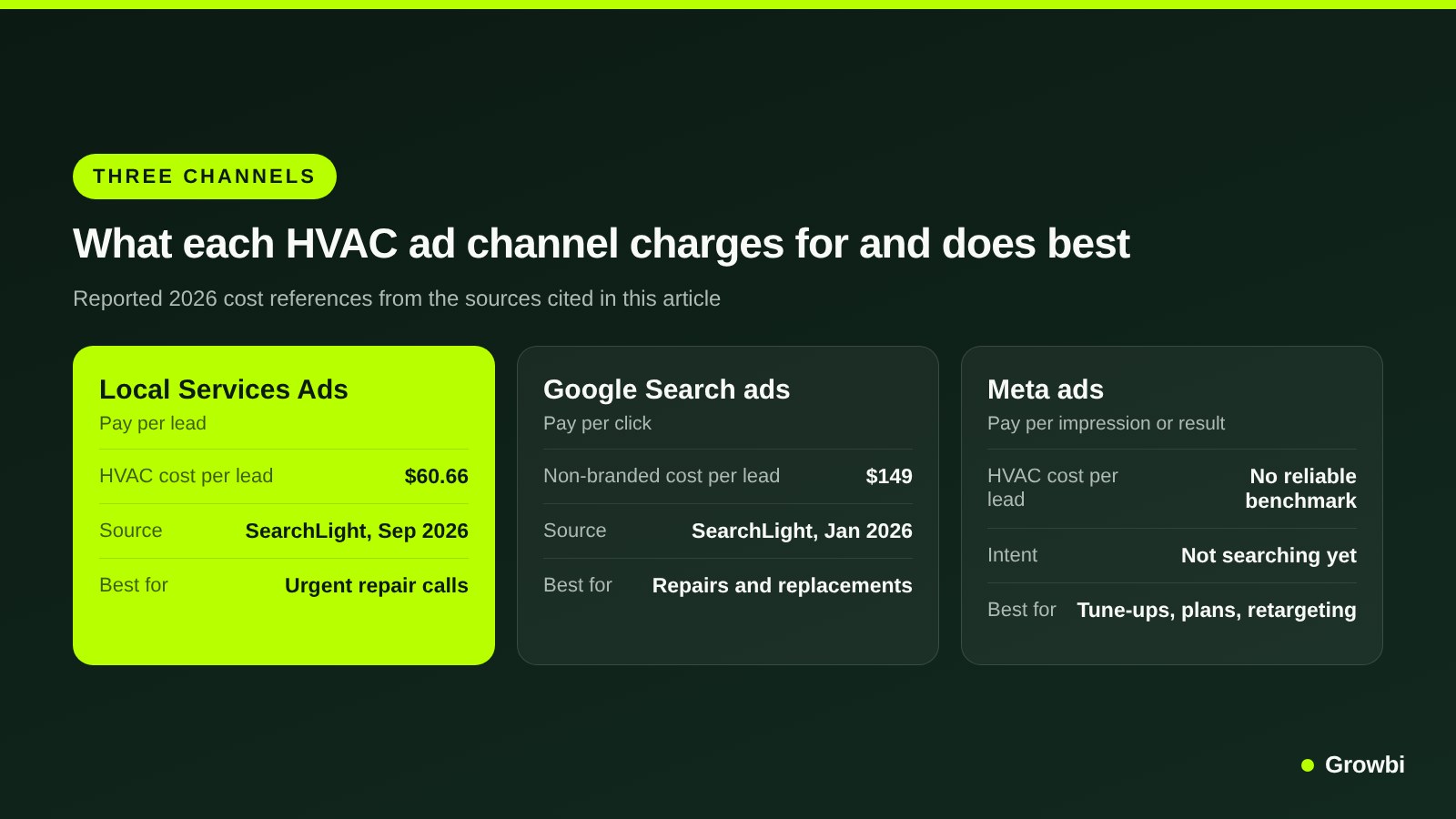
Source: SearchLight Digital, January 2026 HVAC benchmark; September 2026 LSA data compiled by Vendasta
How to set a budget from booked jobs
Start from the jobs you want, not from a monthly figure someone quoted you.
- Pick the number of booked jobs you want from paid search next month.
- Divide by your book rate, the share of leads that become a booked appointment, to get the leads you need.
- Multiply the leads by the cost per lead you expect in that season.
With SearchLight's non-branded averages, 20 booked jobs at a 37.6% book rate need about 53 leads. At $149 per lead that is roughly $7,900 a month, or about $396 per booked job.
The same math shows where to look first. If only 25% of leads book instead of 37.6%, the cost per booked job rises from about $396 to $596 without a single change to the ads.
That is why our guide to HVAC leads judges every source, paid or bought, on cost per booked service call rather than cost per lead.
Split Cooling and Heating Into Separate Campaigns
Demand flips twice a year, and the budget has to flip with it. Separate cooling and heating campaigns let you move money in minutes instead of rebuilding the account.
US search data from DataForSEO shows the swing. "Ac repair near me" averaged 201,000 searches a month, from 110,000 in November 2025 to 246,000 in June and July 2026. "Furnace repair near me" fell from 135,000 in January 2026 to 27,100 in May 2026, and "emergency hvac repair" jumped to 22,200 in July 2026 against a 5,400 average.
Splitting by service also lowers cost. In SearchLight's January data, general HVAC campaigns averaged $198 per lead while dedicated heating repair campaigns averaged $144, and SearchLight says service-line segmentation typically cuts cost per lead by 15 to 25%.
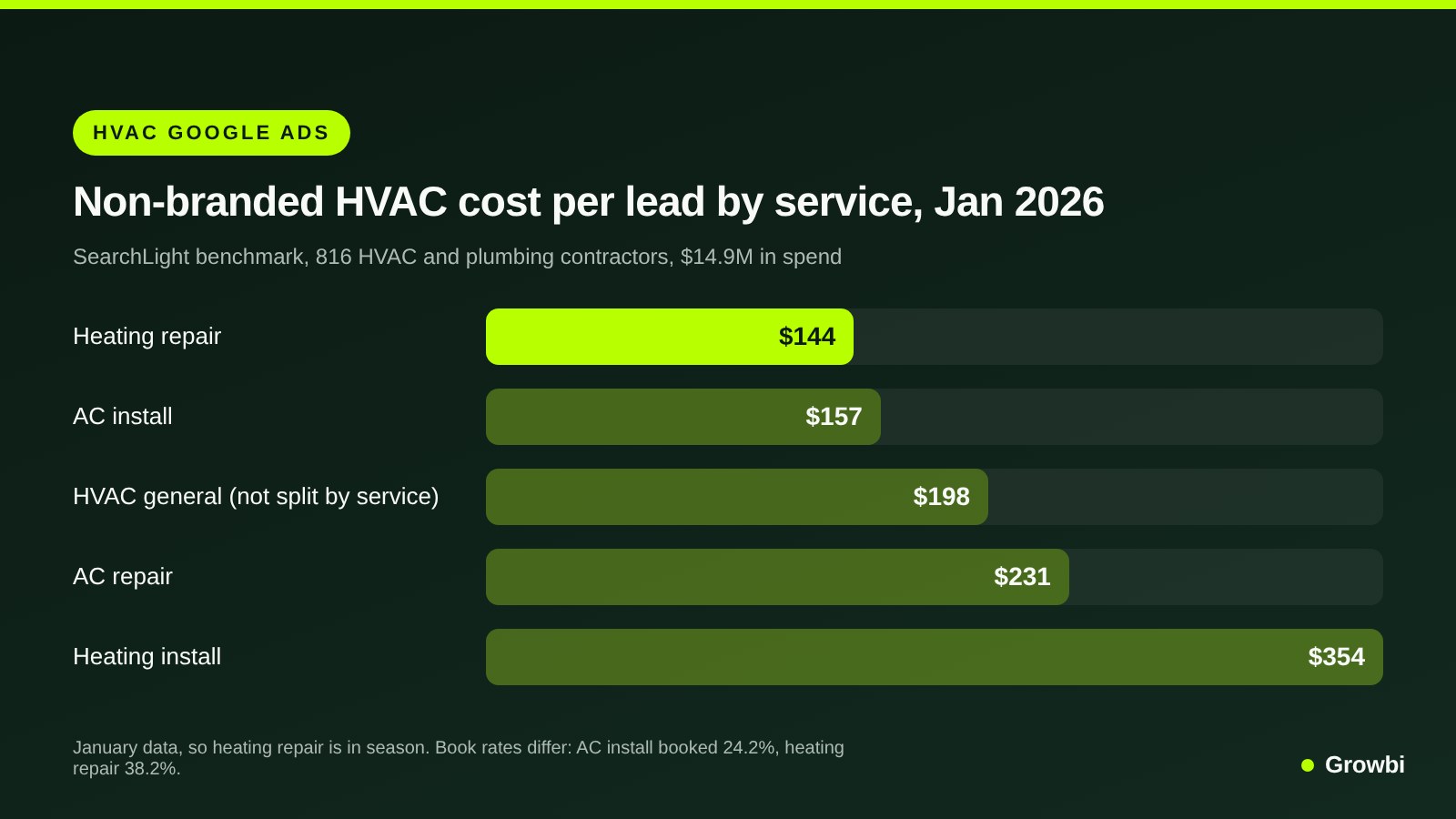
Source: SearchLight Digital, What Is a Good Cost Per Lead for HVAC Google Ads? (January 2026 data)
- Late spring through summer: most of the budget on AC repair, emergency cooling and AC replacement.
- Early fall: shift toward furnace tune-ups and heating repair before the first cold snap.
- Winter: heating repair and no-heat calls get the budget; cooling drops to brand and installation.
- Shoulder months: maintenance plans, tune-ups and planned replacements, where Meta earns its place.
One budget detail matters. Google's ad scheduling help page says that with an ad schedule, campaigns pace toward a monthly spend of 30.4 times the average daily budget, regardless of how many days they run. Reset daily budgets each season on purpose.
Separate Emergency, Replacement and Brand Campaigns
A homeowner with no cooling and a homeowner comparing quotes for a new system behave differently, so they need different campaigns, ads and pages.
In the 99 Calls data, AC repair clicks turned into leads 19.6% of the time and replacement clicks 8.7%, so replacement leads cost more ($353 against $289) despite cheaper clicks.
Emergency and repair campaigns
Built for the call: phone number at the top of the page, the hours you really answer, how soon a tech can arrive, and a call asset on every ad.
Replacement and installation campaigns
Built for the estimate: the brands you install, financing if you offer it, a short estimate form and the phone number. Judge these campaigns over a longer window, because replacements take days to close.
Brand campaign
A small campaign on your own name. Branded leads cost $34 in SearchLight's data, and the campaign protects your name from competitors bidding on it.
Keywords and negative keywords
Bid on searches that say what broke and where, with ad groups tight enough that the ad and page repeat the problem back.
- Cooling repair: ac repair near me, ac not cooling, ac blowing warm air, emergency ac repair.
- Heating repair: furnace repair near me, furnace not turning on, no heat, heat pump repair.
- Replacement: ac replacement, new furnace installation, heat pump installation, ac replacement cost.
- Maintenance: ac tune up, furnace tune up, hvac maintenance plan.
Cost questions are cheap to test in replacement campaigns: "ac replacement cost" averaged 9,900 US searches a month at a $16.33 cost per click in DataForSEO data.
Negative keywords stop you paying for clicks that will never book. Start with these groups and add to them every week from the search terms report:
- Jobs and training: jobs, careers, salary, hiring, school, training, certification, apprenticeship.
- Do it yourself: how to, diy, manual, youtube, video.
- Parts and retail: parts, filter, capacitor, home depot, lowes, amazon, wholesale.
- Equipment you do not service: car ac, auto ac, rv, window unit, portable ac.
- Wrong intent: used, rental, for sale.
Pro tip: Save these groups as one shared negative keyword list in Google Ads and apply it to every campaign, so a new heating or cooling campaign starts protected on day one. Check the search terms report right after each heat wave or cold snap, because that is when odd queries pile up.
Write HVAC Ads and Landing Pages for a Phone Call
Most paid HVAC leads arrive as phone calls, so the ad and the page should make calling the easiest thing to do.
Advertisers can no longer create call-only ads since February 2026, and existing ones stop serving in February 2027, according to Google's transition notice. Calls now come from responsive search ads with call assets.
- Call assets on every repair campaign, scheduled to the days and hours someone answers. Google lets you limit a call asset to set hours.
- Headlines that answer the problem, for example "AC Repair in [City]" or "No Heat? Call Now", with no 24/7 or same-day promise the office cannot keep.
- One landing page per service, never the homepage, with the number at the top, the towns you serve, reviews and what happens after they call.
- A short form for nights and weekends if nobody answers the phone after hours.
Pro tip: Give whoever answers the ad line one opening question: "Is the system running at all right now, or is it completely off?" The answer separates an emergency from a scheduled repair in seconds, so the CSR can offer the first open slot instead of promising a callback.
Run Local Services Ads Next to Search
LSA sits above the search ads, charges per lead and needs no keywords, which makes it the cheapest first test for many HVAC companies.
Two 2026 changes matter. Since October 1, missed calls during business hours can be charged when the caller stays on the line more than 20 seconds, as Search Engine Roundtable reported. And LSA is moving into Google Ads as Performance Max campaigns with pay-per-lead goals.
Our full guide to Google Local Services Ads covers ranking, bidding and lead credits.
Where Meta Ads Fit for HVAC Companies
Meta does not catch the homeowner whose AC just died. It reaches homeowners before something breaks, which suits offers with a date or a price on them.
- Pre-season tune-ups a few weeks before cooling and heating season start.
- Maintenance plan sign-ups with a clear price per visit or per year.
- Replacement retargeting for people who visited your replacement or financing pages.
- Lead forms with qualifying questions such as system age and zip code, so the office knows which leads to call first.
There is a policy question too. Meta's help page on housing ads defines a housing ad as one that promotes a housing opportunity or related service. Its examples are listings, home and renters insurance, mortgage financing, appraisals and real estate services, not HVAC repair.
So a standard tune-up or replacement ad usually runs without a special category.
Meta says its examples are not complete, though, and Jon Loomer's guide to special ad categories lists what the Housing category changes if an ad is put in it: age fixed at 18 to 65+, all genders, at least a 15-mile radius, no zip codes and no lookalike audiences.
Ads that promote financing belong in the Financial Products and Services category.
If an ad is rejected under this policy, select the category or request a review rather than rewording the ad to get around it. Our summary of Meta's October 2026 ad terms covers the other rules owners should check.
Whatever the offer, Meta leads go cold fast. Call them within minutes, the principle behind our guide to speed to lead.
Track HVAC Calls Back to Booked Jobs
If calls are not tracked, Google optimizes for what it can see, usually form fills, and your reports undercount the channel that books the most work.
- Call reporting on call assets. Google forwarding numbers show which campaign and keyword produced each call from the ad.
- Website call conversions. A forwarding number on the landing page records calls from people who clicked an ad, and only calls longer than a minimum length you set count as conversions.
- Separate tracked numbers for the Google Business Profile and LSA, so map and LSA calls do not mix with search.
- Booked jobs sent back to Google as offline conversions from your field software, so bidding learns which calls became revenue.
Google's website call tracking guide explains the setup, including how to verify your domain when you use third-party call tracking so call assets are not disapproved.
Then put answer rate next to cost in every report. SearchLight notes that call handling drives book rate, which decides whether a lead was worth buying.
Pro tip: Once booked jobs are flowing back from your field software, make that the primary conversion action and set raw calls to secondary. Smart Bidding then optimizes toward calls that became jobs instead of every call longer than the minimum length.
Mistakes That Waste HVAC Ad Budget
- One campaign for everything, so AC repair, furnace installs and tune-ups share one budget and one bid.
- Judging by cost per lead alone. Book rate and ticket size decide whether a lead paid off.
- Running ads in hours nobody answers, which pays for clicks and, on LSA, may pay for missed calls.
- Thin negative keyword lists, so the account pays for job seekers, parts shoppers and car AC searches.
- Performance Max on its own, with no search campaign showing the exact terms you pay for.
If you would rather hand it off, our checklist for choosing a Google Ads agency for home services lists what to ask before you sign.
It is time for help when you cannot say what a booked job from ads costs or spend rises every summer without more jobs. Our HVAC marketing team runs Search, LSA and Meta against that number.
FAQs
What is HVAC PPC?
HVAC PPC is pay-per-click advertising for heating and cooling companies. It covers Google Search ads, where you pay per click on keywords such as ac repair near me, Google Local Services Ads, where you pay per lead, and Meta ads on Facebook and Instagram. The goal is phone calls and estimate requests that turn into booked repair, replacement and maintenance jobs.
How much does HVAC PPC cost?
It depends on market and season. SearchLight's January 2026 benchmark put non-branded HVAC Google Ads leads at $149, branded at $34 and Performance Max at $72, while 99 Calls reported median monthly costs of $190 to $335 per lead in early 2026. HVAC Local Services Ads leads averaged $60.66 in SearchLight's September 2026 data.
Are Google Ads worth it for HVAC companies?
They usually are when calls are answered and tracked to booked jobs. In SearchLight's January 2026 data, non-branded leads booked 37.6% of the time, so a $149 lead meant about $396 per booked appointment. Replacement tickets can carry that cost easily, while repair-only campaigns need a high answer rate and tight negative keywords to stay profitable.
Do Facebook ads work for HVAC?
Facebook and Instagram ads work best for HVAC offers that do not depend on an emergency: pre-season tune-ups, maintenance plan sign-ups and replacement retargeting. They rarely catch someone whose system failed today. Standard HVAC service ads usually need no special ad category, but ads that promote financing do, and every lead should get a call within minutes.
Conclusion
HVAC PPC works when each channel does its own job: Local Services Ads and search for the urgent repair call, search for replacements and estimates, and Meta for tune-ups and maintenance plans before the season turns.
Structure decides the cost: separate campaigns by season and service, block searches that never book, and track every call to a booked job.
If you want to see what your HVAC ads should cost per booked job in your market before next season, book a free 15-minute call and we will walk through it with you.
Get this system built for your business
Book a strategy call and we will model a realistic appointment target from your budget, market, and offer.