How Much Do LinkedIn Ads Cost in 2026? CPC, CPL and Budgets

Key Takeaways
- B2B advertisers paid $9.39 per click, $63.19 CPM and $202 per lead on LinkedIn in 2025 spend-weighted data from Metadata.io, but the median advertiser paid $376 per lead.
- LinkedIn's minimum is $10 a day per ad set, and a daily budget can spend up to twice that on a given day while staying within seven times it over a week.
- What you pay for depends on objective and bidding: maximum delivery and cost cap charge by impressions, manual bidding can charge per click, view or send.
- Lead Gen Forms produced leads at $193 against $346 for landing pages, and document ads were the cheapest format at $142 per lead.
- Judge LinkedIn on cost per qualified lead and pipeline. A $15,000, 90-day test is a realistic floor for a decision.
LinkedIn Ads cost B2B advertisers $9.39 per click, $63.19 per 1,000 impressions and $202 per lead on a spend-weighted basis, per Metadata.io's 2026 benchmarks, while the typical advertiser pays $376 per lead. LinkedIn's minimum is $10 a day. Plan a 90-day test and judge it on cost per qualified lead, not clicks.
LinkedIn has no price list. Every impression is sold in an auction, and the price moves with who you target, what you optimize for and how good your ads are.
What you can know is the range. This guide gives you the 2026 numbers for clicks, impressions and leads by format, LinkedIn's own budget and bidding rules, a test budget you can defend to your CFO, and an honest view of when Google search is the better first buy.
One rule runs through all of it. A B2B lead is worth nothing until sales accepts it, so we judge LinkedIn on cost per qualified lead and pipeline, never on cost per click.
LinkedIn Ads Cost per Click, CPM and Cost per Lead in 2026
The most transparent public benchmark is Metadata.io's. It covers 153 B2B advertisers and $57.6 million of 2025 ad spend, publishes its method, and releases the dataset under an open license.
In Metadata's LinkedIn cost breakdown, 138 advertisers on LinkedIn paid these spend-weighted averages:
- Cost per click: $9.39.
- Cost per 1,000 impressions (CPM): $63.19.
- Click-through rate: 0.67%.
- Click to lead conversion: 5.9%.
- Cost per lead: $202.
Here is the catch most cost guides skip. A weighted average is pulled down by a few large, efficient accounts, so $202 sits at only the 26th percentile.
- Top 10% of advertisers: $109 per lead or less.
- Top quarter: under $196.
- Median advertiser: $376.
- Bottom quarter: above $658.
- Bottom 10%: $1,340 or more.
So plan around the median, not the headline. If your first month lands near $376 per lead, you are normal, not failing.
Other trackers quote LinkedIn clicks lower. Dreamdata's 2026 LinkedIn Ads benchmarks put the average CPC at €5.98, against €1.60 on Meta. Samples differ, so treat any single figure as a range, not a quote.
How LinkedIn Charges: Objectives and Billable Events
On LinkedIn, the objective you pick decides what you are billed for. That choice matters more for cost than most budget decisions.
LinkedIn's objective-based pricing page lists the billable event for every combination of objective, optimization goal and bidding strategy. As of November 2026, the ones that matter for a B2B lead program are:
- Brand awareness: charged per 1,000 impressions, or per send for Sponsored Messaging.
- Website visits: charged by impressions on automated bidding, or per landing page click on manual bidding.
- Engagement: charged by impressions, or per engagement click on manual bidding, which includes clicks to your Page, social actions and follows.
- Video views: charged by impressions, or per view on manual bidding, where a view is two or more seconds with the video at least half on screen.
- Lead generation: charged by impressions on the qualified leads and leads goals, per click on enhanced manual bidding, or per send for message ads.
- Website conversions: charged by impressions on automated bidding, or per landing page click on enhanced manual bidding.
Notice what is missing: LinkedIn never bills per lead. Even a lead generation ad set is paying for impressions or clicks, and your cost per lead is the result, not the price.
Campaign Manager's current naming also changed. A campaign now groups ad sets, and the objective, audience, format, bid and budget are set per ad set. The objective and format cannot be changed after an ad set launches.
LinkedIn Bidding Options: Maximum Delivery, Cost Cap and Manual
LinkedIn offers three bidding strategies, and each one shifts who controls the price.
According to LinkedIn's bidding strategies help page, the options work like this:
- Maximum delivery: LinkedIn bids automatically to spend the full budget and get the most results. It is charged by CPM, has no bid or cap to set, and starts with a learning phase where results fluctuate.
- Cost cap: you set an average cost per result that LinkedIn tries to stay under. It is charged by impressions and available for brand awareness, website visits, engagement, video views and lead generation.
- Manual bidding: you set the bid yourself. It can charge per click, per 1,000 impressions, per video view or per send, and gives the most control but may deliver less.
With cost cap or manual bidding, Campaign Manager shows a suggested bid range. LinkedIn describes it as an estimate of what competing advertisers are bidding for the same audience, so a narrow, senior audience shows a higher range.
Pro tip: Start a new lead generation ad set on maximum delivery for two weeks to let it learn, then switch to cost cap at roughly the cost per lead it achieved. You keep the volume and stop the algorithm from chasing expensive leads when budget is left at the end of the week.
LinkedIn Ads Cost by Ad Format
Format changes the cost per lead more than most targeting tweaks. Metadata's 2025 data splits LinkedIn leads by format, with document ads converting at 11.9%, about double the channel average.
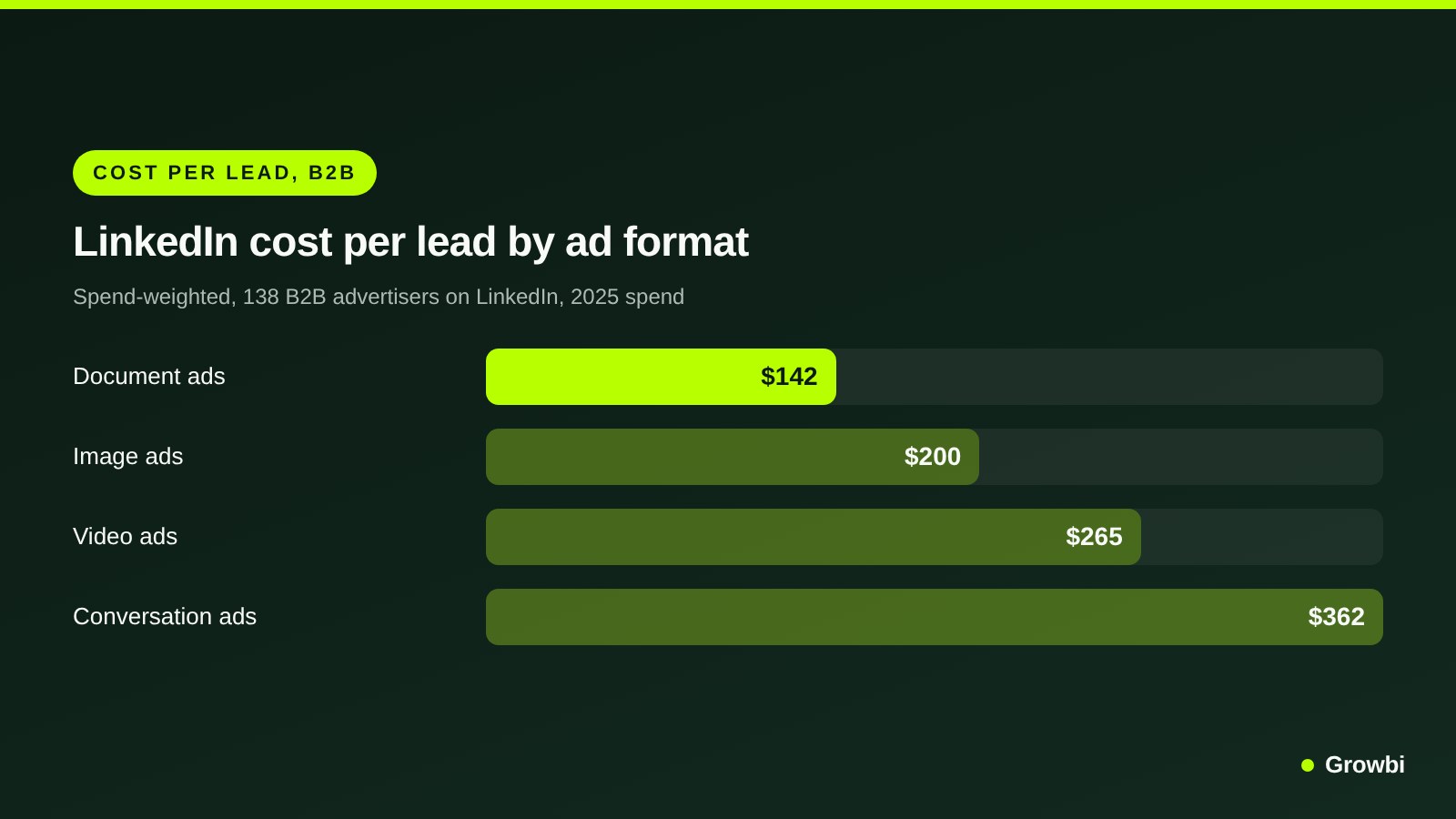
Source: Metadata.io, LinkedIn ads cost for B2B (2025 spend, 138 advertisers)
Where the click goes matters as much as the format. A LinkedIn Lead Gen Form, which arrives pre-filled from the member's profile, produced a lead for $193, while sending the same click to a landing page cost $346, or 79% more.
Two more findings change how you plan. Retargeting on LinkedIn cost $234 per lead against $194 for cold prospecting, the reverse of the pattern on Meta. And company size moves cost: targeting firms of 51 to 200 employees cost $241 per lead, against $204 for firms of 1,001 to 5,000, per Metadata's cross-channel benchmarks.
A cheap form lead can still be a weak lead. Pre-filled forms are easy to submit, which is why the qualified-lead tracking in the last section matters more than the form price.
LinkedIn Ads Minimum Budget and How Spend Is Paced
You can start small on LinkedIn, but small rarely buys an answer.
LinkedIn's budget best practices page sets these rules as of November 2026:
- Minimum daily budget: $10, for any ad format.
- Minimum lifetime budget: $100 for a new campaign, then $10 times the number of scheduled days once it launches.
- Default suggestion: $25 a day for new advertisers and $50 to $100 a day for existing advertisers in US dollars.
Daily budgets are averages. LinkedIn's budget help page explains that an ad set can spend up to 100% more than its daily budget on a given day, but on a continuous schedule it will not spend more than seven times the daily budget in a Monday to Sunday week.
Audience size sets a practical floor too. The audience size guidance requires at least 300 members, suggests 50,000 or more to drive results, and suggests at least 300,000 for Sponsored Content and Sponsored Messaging. A big audience on $10 a day reaches only a sliver of it.
Pro tip: Before launch, open the ad set's placement settings and decide on purpose whether to run on the LinkedIn Audience Network, which shows your ads on partner apps and sites. For a lead program, we start with it off, then test it in a separate ad set so its leads are reported on their own.
A Realistic LinkedIn Ads Test Budget
Size the test from the qualified leads you need to see, not from the minimum. B2B decisions need volume, and LinkedIn's own qualified-lead optimization asks for a two-week learning phase.
Here is a worked example, not a benchmark. A company spends $5,000 a month for 90 days, $15,000 in total, at the median cost per lead of $376. That buys about 40 leads. If sales accepts 30% of them, the test produces 12 qualified leads at about $1,250 each.
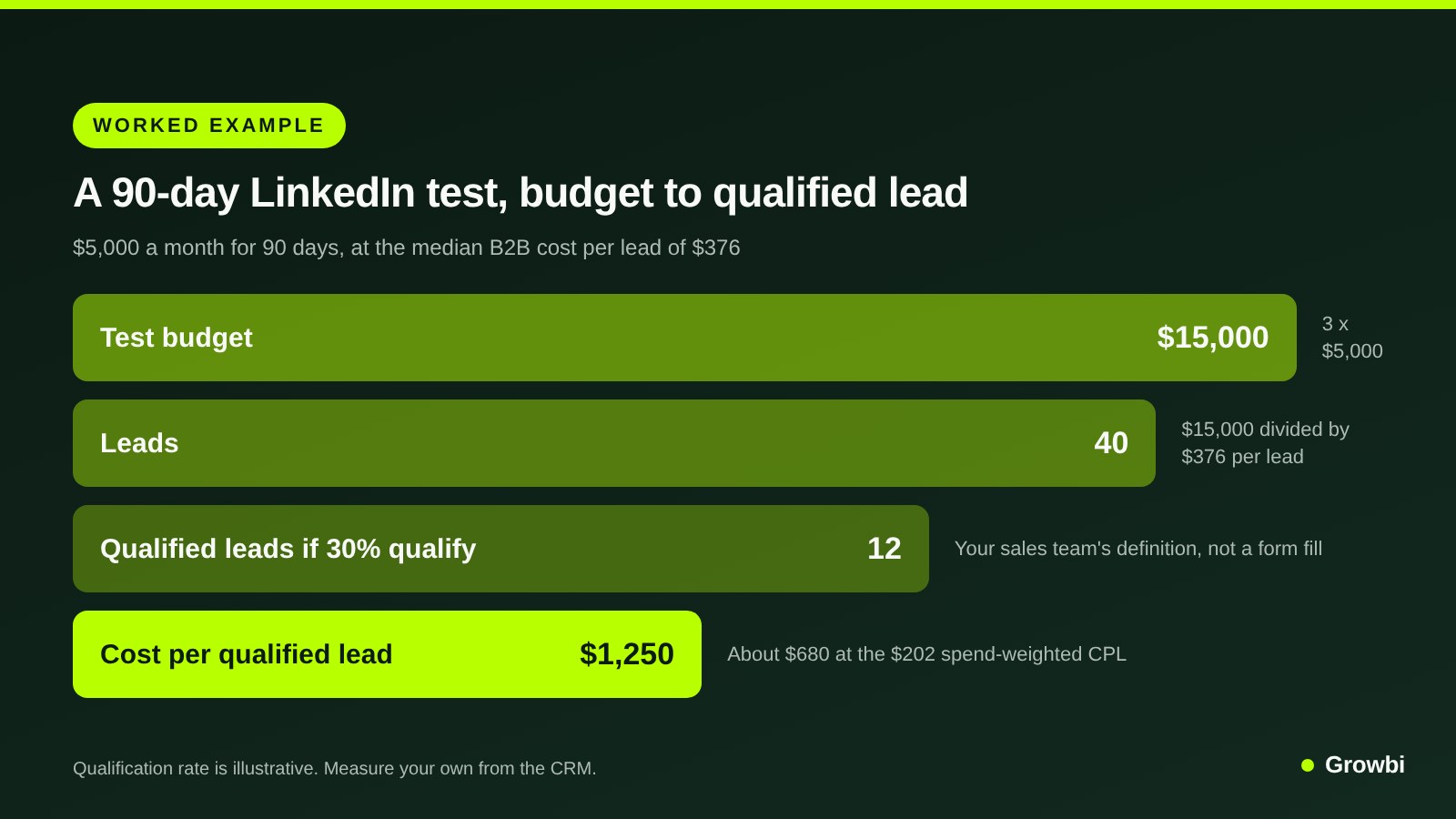
Source: Median cost per lead from Metadata.io, LinkedIn ads cost for B2B; qualification rate illustrative
At the $202 spend-weighted cost per lead, the same budget buys about 74 leads and 22 qualified leads at roughly $680 each. That spread, $680 to $1,250 per qualified lead, is the honest planning range for a first test.
Then compare it with what a customer is worth. Metadata traced pipeline for 94 LinkedIn advertisers: each lead generation dollar sourced $10.20 of pipeline, 19.5% of closed ad-sourced opportunities were won, and each won customer cost $58,572. In the under-200-employee segment, a customer cost $30,739.
Those numbers explain who LinkedIn suits. If a new customer is worth tens of thousands in gross profit over its lifetime, the math can work. If your average deal is a few thousand dollars, LinkedIn lead generation is hard to make pay back.
LinkedIn Ads vs Google Search for B2B
The two channels do different jobs. Google catches buyers who already search for your category; LinkedIn reaches the people who fit your customer profile whether or not they are searching.
On cost per lead, the data is mixed. In Metadata's B2B sample, Google Ads cost $9.76 per click and $524 per lead against LinkedIn's $202. WordStream's 2026 Google Ads benchmarks show a far lower $93.69 per lead for Business Services, at $5.87 per click, across a broader mix of smaller advertisers.
On revenue, Dreamdata's customers saw a 121% return on ad spend from LinkedIn, against 67% for Google Search and 51% for Meta. Dreamdata also reports non-branded search CPCs up 29% and click-through rates down 26%. These are attribution-vendor figures, so test them against your own CRM.
- Start with Google search when buyers type your category or problem into Google, your deal size is small to mid-sized, and you need leads this quarter. Our guide to Google Ads costs shows how to size that budget from cost per lead.
- Start with LinkedIn when you can name the job titles, industries and company sizes that buy, few of them search for what you sell, and one customer is worth a large contract.
- Run both when you have the budget: search for the demand that exists, LinkedIn to reach the buying committee before and during the deal.
If you are new to search, our Google Ads setup guide covers account structure, keywords and negatives step by step.
Be careful with fully automated Google campaigns for lead generation. Our look at when Performance Max works explains why form-fill goals without offline conversion data can fill your CRM with junk.
Meta is the cheaper third option. Metadata measured B2B leads on Facebook at $145 and Instagram at $138, though targeting by job and company is far weaker. Our breakdown of Facebook ads costs covers how that platform prices clicks and leads.
How to Lower Your LinkedIn Cost per Qualified Lead
You cannot negotiate the auction, but you can change what you buy and what LinkedIn learns from.
- Use Lead Gen Forms first. They produced leads at $193 against $346 for landing pages in Metadata's data. Add one or two qualifying questions so sales can filter fast.
- Test document ads. A useful guide or checklist was the cheapest lead format at $142.
- Start broad, then narrow. LinkedIn's audience guidance recommends launching with broader targeting and narrowing based on its demographic reporting.
- Optimize for qualified leads. Feed sales outcomes back so LinkedIn chases buyers, not form fillers.
- Follow up the same day. A form fill from a busy executive goes cold quickly.
The qualified leads goal is the biggest lever. LinkedIn's qualified leads help page explains that it uses lead quality data from the Conversions API or CRM Sync, needs a two-week learning phase, and works best when you upload five or more qualified leads in those two weeks. LinkedIn warns cost per lead may rise while cost per qualified lead falls.
It is the same principle as importing booked outcomes into Google. Our guide to Google Ads conversion tracking shows how to send CRM stages back so bidding optimizes for real customers.
Pro tip: In your CRM, define a qualified lead in one sentence with sales before launch, for example "right title, right company size, agreed to a call", and mark it within 48 hours of the form fill. LinkedIn can only learn from a signal that arrives fast and means the same thing every time.
Speed matters on the sales side too. Our guide to speed to lead shows why the first minutes after a form fill decide how many leads ever turn into a conversation.
Pro tip: Exclude your own company, your competitors and the Unpaid, Training and Entry seniority levels from every prospecting audience. Each click from someone who will never buy raises your cost per qualified lead.
FAQs
How much do LinkedIn ads cost?
LinkedIn ads are sold by auction, so there is no fixed price. In Metadata.io's 2026 B2B benchmarks, built on 2025 spend, LinkedIn averaged $9.39 per click, $63.19 per 1,000 impressions and $202 per lead on a spend-weighted basis. The median advertiser paid $376 per lead, so plan around the higher figure for a first campaign.
What is the minimum budget for LinkedIn ads?
LinkedIn requires a minimum daily budget of $10 for any ad format and a minimum lifetime budget of $100 for a new campaign. LinkedIn suggests $25 a day for new advertisers. A $10 daily budget is enough to run but rarely enough to judge a B2B lead campaign, because it buys only a handful of clicks a week.
Is LinkedIn advertising worth it for B2B?
It can be when a customer is worth a large contract. Metadata.io found each LinkedIn lead generation dollar sourced $10.20 of pipeline, and Dreamdata's customers saw a 121% return on ad spend. Leads are expensive, though, so LinkedIn suits companies with high deal values, a defined buyer profile and a sales team that follows up fast.
Why are LinkedIn ads so expensive?
You pay for precision. LinkedIn lets you target by job title, seniority, company and industry, and many B2B advertisers compete for the same senior audiences in the auction. Click-through rates on feed ads are also low, about 0.67% in Metadata.io's data, so each click carries more of the impression cost.
Is LinkedIn or Google Ads better for B2B lead generation?
Google search is usually better when buyers already search for your category and you need leads quickly. LinkedIn is better when your buyers rarely search for what you sell but are easy to define by job and company. Metadata.io measured B2B leads at $202 on LinkedIn and $524 on Google Ads, but results vary by market.
How does LinkedIn charge for ads?
LinkedIn uses objective-based pricing. Maximum delivery and cost cap bidding charge by impressions, and manual bidding can charge per click, per 1,000 impressions, per video view or per message send. LinkedIn never charges per lead. A daily budget can spend up to twice its amount on one day, but no more than seven times it over a week.
Conclusion
LinkedIn ads cost B2B companies about $9 per click and $200 to $376 per lead in the latest benchmarks, with a $10 daily minimum that buys very little. A realistic first test is around $15,000 over 90 days, judged on cost per qualified lead and pipeline rather than clicks.
Use Lead Gen Forms and document ads, feed qualified leads back through the Conversions API or CRM Sync, and keep Google search for the demand that already exists. See how the Growbi System works when you want both channels measured on pipeline.
If you want a LinkedIn budget worked out for your deal size and buyer profile, book a free pipeline forecast and bring last quarter's leads and opportunities.
Get this system built for your business
Book a strategy call and we will model a realistic appointment target from your budget, market, and offer.
Keep reading
How Much Do Google Ads Cost for a Local Business in 2026?
How Much Do Facebook Ads Cost for a Local Business in 2026?
Google Ads Conversion Tracking: From Calls and Forms to Booked Jobs
Google Ads for Small Business: A Setup Guide for Local Services
Speed to Lead: Why the First 5 Minutes Decide Who Books
B2B Lead Generation Strategies: 9 Ways to Build Qualified Pipeline