B2B PPC: How to Run Paid Search and Social That Builds Pipeline

Key Takeaways
- Core B2B searches cost $37 to $144 per click in DataForSEO's US data, against a $5.42 Google Ads average in WordStream's 2026 benchmarks.
- Forrester's 2026 research puts 13 internal stakeholders and nine external influencers in a typical business purchase, so one click rarely closes a deal.
- Google Search captures demand, LinkedIn reaches job titles, Microsoft Ads adds LinkedIn profile bid adjustments to search, and Meta works best as cheap retargeting.
- Negative keywords for jobs, salaries, students, definitions and free tools protect a B2B budget more than any bid strategy.
- Import qualified leads and closed deals from your CRM into Google and LinkedIn, then bid and report on cost per opportunity, not cost per lead.
B2B PPC is pay-per-click advertising aimed at business buyers, mainly on Google Search, LinkedIn, Microsoft Ads and Meta retargeting. It differs from B2C because deals take months, a buying committee decides, search volume is low and clicks are expensive, so campaigns are judged on qualified leads and pipeline imported from the CRM, not on clicks or form fills.
Most B2B companies that try paid search hit the same wall. The account fills up with form fills from students, job seekers and one-person shops, the sales team stops calling them back, and leadership decides that PPC does not work for B2B.
It does work, but it needs different rules than consumer advertising. Below is how B2B PPC differs from B2C, which channels do which job, the keywords and negatives that keep spend clean, how to feed CRM results back into the platforms, and how to set a budget and pick an agency on pipeline instead of clicks.
What Is B2B PPC?
B2B PPC (business-to-business pay-per-click) is paid advertising that reaches people buying for a company rather than for themselves. You pay when someone clicks, or on some social formats per thousand impressions.
In practice it is a small set of channels, each doing one job:
- Google Search ads capture buyers who are already searching for a solution, a vendor or a competitor.
- LinkedIn Ads reach people by job title, seniority, company and industry, whether or not they are searching.
- Microsoft Ads add Bing search inventory plus LinkedIn profile data you can bid on.
- Meta ads on Facebook and Instagram, mostly as low-cost retargeting of people who already visited your site.
How B2B PPC Differs From B2C
A consumer who searches "plumber near me" often calls within minutes and pays the same day. A company buying software, IT services or manufacturing capacity behaves very differently, and four differences shape every B2B account.
Long sales cycles
The click and the contract can be months apart. If the ad platforms only see the form fill, they optimize for whatever produces the most form fills, which is rarely the lead that becomes revenue.
Buying committees
Forrester's State of Business Buying, 2026 found that the typical buying decision now includes 13 internal stakeholders and nine external influencers. Procurement is a decision-maker in 53% of buying cycles, and more than 60% of buyers use a trial before purchasing.
That means the person who clicks your ad is often a researcher, not the signer. Your ads, landing pages and retargeting have to serve several roles: the user who wants it to work, the manager who owns the budget, and the procurement lead comparing vendors.
Low search volume
B2B niches are small. Even the phrase "b2b ppc" draws about 140 US searches a month in DataForSEO's Google Ads data, and many industrial or vertical software terms draw fewer. Low volume means fewer conversions for bidding algorithms to learn from and a bigger cost to every wasted click.
High cost per click
WordStream's 2026 Google Ads benchmarks, based on 13,474 US search campaigns run through LocaliQ, put the all-industry median cost per click at $5.42. Core B2B software and services searches cost many times that.
In DataForSEO's US data, "payroll software" averages $144.10 per click, "managed it services" $65.28, "cybersecurity services" $53.20, "erp software" $46.41 and "crm software" $37.13. At those prices, ten irrelevant clicks can cost more than a week of a consumer campaign.
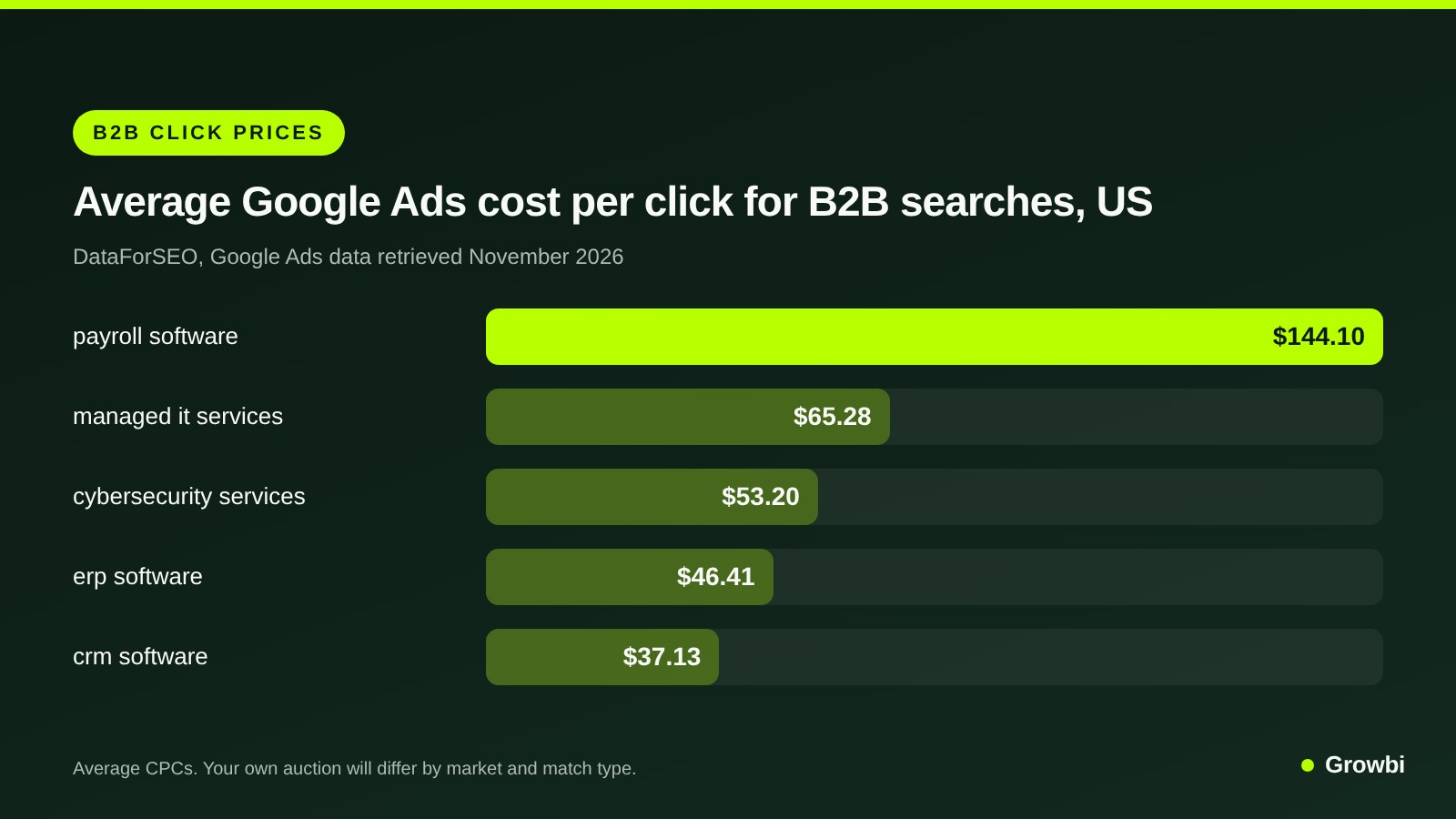
Source: DataForSEO, Google Ads search volume and CPC data, United States, retrieved November 2026
The B2B PPC Channel Mix
No single platform covers the whole B2B journey. The strongest accounts combine a demand-capture channel with a targeting channel and a retargeting layer, then let the CRM decide where the next dollar goes.
Google Search: capture existing demand
Google is where buyers type the problem, the category or a competitor's name. It is usually the first channel to fund, because intent is visible in the query and the lead is closest to a sales conversation.
The price of that intent is high, so structure matters more than in consumer accounts. Our breakdown of what Google Ads cost explains how bids, Quality Score and competition set the price you pay per click.
LinkedIn Ads: reach the buying committee
LinkedIn lets you target by job title, function, seniority, company size and named accounts using its own profile data. That makes it the natural place to reach the other members of the buying committee who will never search for you.
According to LinkedIn's budget guide, the minimum daily budget is $10 for any ad format, and new campaigns need at least a $100 lifetime budget (as of November 2026). Real costs per lead are far higher than those minimums, as our guide to LinkedIn ads cost shows.
Microsoft Ads: search with LinkedIn data
Microsoft Ads offers something Google does not. Microsoft's help center describes LinkedIn profile targeting by company, industry and job function on Search, Dynamic Search, Audience and Performance Max campaigns.
It works as a bid adjustment, not a filter. Targeting a company does not exclude people who work elsewhere, so you use it to bid more on searchers in your target industries and job functions, up to 1,000 companies per ad group or campaign.
Pro tip: Import your Google Search campaigns into Microsoft Ads, then add LinkedIn industry and job function targets in observation with no bid change for the first month. Once you see which segments produce qualified leads, raise bids on those and lower them on the rest.
Meta: low-cost retargeting
Facebook and Instagram cannot target by job title, but they are cheap places to stay in front of people who already visited your pricing page, read a case study or started a demo request. For most B2B companies, Meta is a retargeting and nurture layer rather than a prospecting channel.
Retargeting audiences are small in B2B, so frequency climbs fast. Our guide to Facebook ads cost covers how CPM and frequency drive what you pay on Meta.
Performance Max: use with care
Google's automated campaign type spreads budget across Search, YouTube, Display and Gmail. Without qualified conversion data it tends to find the cheapest form fills, which in B2B often means the least qualified ones.
Run it only once your CRM is feeding qualified lead and opportunity conversions back to Google. Our Performance Max guide covers the controls, exclusions and reporting you need before handing it budget.
Google Ads for B2B: Keyword Strategy
B2B keyword strategy is about intent, not volume. Group keywords by how close the searcher is to a buying conversation, and give the highest-intent groups the most budget.
- Solution and category terms: "payroll software for manufacturers", "managed it services for law firms". The core of most accounts.
- Vendor-selection terms: "best erp software", "crm pricing", "cybersecurity companies". Buyers comparing options, often with procurement involved.
- Competitor and alternative terms: "[competitor] alternative", "[competitor] pricing". Expensive but close to a decision; keep the ad copy factual.
- Problem terms: "reduce payroll errors", "soc 2 compliance help". Earlier stage, cheaper, best paired with a guide or checklist offer.
- Brand terms: your own name. Usually the cheapest qualified clicks in the account; separate them so they do not flatter the other campaigns' numbers.
Write ad copy that pre-qualifies. Naming the audience ("for 50 to 500 employee firms"), a starting price or a minimum contract cuts unqualified clicks before you pay for them.
Negative keywords that protect a B2B budget
Many B2B terms share words with job searches, homework and free tools. In DataForSEO's US data, "what is crm" draws 33,100 searches a month, "free crm" 5,400, "crm jobs" 1,900 and "crm certification" 1,300, all from people who are not buying CRM software for a company.
- Job seekers: jobs, job, careers, hiring, salary, salaries, resume, internship, interview, remote job.
- Students and learners: what is, definition, meaning, course, certification, training, tutorial, pdf, examples, exam.
- Free and DIY: free, open source, template, download, crack, cheap, diy.
- Consumers and personal use: personal, home, for students, app for iphone (adjust to your product).
- Wrong fit: sizes or segments you do not serve, for example "small business" if your floor is 200 employees.
Pro tip: Put these into one shared negative keyword list and apply it to every Search and Shopping campaign on day one. Then review the search terms report weekly for the first month, because B2B terms collide with consumer and job queries in ways no starter list predicts.
Two more filters help. Schedule ads heavier during business hours in your buyers' time zones, and turn off or limit placements like mobile apps on Display and Demand Gen, where accidental clicks are common.
Track Pipeline With Offline Conversion Import
This is the step most B2B accounts skip, and it is the one that decides whether PPC scales. The goal is to tell Google and LinkedIn which clicks became qualified leads, opportunities and customers, so their bidding learns from revenue, not from form fills.
On Google, the current method is enhanced conversions for leads, an upgraded offline conversion import. Your form sends a hashed email to Google, you store the lead in your CRM, and when the lead reaches a stage such as SQL or closed-won, you import that event with the same hashed email and the GCLID when you have it.
Google's help page notes that since June 15, 2026, offline conversion and enhanced conversions for leads uploads go through the Data Manager API rather than the Google Ads API, so older custom integrations may need updating. Our Google Ads conversion tracking guide walks through the tag side of the setup.
LinkedIn has its own route. The LinkedIn Conversions API connects CRM and offline events, with partner integrations for HubSpot, Salesforce Data 360 and others, and LinkedIn recommends setting it up before using its qualified leads optimization goal.
- Capture the GCLID (Google) and the email on every form, and store both on the CRM lead record.
- Agree with sales on stage definitions: what counts as a marketing-qualified lead, a sales-qualified lead and an opportunity.
- Create one conversion action per stage in Google Ads and LinkedIn, with a value per stage if you can estimate it.
- Sync stage changes from the CRM daily through a native connector or an integration tool.
- Once the volume is there, make the qualified stage the primary conversion for bidding and set raw form fills to secondary.
Pro tip: If you only have a handful of closed deals a month, bid on the sales-qualified lead stage, not on closed-won. Smart Bidding needs a steady stream of conversions to learn, and SQLs arrive often enough while still filtering out the junk.
B2B PPC Metrics That Matter
Cost per lead is a trap on its own in B2B. WordStream's 2026 data puts the median Business Services cost per lead at $93.69 and conversion rate at 4.85%, but that figure counts every form fill, including the ones your sales team will never call back.
- Cost per qualified lead: spend divided by leads that pass your agreed qualification criteria.
- Lead-to-opportunity rate: the share of qualified leads that become a real sales opportunity.
- Cost per opportunity: spend divided by opportunities created; the most useful weekly number in a B2B account.
- Pipeline per ad dollar: total opportunity value created divided by spend.
- Customer acquisition cost and payback: spend per closed customer, against the contract value and gross margin.
Report these by campaign and keyword group, not just account-wide. A campaign with a high cost per lead and a high opportunity rate usually beats a cheap-lead campaign that never reaches the pipeline.
How to Set a B2B PPC Budget
Work backward from the deals you need, not from a round monthly number. Here is an example with assumptions, not benchmarks, so replace each figure with your own.
- A $20,000 monthly search budget at a $40 average cost per click buys about 500 clicks.
- At a 5% conversion rate, that is 25 leads, or $800 per lead.
- If 40% pass sales qualification, you get 10 sales-qualified leads at $2,000 each.
- If half become opportunities, that is 5 opportunities at $4,000 each.
- At a 30% win rate, about 1.5 new customers a month, or roughly $13,300 per customer.
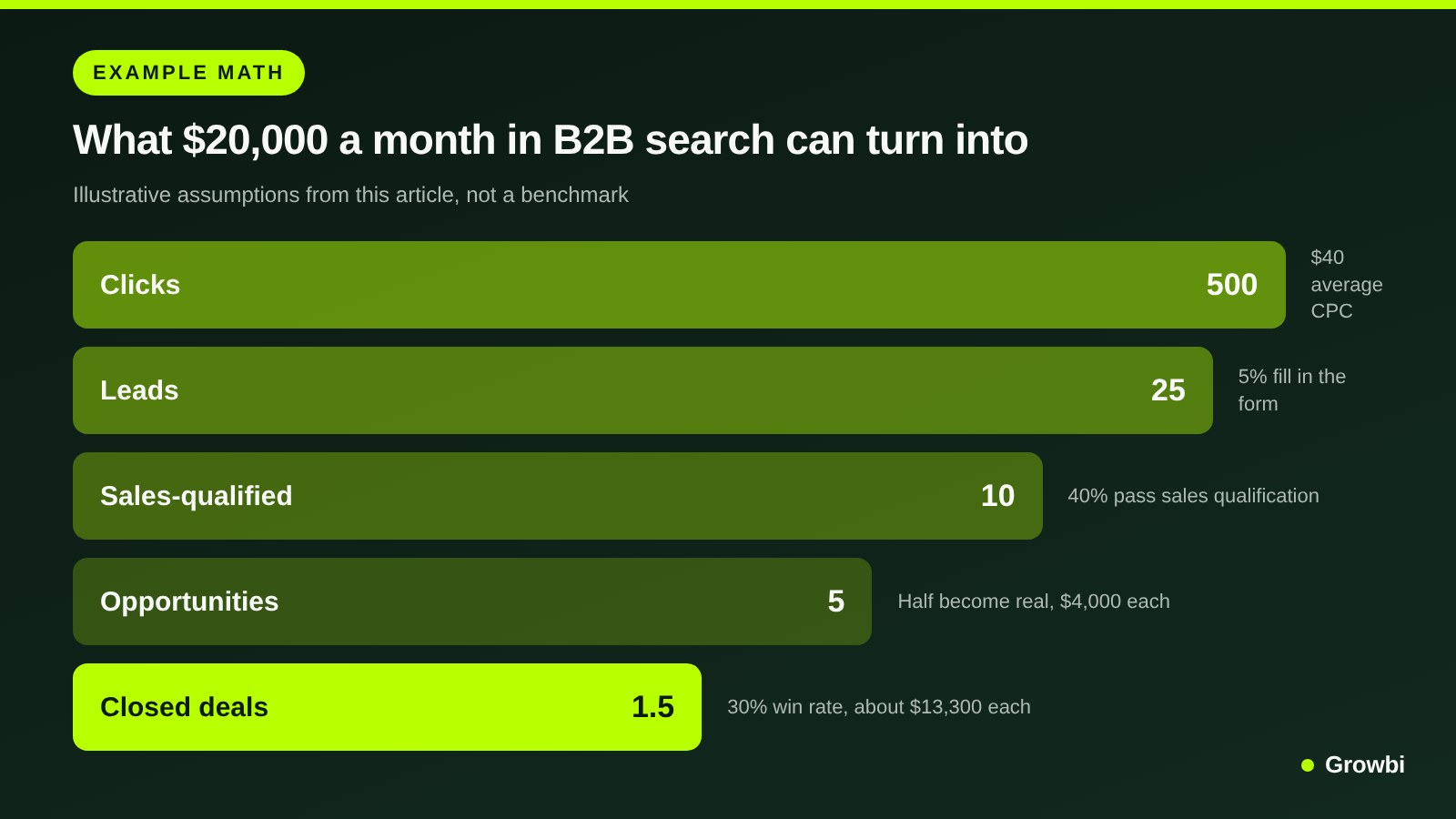
Whether $13,300 per customer is good depends entirely on contract value. For a $60,000 annual contract it is excellent; for a $3,000 one it is a loss, and search alone will not work without a cheaper channel or a higher price.
Budget for patience too. With a long sales cycle, judge the first 60 to 90 days on qualified leads and opportunities created, then on closed revenue once deals have had time to close. Our guide to Google Ads for small business covers how to start lean when the budget is tight.
Pro tip: Before raising spend, test the funnel at a small budget for one high-intent keyword group. If those leads do not become opportunities, more budget will only buy more of the same problem.
What to Look for in a B2B PPC Agency
A B2B PPC agency should talk about your pipeline in the first meeting, not your click-through rate. Use these questions to separate specialists from generalists.
- Do they set up offline conversion import? Ask how they will connect your CRM to Google and LinkedIn and which stage they will optimize toward.
- What do they report on? Cost per qualified lead, cost per opportunity and pipeline, alongside spend, not just impressions and leads.
- How do they handle low volume? They should explain how they bid when conversions are scarce, and what they do in the first 90 days.
- Which channels do they run? Google, LinkedIn and Microsoft Ads in one plan, with budget moved by results rather than by habit.
- Who owns the accounts? You should own the ad accounts, data and creative, with no long lock-in contract.
- Do they talk to sales? The best agencies join a pipeline review every month, because lead quality is decided there.
Red flags are the opposite: guarantees of lead volume, reporting that stops at cost per lead, and no interest in what happened to last month's leads.
FAQs
What is B2B PPC?
B2B PPC is pay-per-click advertising aimed at people who buy for a business. It runs mainly on Google Search, LinkedIn Ads, Microsoft Ads and Meta retargeting. Unlike consumer PPC, success is measured on qualified leads, opportunities and pipeline imported from the CRM, because B2B deals take months and involve a buying committee rather than a single buyer.
Does Google Ads work for B2B?
Yes, when the account is built for B2B. Google Search captures buyers who are already looking for a solution or vendor. It works when keywords focus on purchase intent, negative keywords block job seekers, students and free-tool searches, and CRM results are imported so bidding learns from qualified leads instead of every form fill.
How much should a B2B company spend on PPC?
Work backward from deals. Divide the deals you want by your win rate, opportunity rate and lead qualification rate to get the leads you need, then multiply by your expected cost per lead. Core B2B software and services searches often cost $37 to $144 per click in DataForSEO's US data, so budgets usually start in the thousands per month.
Is LinkedIn or Google better for B2B ads?
They do different jobs. Google Search captures people already searching for your solution, so it usually produces the most sales-ready leads first. LinkedIn reaches job titles, seniority and named companies who are not searching, which suits the wider buying committee and account-based campaigns. Most B2B companies start with Google and add LinkedIn once tracking is in place.
What negative keywords should B2B companies use?
Start with words that signal job seekers (jobs, careers, salary, hiring, internship), students (what is, definition, course, certification, pdf), free tools (free, template, open source, download) and segments you do not serve. Apply them as one shared list across all campaigns, then review the search terms report weekly to add new irrelevant queries.
What does a B2B PPC agency do?
A B2B PPC agency plans and manages paid search and paid social for business buyers: keyword and audience strategy, ad copy, landing pages, bidding, and conversion tracking. A good one connects your CRM to Google and LinkedIn, reports cost per qualified lead and cost per opportunity, and joins pipeline reviews with sales.
Conclusion
B2B PPC works when each channel does its own job: Google and Microsoft Ads capture buyers who are searching, LinkedIn reaches the rest of the buying committee, and Meta keeps you in front of past visitors cheaply.
What decides the result is discipline around the clicks: tight intent-based keywords, a strong negative list, and qualified leads and opportunities flowing back from the CRM so every platform optimizes toward pipeline.
If you want to see what a qualified lead and an opportunity should cost your business before committing a budget, get a free pipeline forecast and we will walk through the numbers with you.
Get this system built for your business
Book a strategy call and we will model a realistic appointment target from your budget, market, and offer.
Keep reading
How Much Do Google Ads Cost for a Local Business in 2026?
How Much Do LinkedIn Ads Cost in 2026? CPC, CPL and Budgets
Google Ads Conversion Tracking: From Calls and Forms to Booked Jobs
Performance Max for Local Service Businesses: When It Works
How Much Do Facebook Ads Cost for a Local Business in 2026?
B2B Lead Generation Strategies: 9 Ways to Build Qualified Pipeline