B2B Lead Generation Strategies: 9 Ways to Build Qualified Pipeline

Key Takeaways
- Start with demand capture: search ads, comparison and pricing pages, and retargeting reach buyers who are already shopping.
- Use LinkedIn, lead magnets and webinars to reach accounts before they shortlist, because most buyers pick a favorite before they contact anyone.
- Agree on written MQL and SQL definitions with sales before you spend, and send the SQL stage back to the ad platforms.
- Respond within minutes: Harvard Business Review research found an hour's delay sharply cuts the odds of qualifying a lead.
- Judge every channel by cost per qualified opportunity, not cost per lead, because cheap leads rarely become cheap pipeline.
B2B lead generation strategies are the channels and offers that turn target accounts into sales conversations. The nine that fill pipeline most reliably are search ads on high-intent terms, comparison and pricing pages, retargeting, LinkedIn, lead magnets, webinars, SEO and AI search, outbound backed by ads, and partners. Judge each by cost per qualified opportunity.
Most lists of B2B lead generation strategies give you 30 ideas and no way to choose. You end up running a little of everything, the form fills pile up, and sales says the leads are bad.
This guide is shorter and more opinionated. It covers nine strategies that reliably produce sales conversations, and for each one it says when it fits, what it costs and how long it takes to show results.
Then it covers what most guides skip: MQL and SQL rules, response speed, and cost per qualified opportunity, the number that tells you where the next dollar should go.
What Is B2B Lead Generation?
B2B lead generation is the work of finding companies that could buy from you and starting a sales conversation with the people who decide. A lead is a person who raised a hand. Pipeline is the leads sales has accepted as real opportunities with a deal size and a close date.
The hard part is timing. In the 6sense 2025 B2B Buyer Experience study of nearly 4,000 buyers, the first contact with a seller came 61% of the way through the buying process. Buyers filled four of five shortlist spots on day one, 79% initiated contact themselves, and they bought from their top-ranked vendor 77% of the time.
AI now shapes that early, invisible part of the journey. In G2's 2026 Buyer Behavior Report, 82% of software buyers had sourced recommendations from an AI chatbot in the last 24 months, and review sites (38%) and AI chatbots (37%) were the top two sources shaping shortlists.
So good B2B lead generation does two jobs. It captures the buyers who are already shopping, and it makes sure you are already the favorite for the ones who are not shopping yet.
Demand Capture: Strategies That Reach Buyers Already Shopping
Start here. These three strategies reach people who are actively comparing vendors, so they produce sales conversations fastest and are the easiest to measure.
1. Search Ads on High-Intent Terms
Bid on the searches a buyer types when they need a provider: "[category] software," "[service] company," "[competitor] alternative," "[category] pricing." Skip broad research terms like "what is [category]" at the start, because they bring students and early researchers.
- When it fits: people search for what you sell by name, and your deal size can carry a lead cost near $100.
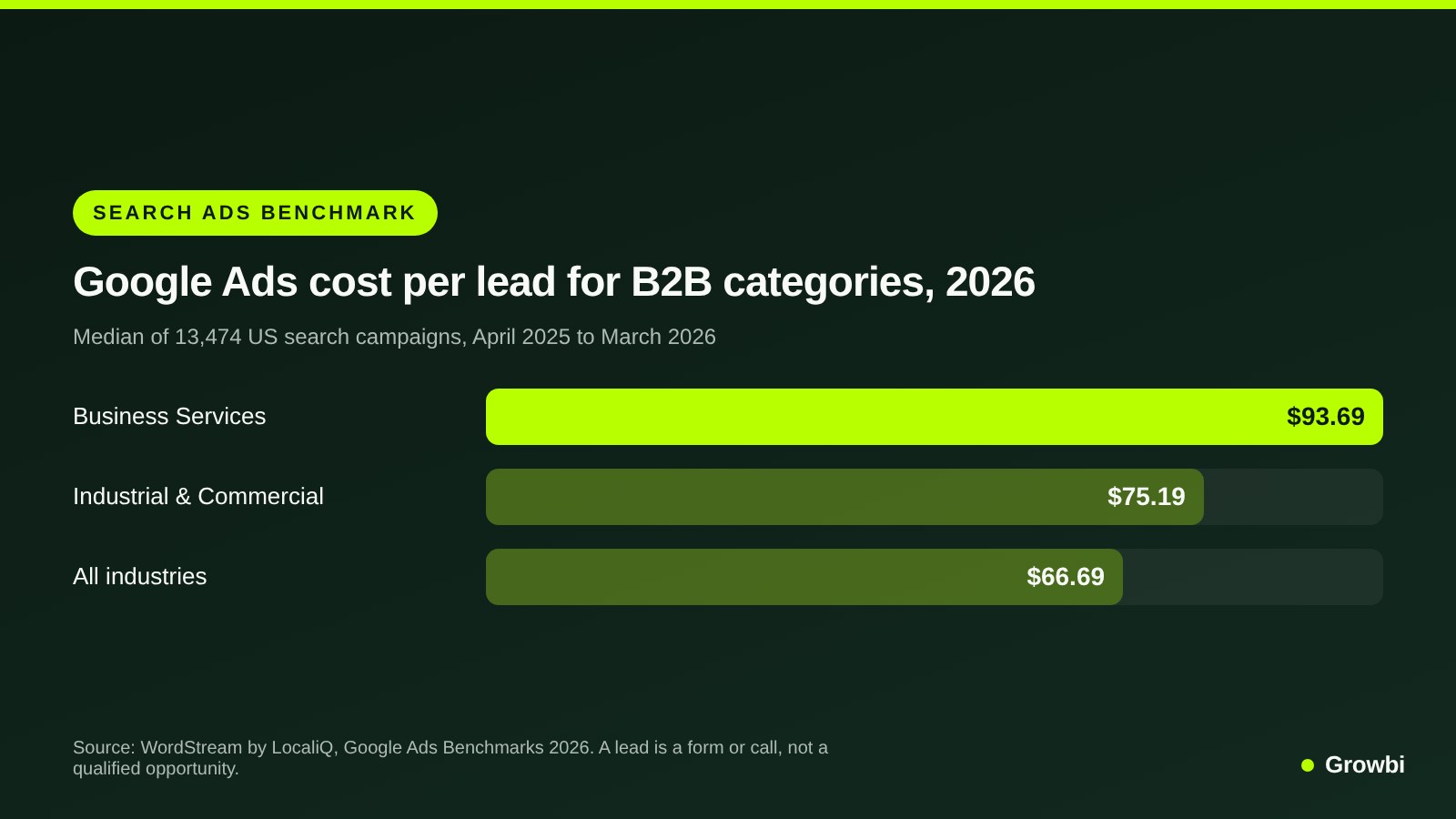
- Cost: in WordStream's 2026 benchmarks, Business Services averaged $5.87 per click, a 4.85% conversion rate and $93.69 per lead; Industrial and Commercial averaged $75.19 per lead.
- Time to results: leads within days of launch; a trustworthy cost per opportunity takes one to two sales cycles.
Those figures come from WordStream by LocaliQ's Google Ads benchmarks, the median of 13,474 US search campaigns that ran from April 2025 to March 2026. The sample leans toward small businesses, so competitive software and enterprise categories usually pay more.
Our B2B PPC guide covers campaign structure, keyword lists and budgets in detail.
Pro tip: Before launch, add a negative keyword list for job and learning searches: jobs, careers, salary, hiring, internship, course, certification, definition, template, free and examples. B2B terms attract job seekers and students, and these words keep them out of your budget from day one.
2. Comparison and Pricing Pages
Shortlisting buyers search for "[you] vs [competitor]" and "[category] pricing." If you have no honest page that answers them, a review site or a competitor will.
- When it fits: you have known competitors and buyers compare before they talk to sales, which is most B2B purchases.
- Cost: mostly writing and design time; the pages also become your best landing pages for competitor and pricing search ads.
- Time to results: paid traffic converts on them immediately; organic rankings take months.
3. Retargeting Site Visitors
Most visitors to a B2B site leave without filling a form. Retargeting on LinkedIn, Meta and Google shows them proof, such as a customer story, a demo video or a webinar, while they keep evaluating.
- When it fits: your site gets steady traffic from search, content or outbound, so the audience is big enough to serve.
- Cost: low total spend, because the audience is small; it is limited by your traffic, not your budget.
- Time to results: weeks, as the audience builds; it lifts the conversion rate of every other channel rather than standing alone.
Meta is often the cheapest place to stay in front of those visitors. Our guide to B2B Facebook ads explains when Meta works for business buyers and when it does not.
Demand Creation: Strategies That Reach Buyers Before They Shortlist
Capture only works if buyers already want what you sell and already know your name. These three strategies put you in front of the right accounts earlier, so you are on the day-one shortlist.
4. LinkedIn Ads
LinkedIn is the only major ad platform where you can target by job title, seniority, company size and a named list of accounts. That precision is why it costs more per click than Meta or most Google searches.
- When it fits: your buyers are a defined set of roles at a defined set of companies, and one deal is worth thousands of dollars or more.
- Cost: as of November 2026, LinkedIn's minimum is $10 a day per campaign, but a useful test needs far more; see our breakdown of LinkedIn ads cost.
- Time to results: leads in the first weeks; opportunities follow over one to two sales cycles.
LinkedIn documents those budget minimums on its campaign budgets page: $10 a day for any ad format, and $100 lifetime for a new campaign. They are a floor for testing, not a plan.
Native forms raise volume because the fields are prefilled from the member's profile, but they also lower intent. Our guide to LinkedIn Lead Gen Forms shows how to add qualifying questions so volume does not swamp sales.
Pro tip: Upload your current customer list and open opportunities as a company list and exclude them from prospecting campaigns. Exclude your own employees too. Every impression then goes to accounts that could still become new pipeline.
5. Lead Magnets and Calculators
A lead magnet trades something useful for contact details. In B2B, the best ones help the buyer do part of their evaluation: an ROI or pricing calculator, a requirements checklist, a benchmark report, or a template they would otherwise build themselves.
- When it fits: your buyers research for weeks before talking to sales, and you need a reason for them to share an email earlier.
- Cost: production time up front, then paid distribution on LinkedIn, Meta or search.
- Time to results: downloads start as soon as you promote it; most become sales conversations only after nurture.
6. Webinars and Live Events
A live session on a real problem, ideally with a customer or partner, puts an hour of your expertise in front of a whole buying group. Attendees can ask questions, and the recording becomes a lead magnet and retargeting asset.
- When it fits: your product or service needs explaining, and you have someone who can teach without pitching.
- Cost: mostly preparation time, a webinar tool and promotion spend to fill the registration list.
- Time to results: several weeks of preparation before the event; follow-up turns attendees into meetings in the weeks after.
Visibility and Relationships: Strategies That Compound
These three strategies take longer to build, but they keep working after you stop paying for each click, and they shape the shortlist before a buyer ever fills a form.
7. SEO and AI Search Visibility
Buyers ask Google, ChatGPT and Google AI Mode which vendors to consider. Those answers draw on pages that clearly explain what you do, for whom and at what price, plus third-party mentions on review sites, comparison articles and forums.
- When it fits: every B2B company, but it pays most where buyers research for weeks and compare many vendors.
- Cost: content, technical work and review building; no media cost per visit.
- Time to results: months, not weeks; it compounds once pages rank and get cited.
Start with the pages a buyer needs to shortlist you: services or product pages, pricing, comparisons, use cases and customer stories. Our guide to answer engine optimization explains how to structure them so AI answers can quote you.
8. Outbound Backed by Ads
Cold email and calls still start conversations, but outreach works better when the account has already seen your name. Run LinkedIn or Meta ads to the same account list your sales team is prospecting, so the first email is not the first touch.
- When it fits: you can name your best-fit accounts and have people to work them.
- Cost: sales development time, data and email tools, plus a modest ad budget against a fixed account list.
- Time to results: meetings in weeks if the list and message are right.
Since most buyers make the first contact themselves, aim outbound at accounts showing signs of a live project, such as site visits, hiring for the role you serve or a new leader.
9. Partner and Referral Programs
Agencies, consultants, implementation firms and complementary vendors already talk to your buyers. A referral from one of them skips most of the trust-building that ads and content have to do.
- When it fits: you have happy customers and natural partners who serve the same buyer without competing with you.
- Cost: a referral fee or revenue share on closed deals, plus the time to manage partners.
- Time to results: slow to set up, then steady; referred buyers arrive with the trust that paid leads still have to earn.
Most partner programs fail because referrals go unanswered, so give partners a simple way to refer and a fast response.
MQL vs SQL: How to Qualify B2B Leads
Most fights between marketing and sales are really a missing definition. Write two of them down before you spend a dollar.
- Marketing qualified lead (MQL): a lead that fits your ideal customer profile and showed buying intent, for example a director or above at a company in your size range who requested a demo or used the pricing calculator.
- Sales qualified lead (SQL): an MQL that sales has spoken to and confirmed has a real need, a budget or budget process, a timeline and access to the people who decide.
- Qualified opportunity: an SQL that sales has entered in the CRM with a deal value and an expected close date.
Put the qualifying questions on the form or in the first call: company size, role, timeline and what they are using today. Two or three good questions cost a little form volume and save a lot of sales time.
Then tell the ad platforms which leads were good. Google's offline conversion imports FAQ recommends a qualified lead or converted lead goal, a separate conversion action for each funnel stage, and bidding to only one stage. It also notes that click IDs are kept for 90 days.
That 90-day limit matters in B2B, where deals often take longer. Import the SQL stage, which usually happens within weeks, rather than closed revenue, which may come too late to count. Our guide to Google Ads conversion tracking walks through the setup.
Pro tip: Add a hidden GCLID field to every form and store it on the lead record in your CRM. When sales moves a lead to SQL, a daily export of those click IDs to Google Ads teaches Smart Bidding what a good B2B lead looks like.
Speed to Lead: Why the First Hour Decides B2B Deals
A demo request is a buyer comparing vendors right now. If you take a day to respond, the vendor who called back first has already framed the evaluation.
In The Short Life of Online Sales Leads, Harvard Business Review audited 2,241 US companies: only 37% responded to a web lead within an hour, 24% took more than 24 hours and 23% never responded.
In a separate study of leads at 29 B2C and 13 B2B companies, firms that tried to reach a lead within an hour were nearly seven times as likely to qualify it as those that waited even an hour longer.
The researchers named three causes that are still common in B2B sales teams: pulling leads from the CRM once a day instead of continuously, reps focused on their own prospecting, and lead routing rules based on territory and fairness instead of speed.
- Route instantly. Assign inbound demo requests to whoever is available now, with territory rules only as a tiebreaker.
- Book on the thank-you page. Show a scheduler right after the form so a qualified buyer can pick a time before they leave.
- Set a written response target. For example, first call within 15 minutes during business hours, and review it weekly.
Our speed to lead guide has the call and text scripts; they were written for local businesses, and the timing rules carry straight over to B2B.
Pro tip: Send every new demo request to a shared Slack or Teams channel with the company name and the answers to your qualifying questions. When the whole team can see a lead waiting, it rarely waits long.
How to Measure Cost per Qualified Opportunity
Cost per lead is easy to see in the ad platforms and easy to game. Cost per qualified opportunity is the number that predicts revenue, and it is the one we use to decide where the next dollar goes.
Divide a channel's total monthly cost, fees and production included, by the opportunities sales accepted from it.
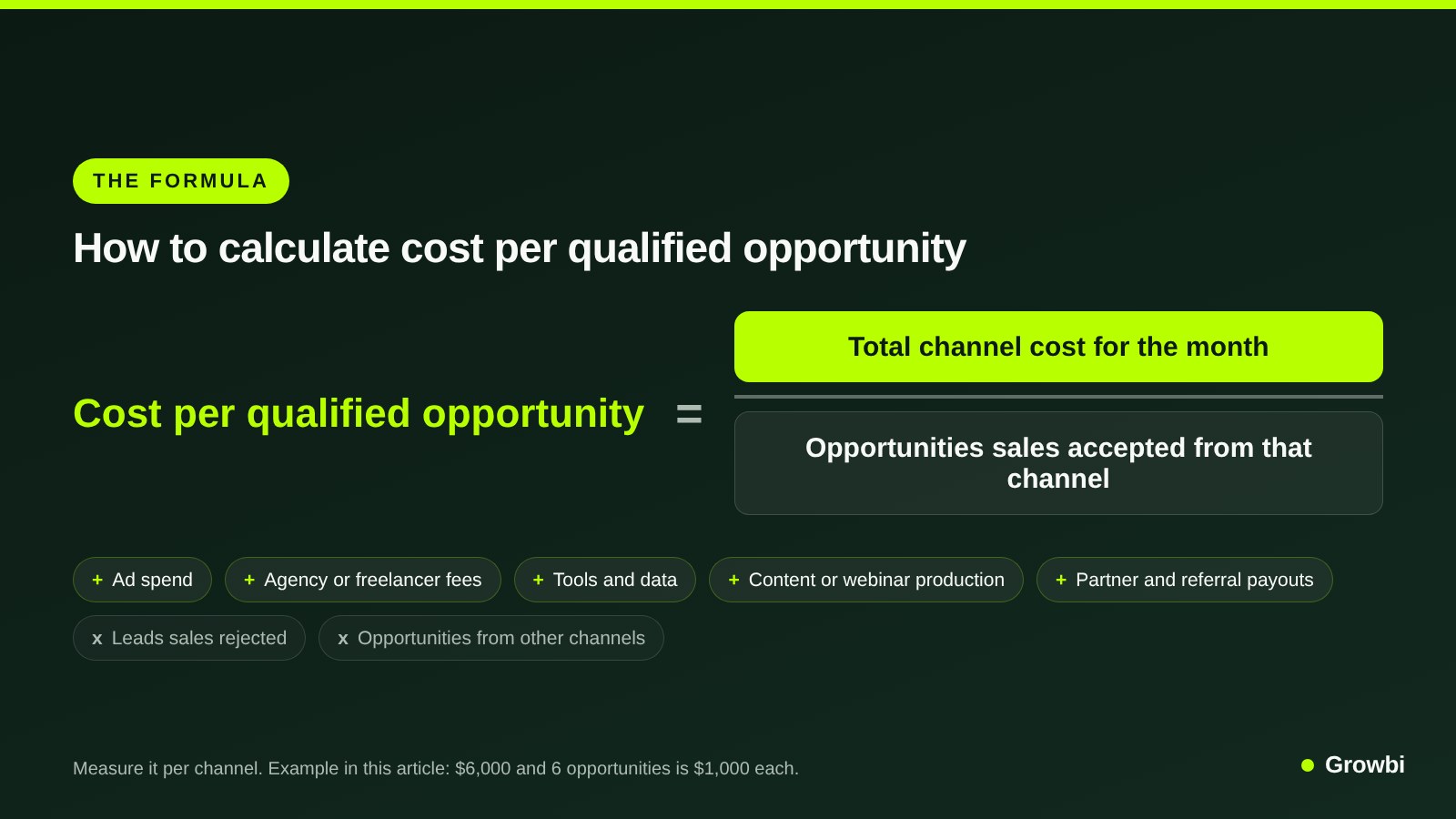
Here is an example, not benchmark data. A company spends $6,000 a month on search ads and gets 60 leads, $100 each. Eighteen meet the MQL rules, sales accepts 9 as SQLs, and 6 become qualified opportunities: $1,000 per opportunity.
The same company spends $6,000 on a LinkedIn lead form campaign and gets 120 leads at $50. Only 3 become opportunities, so the cost per opportunity is $2,000. The channel with the cheaper lead is twice as expensive where it counts.
- Track source on every lead. Save UTM parameters and click IDs in hidden fields so each CRM record shows where it came from.
- Report monthly by channel. Leads, MQLs, SQLs, opportunities, cost per opportunity and pipeline value, side by side.
- Set a ceiling from your deal math. If one in four opportunities closes at $20,000, an opportunity is worth about $5,000 in revenue, which tells you how much you can afford to pay for one.
FAQs
What are the best B2B lead generation strategies?
The most reliable B2B lead generation strategies are search ads on high-intent terms, comparison and pricing pages, retargeting, LinkedIn ads, lead magnets and calculators, webinars, SEO and AI search visibility, outbound backed by ads, and partner referrals. Start with demand capture, which reaches buyers already shopping, then add demand creation, and judge every channel by cost per qualified opportunity.
What is the difference between an MQL and an SQL?
A marketing qualified lead (MQL) fits your ideal customer profile and has shown buying intent, such as a demo request from the right role at the right size company. A sales qualified lead (SQL) is an MQL that sales has spoken to and confirmed has a real need, budget, timeline and access to the decision makers. Write both definitions down with sales before launching campaigns.
How much does B2B lead generation cost?
It depends on the channel. WordStream's 2026 benchmarks put the median Google Ads cost per lead at $93.69 for Business Services and $75.19 for Industrial and Commercial. LinkedIn requires at least $10 a day per campaign, but useful tests cost far more. A lead is not an opportunity, so calculate cost per qualified opportunity for each channel before scaling it.
How long does B2B lead generation take to work?
Search ads and retargeting can produce leads within days, and LinkedIn within the first weeks. Turning those leads into qualified opportunities takes one to two sales cycles, so judge a paid channel after that. Webinars need several weeks of preparation. SEO, AI search visibility and partner programs take months to build but keep producing leads after the work is done.
Is LinkedIn or Google Ads better for B2B lead generation?
They do different jobs. Google Ads captures buyers who are already searching for a provider, so it usually produces sales conversations fastest. LinkedIn reaches specific job titles and named accounts before they search, which suits high-value deals with a defined buyer. Most B2B companies start with search, add LinkedIn for target accounts, and compare both on cost per qualified opportunity.
How fast should you follow up with a B2B lead?
Within minutes during business hours, and always within the hour. Harvard Business Review research found firms that tried to contact a lead within an hour were nearly seven times as likely to qualify it as firms that waited even an hour longer. Route demo requests instantly, show a scheduler on the thank-you page and set a written response target.
Conclusion
The B2B lead generation strategies that fill pipeline are the ones matched to where your buyers are: search ads, comparison pages and retargeting for buyers already shopping, LinkedIn, lead magnets and webinars to reach them earlier, and SEO, AI search, outbound and partners to stay on the shortlist.
Whatever mix you choose, the rules are the same. Define MQL and SQL with sales, respond within minutes, send the SQL stage back to the ad platforms and judge every channel by cost per qualified opportunity. See how the Growbi System works if you want that loop run for you.
If you want to know what a qualified opportunity should cost in your market, get a free pipeline forecast and bring last quarter's leads and opportunities by channel.
Get this system built for your business
Book a strategy call and we will model a realistic appointment target from your budget, market, and offer.
Keep reading
B2B PPC: How to Run Paid Search and Social That Builds Pipeline
How Much Do LinkedIn Ads Cost in 2026? CPC, CPL and Budgets
LinkedIn Lead Gen Forms: How to Set Them Up for Qualified B2B Leads
B2B Facebook Ads: When Meta Works for B2B and How to Run It
Speed to Lead: Why the First 5 Minutes Decide Who Books
Google Ads Conversion Tracking: From Calls and Forms to Booked Jobs