B2B Facebook Ads: When Meta Works for B2B and How to Run It

Key Takeaways
- Meta suits B2B offers aimed at many small and mid-size buyers; for a short list of named enterprise accounts or narrow job titles, LinkedIn and search usually fit better.
- Meta has removed granular detailed targeting options (2022) and detailed targeting exclusions (2025), so your customer lists, lookalikes and retargeting do the targeting now.
- Offer something worth a work email: an audit, a calculator, a webinar or a short demo, and qualify with form questions or a landing page.
- Send CRM stages back to Meta: the Conversion Leads goal needs instant forms, about 200 leads a month and daily uploads.
- WordStream's 2026 data puts the median Meta cost per lead at $27.39, and $35.87 for industrial and commercial advertisers; budget for the cost per qualified lead, which is higher.
B2B Facebook ads work when your buyers are a broad group Meta can reach, such as small business owners, practice managers or trades, and you offer something useful early, like an audit, calculator or webinar. They struggle for narrow enterprise job titles. Build audiences from your own customer data and judge results on qualified pipeline, not cost per lead.
Most B2B marketers file Facebook under consumer brands. Yet the owner of a 20-person agency, the office manager at a dental group and the operations lead at a logistics firm all scroll Instagram and Facebook every day. The question is not whether they are there, it is whether you can reach the right ones and turn them into pipeline.
This guide answers that for owners and marketing leads weighing Meta ads for B2B, on Facebook and Instagram: when the channel works and when it does not, how targeting works now that Meta has cut most precise options, which audiences and offers to use, how to send CRM outcomes back to Meta, and what it costs.
When Facebook Ads Work for B2B, and When They Do Not
Meta is a reach and demand creation channel. It does well when the people who buy from you are numerous, reachable as a broad group, and willing to engage with a useful offer before they are ready to talk to sales.
- Good fit: software, services or supplies sold to small and mid-size businesses, owner-operators, practitioners and trades, where thousands of companies could buy.
- Good fit: offers with a clear first step, such as a free audit, a calculator or a webinar, that works before the buyer has a budget line.
- Good fit: a sales team that calls new leads the same day and a CRM that records which leads became opportunities.
- Poor fit: account-based selling to a list of 50 enterprises, or deals that depend on reaching one job title inside a specific company.
- Poor fit: buyers who only act on urgent need. They search, and search ads catch them first.
If precise job-title and company targeting is non-negotiable, LinkedIn is the platform built for it, at a price. Our breakdown of LinkedIn ads cost shows what that precision runs in 2026.
Many B2B companies end up using both, plus Google for buyers who already search. The B2B PPC guide covers how to split a budget across the three.
What Meta's Targeting Changes Mean for B2B
The B2B playbook of stacking job titles, employers and industry interests has been dismantled in steps, by Meta itself.
- 2017: Facebook removed self-reported education and employer targeting fields "until we have the right processes in place", after offensive entries showed up as targetable audiences.
- January 2022: Meta removed detailed targeting options tied to sensitive topics, and also options that "have not been widely used because they may be redundant with others or too granular".
- 2025: Meta removed detailed targeting exclusions from ad sets. Excluding your own employees remains possible only as an account-level control.
The 2022 change is spelled out in Meta's announcement, Removing Certain Ad Targeting Options and Expanding Our Ad Controls. The same post recommended alternatives: engagement and video view custom audiences, website custom audiences, lookalikes and customer lists.
On the 2025 exclusions change, Meta's developer announcement cites an advertiser test in which median cost per conversion was 22.6% lower without detailed targeting exclusions. Meta's direction is clear: fewer manual filters, more signals from your own data.
New ad sets default to Advantage+ audience. Only location, minimum age, excluded custom audiences and language are hard limits; interests, job titles and lookalikes you add are suggestions Meta can go beyond, as Jon Loomer's Advantage+ audience guide explains.
Build Audiences From Your Own Customer Data
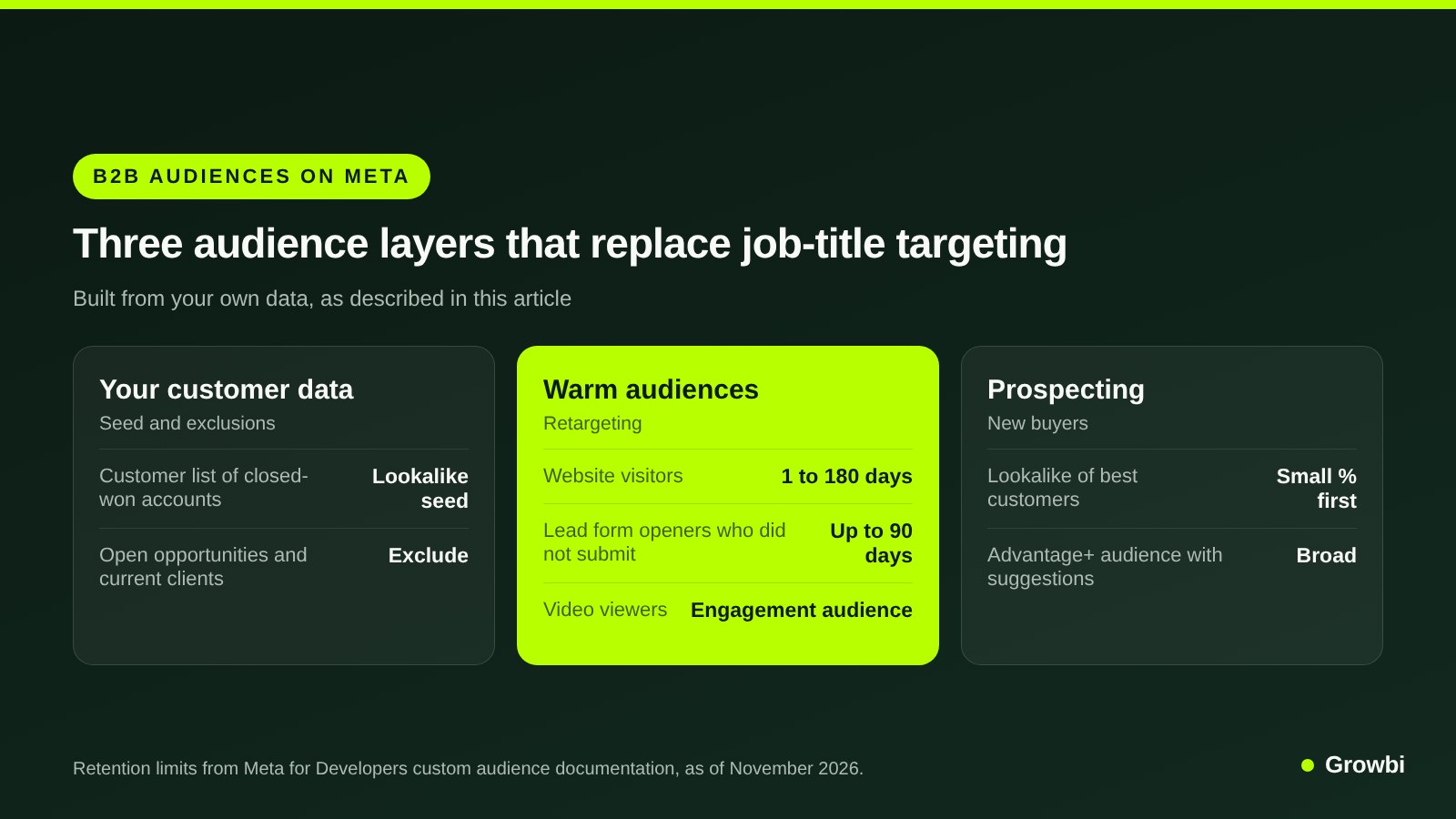
With precise targeting gone, your first-party data is the strongest B2B signal you can give Meta. Start with three layers.
- Customer list of your best accounts. Export closed-won contacts from your CRM, with the permission your privacy policy requires, and upload them as a custom audience.
- Lookalike of that list. Meta's lookalike audience help page notes that a smaller percentage matches the source more closely, and that a source of your best customers can beat one of all customers.
- Exclusions. Current clients and open opportunities, uploaded as custom audiences, so you stop paying to reach people sales already talks to.
Seed lookalikes with customers who paid, not with every lead. A lookalike of form fillers finds more form fillers; a lookalike of signed accounts finds people more like your buyers.
Source: Meta for Developers, Website Custom Audiences and Engagement Custom Audiences
Pro tip: Use the work email and company domain columns from your CRM when building the customer list, and add personal emails where sales has them. People often register Facebook with a personal address, so a list of work emails alone tends to match fewer people.
Retarget Site Visitors and Video Viewers
B2B buyers rarely convert on the first visit. Retargeting keeps your offer in front of the people who already showed interest while they compare options with colleagues.
- Website visitors: website custom audiences can keep a person for 1 to 180 days. Build separate audiences for pricing page, case study and demo page visitors.
- Lead form openers who did not submit: Meta's lead ad engagement audiences have a maximum retention of 90 days.
- Video viewers: run a short explainer or customer story to cold audiences, then retarget people who watched a meaningful share of it.
- Page and Instagram profile engagers: retention goes up to 730 days, useful for long sales cycles.
The retention limits come from Meta's developer documentation on engagement custom audiences, as of November 2026. Retargeting audiences are small, so give them their own modest budget rather than splitting prospecting spend.
Lead Ads vs Landing Pages for B2B
Instant forms open inside Facebook or Instagram with contact details prefilled. That makes them cheap, and it is also why many B2B instant form leads never answer the phone.
- Choose Higher Intent, which adds a review step before submitting, according to Jon Loomer's instant forms guide.
- Ask for work information: work email, company name and job title fields filter out casual sign-ups.
- Add one or two qualifying questions, such as company size or the system they use today, with conditional logic that closes the form for clear non-fits.
- State the next step on the ending screen: "A specialist will email your audit within two business days."
A landing page costs more per lead but lets a buyer read case studies, pricing logic and proof before raising a hand. It needs the Meta Pixel and the Conversions API, so Meta can see which visits became qualified leads.
The same trade-off shows up on LinkedIn; our guide to LinkedIn lead gen forms compares native forms and landing pages there. On Meta, start with a Higher Intent form if you want CRM-based optimization, since it currently works only with instant forms.
Pro tip: Before launch, submit a test lead with Meta's Lead Ads Testing Tool and confirm it reaches the right owner in your CRM within minutes, with every answer and the Meta lead ID intact. A lead that sits in Ads Manager for a day is a lead lost.
B2B Offers That Work on Meta
On a feed full of friends and entertainment, "Book a demo" asks for too much too soon. The offers that work give a concrete answer in exchange for contact details.
- Audits: a free review of the prospect's ads, website, security setup or energy bills, delivered as a short report. The report is a reason to book a call.
- Calculators: cost savings, ROI or pricing estimates. People share them internally, and the inputs qualify the lead.
- Webinars and workshops: a 30-minute session on a problem your buyer has this quarter, with registration through an instant form.
- Short demos: a 15-minute product walkthrough for warm audiences who visited pricing or watched your video, not for cold traffic.
- Templates and benchmarks: useful for building retargeting audiences, weaker as direct sales leads.
Match the offer to the audience temperature: the audit or calculator for cold prospecting, the demo for warm retargeting. Creative should show the deliverable itself, such as a screenshot of the report or the calculator.
Pro tip: Put the qualifier in the ad copy, not only the form: "For agencies with 10 to 50 staff" or "For clinics running two or more locations". The wrong people scroll past, and the right ones feel addressed.
Send CRM Outcomes Back to Meta
By default, Meta optimizes for whoever submits a form. In B2B, that rewards students, competitors and job seekers. The fix is telling Meta which leads turned into pipeline.
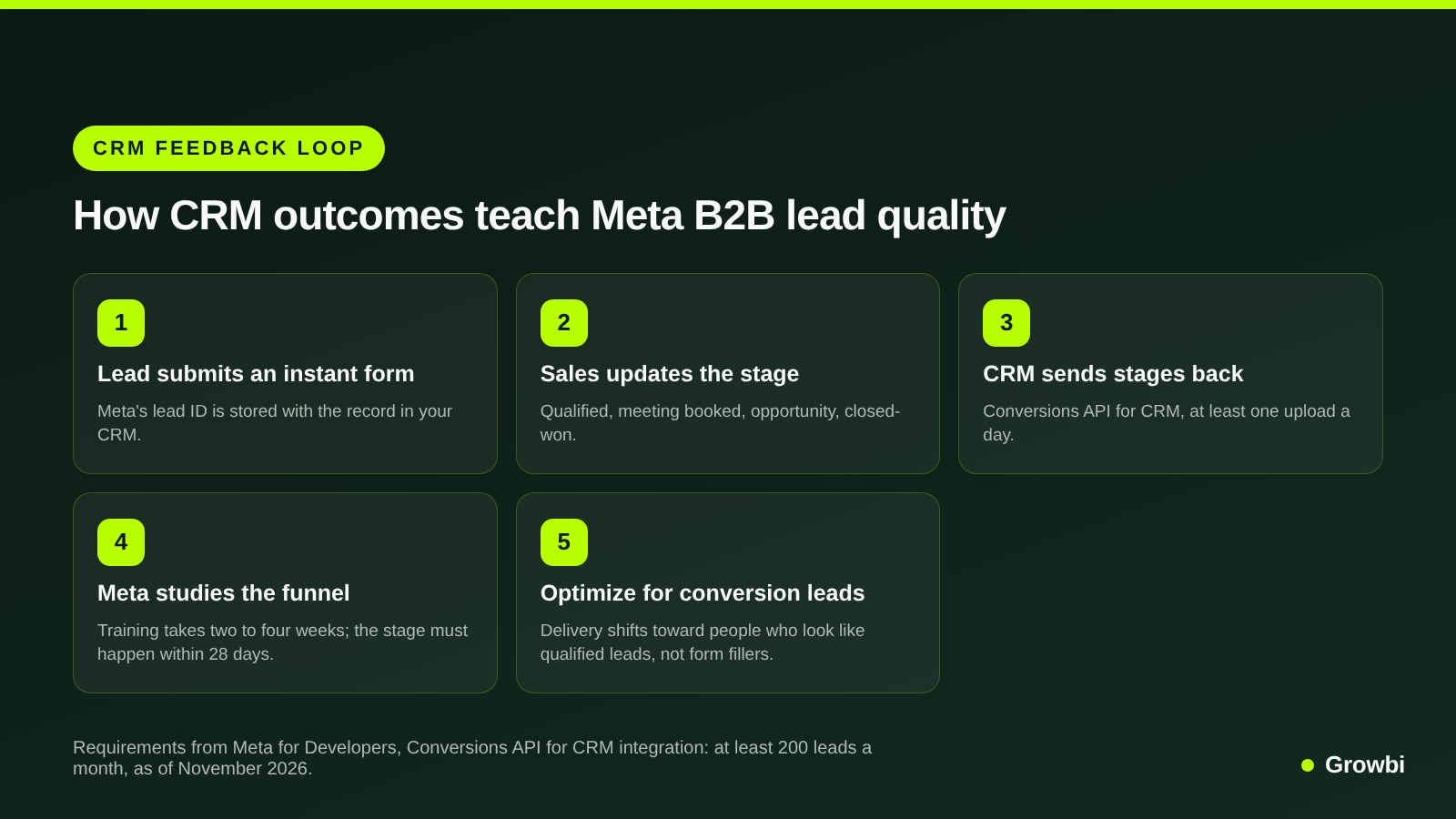
Meta's Conversions API for CRM integration powers the Conversion Leads performance goal. Its eligibility guidelines, as of November 2026, are:
- Facebook and Instagram lead ads (instant forms), with the Meta lead ID stored in your CRM.
- At least 200 leads a month.
- Uploads at least once a day.
- The stage you optimize for happens within 28 days of the lead, with a conversion rate between 1% and 40%.
Meta estimates under a day for a Zapier or partner integration and three to four weeks for a custom build, then a two to four week training period. Pick a stage such as "meeting booked" or "sales qualified", since closed-won usually takes longer than 28 days in B2B.
Source: Meta for Developers, Conversions API for CRM integration
Below 200 leads a month, still mark every lead's stage in the CRM and report cost per qualified lead by campaign. The principle matches offline conversion imports on Google, covered in our Google Ads conversion tracking guide.
B2B Facebook Ads Budgets and Costs
Meta is cheap per click and per lead compared with LinkedIn. The real number is what each qualified lead costs.
WordStream's Facebook Ads Benchmarks 2026, based on 452 US leads campaigns between April 2025 and June 2026, reports these medians:
- All industries: $27.39 cost per lead, $1.80 cost per click, 8.54% conversion rate for leads campaigns.
- Industrial and commercial: $35.87 cost per lead and a 4.50% conversion rate, the second lowest in the study.
- Business services (traffic campaigns): $0.70 cost per click.
Meta's learning phase guidance says an ad set usually exits learning after about 50 results in the week after its last significant edit. That sets a realistic floor.
- Example, not data: 50 leads a week at a $35.87 cost per lead is about $1,790 a week, or roughly $7,800 a month for one ad set.
- Example, not data: reaching the 200 leads a month needed for Conversion Leads at the same cost per lead takes about $7,170 a month.
- Example, not data: if one lead in four qualifies, the cost per qualified lead is about $143, the figure to compare with LinkedIn and search.
Smaller budgets can still work for retargeting and webinar registrations; just expect slower learning. For the wider cost picture by objective and placement, see how much Facebook ads cost.
Mistakes That Waste B2B Meta Budgets
Most failed B2B Meta tests fail for the same handful of reasons, and almost none of them are the platform's fault.
- Judging on cost per lead. A $20 lead that never answers costs more than a $150 lead that books a meeting.
- Running Traffic campaigns for leads. Traffic optimizes for clicks, not for people who fill out forms or become opportunities.
- Too many ad sets. Splitting a small budget across interest audiences keeps every ad set in learning.
- Seeding lookalikes with all leads instead of paying customers.
- "Book a demo" to cold audiences, instead of an audit, calculator or webinar first.
- Slow follow-up. A lead from a feed forgets you fast; our guide to speed to lead covers response times and scripts.
- No CRM feedback, so Meta keeps finding more of the wrong people.
The setup basics, such as objectives, conversion locations and one broad ad set, are the same as for any business. Our guide to Facebook ads for small business walks through them step by step.
Pro tip: Add a "lead source detail" field in your CRM that stores the Meta campaign and ad name from the form's tracking parameters. After a month you can see which ad produces meetings, not just leads.
FAQs
Do Facebook ads work for B2B?
Yes, when your buyers are a broad group such as small business owners, practice managers or trades, and you offer something useful before a sales call, like an audit, calculator or webinar. They work poorly for account-based selling to a few named enterprises or for narrow job titles, where LinkedIn and search ads fit better. Judge them on qualified leads and pipeline, not cost per lead.
Can you target by job title on Facebook?
Only loosely. Facebook removed self-reported employer and education targeting fields in 2017, Meta removed many granular detailed targeting options in 2022 and dropped detailed targeting exclusions in 2025. Under Advantage+ audience, any job titles or interests you add are suggestions, not limits. Customer lists, lookalikes of paying customers and retargeting now do most of the B2B targeting work.
Are Facebook ads cheaper than LinkedIn ads for B2B?
Per click and per lead, usually yes. WordStream's 2026 benchmarks put the median Meta leads campaign at $27.39 per lead, and $35.87 for industrial and commercial advertisers. LinkedIn costs more because you pay for job-title precision. The fair comparison is cost per qualified lead or per opportunity, which you can only measure by tracking lead stages in your CRM.
Should B2B companies use Facebook lead ads or landing pages?
Instant form lead ads produce more leads at a lower cost and are required for Meta's Conversion Leads optimization. Landing pages produce fewer, better informed leads. Many B2B advertisers start with a Higher Intent instant form that asks for work email, company name and one qualifying question, then test a landing page if too few leads qualify.
How much should a B2B company spend on Facebook ads?
Enough for about 50 leads a week per ad set, since Meta says ad sets usually exit learning after about 50 results in a week. As an example, at WordStream's $35.87 median cost per lead for industrial and commercial advertisers, that is roughly $7,800 a month. Smaller budgets can work for retargeting and webinars but learn slowly.
Conclusion
B2B Facebook ads are not a replacement for LinkedIn or search. They are a way to reach many small and mid-size buyers cheaply, with an offer that earns a work email, audiences built from your own customer data, and CRM feedback that teaches Meta what a qualified lead looks like.
Run Meta as part of a system: search for active demand, LinkedIn for precise accounts, Meta for scale and retargeting, all judged on pipeline. That is the approach behind the Growbi System.
Want to know what Meta could add to your pipeline? Get a free lead forecast and bring last quarter's leads and how many became opportunities.
Get this system built for your business
Book a strategy call and we will model a realistic appointment target from your budget, market, and offer.
Keep reading
B2B PPC: How to Run Paid Search and Social That Builds Pipeline
How Much Do LinkedIn Ads Cost in 2026? CPC, CPL and Budgets
LinkedIn Lead Gen Forms: How to Set Them Up for Qualified B2B Leads
How Much Do Facebook Ads Cost for a Local Business in 2026?
Facebook Ads for Small Business: How Local Services Get Booked Leads
Google Ads Conversion Tracking: From Calls and Forms to Booked Jobs