Real Estate Leads: Where to Get Them and What Each Closing Costs

Key Takeaways
- 66% of sellers and 43% of buyers found their agent through a referral or a past relationship in NAR's 2025 profile, so your database is your cheapest lead source.
- Paid leads range from about $14 each on Meta to $158 on Google search, and pay-at-closing networks take 30% to 40% of your commission instead.
- With 2% to 3% of online inquiries closing, roughly 40 leads stand behind one closing, which is why cost per closing is the only fair comparison.
- Expired and FSBO listings are covered by the federal Do Not Call rules: scrub every list at least every 31 days.
- Speed and patience decide the return: text within a minute, call within five, and nurture for months.
Real estate leads come from three places: people who already know you (past clients, sphere and referrals), prospecting (open houses, expired and FSBO listings) and paid sources (Zillow, pay-at-closing networks, Google and Meta ads). Compare them on cost per closing, not cost per lead, because only 2% to 3% of online inquiries typically close.
Search for real estate leads and you mostly find companies selling them. Lead vendors pay an average $59.51 a click to show up for that exact search in the US, per DataForSEO's Google Ads data for November 2026, which tells you how valuable your attention is to them.
This guide takes the other side. It lists the 11 lead sources agents actually use, what each costs as of November 2026, and how to turn the numbers into one figure you can compare: what a closed deal costs you.
If you are already choosing between lead companies and agencies, our comparison of the best real estate lead generation agency goes deeper on provider contracts. This article is about the whole mix.
What Is a Real Estate Lead?
A real estate lead is a person who may buy, sell or rent property in the near future and whose contact details you have. A lead is not a client until there is a signed listing agreement or buyer agreement.
- Seller leads: homeowners asking what their home is worth, expired listings and FSBO owners. Worth more, because a listing often brings the seller's next purchase too.
- Buyer leads: people browsing homes, requesting showings or getting pre-approved. Easier to find, slower to close.
- Warm vs cold: a warm lead asked to hear from you; a cold lead is a name on a list you call first.
- Exclusive vs shared: an exclusive lead goes only to you; a shared lead goes to several agents, and the first one to call usually wins.
Where Most Real Estate Clients Come From
Before spending a dollar, look at how clients actually choose agents. Paid leads fill gaps; they rarely carry a business on their own.
In NAR's 2025 Profile of Home Buyers and Sellers, summarized by Virginia REALTORS, 66% of sellers found their agent through a referral or used an agent they had worked with before. Among buyers, 43% used an agent found by referral and 18% one they had used in the past.
The same report shows how small the FSBO pool has become: only 5% of recent sales were for sale by owner, a historic low. Sellers also stayed in their homes a median of 11 years, so a past client may not move again for a decade, but they will refer friends in the meantime.
Free and Low-Cost Lead Sources
These sources cost time more than money. For a newer agent they are where the first deals come from; for an established agent they produce the cheapest closings.
1. Past clients and your sphere
Put every past client, friend, neighbor and former colleague into one CRM. Call each person at least twice a year, send a monthly market update, and ask directly for referrals after every closing.
HousingWire's guide on where to buy real estate leads notes that many agents never pay for leads at all and rely on referrals and repeat business. That takes years, which is why newer agents mix in the sources below.
2. Open houses
An open house gives you neighbors who are curious about values and buyers who do not have an agent yet. Host them for your own listings or ask colleagues for theirs.
Pro tip: Use a digital sign-in with three questions, "Are you working with an agent?", "Do you own a home nearby?" and "When are you hoping to move?". Enter every visitor in the CRM the same day and send recent sold prices for the street within 24 hours.
3. Expired and FSBO listings
Expired listings are owners who tried to sell and failed, and FSBO owners are selling without an agent. Both want to sell now, which makes them some of the fastest seller leads, but they get many calls and the federal Do Not Call rules apply (covered below).
4. Google Business Profile and local SEO
Sellers search "realtor near me" and read reviews before they call. A complete Google Business Profile, steady reviews and neighborhood pages bring leads at no cost per click, though it takes months to rank.
Our guide to real estate SEO covers where local agents can realistically rank and why the portals own "homes for sale" searches.
Paid Lead Sources and What They Cost
Paid sources fall into four groups: portals, pay-at-closing networks, lead platforms and data lists, and your own ads. Prices below are as of November 2026 and exclude your time.
5. Zillow Premier Agent
Premier Agent places you next to listings in the ZIP codes you buy. HousingWire puts its leads at $20 to $60 each, with typical spend of $300 to $500 a month outside metros and $1,000 or more in metro areas, on a six-month minimum. Leads are shared with other agents in your ZIP code.
6. Pay-at-closing networks
You pay nothing up front and a share of your commission when the deal closes. Zillow's Preferred pricing page sets the success fee for all seller connections at 40% of the commission you expect to earn, while buyer fees vary by market and price.
Sold.com charges a 30% to 35% referral fee on your gross commission, per HousingWire. Pay-at-closing suits agents with little cash, but the fee grows with the price of the home.
7. Lead platforms
Platforms bundle a website, CRM and ads they run for you. HousingWire lists Market Leader at $189 a month plus about $30 to $50 per lead for solo agents, and CINC from $899 a month with leads included, both on six-month minimums.
8. Seller data lists
REDX sells expired, FSBO and pre-foreclosure lists from $60 per lead type a month, and SmartZip sells predicted sellers at an average $0.35 per lead plus a $99 monthly fee and $396 setup. These are cold leads: someone has to call or mail them for months.
9. Google search ads
Search ads reach people typing "how much is my house worth" or "realtor near me" right now. LocaliQ's 2026 real estate search benchmarks, from 894 US campaigns, put the median cost per lead for residential agents at $157.59 and the median click at $3.19.
The leads are exclusive and many are sellers, which is why they cost more. Our guide to Google Ads for real estate agents covers the housing targeting rules, keywords and negatives.
10. Meta ads
Facebook and Instagram lead ads are the cheapest paid leads. WordStream's 2026 Facebook ads benchmarks put the median cost per lead for real estate at $13.74, the second lowest of 14 industries, with a 9.95% conversion rate.
Cheap leads are colder. Most come from people scrolling, not searching, so they need more follow-up. Our real estate Facebook ads guide explains Meta's Housing category and the ad types that bring better leads.
Pro tip: Choose the "Higher intent" form type in Meta lead ads and add one qualifying question, such as "When are you planning to sell?" with set answers. Volume drops, but your calls go to people with a timeline.
11. Google Local Services Ads
Local Services Ads show your profile and reviews above the regular ads, and you pay per lead instead of per click. Our guide to Google Local Services Ads explains how ranking, lead charges and disputes work.
Cost per Closing: How to Compare Lead Sources
A $14 lead and a $158 lead are not comparable on price alone. Cost per closing is, because every source ends with the same commission check.
The formula is simple: total cost of the source in a period, divided by closings from that source in the same period. For per-lead sources, that is cost per lead divided by your lead-to-closing rate.
For the rate, The Close's lead generation statistics cite 2% to 3% of online inquiries turning into closings, or one closing for every 33 to 50 leads. The example below uses 2.5%, which is 40 leads per closing.
For the commission, take NAR's median agent-assisted sale price of $425,000 and Clever's 2026 commission survey average listing-side rate of 2.76%. That is $11,730 in gross commission before your brokerage split, which sets the referral fees.
- Meta lead ads: $13.74 x 40 leads = about $550 per closing.
- Zillow Premier Agent: $20 to $60 x 40 leads = $800 to $2,400, or $1,600 at a $40 midpoint.
- Sold.com: 30% to 35% of $11,730 = $3,519 to $4,106.
- Zillow Preferred seller connection: 40% of $11,730 = $4,692.
- Google search ads: $157.59 x 40 leads = about $6,304.
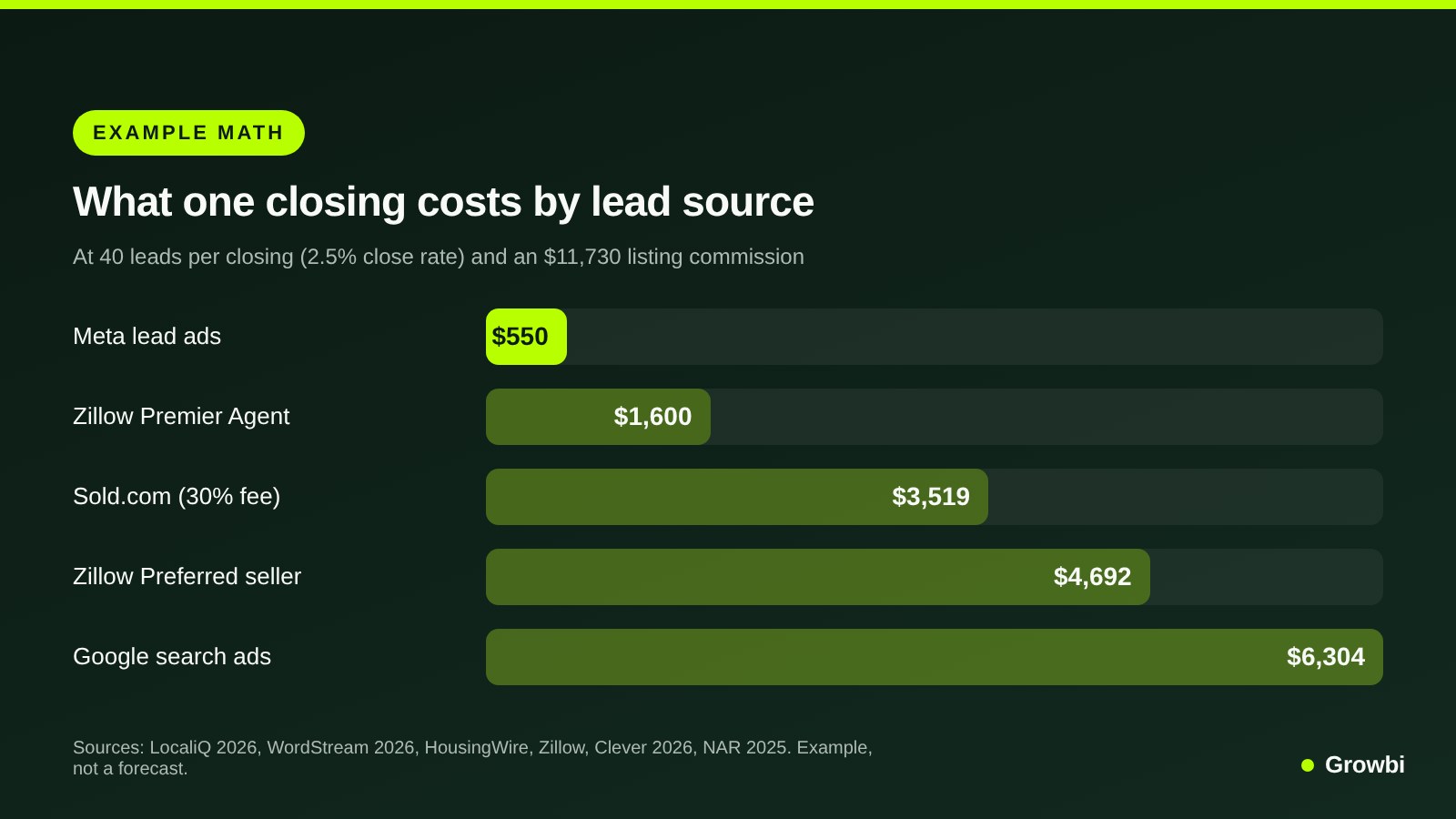
This is example math, not a forecast, and the same close rate for every source flatters the cold ones. If Meta leads close at 1%, a closing costs $1,374. If seller leads from Google search close at 5%, it drops to about $3,152.
The structure matters as much as the price. Referral fees rise with every more expensive home you sell, while ad costs stay flat, so owned ads pull ahead as price points rise and as your follow-up gets better.
Pro tip: Make lead source a required field in your CRM and tag it on entry, not at closing. Twelve months later you can divide each source's spend by its closings, instead of guessing which one paid.
How to Turn Leads Into Closings
Most of the difference between sources happens after the lead arrives. A shared lead goes to whoever calls first, and an online lead may be months away from moving.
NAR's 2025 profile puts the median buyer search at 10 weeks, and HousingWire notes that many Zillow leads have a lead time of six to 12 months. Plan for both speed on day one and patience after it.
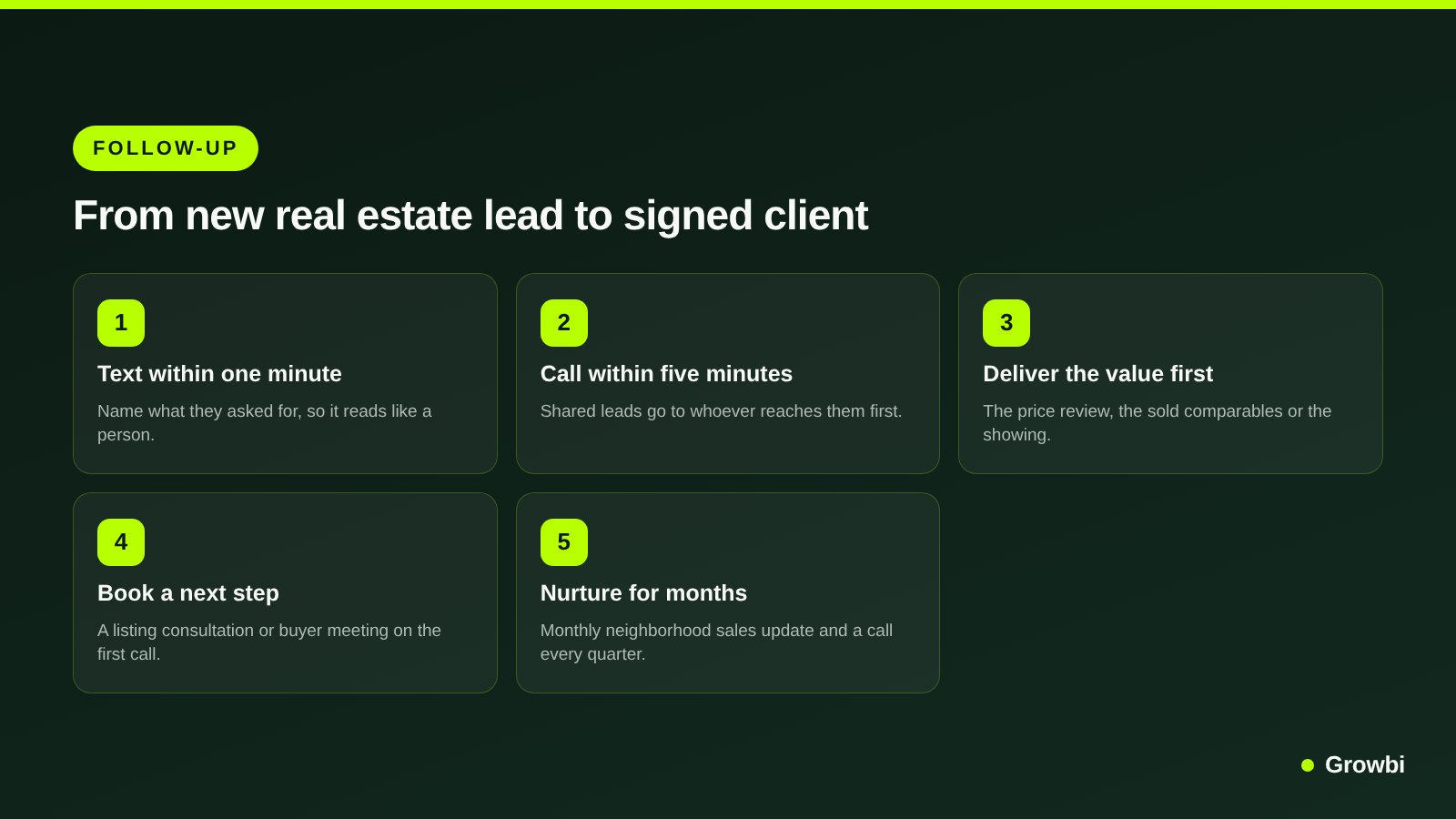
- Text within one minute naming what they asked for, then call within five minutes.
- Deliver the promised value first: the price review, the sold comparables or the showing.
- Book a specific next step on the first call: a listing consultation or buyer meeting.
- Nurture the rest for months with a monthly neighborhood sales update and a call every quarter.
Our speed to lead guide covers the research on response time and a call and text cadence you can copy.
Do Not Call and Fair Housing Rules for Lead Generation
Two sets of rules apply to almost every lead source. Breaking either costs more than any lead.
Florida Realtors' summary of the Do Not Call rules states that FSBOs and expired listings are covered by the federal rules. You must check the National Do Not Call Registry at least every 31 days, and the first five area codes are free.
- FSBOs: you may call a registered FSBO on behalf of a buyer client if they advertised their number, but not to solicit the listing.
- Established relationships: calls within 18 months of a prior business relationship are allowed.
- Written permission: consumers who gave written consent may be called.
- State rules: many states add their own lists and calling hours, so check with your broker or state association.
Pro tip: Scrub every expired, FSBO and purchased list against the national registry and your own internal do-not-call list right before each calling session, and log the date you did it.
For ads, the Fair Housing Act bans wording that shows a preference for a type of buyer, and Google and Meta restrict targeting for housing ads in the US. Our real estate ad examples show compliant copy you can adapt.
How to Build a Lead Plan for Your Stage
No single source is best. The right mix depends on cash, time and who answers the phone.
- New agent: sphere, open houses and a pay-at-closing network, since you pay only from commission you earn.
- Solo agent with steady income: add one paid source you can follow up on daily, such as Meta seller ads or a platform.
- Listing-focused agent: expired and FSBO prospecting, a home value campaign on Google search and a monthly mailer to your farm.
- Team or brokerage: your own Google and Meta campaigns with someone assigned to call every lead within minutes.
Whatever you choose, test one new paid source at a time for at least 90 days and judge it on appointments and closings. HousingWire's rule of thumb is simple: if $500 a month in leads produces one or more closings a month, the return is positive.
Growbi runs Google Search, Local Services Ads and Meta campaigns for agents and teams in the agent's own accounts, reported on appointments. You can see how on our real estate marketing page.
FAQs
How do real estate agents get leads?
Most agents combine three groups of sources. People who know them, such as past clients, sphere and referrals; prospecting, such as open houses, expired listings and FSBOs; and paid sources, such as Zillow, pay-at-closing networks and Google or Meta ads. In NAR's 2025 profile, 66% of sellers found their agent through a referral or past relationship.
How much do real estate leads cost?
As of November 2026, Meta lead ads cost a median $13.74 per real estate lead in WordStream's data, Zillow Premier Agent leads run about $20 to $60 each per HousingWire, and Google search leads for residential agents cost a median $157.59 per LocaliQ. Pay-at-closing networks charge 30% to 40% of your commission instead of a per-lead price.
What is the best source of real estate leads?
Referrals and past clients produce the cheapest closings, because they cost little and already trust you. Among paid sources, there is no single best one: compare each on cost per closing, which is cost per lead divided by your lead-to-closing rate. Seller leads from Google search cost more per lead but often convert better than cheaper social leads.
Is buying real estate leads worth it?
It can be, if you follow up fast and track results. With 2% to 3% of online inquiries typically closing, you need about 33 to 50 leads per deal, so the math works when one closing covers several months of spend. Test one source for at least 90 days and judge it on appointments and closings, not on lead volume.
Can real estate agents call expired listings and FSBOs on the Do Not Call list?
Generally not to solicit the listing. Federal Do Not Call rules cover expired listings and FSBOs, so agents must scrub call lists against the National Do Not Call Registry at least every 31 days. Exceptions include calling a FSBO on behalf of a buyer client, an established business relationship within 18 months, and written consent. State rules may be stricter.
How many real estate leads does it take to close a deal?
Industry figures cited by The Close put online lead-to-closing rates at 2% to 3%, which means roughly 33 to 50 leads per closing. Referral leads close at much higher rates, and cold list leads at lower ones. Your own rate depends on response speed and nurturing, so track it per source in your CRM for a year.
Conclusion
Real estate leads are not scarce; closings are. Referrals and past clients still produce most deals, prospecting fills the gaps for listing agents, and paid sources add volume when you can afford them and call every lead within minutes.
Pick sources that fit your cash and your hours, tag every lead with its source, and compare them a year later on cost per closing. The example math above is a starting point; your own close rates are the real answer.
If you want to see what Google and Meta campaigns could produce in your market, get a free lead forecast and we will run the numbers with you.
Get this system built for your business
Book a strategy call and we will model a realistic appointment target from your budget, market, and offer.
Keep reading

The 'Best' Real Estate Lead Generation Agency: A Myth Debunked by Cost per Closing
Google Ads for Real Estate Agents: Costs, Rules and Campaign Setup
Real Estate Facebook Ads: What Works Under Meta's Housing Rules
Real Estate SEO: How Agents Rank for Their Neighborhoods
Speed to Lead: Why the First 5 Minutes Decide Who Books