Real Estate SEO: How Agents Rank for Their Neighborhoods

Key Takeaways
- "Homes for sale near me" draws about 368,000 US searches a month with a difficulty of 63, while "best neighborhoods in denver" draws 1,900 with a difficulty of 1.
- For "homes for sale in plano tx", portals and national brokerages held 7 of 9 organic results on page one.
- Google lets real estate agents, as individual practitioners, have their own Business Profile, with naming rules inside a brokerage.
- IDX listings repeat the same MLS data everywhere, so original neighborhood content is what ranks and gets cited by AI.
- Under Fair Housing rules, describe places and homes, never the people who live there.
Real estate SEO is the work of getting an agent or brokerage found on Google and in AI answers by people buying or selling in a specific area. Local agents rarely beat Zillow or Realtor.com for "homes for sale" searches, so they win with neighborhood and relocation pages, a complete Google Business Profile, steady reviews and local links.
A buyer relocating to Denver does not start by searching for an agent. They search "best neighborhoods in denver", read a few guides, watch a video tour, then open Zillow. By the time they pick an agent, they already trust whoever explained the city best.
That is the opening for a local agent. We pulled US search volumes and live Google results for the queries buyers and sellers use, and the pattern is clear: the portals own the listing searches, and almost nobody owns the neighborhood searches.
Where Local Agents Can Realistically Rank
Not on the biggest searches. The listing and "near me" queries have enormous volume, but their difficulty scores show how hard they are for a small site to crack.
- homes for sale near me: about 368,000 US searches a month, keyword difficulty 63 out of 100.
- realtors near me: 90,500 a month, difficulty 100, decided mostly in the map pack.
- real estate agents near me: 40,500 a month, difficulty 65.
- how much is my house worth: 22,200 a month, difficulty 54, dominated by home value tools.
Now compare the questions people ask before they move. "Best neighborhoods in denver" and "best neighborhoods in atlanta" each average 1,900 searches a month with difficulty scores of 1 and 2. "Living in charlotte nc" gets 1,300 at a difficulty of 4, and "moving to austin" gets 480 at a difficulty of 0.
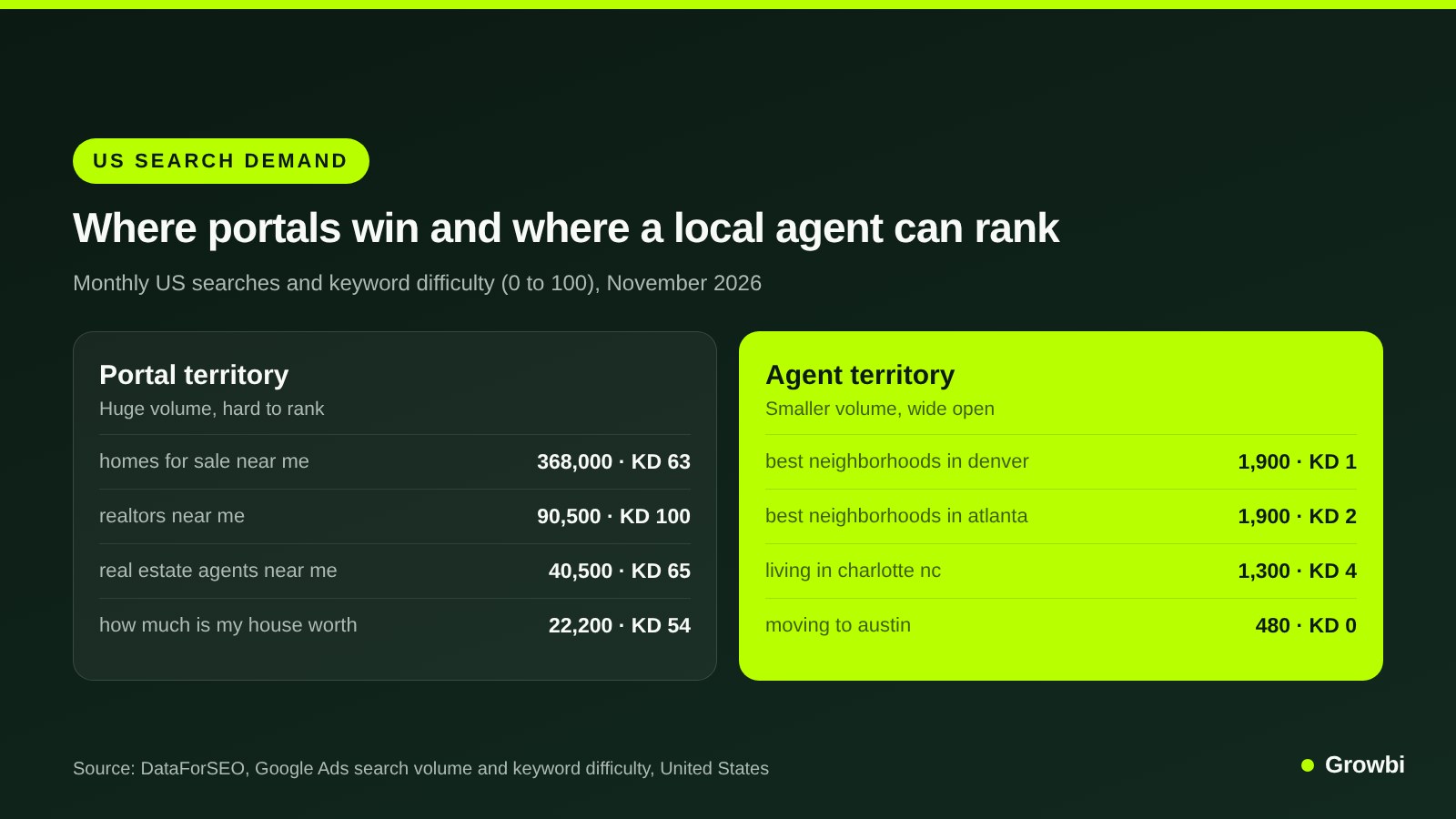
Source: DataForSEO, Google Ads search volume and keyword difficulty, United States, November 2026
Each one is small, but your market has dozens: every subdivision, suburb and "moving to" question. The person behind each is months away from choosing an agent.
Why You Will Not Outrank Zillow for Homes for Sale
Because listing searches reward the site with the most complete inventory, and the portals were built for exactly that. We checked the live page one results for "homes for sale in plano tx", a query with about 8,100 US searches a month, from a Plano location on November 1, 2026.
Trulia held 3 of the 9 organic results, Realtor.com 2, and Century 21 and eXp Realty one each. Only 2 belonged to local players, a local team site and a local Keller Williams office.
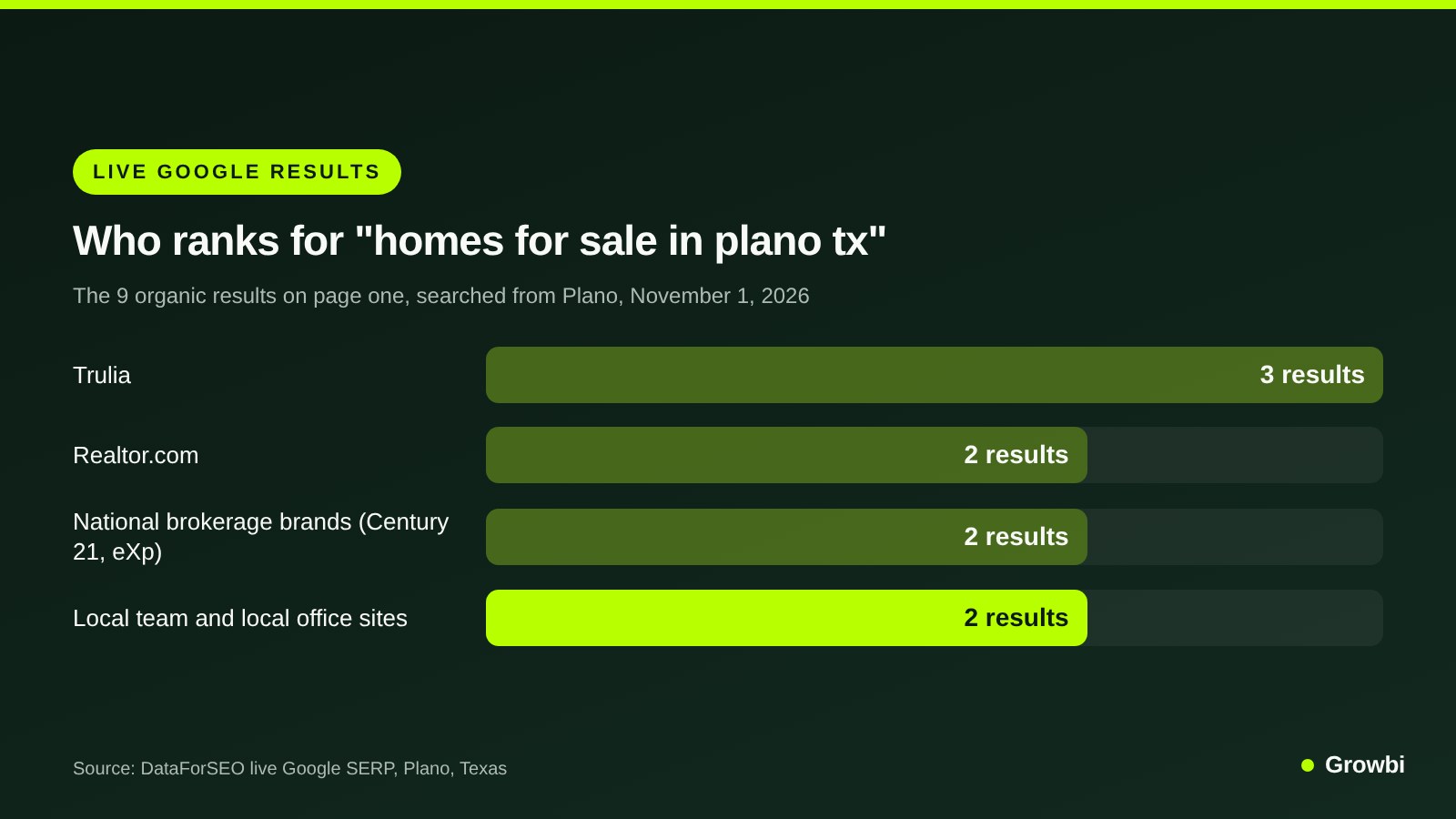
Source: DataForSEO live Google SERP, Plano, Texas, November 1, 2026
So the door is not closed, but a single agent site needs years of content and links to get there. City-wide listing searches are a long-term goal, not the place to start.
Paid channels can cover the gap while SEO builds. Our guide to real estate Facebook ads explains what still works under Meta's Housing rules.
If you are weighing buying leads against building your own, our review of real estate lead generation agencies compares the options.
How to Build Neighborhood and Community Pages That Rank
Write the page a buyer wants before visiting, with details only someone who works the area knows. The Denver results show what Google rewards: the AI Overview for "best neighborhoods in denver" cited a local real estate blog next to 5280 magazine and Reddit, and a guide on another local real estate site ranked third organically.
- Housing stock: from 1950s ranches to new townhomes, lot sizes and HOA rules.
- Price context: recent MLS sale ranges, with the month you pulled them.
- Getting around: commute times, transit lines and walkability.
- Daily life: parks, trails, groceries and restaurants, named specifically.
- Schools: assigned schools, linked to official district pages rather than your own ratings.
- Original media: your own photos and a short video drive, not stock images.
- A filtered listing feed: current homes for sale below the guide, not instead of it.
Start with the 5 to 10 neighborhoods where you already sell, then add "moving to" and "living in" guides for your city. Google's guidance on creating helpful content warns against pages made mainly to attract search traffic, so a template with the neighborhood name swapped in will not hold up.
Update each page at least twice a year, because a page with last spring's prices stops being the most useful answer.
Pro tip: Put a visible line such as "Sale prices last updated March 2027" under each price range, and refresh every neighborhood page in the same sitting each spring and fall so no page falls behind the others.
What Fair Housing Rules Mean for Neighborhood Content
A neighborhood page is a statement about housing, so the Fair Housing Act applies to it just as it does to a listing ad. Describe the place and the homes, never the people who live there or the people who should.
HUD's regulation on discriminatory advertisements prohibits any statement about the sale or rental of a dwelling that indicates a preference or limitation based on race, color, religion, sex, handicap, familial status or national origin, including words, phrases and photographs.
HUD's rule on steering goes further for neighborhood content. It bars discouraging someone from a neighborhood because of who lives there, exaggerating a community's drawbacks, or telling a buyer they would not be comfortable with existing residents because of a protected characteristic.
- Safer: "Three elementary schools within two miles, linked to the district's site." Riskier: "Perfect for young families."
- Safer: "Single-level homes, most built between 1995 and 2005." Riskier: "Ideal for retirees."
- Safer: "Ten minutes to the light rail station and downtown offices." Riskier: "Popular with young professionals."
- Safer: "Crime data for this area is published by the city police department." Riskier: "A safe, quiet neighborhood, not like the east side."
In April 2026 HUD published a notice withdrawing several Fair Housing guidance documents, including its guidance on online advertising. The Act and the regulations above still apply, and the notice says noncompliant actions remain subject to enforcement. This is not legal advice, so have your broker review your neighborhood templates.
Pro tip: Before a neighborhood page goes live, search the draft for words that describe people rather than places, such as "families", "retirees", "professionals" or "safe", and rewrite each one as a fact about the homes, the distances or a linked official source.
The same wording rules apply to your ads. Our real estate ad examples show compliant copy in practice.
How to Set Up Google Business Profile as a Real Estate Agent
The map pack decides searches like "realtors near me", and Google's rules for agents are more specific than most guides admit.
Google's guidelines for representing your business name real estate agents as individual practitioners, who may have their own profile if they are public-facing and can be contacted at the verified location during stated hours.
- Multi-agent office: the brokerage gets its own profile, and yours uses your name only, without the brokerage name.
- Solo agent at a branded office: Google prefers one shared profile named "Brand: Your Name".
- One profile per person: no separate profiles for buyer, seller or luxury specialties.
- No virtual offices: a mailing address you do not work from is not eligible.
- Service area: if clients do not visit your address, hide it and set a service area within about 2 hours of driving time.
Google's guide to improving your local ranking says local results are based mainly on relevance, distance and prominence, and that there is no way to pay for a better local ranking. Relevance comes from a complete profile: category, service area, hours, description and real photos from your neighborhoods.
How Reviews Feed Rankings and Referrals
Google counts reviews and ratings toward prominence, and buyers comparing agents in the map read them before calling.
Google's rules on fake and misleading reviews are strict, and several common agent habits break them.
- No incentives: no gift cards or discounts in exchange for a review.
- No selective asking: do not ask only happy clients or discourage negative reviews.
- No scripted content: do not ask clients to mention a neighborhood, keyword or team member.
- No pressure on site: do not require a review during the closing appointment.
The routine that stays inside these rules: send every client the same review link a few days after closing, then reply to every review.
Pro tip: Copy the review link from your Business Profile once, save it as a message template in your CRM and attach it to the closing stage so it sends automatically to every closed client. Nobody on the team then decides who gets asked.
What IDX Can and Cannot Do for SEO
IDX is worth having for visitors and lead capture, but it is weak as an SEO strategy. Every listing page shows the same MLS data that appears on the portals and on every other agent site in your market.
Google's documentation on canonicalization explains that Google clusters near-identical pages and shows the one it judges most complete and useful. Duplicate content is not a spam violation, but for a listing that is usually the portal's page.
Google's quality guidance also describes pages generated automatically from feeds as little to no effort, while original analysis counts as high effort.
- Put IDX inside community pages, as a filtered feed under your original neighborhood guide.
- Use saved searches and new listing alerts to turn visitors into registered leads.
- Do not rely on listing detail pages for traffic, since they expire when homes sell.
Your own listings are the exception: a page with original photos, video and notes about the street is content no portal has.
How to Get Cited in AI Answers About Your Area
AI answers pull from the same pages that rank, so the neighborhood pages above do double duty.
Google's guidance on AI features and your website says there is no special optimization for AI Overviews or AI Mode: a page needs to be indexed and eligible to show a snippet, and normal SEO best practices apply.
Google adds that these features may run several related searches across subtopics for one answer. A relocation question can pull from separate pages on commutes, prices and neighborhoods, which rewards an agent with a full set of local pages.
- Answer first: open each section with a direct, factual sentence an AI tool can quote.
- Be specific: named parks, commute minutes and dated price ranges beat adjectives.
- Stay consistent: the same name, brokerage, phone and service area everywhere.
- Show up where AI looks: Reddit and YouTube appeared in the Denver answer too.
Our guide to answer engine optimization covers how AI tools choose which local businesses to name.
If you would rather hand this off, our AI SEO services page explains how we approach visibility in Google's AI features and ChatGPT.
How Agents Earn Local Links
Links feed prominence, and the best ones for an agent come from the community, not from paid link packages or directory blasts.
- Local partners: lenders, inspectors, title companies and builders often list trusted agents.
- Community sponsorships: youth sports, school foundations and neighborhood events usually credit sponsors with a link.
- Local media: a quarterly market update gives local reporters a source to quote.
- Your brokerage: make sure your agent profile links to your own site.
How to Measure Real Estate SEO
Measure appointments, not traffic. A neighborhood page with 200 visits a month that produces two buyer consultations beats a blog post with 5,000 visits and none.
- Google Search Console: impressions, clicks and queries for each neighborhood page.
- Business Profile performance: calls and website clicks from the profile.
- Lead source tagging: every form and saved search records its page in your CRM.
- Response time: how fast someone calls a new website lead.
Slow follow-up wastes what SEO produced. Our guide to speed to lead explains why the first few minutes matter.
If you are comparing outside help, these questions to ask a real estate marketing agency help you check whether an SEO plan is tied to appointments rather than rankings alone.
FAQs
What is real estate SEO?
Real estate SEO is the process of getting an agent or brokerage website and Google Business Profile to appear in Google results and AI answers when people search for homes, agents or neighborhoods in an area. For local agents it centers on neighborhood and relocation pages, a complete Business Profile, genuine reviews and local links, not on beating portals for listing searches.
Can real estate agents compete with Zillow on Google?
Rarely on listing searches such as homes for sale in a city, where portals and national brokerages hold most page one results. Agents compete well on neighborhood, relocation and local questions, which have low difficulty scores. In November 2026, best neighborhoods in denver showed a keyword difficulty of 1, and a local real estate blog was cited in Google's AI Overview.
Should a real estate agent have their own Google Business Profile?
Usually yes. Google names real estate agents as individual practitioners who may have their own profile if they are public-facing and reachable at the verified location during stated hours. At a multi-agent office, the brokerage keeps its own profile and the agent's profile uses only the agent's name. A solo agent at a branded location shares one profile named Brand: Agent Name.
Do IDX listings help SEO?
Only a little. IDX pages show the same MLS data as the portals and other agent sites, and Google groups near-identical pages and shows the version it judges most complete and useful, usually a portal. IDX is valuable for visitors, saved searches and lead capture, and works best as a filtered feed inside original neighborhood pages.
Can I do SEO for my real estate website myself?
Yes, much of it. An agent can maintain a Google Business Profile, ask every client for a review and write neighborhood guides from local knowledge. Technical setup, IDX configuration, link building and tracking leads by page take more time and skill, which is where agents and small brokerages often bring in a specialist.
Conclusion
Real estate SEO for a local agent is not a fight with Zillow. The portals own listing searches, while neighborhood and relocation questions are open, often with difficulty scores near zero.
Build a genuinely useful page for each neighborhood you sell in, describe places rather than people, set up your Business Profile the way Google defines it for agents, and ask every client for an honest review.
Our real estate marketing page shows how we connect lead generation to follow-up and reporting down to closed transactions.
If you want a plan for your market, book a free 15-minute call and we will map the neighborhood searches you can win.
Get this system built for your business
Book a strategy call and we will model a realistic appointment target from your budget, market, and offer.
Keep reading
Real Estate Facebook Ads: What Works Under Meta's Housing Rules

The 'Best' Real Estate Lead Generation Agency: A Myth Debunked by Cost per Closing

Real Estate Ads That Book Seller and Buyer Appointments: 10 Examples and Templates

Beyond Leads: Smart Questions to Ask a Real Estate Marketing Agency Before You Sign