How Much Do Med Spa Owners Make? Revenue, Margins and Owner Pay

Key Takeaways
- AmSpa's 2024 report puts average annual med spa revenue at $1,398,833, about $116,600 a month, with 245 patient visits a month at $527 per visit.
- Owner income is profit plus any wage for clinical work. An NP owner who injects is also earning the job, which BLS valued at a $134,920 median in May 2025.
- In our worked example, a $1.4M med spa leaves $137,145 for an owner who does not treat and $285,557 for an NP owner who replaces one paid injector.
- Utilization is the biggest lever: Zenoti's 2026 medspa benchmarks put median staff utilization at 38% against 80% at the 90th percentile.
- Acquisition cost and retention decide whether marketing adds profit: Growth99 reports a $132 average new patient acquisition cost, and AmSpa says 73% of patients are repeat patients.
AmSpa's public report summary does not publish owner pay, so it has to be built from revenue and margin. AmSpa puts average med spa revenue at $1,398,833 a year. At profit margins between 10% and 29%, that leaves roughly $140,000 to $406,000 for the owner, plus a provider's wage when the owner also treats patients.
Most answers to this question quote one number, usually $300,000 to $375,000 a year, and move on. That figure is real arithmetic, but it is not a survey of what owners take home, and it hides the biggest variable: whether the owner also works as an injector.
This guide rebuilds owner pay from sourced numbers instead. You get the latest revenue data, how margin and owner pay are calculated, a worked example P&L for three owner types, and the operating levers that move the result.
How Much Med Spas Make: The Revenue Benchmarks
The best public revenue data comes from the American Med Spa Association, which publishes its Medical Spa State of the Industry Report about every two years. The 2024 edition is the most recent one with a free public summary as of November 2026.
According to AmSpa's 2024 executive report recap, the industry looks like this:
- Average revenue: $1,398,833 a year, up from $1,307,587, or about $116,600 a month.
- Volume and ticket: 245 patient visits a month, with patients spending an average of $527 per visit.
- Size: 81% of med spas are single-location, and single-location practices average eight employees.
- Retention: 73% of patients are repeat patients, up from 65% in the 2022 report.
- Market: 10,488 med spas, with 18% newly opened in 2023.
Software data skews higher because it tracks clinics on one platform. Zenoti's 2026 medspa benchmarks put median revenue per location at $1,860,000 in 2025, with $2,340,000 at the 75th percentile and $4,250,000 at the 90th.
Treat the AmSpa average as the typical clinic and the Zenoti percentiles as what established, well-run locations reach. Revenue per employee at the AmSpa averages works out to roughly $175,000 ($1,398,833 divided by eight), a useful sanity check for your own payroll.
Owner Pay Is Profit Plus a Wage
"Med spa owner salary" mixes up two different kinds of income. Keeping them apart is the only way to compare your numbers with anyone else's.
- Wage for work performed: if you inject, run lasers or manage the clinic full time, part of what you take is pay for that job. Someone would have to be hired to do it if you stopped.
- Profit for owning the business: what is left after every job, including yours, is paid at a market rate. This is the return on the money and risk you put in.
- Owner draw or distribution: the cash you actually take out. It can be more or less than profit in a given year, depending on loan payments and reinvestment.
Tax structure forces the split in some cases. The IRS guidance on paying yourself says a corporate officer is generally an employee, and that wages should be "commensurate with your duties" rather than labelled as distributions to avoid payroll tax.
So when a source quotes owner salary, ask which of the three it means. The popular $300,000 to $375,000 range is a good example: Zenoti's profitability article presents it as an estimated 20% to 25% margin applied to average revenue, which is a profit estimate, not a measured salary.
Are Med Spas Profitable? What the Margin Data Says
Med spas can be very profitable, but the published margins vary with who measured them and how. Three data points are worth knowing.
- AmSpa 2019 report: a 29% profit margin on 2018 data, with average revenue of $1.5 million, as summarized by LaingBuisson.
- Growth99 2026 marketing report: describes practices "leveraging their 38% profit margins" in the summary AmSpa published.
- AmSpa business planning guide: consultant Bryan Durocher writes that many med spas are not profitable, that payroll takes a significant share of service revenue, and that margins are tight.
Neither public summary says whether owner pay was deducted before the margin was calculated. A 29% margin for a clinic whose owner injects unpaid is a very different business from a 29% margin after paying every provider, so read these figures as what strong clinics reach, not as a promise.
Applied to AmSpa's average revenue, the range is wide. A 10% margin leaves about $139,900 a year, and a 29% margin leaves about $405,700. That is the honest answer to how much med spa owners make: anywhere in that band, before counting any clinical wage the owner earns.
Where the Money Goes: Med Spa Costs
Most of a med spa's revenue leaves as payroll and product. The rest is a stack of fixed costs that stay the same whether the schedule is full or half empty.
- Staff payroll: the largest line. BLS May 2025 medians: nurse practitioners $134,920, registered nurses $97,550 and skincare specialists $45,330 a year, before payroll taxes and benefits.
- Medical director: AmSpa's 2022 summary put the average full-time medical director salary at $120,691. Many single-location med spas use a part-time or contract director instead, so the cost ranges widely.
- Product cost: AmSpa's planning guide suggests product cost should average no more than 18% of the service price, and notes that branded retail lines cost 48% to 56% of their shelf price.
- Rent and build-out: fixed every month, and the reason empty treatment rooms are so expensive.
- Equipment: lasers and body contouring devices are often financed, so payments run whether or not the device is booked.
- Marketing: the Growth99 report recommends 5% of revenue, about $5,800 a month for an average med spa, yet 52% of practices spend under $2,500 a month.
- Overhead: software, malpractice and liability insurance, card processing, accounting and legal.
The 18% product benchmark matters for service mix. Injectables carry product cost on every syringe, while a paid-off laser uses almost none, which is why the medical director and equipment lines need to be read together with what you sell.
A Worked Example P&L for a $1.4M Med Spa
The example below is our own illustration, not survey data. Revenue is rounded from AmSpa's average, headcount matches AmSpa's eight employees, clinical wages are the BLS medians above, and every other line is a labelled assumption you should replace with your own numbers.
- Revenue: $1,400,000.
- Clinical wages: two NP injectors at $134,920 each, one RN at $97,550 and two estheticians at $45,330 each, for $458,050.
- Non-clinical wages (assumption): a manager and two front desk staff, $130,000.
- Payroll taxes and benefits (assumption): 10% of wages, $58,805, for total payroll of $646,855.
- Product cost: 18% of revenue, $252,000.
- Medical director (assumption): part-time contract at $4,000 a month, $48,000.
- Rent (assumption): $8,000 a month, $96,000.
- Marketing: 5% of revenue, $70,000.
- Equipment payments (assumption): $60,000.
- Software, insurance, card fees, accounting (assumption): $90,000.
Total costs come to $1,262,855, which leaves $137,145, a 9.8% margin, for an owner who does not treat patients. That is close to the low end of the range and lines up with AmSpa's warning about tight margins.
Now make the owner an NP who injects full time and replaces one paid injector. Payroll drops by $148,412 (the $134,920 wage plus 10%), and the owner keeps $285,557. Roughly $135,000 of that is the market value of the injecting job and about $150,000 is profit.
The third scenario keeps the non-treating owner but fills 32 more visits a month with the same team. At AmSpa's $527 average visit, that is about $200,000 more revenue; after 18% product cost, the owner keeps $301,145, before small variable costs like card fees.
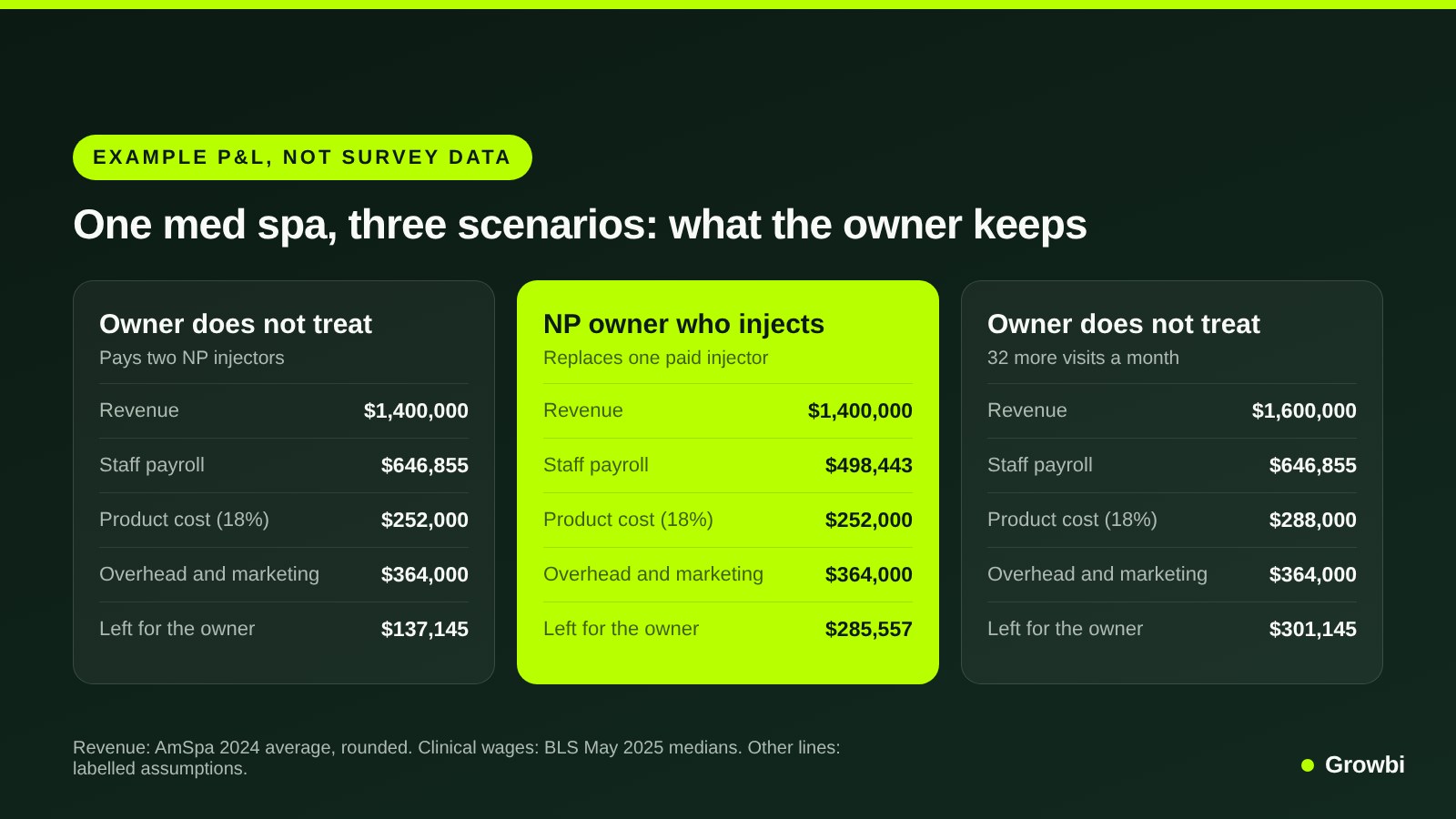
Source: Growbi example built on AmSpa 2024 revenue and BLS May 2025 wages
The lesson: filling empty hours is worth as much as the owner picking up a syringe. If you are writing a lender-ready version of this model, our med spa business plan guide shows how to build revenue from room hours instead of a single average.
Pro tip: put your own wage on the P&L as a separate line at the market rate for the job you do, even if you pay yourself through distributions. It is the only way to see whether the clinic is profitable or whether you are simply paying yourself to work.
Owner Pay by Owner Type
Who owns the clinic changes the cost structure more than any marketing decision. AmSpa's 2024 data says 67% of single-owner practices are owned by non-MDs or surgeons, and that NPs have nearly pulled even with MDs and surgeons as the largest owner group.
- Physician owner: may be able to serve as the medical director, which removes that contract cost, but every hour spent injecting has a high opportunity cost against other medical work.
- Nurse practitioner owner: the most common path to the scenario-two economics above, where the owner earns a provider wage plus profit. Whether an NP can own and practice independently depends on state law.
- RN, PA or esthetician owner: medical treatments still need physician oversight, or NP oversight where state law allows it, and many states limit who may own the medical side of the business.
- Non-clinical investor owner: pays every provider and the medical director at market rates, so profit depends entirely on utilization, pricing and acquisition cost. In states with corporate practice of medicine rules this usually means a management services structure.
Ownership rules vary by state, and getting them wrong can unwind the whole model. Our guide on how to open a med spa covers ownership, medical director requirements and state rules in detail.
What Drives Med Spa Profitability
Once rent, equipment and the core team are paid, each extra booked hour carries mostly product cost. That is why the clinics at the top of the range look different on five operating numbers, not on revenue alone.
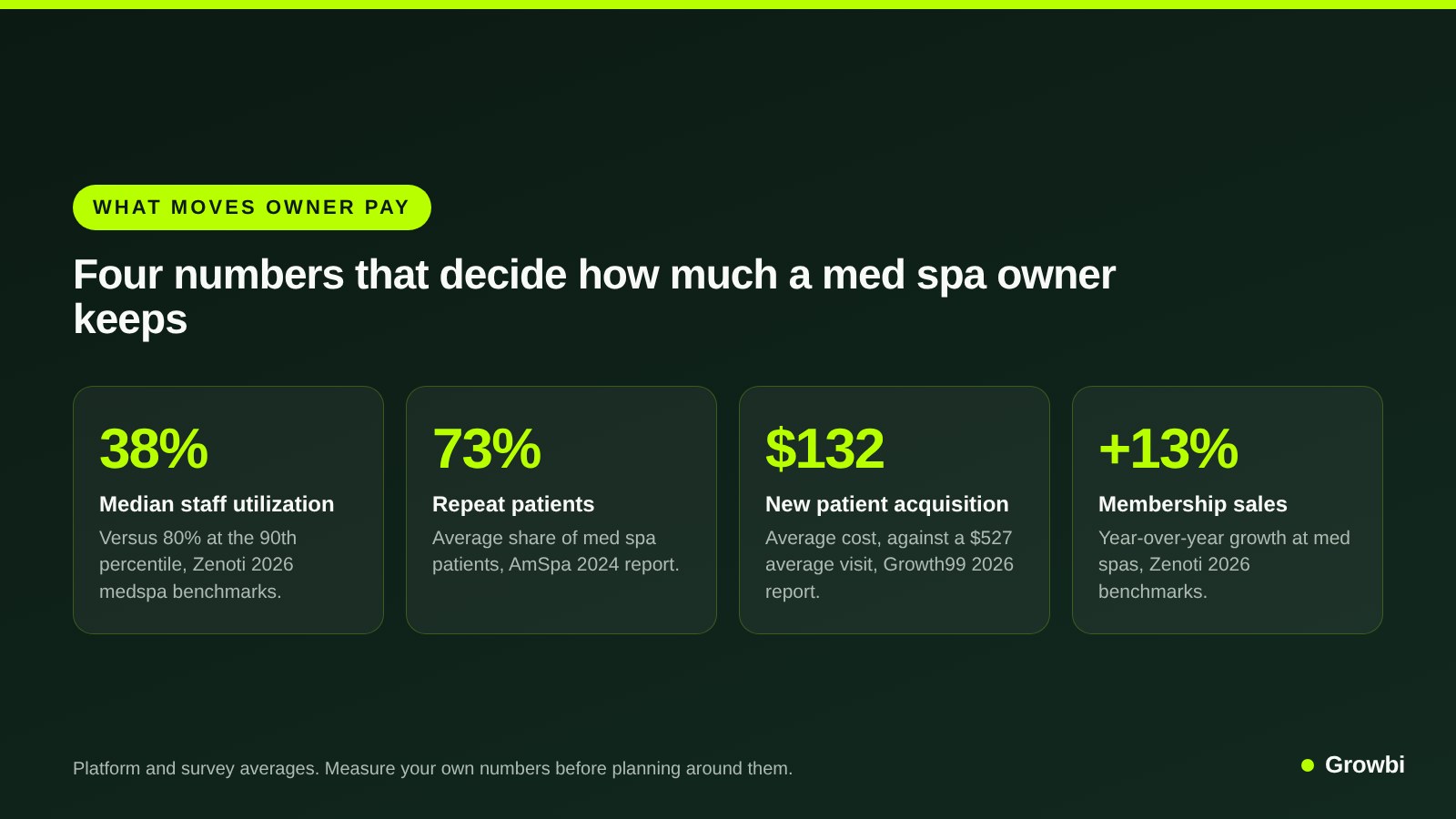
Source: Zenoti 2026 medspa benchmarks, AmSpa 2024 report, Growth99 2026 report
Provider Utilization
Zenoti calls utilization the standout opportunity: 80% at the 90th percentile against 38% at the median, the widest gap of any vertical it measures. AmSpa's planning guide sets similar targets for new clinics, 45% capacity by the end of year one and 75% as the long-term goal.
Service Mix
Not every treatment earns the same margin, so the menu shapes profit as much as the price list.
An AmSpa article by Skytale Group ranks lasers as the highest-margin category, with payback often in seven to eight months, ahead of body contouring and injectables. Injectables earn less per treatment but bring patients back for maintenance, which feeds every other service.
Retention and Memberships
With 73% of patients coming back, retention is where most revenue sits. Zenoti's 2026 data shows medspa new guest visits fell 11% while membership sales grew 13%.
Memberships turn that repeat behavior into predictable monthly revenue. Our guide to med spa membership programs shows how to price tiers that protect margin.
No-shows erode the same hours. Zenoti reports that among patients rebooked once, 37% of those appointments were cancelled, against 4% for patients rebooked two or more times, so see our no-show reduction strategies for deposit and reminder setups.
Pro tip: book the next appointment before the patient leaves the treatment room, and take a card on file for it. It is the cheapest way to move utilization, because the patient is already acquired.
Patient Acquisition Cost
Growth99's 2026 report puts the average cost per lead at $39 and new patient acquisition at $132, against a $527 average visit. In our third scenario, even if all 380 extra visits a year came from brand-new patients at $132 each, acquisition would cost about $50,000 against a $164,000 profit gain.
That math only holds if leads are answered fast and booked, so tie the budget to booked patients rather than clicks. A written med spa marketing plan sets the number of first visits you need each month and the budget that buys them.
Pro tip: track cost per booked first visit by channel every month, not cost per lead. A $20 lead that never books costs more than a $60 lead that shows up and comes back three times.
If you are deciding whether to run acquisition in-house or hire help, compare the options in our list of the best med spa marketing agencies and the channel-by-channel med spa marketing guide.
FAQs
How much do med spa owners make?
AmSpa's 2024 report puts average med spa revenue at $1,398,833. At profit margins between 10% and 29%, that leaves about $140,000 to $406,000 a year for the owner. An owner who also treats patients earns a provider's wage on top; BLS put the median nurse practitioner wage at $134,920 in May 2025.
Are med spas profitable?
Many are, but not automatically. AmSpa's 2019 report found a 29% average profit margin, and Growth99's 2026 report describes 38% margins, while AmSpa's business planning guide warns that many med spas are not profitable because payroll and product costs run high. Utilization, service mix and retention decide which side a clinic lands on.
How much does a med spa owner make a month?
At AmSpa's average revenue of $1,398,833, monthly revenue is about $116,600. A 10% margin leaves roughly $11,700 a month and a 29% margin about $33,800, before any wage the owner earns for treating patients. New clinics usually earn less while the schedule fills, since AmSpa's planning guide targets 45% capacity by the end of year one.
How much do med spas make a year?
The average med spa made $1,398,833 in annual revenue in AmSpa's 2024 State of the Industry report, up from $1,307,587 the year before. Zenoti's 2026 platform data shows a median of $1.86 million per location, with the 90th percentile at $4.25 million. Revenue is not profit; most of it goes to payroll and product.
How much should you pay a medical director?
AmSpa's 2022 State of the Industry summary put the average full-time medical director salary at $120,691. Many single-location med spas use a part-time or contract director instead, paid a monthly fee based on hours, chart review and the number of providers supervised. State rules decide what the director must do, so price the role after confirming the requirements.
Conclusion
Med spa owners make what is left of about $1.4 million in average revenue after payroll, product and fixed costs, plus a wage if they treat patients. Margins between 10% and 29% put that between roughly $140,000 and $406,000 for an average clinic.
The gap between those numbers is mostly operational: booked provider hours, repeat visits and what each new patient costs to acquire. Build your own P&L with your wage on its own line, then work on the lever with the most room.
If you want to see how many booked patients your marketing budget should buy and what that does to your margin, get a free patient forecast.
Get this system built for your business
Book a strategy call and we will model a realistic appointment target from your budget, market, and offer.
Keep reading

Med Spa Business Plan: The Numbers Investors and Lenders Ask For
How to Open a Med Spa: What You Need, State Rules and a Startup Checklist
Med Spa Membership Programs: How to Price, Launch and Keep Members
Med Spa Marketing Plan: A 90-Day Launch and a 12-Month Calendar

How to Reduce Med Spa No-Shows Without Upfront Deposits
Best Med Spa Marketing Companies & Agencies in 2026: 15 Compared