Med Spa Business Plan: The Numbers Investors and Lenders Ask For


Key Takeaways
- Use the traditional format the SBA describes, from executive summary to financial projections, then add med spa detail.
- Build revenue from treatment room hours and provider capacity, with utilization that ramps over the first year.
- Show the ownership and medical oversight structure, since supervision and ownership rules vary by state.
- Set the marketing budget from the first visits you need, then check it against AmSpa's 7% of revenue average.
A med spa business plan should follow the standard lender format, from executive summary to financial projections, but build revenue from treatment room hours, provider capacity, and repeat visits rather than price lists. It must also show an ownership and medical oversight structure that fits your state's rules and a marketing budget that can realistically fill the schedule.
Most med spa plans fail the same test. They multiply a treatment price by an optimistic number of clients and call it revenue. Anyone who has funded a clinic before will go straight to utilization, acquisition cost, and repeat rate, because those decide whether the top line is achievable.
This guide covers what goes in the plan and how to build numbers that hold up. It is not a startup checklist. For that, see how to open a med spa. For running the marketing once you are open, see the 90-day med spa marketing plan.
The Sections a Med Spa Business Plan Needs
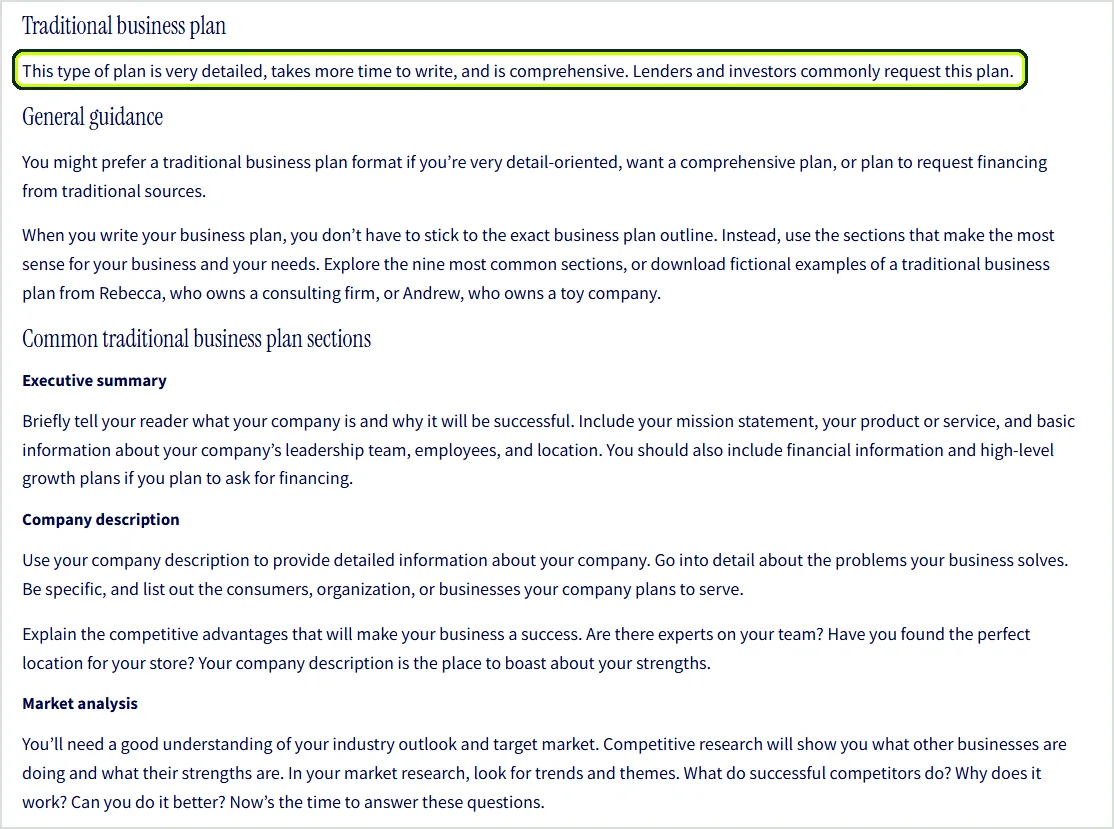
Use the traditional business plan format, because it is the one lenders and investors commonly request. Then add med spa detail where the risk sits.
The SBA's business plan guide describes a traditional plan with sections that include an executive summary, company description, market analysis, organization and management, service or product line, marketing and sales, a funding request, and financial projections.
Source: U.S. Small Business Administration, captured Oct 2026
- Executive summary. What the clinic is, who it serves, how much funding you need, and why the plan will work. Write it last.
- Market and positioning. Your local area, competing clinics, and the specific gap you fill. Name the competitors.
- Ownership and medical oversight. Your legal entity, who owns what, your medical director or supervising provider, and how the structure meets your state's rules. Have a healthcare attorney confirm it.
- Service and pricing model. Service list with time required, cost of goods, and revenue per hour, not just a price list.
- Capacity and staffing. Rooms, provider hours, licensing limits, and a hiring schedule tied to projected demand.
- Marketing plan and budget. Channel by channel, from Google search to Meta and other social media, with expected acquisition cost and the ramp it supports.
- Funding request. How much you need, what it pays for, such as build-out, equipment, working capital, and launch marketing, and the terms you are seeking.
- Financial projections. Three scenarios, monthly for year one and quarterly after. State every assumption in a single visible table.
- Risk section. Provider departure, equipment downtime, regulatory change, and competitive pricing pressure, with your response to each.
Projecting med spa revenue from room hours
Your real constraint is treatment room hours and provider hours, not demand on paper. Build the revenue model on those hours first.
A high-priced treatment that occupies a room for two hours can be worth less per hour than a short injectable appointment. So model hours available, realistic utilization, and revenue per hour by service.
- Rooms x open hours. Why it matters: Sets the theoretical ceiling; Common error: Assuming every hour is booked
- Realistic utilization. Why it matters: Ramps over the first year; Common error: Using mature utilization from month one
- Revenue per room hour. Why it matters: Compares services fairly; Common error: Comparing headline prices instead
- Provider availability. Why it matters: Injectors are often the real bottleneck; Common error: Modeling rooms without staffing them
- No-show and cancellation rate. Why it matters: Directly reduces capacity; Common error: Leaving it out entirely
Benchmarks help you sanity-check the result. AmSpa's 2024 Medical Spa State of the Industry Report puts average annual med spa revenue at $1,398,833, average spend per visit at $527, and average volume at 245 patient visits per month (AmSpa).
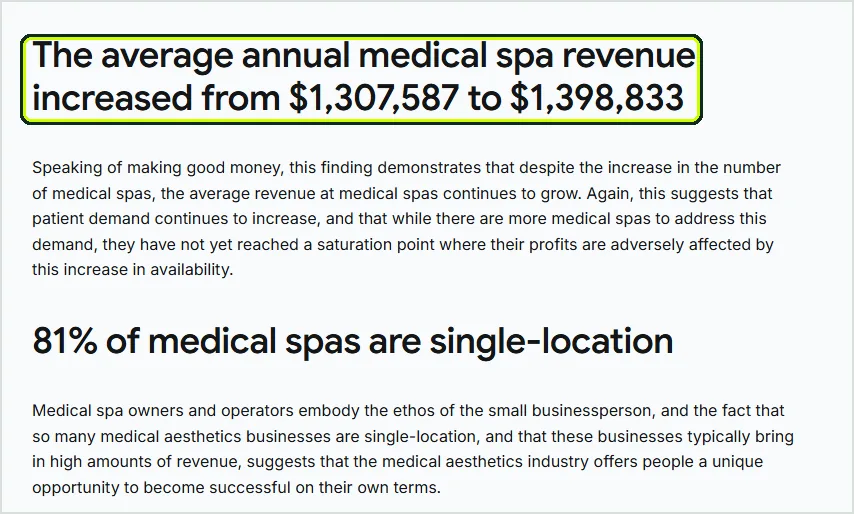
Those are averages across the medical spa industry, covering clinics of many sizes and ages. If your year-one projection lands well above them, expect a lender to ask why.
Run one cross-check of your own. AmSpa's 245 visits at $527 come to about $129,000 a month, or $1.55 million a year, in the same range as its reported average. Apply that multiplication to your month-12 visits and spend per visit.
A fill-in assumptions table for your projections
Lenders read the assumptions before the totals. Put every input in one table, with the number and where it came from, so nobody hunts through tabs.
- Treatment rooms x open hours per week. Your number: ____; Source to cite: Lease, floor plan, opening hours
- Utilization in months 3, 6 and 12. Your number: ____ / ____ / ____; Source to cite: Your own ramp, not mature benchmarks
- Revenue per room hour, by service. Your number: ____; Source to cite: Price list and treatment times
- Cost of goods per treatment. Your number: ____; Source to cite: Supplier quotes
- Marketing cost per first visit. Your number: ____; Source to cite: Agency estimate or a test campaign
- Visits per client in 12 months. Your number: ____; Source to cite: Service cycle and membership plan
- No-show and cancellation rate. Your number: ____; Source to cite: Booking software or a conservative estimate
- Monthly fixed costs. Your number: ____; Source to cite: Lease, payroll and insurance quotes
Then build three scenarios from the same table: conservative, expected, and strong. Change only the inputs you are least sure of, which for a new clinic means utilization and cost per first visit.
Operating costs the plan should include
Lenders look for a complete cost picture, not just rent and equipment. List each category with its source, such as a quote, a lease, or a payroll estimate.
- Occupancy. Examples: Rent, utilities, maintenance; Planning note: Use the actual lease terms, including increases
- Clinical staff. Examples: Injectors, nurses, laser technicians; Planning note: Tie hiring dates to projected demand
- Medical oversight. Examples: Medical director agreement; Planning note: Scope depends on state rules and service mix
- Product and supplies. Examples: Neurotoxin, filler, skincare, disposables; Planning note: Model cost of goods per treatment
- Equipment. Examples: Purchase or lease payments, service contracts; Planning note: Include downtime and maintenance
- Insurance. Examples: Malpractice, general liability, property; Planning note: Get quotes for each provider and service
- Software. Examples: Booking, charting, payments, CRM; Planning note: Monthly fees often scale with staff
- Marketing. Examples: Ads, creative, agency or staff time; Planning note: Set from the bookings you need, not a guess
Mark which costs are fixed and which rise with volume. Product, supplies and per-seat software scale with treatments. Rent, insurance and the medical director agreement do not, and they set your break-even point.
Marketing numbers that belong in the plan
The marketing section is where reviewers check whether the schedule can actually fill. Four numbers carry it.
- Client acquisition cost, including ad spend, agency or freelancer fees, software, and any launch discount.
- First visit value versus twelve-month value. Med spa economics live in the second, third, and fourth visits.
- Repeat rate and visit frequency by service. Injectables repeat on a predictable cycle, laser courses do not.
- Membership or package take-up, which turns unpredictable revenue into a monthly baseline. See our guide to med spa membership programs.
For the overall budget, AmSpa reports that med spas invest about 7% of revenue in marketing on average, with a range of 2% to 15% (AmSpa).
What the budget buys: a worked example
Here is how to turn a percentage into bookings. Seven percent of AmSpa's $1,398,833 average revenue is about $97,900 a year, or roughly $8,160 a month.
Now divide by a real cost per first visit. Growbi's published CPL vs CPA research on a med spa account put the cost at $38.48 per arrived customer.
At that rate, $8,160 a month buys about 212 first visits. First visits usually come from an entry offer priced well below the regular price, so the plan still needs a repeat-visit path behind them.
A new account rarely starts at its best cost per first visit. Model your first quarters at a higher cost per first visit and show how it falls as the account learns. For an estimate in your market, book a free 15-minute call.
Show the ramp. A plan showing a full schedule in month three is not ambitious. It is a red flag. Model a ramp across the first year or longer, and state the marketing spend required to achieve it. Reviewers trust conservative plans with clear assumptions far more than aggressive ones.
Licensing, ownership and medical oversight
A med spa plan has a section most retail plans do not: how the business is allowed to operate. Lenders will ask about it.
Corporate practice of medicine rules, medical director requirements, and scope-of-practice limits for nurses and other providers vary by state. They decide who can own the clinical side, how revenue flows between entities, and which staff perform which treatments.
So answer the question many owners search first, who can open a med spa, inside the plan. Show the structure, the kind of license each provider holds, the medical director or your plan to hire one, and that a healthcare attorney reviewed it.
It also affects your staffing math. AmSpa reports that single-location practices average eight employees (AmSpa). If a revenue line depends on a provider type your state does not allow to perform that treatment, the line does not hold, however strong the demand.
Profit and owner pay in the plan
Lenders and partners want to see when the clinic turns profitable, not only how large revenue gets. Show the month you expect to break even and what drives it.
Profit in a medical spa business comes from margin per room hour minus fixed costs. Injectables, laser courses and facials carry different product costs and appointment lengths, so model margin by service instead of one blended rate.
Owner pay belongs in the plan as its own line. How much money med spa owners make depends on whether the owner also treats patients, because a provider-owner's clinical hours are capacity, and the model should count them that way.
Assumptions that get challenged
Four assumptions draw the most questions in a lender or investor meeting. Each one makes the plan look easier than the first year will be.
- Client acquisition cost that stays flat as you scale. It normally rises as you use up the easiest demand.
- Retention rates borrowed from industry articles instead of your own market and pricing.
- Injectable pricing that ignores product cost changes and local competitive pressure.
- Revenue projections that require an injector you have not yet hired in a tight labor market.
This is a planning framework, not financial or legal advice. Have projections reviewed by an accountant familiar with medical aesthetics, and confirm ownership and supervision requirements in your state with your state medical board and a healthcare attorney.
FAQs
How much revenue does a med spa make?
AmSpa's 2024 Medical Spa State of the Industry Report puts average annual med spa revenue at $1,398,833, up from $1,307,587 the year before. That is a national average across clinics of different sizes and ages, so use it to sanity-check your projection rather than as your forecast.
How much money do I need to open a med spa?
It varies widely with location, size, equipment, and build-out standard, so a range copied from an article is not useful for your plan. Build it from the bottom up using your actual lease, equipment quotes, staffing, insurance, and a marketing budget that covers at least two quarters.
Is a med spa a profitable business?
It can be, but profit depends on filling room hours at a margin above fixed costs. AmSpa's rising average revenue signals demand, not profit. A lender will want to see your break-even month and the utilization you need to reach it, built from your own costs.
Conclusion
A med spa business plan earns trust when its revenue comes from room hours and its marketing budget comes from the first visits it has to buy. The SBA format gives you the skeleton, and the capacity model gives it weight.
Keep the ramp honest. Show utilization rising across the first year, cost per first visit falling as campaigns learn, and an ownership structure a healthcare attorney has reviewed.
If you want the marketing section built on real cost-per-visit numbers for your market, book a free 15-minute call and we will map the budget your ramp needs.
Mor Romano
CTO, Growbi
Written and fact checked by Mor Romano, published , last reviewed .
More about Mor RomanoGet this system built for your business
Book a strategy call and we will model a realistic appointment target from your budget, market, and offer.