Transform Your Hiring with a Specialized Agency


Key Takeaways
- Recruiting clinical and caregiver staff is a different job from generating patient leads, with different messages, rules and success metrics.
- BLS projects about 760,500 openings a year for home health and personal care aides, so competition for caregivers will stay intense.
- Employment ads on Google cannot be targeted by age, gender, parental status, marital status or ZIP code in the US and Canada.
- Judge an agency by booked interviews, show rate and cost per qualified interview, not by clicks or raw application counts.
A specialized healthcare recruitment marketing agency runs paid hiring campaigns built for clinical and caregiver roles, not patient leads. It writes role-specific ads, targets within employment ad rules, and sends candidates to screening and booking pages, so med spas, dental practices and home care companies get qualified interviews instead of a pile of unqualified applications.
This guide is for owners and hiring managers at med spas, dental practices and home care companies who run job ads that bring applicants but few hires.
It covers why healthcare hiring needs its own approach, what a specialized agency does differently, and how to vet one before you sign.
The short version: healthcare hiring needs its own playbook
Recruitment advertising for healthcare roles is not another form of lead generation. Treating it that way fills your inbox with applicants who are not licensed, local or available.
Hiring a med spa nurse injector, a dental assistant or a caregiver means persuading someone who already has a job to choose yours. That takes different messaging, different screening and different metrics than selling a treatment.
The common misconception in healthcare recruitment
The common belief is that any agency good at patient leads can fill clinical roles. In practice the skills overlap far less than owners expect.
Patient ads sell an outcome to a buyer. Recruitment ads sell a job to a professional who compares pay, schedule, commute, team and growth across several offers at once.
A general agency judges success by lead volume and cost per lead. For hiring, a cheap applicant who lacks a license or never answers the phone is not a lead at all.
The pitfall of generic recruitment strategies
Generic campaigns struggle most where competition for staff is highest, and healthcare support roles are among the most contested hires in the country.
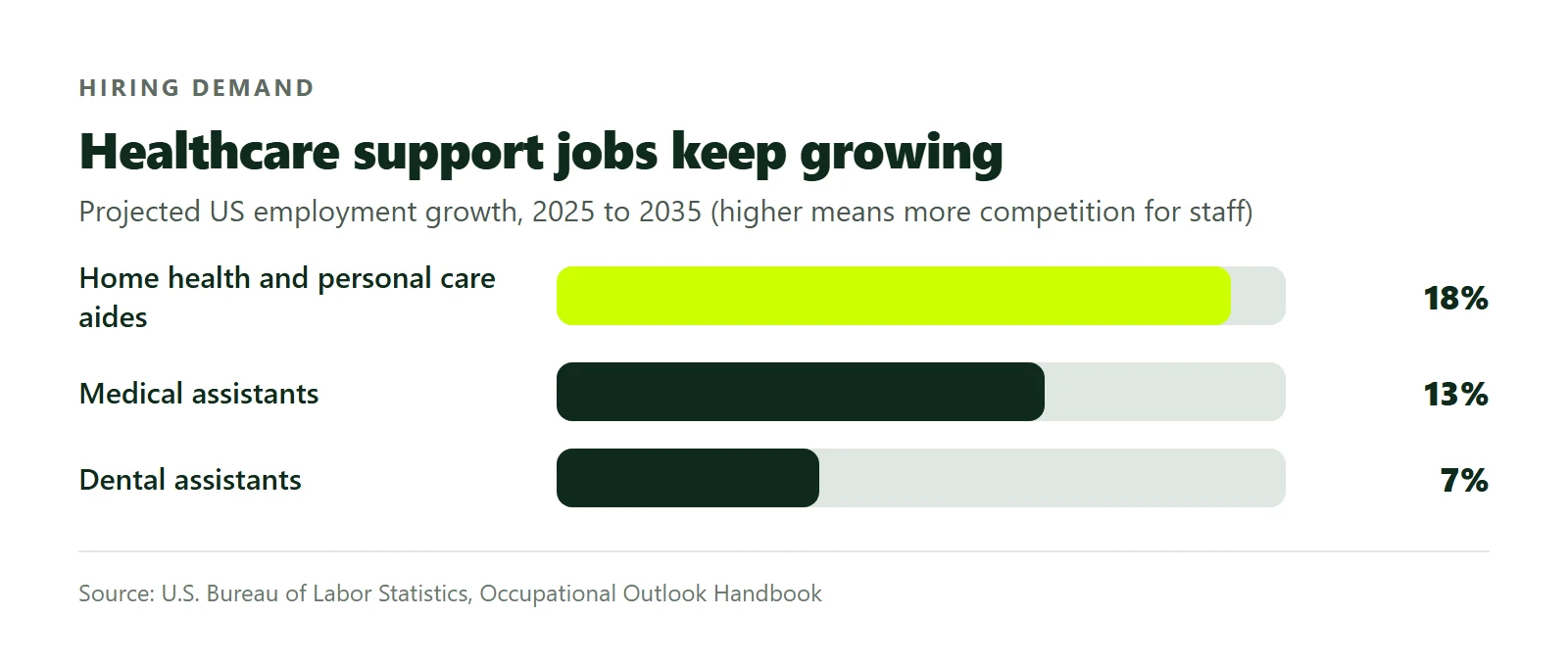
The U.S. Bureau of Labor Statistics projects employment of home health and personal care aides to grow 18% from 2025 to 2035, with about 760,500 openings each year, mostly to replace workers who change jobs or leave the labor force.
Clinical support roles follow the same pattern. BLS projects medical assistant jobs to grow 13% over the same decade, with about 109,700 openings a year, and dental assistant jobs to grow 7%, with about 53,000 openings a year.
When every clinic in town is hiring for the same roles, a vague ad that says join our team disappears. Candidates respond to concrete details: pay range, schedule, location, and why your team is a better place to work.
A specialized approach to healthcare talent acquisition
A specialized agency builds each campaign around one role, one location and one candidate profile, then measures it by booked interviews.
On Meta and Google, that means ad copy and visuals written for the professional you want. Messaging for a dental hygienist has to differ from an ad that attracts a new patient, even on the same platform.
It also means working inside ad policy. Google's personalized advertising policy bars employment ads in the US and Canada from targeting by age, gender, parental status, marital status or ZIP code, so precision has to come from the message and the screening.
Candidates then land on a short page for that role, answer qualifying questions about licenses and availability, and book an interview in a two-step flow. Warm candidates who did not finish get a follow-up.
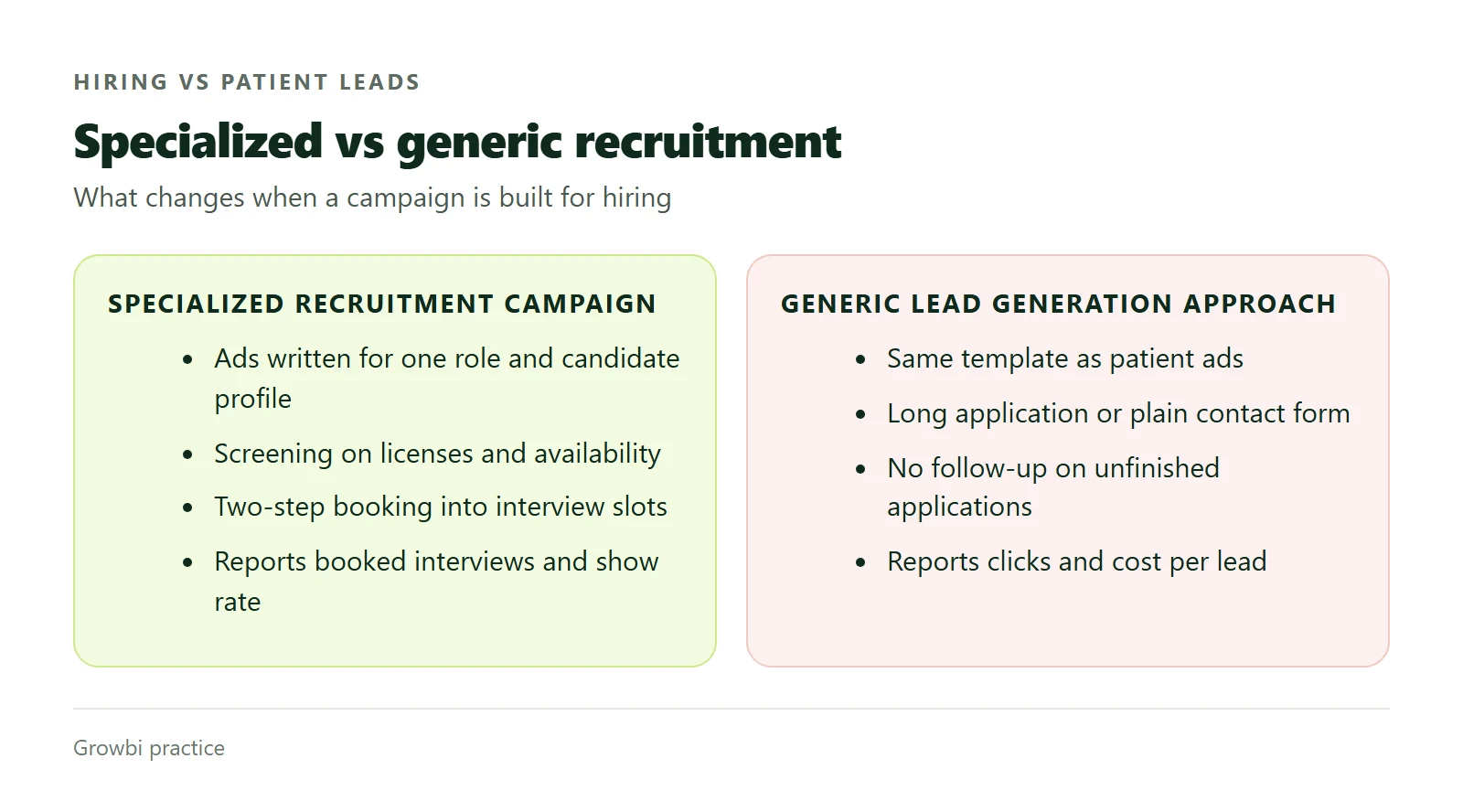
That is the same structure behind our recruitment marketing services and the Growbi system for patient acquisition: tested creative, focused landing pages, and tracking that follows each person to a booked appointment.
How to evaluate a healthcare recruitment marketing agency
Use these five checks to separate an agency that fills clinical roles from one that only generates applications for you to sort through.
- Define your ideal candidate profile. Write down the skills, licenses, schedule and cultural fit you need. An agency cannot target a hire you have not described.
- Check agency specialization and track record. Look for experience with healthcare, med spas or home services, and ask for examples that report qualified interviews and time-to-hire.
- Evaluate their funnel and tracking. Ask for dashboards that show booked interviews and cost per qualified interview, with visibility into each step of the applicant journey.
- Assess creative production and testing. Find out how they write ads and visuals for each role, how many versions they test, and how they decide which ones win.
- Review retargeting and local targeting. Ask how they reach warm, unbooked candidates again and how they use radius and city targeting within employment ad rules.
What to measure once campaigns are live
Once campaigns run, the dashboard should show every step from ad spend to hire, not just clicks and applications.
- Qualified applicants. What it shows: People who meet license, location and schedule requirements
- Booked interviews. What it shows: Applicants who picked a time, not just submitted a form
- Interview show rate. What it shows: Share of booked candidates who actually attend
- Cost per qualified interview. What it shows: Ad spend divided by interviews with qualified candidates
- Interview-to-hire rate. What it shows: How well the funnel matches your real requirements
If an agency cannot report these, ask why. For a breakdown of fees and ad spend, read our guide to the real cost of a recruitment marketing agency.
Show rate is where follow-up matters most. The reminder habits that help reduce med spa no-shows work just as well for interview slots.
Key lessons for strategic healthcare staffing
Healthcare hiring rewards employers who treat recruitment as a steady campaign, not a scramble each time someone resigns.
A specialized agency keeps a pipeline of interested, qualified professionals, so your team spends its time onboarding good hires instead of sorting unqualified resumes.
If you are still weighing ad models, compare programmatic job advertising with recruitment marketing before you commit budget to either one.
FAQs
What does a healthcare recruitment marketing agency do?
It plans and runs paid hiring campaigns for clinical and caregiver roles on platforms such as Meta and Google. That covers role-specific ads, landing pages with screening questions, interview booking, follow-up, and reporting on qualified interviews and hires.
How should I compare recruitment marketing quotes?
Expect two parts: the agency's management fee and the ad spend that goes to the platforms. Compare quotes by expected cost per qualified interview, not by monthly fee alone, because a cheaper agency that books no-shows costs more.
Why are caregivers so hard to hire?
Demand is high and turnover is constant. BLS projects about 760,500 openings a year for home health and personal care aides through 2035, mostly to replace workers who move to other occupations or leave the labor force.
Conclusion
Healthcare hiring needs its own approach. The candidates you want already have jobs, compare offers carefully, and respond to specific details about pay, schedule and team.
A specialized recruitment marketing agency writes for those people, works within employment ad rules, and measures success by booked, qualified interviews rather than applications.
To see how this would work for your open roles, book a free 15-minute call with Growbi. We will review your current hiring ads and the positions you need to fill.
Get this system built for your business
Book a strategy call and we will model a realistic appointment target from your budget, market, and offer.