Programmatic Job Advertising vs. Recruitment Marketing

Key Takeaways
- Programmatic job advertising automates the buying and placement of job ads, with algorithms setting bids across job boards and aggregators.
- It works best for high-volume roles like caregiving, where BLS projects about 760,500 openings a year, not for licensed specialist positions.
- A recruitment marketing agency owns the full path from ad to booked interview, including creative, landing pages, screening and follow-up.
- Judge either option by cost per qualified interview and hires, because a cheap click means little if the applicant never shows up.
Programmatic job advertising uses software to buy and place job ads across job boards and aggregators, usually paying per click or per application. A recruitment marketing agency builds the whole path from ad to booked interview: role-specific creative, landing pages, screening and follow-up. Programmatic buys reach. Recruitment marketing turns that reach into qualified interviews.
This guide compares the two models for owners of med spas, dental practices and home service companies who hire locally and need people who actually show up.
You will see how each one is priced, where each one fits, which targeting rules apply to job ads, and which numbers to ask for before you sign with either.
How programmatic job advertising works
Programmatic job advertising is software that buys and places your job ads across many job boards and aggregators, then shifts budget toward the sites that perform.
SocialTalent's recruiting glossary describes it as automated buying where bidding algorithms handle placement and spend, instead of a recruiter buying slots on each board by hand. You set goals and limits. The platform does the bidding.
Pricing follows one of three models: cost per click, cost per application, or pay for performance. Cost per application has become more common because the platform is paid only when applications arrive.
DirectEmployers adds that these platforms use automation, machine learning and real-time data to manage ads across recruiting channels. In short, programmatic is a media buying engine. It decides where your ad runs and what you pay for it.
Where programmatic fits and where it falls short
Programmatic is strongest when you need a large number of applications for roles with a broad candidate pool, such as hourly, entry-level or customer service jobs.
Caregiving is a clear example of volume hiring. The U.S. Bureau of Labor Statistics projects about 760,500 openings a year for home health and personal care aides, with employment growing 18% from 2025 to 2035.
SocialTalent also notes that for specialist or senior hiring, programmatic plays a smaller role than direct sourcing and referrals. That matches what local employers see when they hire licensed injectors, dental hygienists or experienced technicians.
The weak point is what happens after the click. Most programmatic campaigns send candidates to a standard job board listing or an applicant tracking form. Nobody tests the message, screens for licenses, or follows up with the person who started an application and stopped.
Why a lower cost per click can raise your cost per hire
A cheap click is not a cheap hire. Every unqualified applicant costs screening time, and every no-show wastes an interview slot your manager blocked out.
That is why the click price on a programmatic dashboard says little about what a hire costs you. The numbers that matter sit further down the funnel: qualified applicants, booked interviews, shows and hires.
SHRM's recruiting benchmarking research, built on data from more than 4,600 organizations with trends back to 2017, tracks outcome metrics such as cost-per-hire and time-to-fill. Its 2026 brief puts median time-to-fill for nonexecutive positions at 39 calendar days.
Those are the metrics to compare vendors on. If a platform reports clicks and applications but cannot tell you how many people showed up to an interview, you are paying for activity, not results.
The targeting rules every job ad must follow
Job ads are a restricted category on Google, so no platform or agency can target candidates there by age, gender or ZIP code in the US and Canada.
Google's personalized advertising policy bars employment advertisers in both countries from targeting by gender, age, parental status, marital status or ZIP code. Radius targeting must cover at least 1 km, and city targeting is allowed.
This is where promises of hyper-local candidate targeting fall apart. Precision in recruitment comes from the message, the role details and the screening questions, not from narrowing the audience by demographics or postcode.
What a specialized recruitment marketing agency adds
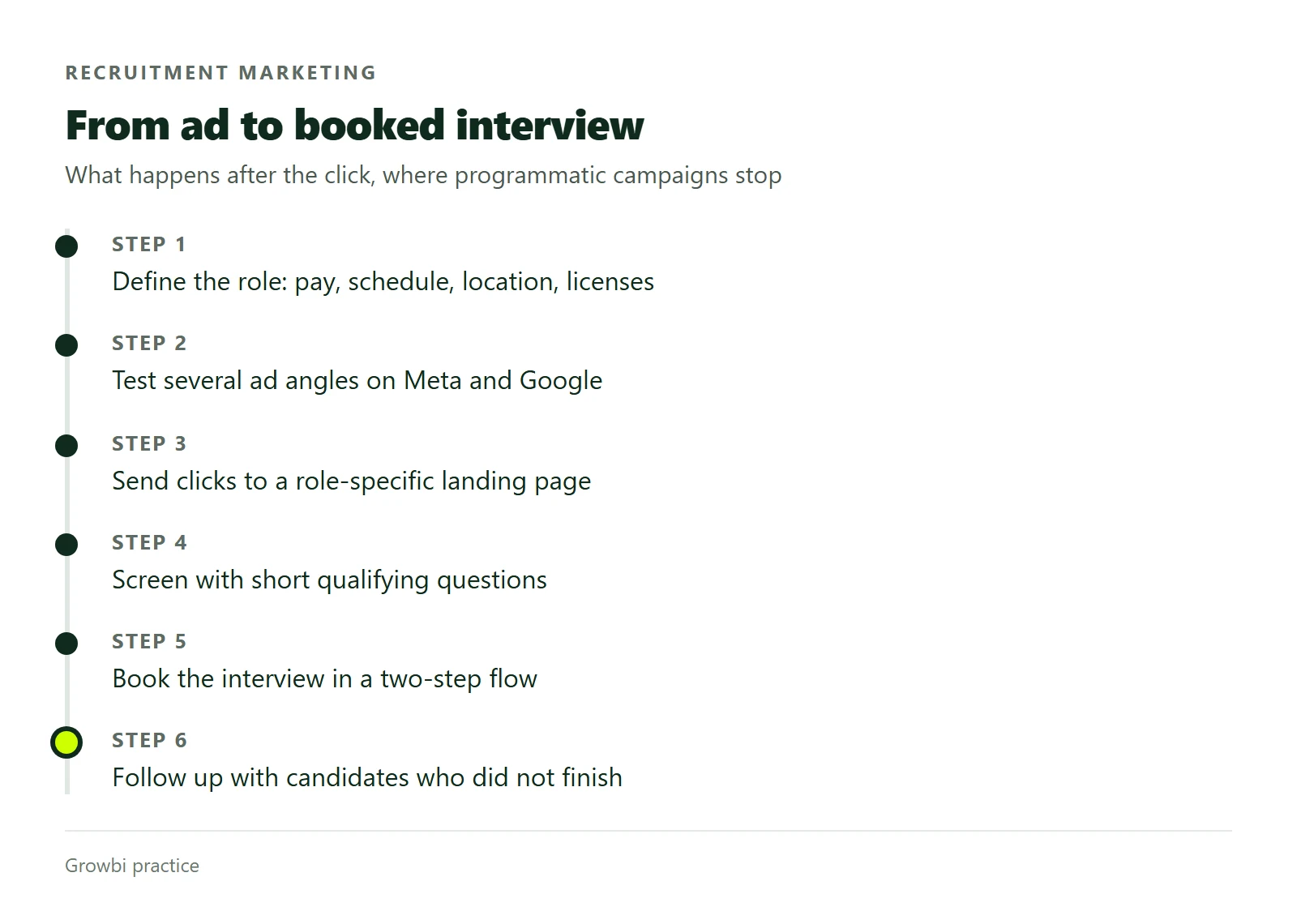
A recruitment marketing agency treats the job ad as the first step of a funnel that ends with a booked interview, not with a submitted form.
The work starts with the role. Pay, schedule, location, required licenses, and the reasons your clinic or company beats the one down the street go into the ad copy and visuals.
Creative gets tested. Several angles run at once, the weak ones are cut, and budget moves to the version that produces qualified applicants rather than the cheapest clicks.
Candidates land on a short page built for that role, answer a few screening questions, and pick an interview time in a two-step booking flow. People who start and stop get a reminder by text or email.
We describe this process on our recruitment marketing services page. The same build of tested creative, focused pages and tracking runs through the Growbi system we use for patient and customer acquisition.
Programmatic and recruitment marketing side by side
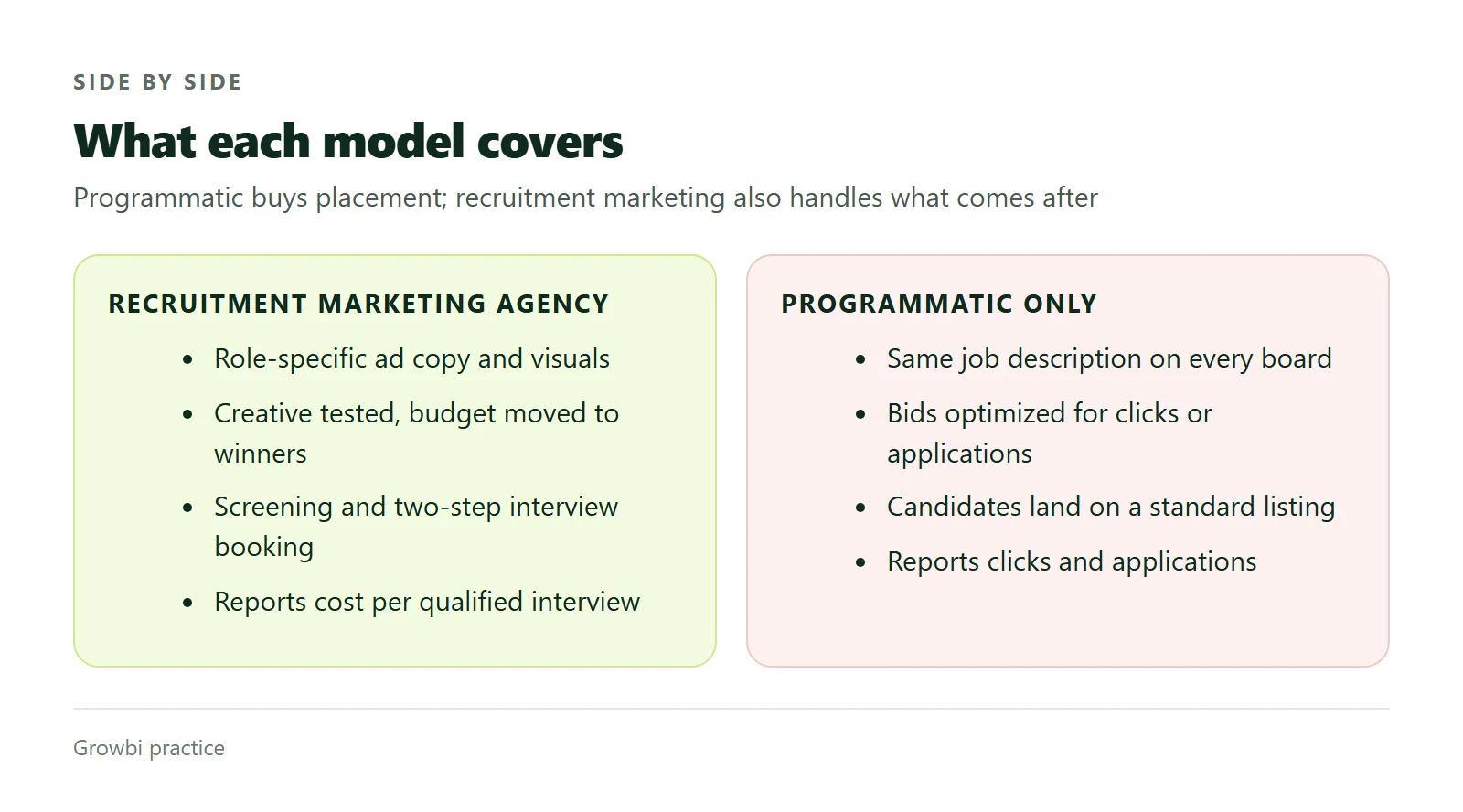
The two models answer different questions. Programmatic decides where a job ad runs and what it costs. An agency decides who responds and whether they book.
- Main job. Programmatic job advertising: Buy and place ads across job boards; Recruitment marketing agency: Turn ads into booked, qualified interviews
- Pricing. Programmatic job advertising: Cost per click, per application, or performance; Recruitment marketing agency: Management fee plus ad spend
- Best fit. Programmatic job advertising: High-volume hourly and entry-level roles; Recruitment marketing agency: Licensed, skilled or hard-to-fill local roles
- Where candidates land. Programmatic job advertising: Job board listing or applicant tracking form; Recruitment marketing agency: Role-specific page with screening and booking
- Main metric. Programmatic job advertising: Cost per click or per application; Recruitment marketing agency: Cost per qualified interview and hires
Many employers use both. Programmatic covers volume roles across job boards, while an agency runs paid social and search campaigns for the positions where a bad hire costs the most.
Measure cost per qualified interview, not cost per click
The metric that ties ad spend to hiring is cost per qualified interview: total spend divided by interviews held with candidates who meet your requirements.
It is easy to track if you log three things each week: spend, qualified applicants, and interviews that actually happened. Ask any vendor to report in those terms, and compare your hiring speed with SHRM's 2026 median of 39 days.
Our guide to the real cost of a recruitment marketing agency breaks down fees, ad spend and the hidden cost of a slow pipeline. If you hire clinical staff, see how a specialized healthcare recruitment agency handles licensed roles.
Show rate is where follow-up pays off. The reminder habits that help reduce med spa no-shows work just as well for interview slots.
Choosing the right option for your hiring goals
Choose programmatic if you mainly need application volume for roles with a large pool. Choose an agency if you need fewer, better candidates who show up.
For a med spa hiring an injector, a dental office replacing a hygienist, or a home service company adding technicians, the second case is far more common. An empty chair or truck costs more than the difference in click prices.
If a role has stayed open well past the 39-day median SHRM reports, the funnel after the click is the likely problem. Fix screening, booking and follow-up before you raise the budget.
FAQs
Is programmatic job advertising worth it for small businesses?
It pays off if you hire often for hourly or entry-level roles with a large candidate pool. For a few skilled hires a year, the automation adds little, and the bigger gains come from better messaging, screening and fast follow-up.
How is programmatic job advertising priced?
Most platforms charge by cost per click, cost per application, or a pay-for-performance model. SocialTalent notes that cost per application is increasingly standard because the platform is paid only when applications actually arrive.
Can I target job ads by ZIP code?
Not on Google in the US and Canada. Google's personalized advertising policy bars employment ads from targeting by ZIP code, age, gender, parental status or marital status. Radius targeting of at least 1 km and city targeting are allowed.
Conclusion
Programmatic job advertising is a capable media buying tool. It places your ads widely and manages bids, but it stops at the application and leaves screening and follow-up to you.
A recruitment marketing agency covers the steps after the click. For skilled local roles, that is where hires are won or lost, and where you should measure every vendor.
If you want to see what this would look like for your open roles, book a free 15-minute call with Growbi. We will review your current hiring ads and tell you plainly which model fits.
Get this system built for your business
Book a strategy call and we will model a realistic appointment target from your budget, market, and offer.