Recruitment Marketing Agency Cost: What You Pay Beyond the Monthly Fee


Key Takeaways
- The monthly fee is one line; ad spend, setup and your team's screening time sit on top of it.
- Recruiters bill per hire, on average 20% to 25% of first-year salary, according to Indeed's guide to headhunter fees.
- For a dental hygienist at the $98,100 BLS median, one recruiter fee runs $19,620 to $24,525.
- Judge any agency on cost per hire and time to fill, not on cost per click or the number of applications.
A recruitment marketing agency charges a monthly management fee, 10% to 20% of ad spend or $1,000 to $3,000 a month on published PPC pricing, plus the ad budget itself. The real cost is fee plus spend divided by hires made. Compare that number with a recruiter's typical 20% to 25% placement fee.
Ask a recruitment marketing agency what it costs and you will hear a monthly number. That number matters, but it is rarely the biggest line in what a hire actually costs you.
This guide breaks the cost into its real parts, compares it with paying a recruiter per hire, and works through one example: filling a dental hygienist role with published salary and fee data.
What a recruitment marketing agency charges each month
Most recruitment marketing agencies price like paid ads agencies: a management fee for running campaigns, with the ad budget paid on top.
WebFX's PPC pricing guide puts management fees at 10% to 20% of ad spend, or around $1,000 to $3,000 a month. Its own tiers start at $750 a month, with a first-month charge of $1,200 to $5,800 that covers the audit and setup.
Those are general paid search figures from an agency that sells the service, not a recruitment price list. They give you a fair range to hold a recruitment quote against before you ask what the fee includes.
The costs that sit outside the monthly fee
The retainer is the number on the proposal. Four other costs decide whether a hire ends up cheap or expensive for your business.
- Ad spend. Paid to Google, Meta or a job board directly. On a $2,000 monthly budget, it is larger than most fees.
- Setup and creative. Landing pages, application forms and job ad creative, billed once or folded into the first month.
- Screening time. Every applicant your office manager calls is paid time. Weak applicants cost hours, not just ad dollars.
- The open seat. Each week a chair or truck sits empty is work you turn away while the search runs.
Job boards add their own billing. Indeed's pricing page says sponsored jobs are billed for interactions such as clicks or started applications, invoiced monthly or once spending reaches $500, against a budget Indeed suggests for each job.
Recruiter fees vs a recruitment marketing retainer
A recruiter and a recruitment marketing agency get paid for different things, so their prices only compare once you turn both into cost per hire.
A recruiter, or headhunter, bills per placement. Indeed's guide to headhunter fees puts the average at 20% to 25% of first-year salary, ranging from as low as 15% to 40% or more, paid on the new hire's start date.
A recruitment marketing agency bills for running campaigns that bring applicants to you. Your team still screens, interviews and hires, but the monthly cost stays the same whether the campaign produces one hire or four.
That fixed cost is the whole argument. One hire a year favors the recruiter. Several hires a year, in the same role and market, favor owning the campaign and the applicant pipeline.
A worked example: hiring a dental hygienist
Put real numbers on one role and the difference between the two models becomes easy to see on a single page.
The BLS Occupational Outlook for dental hygienists lists median pay of $98,100 a year in 2025, with about 15,000 openings projected each year. At 20% to 25%, one recruiter placement costs $19,620 to $24,525.
- Recruiter. How it is priced: 20% to 25% of $98,100 salary; One hire: $19,620 to $24,525; Three hires: $58,860 to $73,575
- Campaign, illustrative. How it is priced: $1,500 fee plus $2,000 ads a month; One hire: $7,000 over 2 months; Three hires: $10,500 over 3 months
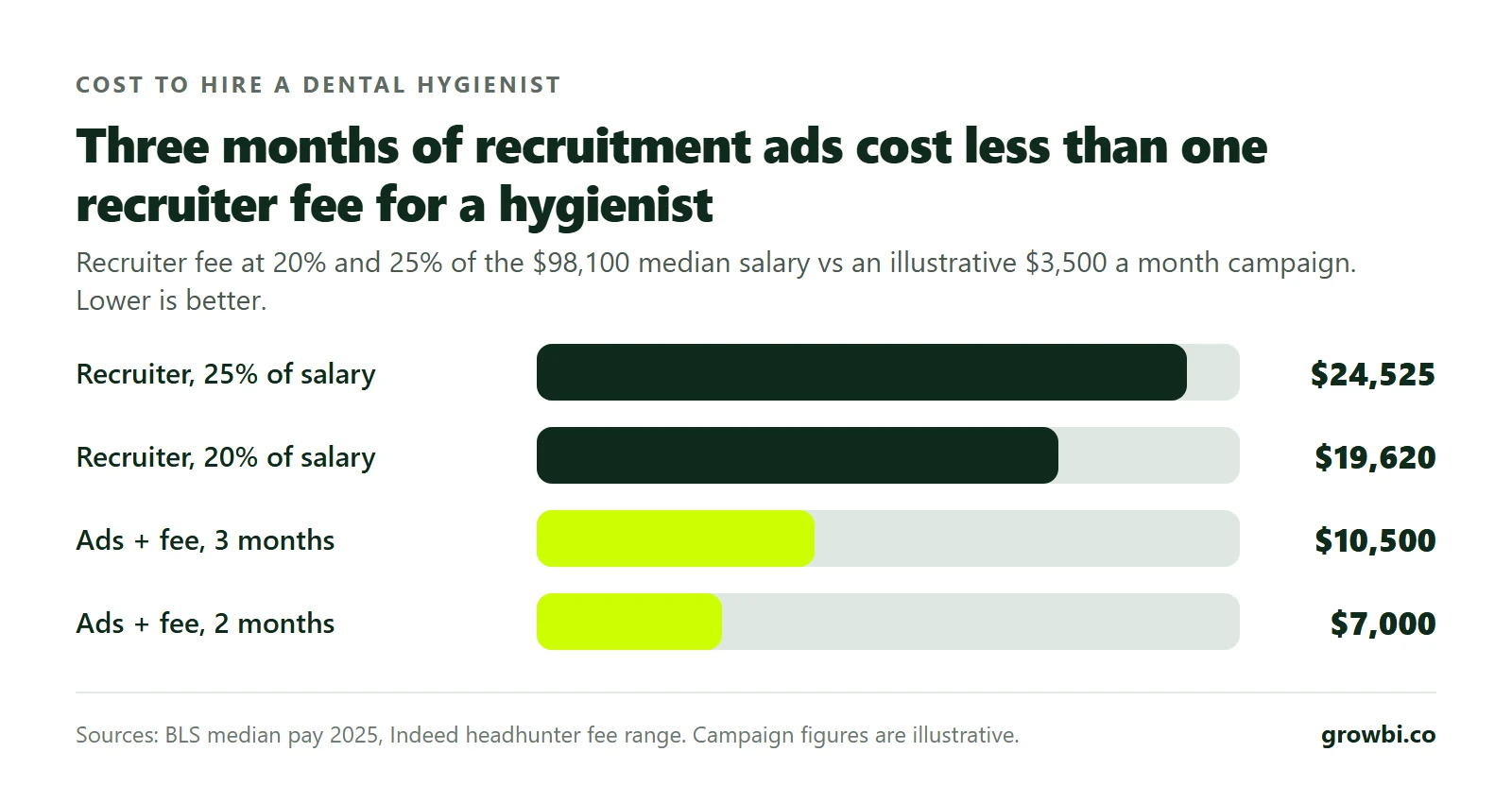
How to read this example. The campaign row is an assumption, not a promise: $1,500 sits inside the published fee range and $2,000 is a modest local budget. It only wins if the campaign actually produces hires, so ask any agency what fill rate it expects and how it will prove it.
What job ads cost per applicant
Ad spend buys clicks and applications, and published benchmarks show that hiring ads cost more per lead than most other categories.
WordStream's 2026 Google Ads benchmarks put Career and Employment at a $5.81 average cost per click, a 3.05% conversion rate and $67.36 per lead. That compares with a $5.42 click and 8.18% conversion rate across all industries.
At $67.36 per lead, a $2,000 monthly budget buys about 30 applicants. If the screen passes one in three, that is roughly 10 people worth calling each month, which is why the landing page and screening questions matter as much as the ads.
Targeting has limits too. Google's employment ad policy bars US and Canadian job ads from targeting by gender, age, parental status, marital status or ZIP code, so the ad and the offer have to do the filtering.
Measure cost per hire, not cost per application
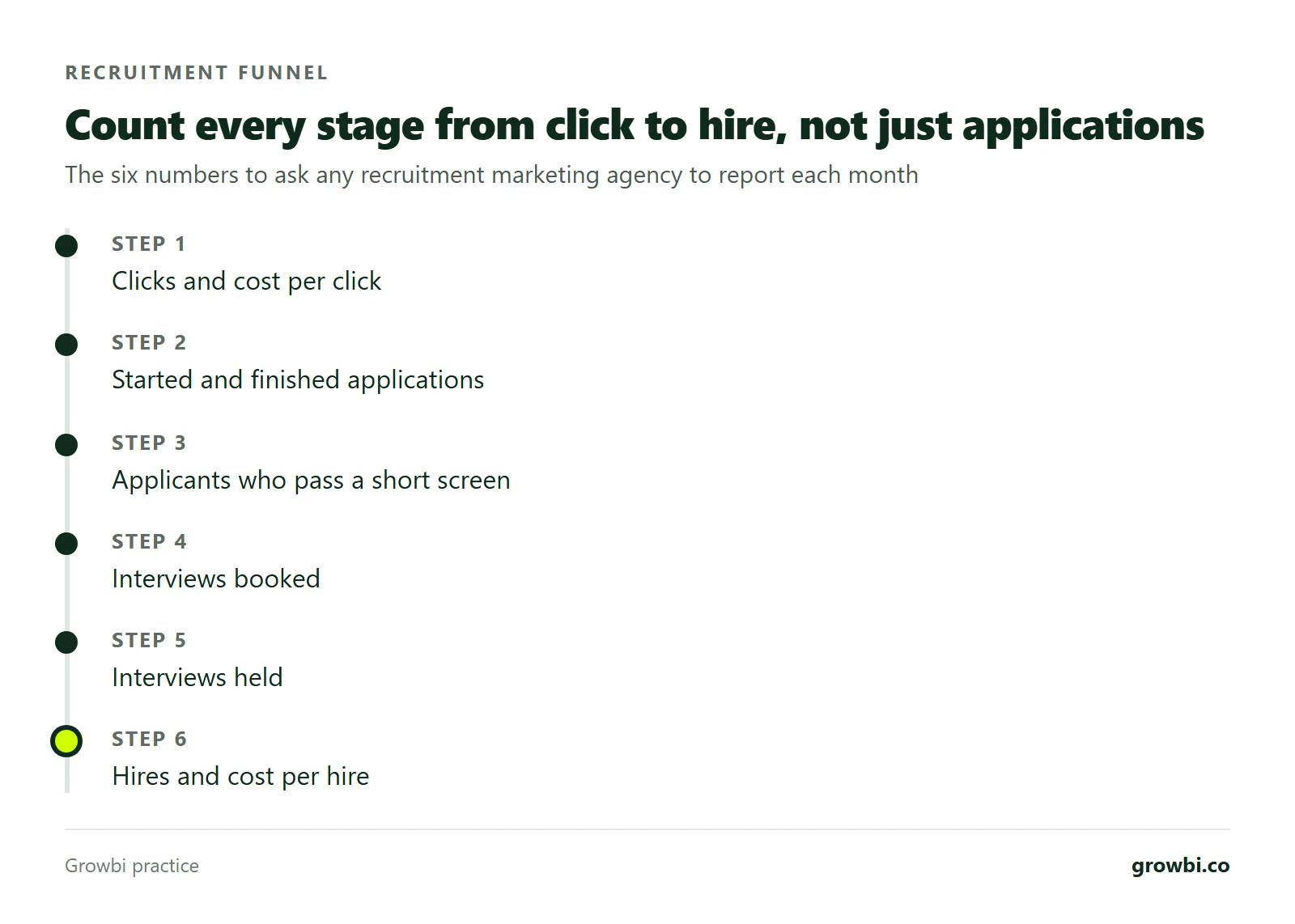
Applications are easy to count and easy to inflate. The number that pays your bills is a hire who shows up and stays.
Time matters as much as money. SHRM's 2026 recruiting benchmarks, based on data from more than 4,600 organizations, report a median time to fill of 39 calendar days for nonexecutive positions.
Use that as the bar. If a campaign has not booked interviews within the first two to three weeks, the problem is the offer, the page or the screening, and more budget will not fix it.
Why growing service businesses end up hiring
Hiring pressure usually follows demand. When the calendar fills, the bottleneck moves from leads to the people who do the work.
A home service company that books more jobs needs more technicians to run them, and a wider service area needs more crews. Plan the hiring campaign before the schedule is full, not after jobs start slipping.
For clinics, the roles differ but the logic holds. Our guide to healthcare recruitment marketing for clinics covers hygienists, medical assistants and front desk roles in detail.
Questions to ask before you sign a retainer
A good proposal answers these without being asked. A weak one turns vague the moment you raise them in the first call.
- What does the fee include? Ads only, or landing pages, creative and screening questions as well.
- Who owns the ad accounts? You keep the data and history if you leave.
- What do you report? Interviews and hires, not only clicks and applications.
- How do you handle employment ad rules? No age, gender or ZIP code targeting in the US and Canada.
If you are weighing job boards against your own campaigns, our comparison of programmatic job advertising and recruitment marketing explains when each one fits.
Building a hiring funnel that produces hires
This is the order we build recruitment campaigns in, so every dollar of ad spend lands on a page that screens before your team calls.
Start with the role and the page, then add budget.
- Write the role in the candidate's words. Pay range, schedule, location and what a normal day looks like. Vague ads attract vague applicants.
- Build one page per role. A short application with 3 to 5 screening questions: license, experience, availability and commute.
- Launch search and social ads. Google for people searching for the job, Meta for people who are not looking yet but would move for the right offer.
- Call qualified applicants the same day. Book the interview on the first call. Every day of delay gives another employer the first conversation.
- Report cost per interview and per hire. Review weekly. Cut ads that fill the inbox but not the interview calendar.
This is the system behind our recruitment marketing service. If you want it costed for your roles, book a free 15-minute call and we will estimate cost per hire for your market.
FAQs
How much does it cost to advertise a job on Indeed?
Indeed does not publish one rate. Sponsored jobs are billed for interactions such as clicks or started applications, against a budget Indeed suggests for each job with a minimum per job. Invoices go out monthly or when spending reaches $500.
Is a recruitment marketing agency cheaper than a staffing agency?
Per hire, it depends on volume. A recruiter at 20% to 25% of a $98,100 salary costs $19,620 to $24,525 for one hygienist. A campaign has a fixed monthly cost, so it gets cheaper per hire as hires add up.
How long does it take to fill an open position?
SHRM's 2026 benchmarks report a median of 39 calendar days for nonexecutive positions. Plan a campaign for at least that window, and expect booked interviews in the first two to three weeks.
Conclusion
The monthly fee of a recruitment marketing agency is the easy part to compare. Ad spend, setup, screening time and the open seat decide what a hire really costs.
Turn every option into cost per hire. A recruiter at 20% to 25% of salary is simple for one hire; a campaign with a fixed monthly cost wins when you hire the same role several times a year.
If you want that comparison for your own roles, book a free 15-minute call. We will look at what you hire for, what you spend today, and estimate cost per hire before you commit.
Mor Romano
CTO, Growbi
Written and fact checked by Mor Romano, published , last reviewed .
More about Mor RomanoGet this system built for your business
Book a strategy call and we will model a realistic appointment target from your budget, market, and offer.
Keep reading

Transform Your Hiring with a Specialized Agency
Programmatic Job Advertising vs. Recruitment Marketing

Med Spa Marketing Agency Booked Appointments: What a Guarantee Really Means

Dental Marketing Agency: Why Yours Should Track Production, Not Leads

The 'Best' Real Estate Lead Generation Agency: A Myth Debunked by Cost per Closing