Med Spa Paid Advertising Management Cost: Why 'Normal' Is the Wrong Benchmark

Key Takeaways
- Published agency pricing puts paid ads management at 10% to 20% of ad spend or $1,000 to $3,000 a month.
- A flat fee weighs most on small budgets: $1,500 is 38% of the total bill at $2,500 in ad spend.
- AmSpa's 2024 industry report shows med spas spend 2% to 15% of revenue on marketing, about 7% on average.
- Compare quotes by fee plus ad spend divided by patients who arrived, not by the monthly fee alone.
Med spa paid advertising management usually costs 10% to 20% of ad spend or a flat $1,000 to $3,000 a month, according to WebFX's 2026 pricing guide. There is no normal fee worth chasing. Judge any quote by what it adds to your cost per patient who actually arrives, not by the monthly number.
Most owners ask for the normal retainer because they want a safe number to hold quotes against. The trouble is that the fee alone tells you almost nothing about what it buys.
This guide lays out the published fee ranges, shows how the fee changes your real cost at different budgets, and gives you one figure to compare every quote: cost per patient in the chair.
What med spa ad management costs in 2026
Published agency pricing clusters in two bands: a percentage of your ad spend, or a flat monthly fee that does not move with the budget.
WebFX's PPC pricing guide puts management fees at 10% to 20% of ad spend, or around $1,000 to $3,000 a month. Its own published tiers start at $750 a month, with a first-month charge of $1,200 to $5,800 that includes the campaign audit.
Those numbers come from an agency that sells the service, so read them as a market range, not a price list. A quote outside the band is not wrong by itself. The question is what the money pays for.
Three ways agencies price ad management
Almost every quote you receive will follow one of three pricing models, and each one rewards the agency for something different.
- Flat monthly retainer. The same fee whatever you spend. Easy to budget, heavy on small accounts, and with no built-in link to results.
- Percentage of ad spend. The fee rises with the budget. Simple, but it pays the agency more for spending more, not for booking more.
- Minimum plus percentage. A floor fee or a percentage, whichever is higher. WebFX's upper tiers use this model at 12% to 15% of spend.
None of the three is a scam. Each one just needs a second number next to it: how many booked and arrived patients the account produces for the total you pay each month.
How the fee scales with your ad budget
A flat fee feels cheap or expensive depending on the budget beside it, so look at the fee as a share of the total monthly bill.
- $2,500. Fee at 10% to 20% of spend: $250 to $500; $1,500 flat fee, share of total: 38%
- $5,000. Fee at 10% to 20% of spend: $500 to $1,000; $1,500 flat fee, share of total: 23%
- $10,000. Fee at 10% to 20% of spend: $1,000 to $2,000; $1,500 flat fee, share of total: 13%
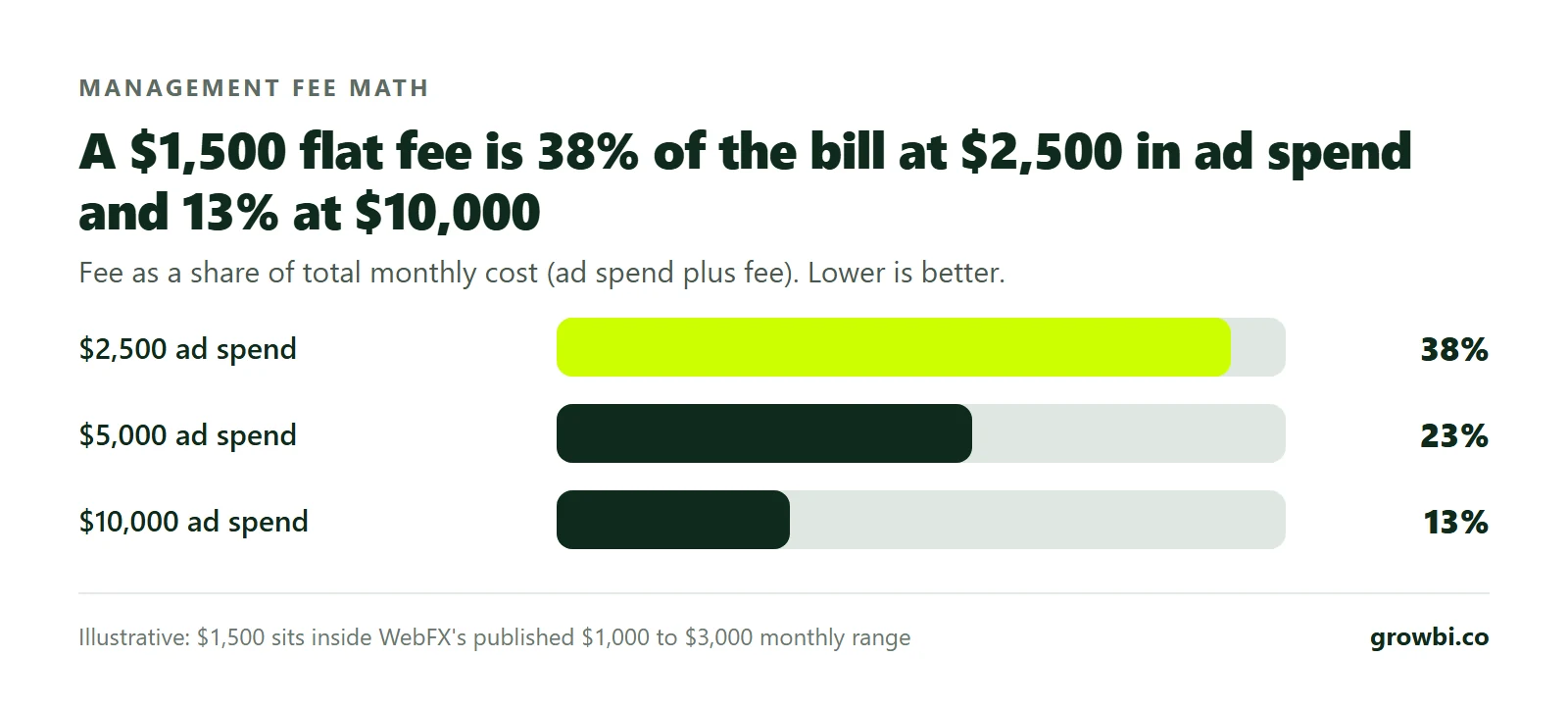
At $2,500 a month, a flat fee takes more than a third of the money and leaves less to test offers and creative. That is a common position: AmSpa reports that 52% of med spa practices invest less than $2,500 a month in marketing.
For small budgets, a percentage model or a low floor fee keeps the fee in proportion. Above $10,000 in monthly spend, the flat fee becomes a small line and the quality of the creative matters far more than the rate.
Why a normal retainer is the wrong benchmark
Med spas spend very different amounts on marketing, so the fee that fits one clinic is wrong for the next one down the road.
According to AmSpa's summary of its 2024 State of the Industry Report, med spas invest about 7% of revenue in marketing on average, in a range of 2% to 15%. A clinic doing $60,000 a month at 7% has $4,200 for everything.
Inside that $4,200, a $1,500 retainer leaves $2,700 for ads and a $750 retainer leaves $3,450. Neither one is normal. The right one is whichever produces more arriving patients from the money left over.
For what sits inside a typical retainer, see our guide to med spa marketing agency fees. For splitting one budget between fee and media, read med spa agency cost versus ad spend next.
Judge the fee by cost per arrival, not cost per lead
The fee only makes sense next to what the account produces, and the most honest output is a patient who actually walks in.
Lead prices set the baseline. WordStream's 2026 Google Ads benchmarks put Beauty and Personal Care at $39.25 per lead, with a $4.62 average cost per click and a 10.35% conversion rate, against $66.69 per lead across all industries.
A lead is not a patient, though. An account optimized for arrivals usually pays more per lead than the cheapest possible, and produces more patients. Judged on cost per lead alone, it would look expensive.
A worked example: what the fee adds per patient
To compare two quotes fairly, add the fee to the ad spend and divide the total by the patients who arrived that month.
Start from a real cost per arrival. Growbi's published CPL vs CPA research found $38.48 per arrived customer on a med spa account, on ad spend alone.
Now add an illustrative $1,500 management fee and divide it by that month's arrivals. The more patients the account delivers, the less the fee adds to each one.
Run the same math on every quote. A higher fee that lifts arrivals by 20% beats a cheaper fee on a flat account, and the per-patient figure shows that in one line instead of a sales deck.
What the retainer should pay for
A retainer earns its price when it covers the work that moves arrivals, not only campaign setup and a monthly report.
- Creative rotation. New ads before old ones fatigue.
- One treatment, one offer. A clear entry offer to test every ad against.
- Landing page and booking flow. The page and form the ads send people to, built around one treatment.
- Tracking to arrival. Every lead followed past the form fill to booked and arrived, reported each month.
On Meta, creative carries even more weight. Meta removed health-related interest targeting in 2022, so results come from geography, first-party data, exclusions and the ads themselves.
That is the scope of our med spa marketing service. Platform choice changes the work as well, and our comparison of Meta and Google Ads for med spas shows which channel fits which treatment and budget.
Red flags in an ad management quote
Most bad quotes are not expensive. They are vague about what the fee buys and how the results will be counted.
- Reports that stop at leads. No booked or arrived numbers means no way to judge the fee.
- The agency owns the ad account. You lose the history and pixel data if you leave.
- A long lock-in with no exit terms. Twelve months committed before any result is measured.
- No creative in scope. Management without new ads every month, shown to the same local audience.
If you are comparing several agencies side by side, our guide on how to choose a med spa marketing agency lists the questions to ask before you sign a contract.
How to set your budget before asking for quotes
Walk into every sales call with your own numbers, so each quote is measured against the same target instead of the agency's pitch.
Five steps, each one done with your own booking data.
- Find your marketing budget. Multiply monthly revenue by your target share. AmSpa's 2024 average is 7%, inside a 2% to 15% range.
- Pick one treatment to advertise. Start with the treatment that has the best margin and open capacity, and one entry offer for it.
- Set a target cost per arrival. Work back from the first-visit value of that treatment and how often those patients rebook.
- Ask each agency for one total. Fee plus suggested ad spend plus any setup charge, written as a single monthly figure.
- Divide by expected arrivals. Ask how many patients they expect to arrive at that total, and how they will report it each month.
If you want those numbers worked out for your clinic, book a free 15-minute call and we will map the fee, the ad spend and the expected cost per arrival before you commit.
FAQs
How much should a med spa spend on paid ads each month?
There is no fixed number. AmSpa's 2024 report puts total marketing at about 7% of revenue on average, in a 2% to 15% range. A clinic doing $60,000 a month at 7% has $4,200 for ads, fees and creative combined.
Is a percentage of ad spend better than a flat fee?
On budgets under $5,000 a month, a percentage keeps the fee in proportion to the spend. Above $10,000, a flat fee becomes the smaller line. Either way, compare quotes by total cost per arriving patient.
How long do med spa ads take to show results?
Plan for a learning period. A new account starts with no pixel history, no creative data and no baseline, so the first months are for testing. Track arrivals from the first month so every test teaches the account something.
Conclusion
There is no normal med spa paid advertising management cost. Published ranges run from 10% to 20% of ad spend or $1,000 to $3,000 a month, and the right fee depends on your budget and on what it pays for.
Put every quote into one figure: fee plus ad spend, divided by the patients who arrived. Spread across a month of arrivals, the fee becomes a per-patient number that is easy to weigh against the value of a first visit.
If you want that math done for your clinic, book a free 15-minute call. We will look at your budget, your treatments and your current bookings, and show what a fee would add to your cost per arriving patient.
Mor Romano
CTO, Growbi
Written and fact checked by Mor Romano, published , last reviewed .
More about Mor RomanoGet this system built for your business
Book a strategy call and we will model a realistic appointment target from your budget, market, and offer.
Keep reading
Best Med Spa Marketing Companies in 2026: 13 Agencies Compared

Med Spa Marketing Agency Fees: Fee Models, Real Ranges and Contract Terms

Med Spa Marketing Agency Cost: The Fee, the Ad Spend and the Real Price per Patient

Med Spa Marketing Alternatives to ClinicGrower and HIP Creative

Med Spa Marketing Agency for Patient Flow: A Plan for Smaller Clinics