Med Spa Marketing Agency for Patient Flow: A Plan for Smaller Clinics


Key Takeaways
- Predictable patient flow depends on the system behind the ads, not on whether your clinic earns more than $1 million a year.
- Measure cost per arrived patient, because cheap leads that never walk in cost money and produce nothing.
- Start with one treatment and one entry offer so your creative tests and booking data stay easy to read.
- Ask any agency to show arrivals and cost per arrival from real accounts before you sign a contract.
A smaller med spa gets predictable patient flow from structure, not size. Advertise one treatment with one entry offer, measure cost per arrived patient instead of cost per lead, call every lead fast and replace ads before they fatigue.
Many owners of smaller med spas believe steady bookings belong to the big multi-location brands. Their own calendar swings from packed weeks to empty afternoons, and nobody can say why.
The swings usually come from how the marketing is built, not from the size of the clinic. This guide shows what to spend, what to measure and how to judge a med spa marketing agency for patient flow, with numbers from published sources.
Why smaller med spas get unpredictable bookings
Bookings swing when a clinic advertises its full menu, judges ads by lead count and leaves follow-up to whoever is free at the front desk.
Each of those habits hides the real problem. A full menu splits a small budget across ten treatments, so no ad gets enough data to improve. Lead counts reward cheap form fills from people who never meant to book.
Slow follow-up is the quiet leak. A lead who waits a day for a call has already booked somewhere else or forgotten why she clicked. None of this gets fixed by spending more.
What smaller med spas spend on marketing
Most clinics spend well below the usual benchmark, which is one reason their flow never steadies.
The American Med Spa Association reports that 52% of med spa practices invest less than $2,500 a month in marketing. The common benchmark is 5% of revenue, about $5,800 a month for the average practice earning $1.39 million.
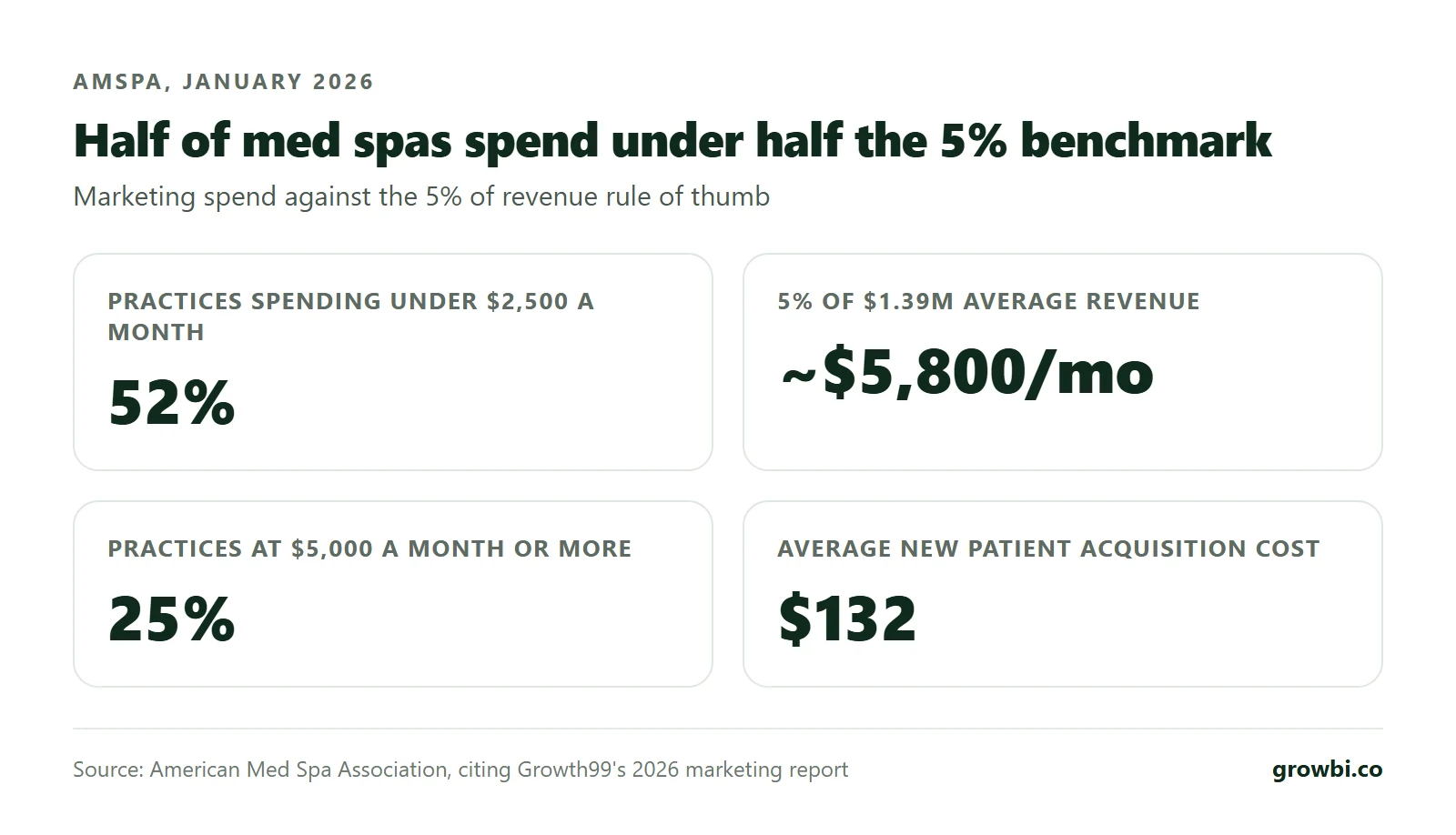
The same report puts the average new patient acquisition cost at $132 and the average visit value at $527. Only 25% of practices spend $5,000 a month or more.
A smaller budget is workable. It just leaves no room for waste, so every dollar has to be judged by the patients it puts in a treatment chair.
Measure patient flow by arrivals, not leads
Patient flow means people in the chair. The number to track is cost per arrived patient: ad spend divided by patients who booked and showed up.
A higher cost per lead is often deliberate. Leads bought cheaply tend not to show up. Judged by cost per lead, an account built for arrivals can look expensive; judged by arrivals it is efficient.
If your reports stop at the form fill, you cannot tell good leads from cheap ones. Ask for arrivals by week, by campaign and by offer.
One treatment and one entry offer
A small budget works best when it sells one thing. Pick the treatment with the best margin and repeat potential, then build one first-visit offer around it.
One offer gives a cold audience an easy first step. It also gives the account a fixed baseline, so when bookings move you know the creative or the audience changed, not the offer.
The entry visit is not where the profit sits. AmSpa notes that about 73% of a practice's revenue likely comes from repeat patients, so the first visit is the door to a treatment plan.
Targeting after Meta removed health interests
There is no anti-aging audience to buy on Facebook or Instagram anymore. Targeting now comes from geography, your own data, exclusions and creative.
Meta announced in November 2021 that starting January 19, 2022 it would remove detailed targeting options tied to sensitive topics, health among them. Agencies that still sell interest targeting for med spas are selling something that no longer exists.
- Geography: a radius or zip codes your patients will actually drive from.
- First-party data: past patient lists to build lookalikes and to exclude current patients from entry offers.
- Exclusions: people who already booked, so you do not pay twice for the same patient.
- Creative: the ad itself picks the audience, because the people who stop on it are the ones the platform finds more of.
Ad copy also has to pass Meta's health policies. Our guide to med spa Meta ads compliance covers the claims and before-and-after images that get ads rejected.
Creative rotation keeps the flow steady
In a fixed local area the same people see your ads month after month. Ads wear out long before a good offer does.
For a smaller clinic, plan 3 or 4 new ads a month on the same offer: a new hook, a new face, a different format. Retire an ad when its cost per arrival climbs for two weeks in a row, not when someone gets bored of it.
From lead to arrival: the booking flow
Ads create interest. The booking flow decides how much of it turns into a patient at the front desk.
The order we set this up in for a smaller clinic.
- Send ads to one offer page. One page per offer, with the price, what the visit includes, real photos of the clinic and one short form.
- Ask 2 or 3 qualifying questions. Treatment interest, preferred days and whether the lead is a first-time visitor. It filters out repeat bargain seekers.
- Call or text within minutes. Route new leads to one person who can respond during opening hours, with an automatic text when nobody picks up.
- Confirm and remind. Confirm the booking by text, then remind the patient the day before. Our guide on how to reduce med spa no-shows covers the scripts.
- Record who arrived. Mark every lead as booked, arrived or lost, and feed that back into the ad account so it optimizes for arrivals.
Leads who do not book on the first call still have value. A short email and SMS follow-up sequence brings a share of them back over the next two weeks.
What a smaller budget buys: a worked example
Divide your monthly budget by a realistic cost per arrival and you get a patient forecast you can plan staff around.
For example, Growbi's published CPL vs CPA research found $38.48 per arrived customer on a med spa account. At that rate, $2,500 a month buys about 65 arrivals and the $5,800 benchmark about 151.
That is not a promise. Costs like that come after months of testing, and your market, offer and competition will move the number. A new account should expect a learning period first.
The method is the point. Once you know your own cost per arrival, the budget question becomes simple: how many new patients can your team treat each month?
How to judge a med spa marketing agency for patient flow
Ask every agency on your shortlist the same questions, and judge the answers by what they can show you.
- What do you report each week? Good answer: Arrivals and cost per arrival; Red flag: Clicks, reach and lead counts
- How do you target without interests? Good answer: Geography, first-party data, exclusions, creative; Red flag: Anti-aging interest audiences
- How often do you replace ads? Good answer: Several new ads a month, by data; Red flag: Once a quarter or on request
- Who owns the ad account? Good answer: Your clinic, from day one; Red flag: The agency keeps it
- Can I see real med spa results? Good answer: Named case studies with spend and arrivals; Red flag: Percent lifts with no numbers
For a wider comparison of providers, see our list of the best med spa marketing agencies and how Meta compares with Google Ads for aesthetics clinics.
If you want a second opinion on your current numbers, book a free 15-minute call and bring last month's spend and arrivals.
FAQs
How much should a small med spa spend on marketing?
A common benchmark is 5% of revenue, about $5,800 a month for a practice earning $1.39 million, according to AmSpa. Start from the number of new patients you can treat, multiply by your cost per arrived patient, and set the budget from that.
How long do med spa ads take to produce steady bookings?
Expect a learning period. A new account has no pixel history or creative data, so the first month rarely shows the final picture. Steady flow comes from continuous testing on one offer, measured by arrivals.
Is a lower cost per lead always better for a med spa?
No. Cheap leads tend not to show up. An account optimized for arrivals often pays more per lead and still costs less per patient in the chair.
Conclusion
Predictable patient flow is not reserved for large practices. A clinic with no ad history can build it with the right structure.
The pattern is the same at any size: one treatment, one entry offer, targeting built on geography and your own data, fresh ads every month and a booking flow measured by who walks in. See how we set this up on our med spa marketing page.
If you want your own numbers mapped, book a free 15-minute call. We will work out your cost per arrived patient and what your budget can realistically deliver each month.
Mor Romano
CTO, Growbi
Written and fact checked by Mor Romano, published , last reviewed .
More about Mor RomanoGet this system built for your business
Book a strategy call and we will model a realistic appointment target from your budget, market, and offer.
Keep reading
Best Med Spa Marketing Companies in 2026: 13 Agencies Compared

Med Spa Lead Generation: How to Get Medspa Leads That Book and Show Up

Med Spa Marketing Results: How to Judge Any Agency's Numbers

Med Spa Marketing Alternatives to ClinicGrower and HIP Creative
Med Spa Paid Advertising Management Cost: Why 'Normal' Is the Wrong Benchmark