HVAC SEO: How to Rank for Heating and Cooling Calls All Year

Key Takeaways
- "AC repair" averages 368,000 US searches a month and "furnace repair" 201,000, according to DataForSEO data to September 2026.
- HVAC demand has two peaks: "ac repair" hit 673,000 searches in July 2026 and "furnace repair" 450,000 in January 2026.
- Several urgent searches have very low keyword difficulty, such as "ac repair near me" at 3 and "emergency hvac repair" at 0, so a strong service page can rank.
- Maintenance plan and tune-up pages fill the shoulder months and turn one-time repairs into recurring visits.
- Google says you cannot pay for a better local ranking, so your profile, reviews and pages do the work.
HVAC SEO is the work of getting your company into Google's map pack and organic results when homeowners search for AC repair, furnace repair or HVAC service nearby. It rests on a complete Google Business Profile, steady reviews, separate pages for cooling, heating and maintenance, and publishing each season's pages months before demand peaks.
An HVAC company has two busy seasons and two kinds of panic. In July it is a house at 84 degrees and a kid who cannot sleep. In January it is a furnace that clicks and does nothing while the temperature outside drops below freezing.
Both homeowners grab a phone, search, and call one of the first companies they see. We pulled 12 months of US search data for the queries behind those calls to show where HVAC SEO is won, and when each part of it has to be ready.
What Homeowners Search for When the Heat or AC Fails
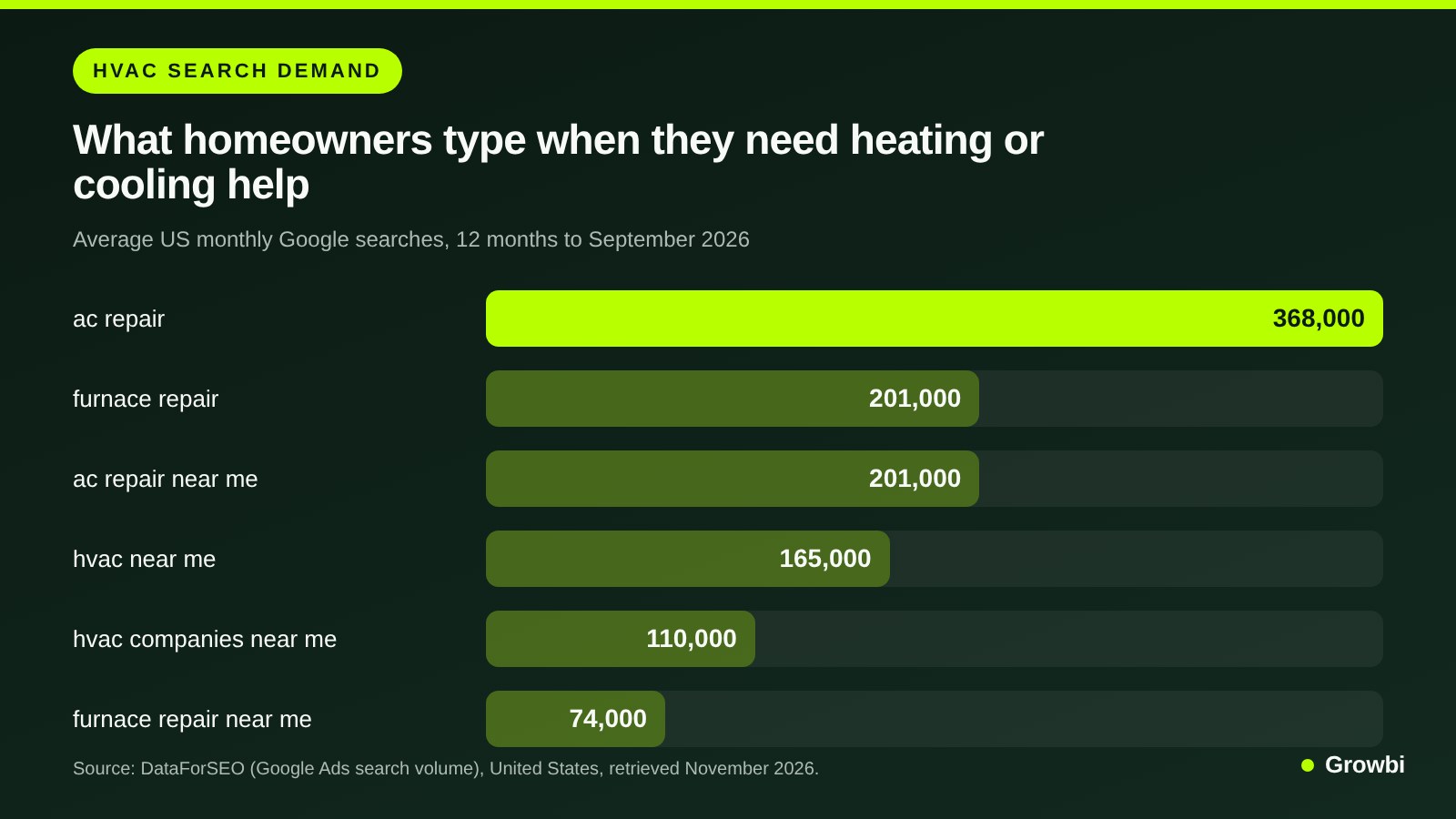
Mostly repair searches, and mostly local ones. The largest HVAC queries in the US are about fixing a broken system today, not about learning how HVAC works.
- ac repair: 368,000 searches a month.
- furnace repair: 201,000 a month.
- ac repair near me: 201,000 a month, keyword difficulty 3 out of 100.
- hvac near me: 165,000 a month, difficulty 19.
- hvac companies near me: 110,000 a month, difficulty 39.
- furnace repair near me: 74,000 a month, difficulty 16.
- hvac repair near me: 49,500 a month, difficulty 39.
- heating repair near me: 40,500 a month, difficulty 39.
Source: DataForSEO, Google Ads search volume, United States, retrieved November 2026
Two things matter in that list. The generic "hvac companies near me" type searches are the most competitive, while service-specific ones such as "ac repair near me" score far lower on difficulty. That means a contractor with a good service page and a solid profile can compete for the searches that actually say what is broken.
The other is cost. The same data shows an average cost per click of $46.35 for "ac repair near me" and $73.88 for "emergency hvac repair". Every one of those clicks you win organically is one you do not buy.
HVAC Search Has Two Seasons, Not One
Most local businesses plan around one busy season. HVAC companies have two, and the searches swap places between them.
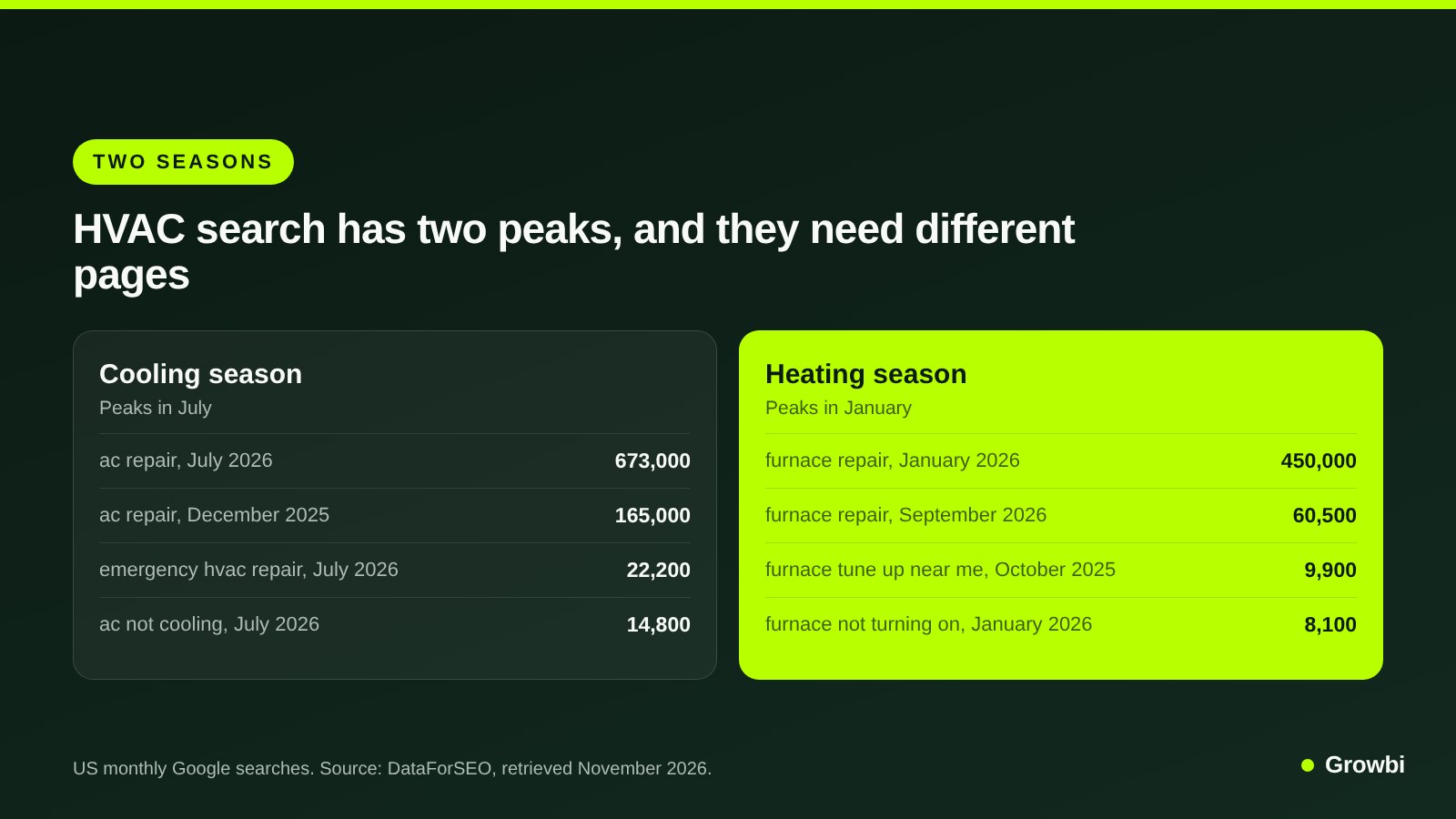
- Cooling: "ac repair" ran from 165,000 searches in December 2025 to 673,000 in July 2026. "Emergency hvac repair" jumped to 22,200 in July against a 5,400 average.
- Heating: "furnace repair" ran from 450,000 searches in January 2026 down to 60,500 in September 2026.
- Troubleshooting: "furnace not turning on" reached 8,100 in December and January, while "ac not cooling" peaked at 14,800 in July.
- Tune-ups: "furnace tune up near me" peaked at 9,900 in October 2025, right before the first cold snap.
Source: DataForSEO, Google Ads search volume, United States, retrieved November 2026
New pages need time to be crawled and to settle in the rankings, so publish against the calendar, not the weather. Cooling pages go live by early spring, heating and no-heat pages by late summer, and the tune-up pages a few weeks before each switch.
Pro tip: Put two publish deadlines in your calendar now, one in late winter for cooling pages and one in midsummer for heating pages, and use the same dates to refresh last season's pages with new photos and answers.
In Search Console, compare a page's impressions with the same month last year rather than last month, because the seasonal swing hides real progress.
How to Set Up Your Google Business Profile for HVAC
The map pack is where most of those "near me" searches end, and your Google Business Profile is what Google ranks there.
Google's page on improving your local ranking names three factors: relevance, distance and prominence. It also states that you cannot request or pay for a better local ranking.
- Categories: HVAC contractor as the primary category, plus secondary categories only for work you really do. Google asks for the fewest categories that describe the core business.
- Service area: the towns you really serve. Google's guidelines say a service area should not extend much beyond about 2 hours of driving from your base.
- Address: if customers never visit your shop, hide the address and use a service area instead.
- Hours: your real customer-facing hours. Never add "24 Hour" or "Emergency" to the business name; Google bans hours information in the name.
- Services and photos: every service you sell, with photos of your own trucks, techs and installs.
All of those rules come from Google's guidelines for representing your business, and breaking them can get a profile suspended in the middle of a heat wave.
Reviews feed prominence. Ask on the day the system is running again, by text with a direct link, and answer every review. A homeowner choosing who to let into the basement reads the replies as closely as the stars.
Pro tip: Add the review link to the job-complete text your field software sends when the tech closes the ticket, so the ask never depends on someone remembering. When you reply, name the service and the town, for example "Glad we got your heat pump running again in Westfield", so the reply itself describes the job.
The Pages Every HVAC Website Needs
One page per service and season. A single "Heating and Cooling Services" page cannot rank for both "ac repair near me" in July and "furnace repair" in January.
Cooling pages
AC repair, AC installation and heat pump pages. "Ac installation near me" averages 40,500 searches a month and "heat pump installation near me" 6,600 with a difficulty of 0. Cover common failures, how fast a tech can arrive and the brands you install.
Heating pages
Furnace repair, furnace installation and heat pump repair. "Furnace installation near me" averages 18,100 a month and "heat pump repair near me" 8,100. Explain what you check on a no-heat call and when repair stops making sense.
Emergency and no-heat pages
A page built for the person with no heat or no cooling right now. Put the phone number at the top, say plainly whether you take after-hours calls, and list what they can check safely while they wait.
Cost pages
"Furnace replacement cost" draws 14,800 searches a month and "ac replacement cost" 9,900, each with a difficulty of 13 or lower. Give honest ranges for your area, the factors that move the price and how a free estimate works.
Service-area pages
One page per main town you serve, built around real local jobs, photos and reviews from that town. Google's spam policies list pages targeted at specific cities that funnel users to one page as doorway abuse, and blocks of city names as keyword stuffing.
Turn Maintenance Plans Into a Search Asset
Maintenance plans are the HVAC page most competitors forget, and the searches behind them are easy to win.
- hvac maintenance plan: 3,600 searches a month, difficulty 9.
- ac tune up near me: 4,400 a month, difficulty 2.
- furnace tune up near me: 2,400 a month on average, difficulty 0, peaking at 9,900 in October.
Give the plan its own page: what each visit includes, how many visits a year, priority scheduling and any repair discount, and how to cancel. Then link to it from every repair and installation page, because a homeowner who just paid for a repair is the best person to offer a plan to.
Plan members also fill the shoulder months. Spring and fall tune-up visits keep techs busy when repair searches dip, which is where SEO and scheduling meet.
Certifications and Partners That Earn Trust and Links
HVAC has more verifiable credentials than most trades, and each one is a trust signal on the page and a possible link to your site.
- EPA Section 608. Federal rules require technicians who service equipment that could release refrigerant to hold Section 608 certification. Say your techs are certified on every AC and heat pump page.
- NATE certification. North American Technician Excellence calls itself the largest nonprofit certification body for HVACR technicians in the US. It is voluntary, so name the specialties your techs hold, such as Air Conditioning, Heat Pumps or Gas Heating.
- Manufacturer dealer programs. If you are an authorized dealer, ask whether the brand's dealer locator links to your website.
- Local and trade associations. Chamber of commerce, Better Business Bureau and state contractor associations confirm you are an established local business.
Only claim what you can prove. NATE runs a Verify a NATE ID page, and homeowners and AI tools increasingly check what you say against what others say about you.
How AI Search Changes HVAC SEO
It raises the bar for consistency. More homeowners ask Google's AI Overviews or ChatGPT which HVAC company to call, and those tools name businesses they can verify across several sources.
Google's guidance on AI features says there are no extra technical requirements to appear in AI Overviews or AI Mode. Pages need to be indexed and eligible for a snippet, structured data has to match the visible text, and your Business Profile has to be up to date.
For an HVAC company that means clear answers on your service pages, the same name, phone and hours everywhere, and reviews that mention the job and the town. Our guide to answer engine optimization shows how AI tools pick which business to recommend.
The off-site half, listings, reviews and mentions on other sites, is what our AI SEO services handle for local businesses.
How to Measure HVAC SEO by Booked Calls
Rankings and traffic are early signals. The number that matters is booked service calls and installs from organic search, by season.
- Call tracking on the website and a separate tracked number on the Business Profile, so you can tell map calls from website calls.
- Search Console for the queries and pages gaining impressions, checked before each season starts.
- Job source in your field software, so every booked job carries where the customer came from.
- Answer rate. A missed call in a heat wave goes to the next company on the list, so track it next to rankings.
Pro tip: Add a UTM tag such as ?utm_source=google&utm_medium=organic&utm_campaign=gbp to the website link on your Business Profile. Profile visits then show up separately in your analytics instead of blending into the rest of your organic traffic.
SEO takes months to compound, so most contractors keep paid channels running while it builds. Our guide to HVAC leads compares what each paid source costs per booked call.
The pay-per-lead option that sits above the map pack is covered in our guide to Google Local Services Ads, including how it ranks and what a lead costs.
Seasonal spikes are not unique to HVAC. Our roofing SEO guide shows how storms reshape a roofer's calendar in the same way.
Whatever the season, the speed of your follow-up decides how much of that demand you keep, as our piece on speed to lead explains.
And if you would rather have one team run SEO, Local Services Ads and search campaigns together, our HVAC marketing page explains how we tie them to booked calls.
FAQs
What is HVAC SEO?
HVAC SEO is the process of getting a heating and cooling company into Google's map pack and organic results when homeowners search for AC repair, furnace repair or HVAC service in its area. It combines a complete Google Business Profile, steady reviews, separate pages for each service and season, and content that answers cost and troubleshooting questions.
How does HVAC SEO work?
Google ranks local results on relevance, distance and prominence. HVAC SEO improves relevance with accurate categories, services and dedicated service pages, and improves prominence with reviews, local links and consistent listings. Organic pages then rank for specific searches such as furnace repair or AC installation, while the Business Profile competes in the map pack.
What keywords should an HVAC company target?
Start with local repair searches such as ac repair near me, furnace repair near me and hvac repair near me, which are won mainly through the map pack. Then build pages for installation, heat pumps, emergency service, cost questions such as furnace replacement cost, and maintenance searches such as hvac maintenance plan and ac tune up near me.
How long does SEO take for an HVAC company?
Business Profile fixes and new reviews can improve map visibility within weeks. New service pages for low-difficulty searches usually take a few months to rank, and competitive city searches take longer. Because HVAC demand peaks in summer and winter, publish each season's pages several months ahead so they are ranking when calls spike.
Can I do SEO for my HVAC business myself?
Yes, much of it. Owners can complete the Business Profile, request and answer reviews, and write service pages based on real jobs. Technical work, content planning across two seasons and link building take more time and skill, which is where many contractors bring in help. Judge any provider on booked calls, not traffic.
When do people search most for HVAC services?
Cooling searches peak in summer and heating searches in winter. In the 12 months to September 2026, US searches for ac repair peaked at 673,000 in July 2026, while furnace repair peaked at 450,000 in January 2026. Furnace tune-up searches peaked in October, just before heating season.
Conclusion
HVAC SEO is won in the map pack and on service pages that match what broke. Google ranks local results on relevance, distance and prominence, which you improve with a complete profile, real reviews and a page for every service, season and main town you serve.
Timing does the rest. Cooling and heating searches peak six months apart, so the pages for each season have to be live and ranking before the weather turns, with maintenance plans carrying you through the months in between.
If you want to see where your company ranks across your service area before next season, book a free 15-minute call and we will map the gaps with you.
Get this system built for your business
Book a strategy call and we will model a realistic appointment target from your budget, market, and offer.