GEO SEO: How Generative Engine Optimization Works for Local Businesses

Key Takeaways
- GEO comes from a research paper by Aggarwal and colleagues, posted in November 2023 and accepted to KDD 2024, that tested nine ways to rewrite pages for AI answers.
- Adding quotations, statistics and cited sources lifted a page's visibility in AI answers by roughly 27% to 41%, while keyword stuffing cut it by about 8%.
- The gains were biggest for lower-ranked pages: citing sources raised visibility 115% for the fifth Google result, which favors smaller local businesses.
- Google says AI Overviews need no special optimization, and Ahrefs found only 38% of AI Overview citations also rank in the organic top 10.
- Measure GEO with a fixed set of local prompts, AI referral traffic and booked appointments, not rankings alone.
GEO SEO, or generative engine optimization, is the practice of making your pages more likely to be quoted and cited inside AI-generated answers from tools like ChatGPT, Perplexity and Google AI Overviews. The term comes from a 2023 Princeton and IIT Delhi paper, which found that adding quotations, statistics and cited sources raised visibility by up to 40%.
Type "geo seo" into Google and you get two different meanings. A few agencies use it for geo-targeted local SEO, ranking in a specific city or neighborhood. Most of the industry now uses it for generative engine optimization, the work of getting your content cited inside AI answers.
This guide covers the second meaning, with the first never far away. It walks through the research that coined the term, what that research actually measured, how generative engines choose their sources, and which tactics a med spa, dental practice or contractor should act on.
What Is GEO SEO?
Generative engine optimization (GEO) is the practice of shaping your content so that generative engines quote and cite it when they write an answer. A generative engine is any tool that searches the web, reads several sources and writes a single response with citations, such as ChatGPT search, Perplexity, Google AI Overviews and Google AI Mode.
Traditional SEO competes for a position in a list of links. GEO competes for space inside the answer: how much of the response draws on your page, and how early your citation appears.
- SEO earns a ranking in Google's or Bing's list of results.
- AEO (answer engine optimization) is the marketing term for being the answer or the business an AI tool recommends.
- GEO is the research term, measured by how much of a generated answer cites your page and where.
- LLM SEO is a looser label for the same goal, used mostly by software vendors.
For a local business the practical work overlaps almost completely. Our guide to answer engine optimization covers how to get your business recommended by name; this article goes deeper on the research and the mechanics behind it.
Where the Term GEO Came From
The term comes from a paper titled GEO: Generative Engine Optimization, by Pranjal Aggarwal, Vishvak Murahari, Tanmay Rajpurohit, Ashwin Kalyan, Karthik Narasimhan and Ameet Deshpande, with researchers from Princeton University and IIT Delhi. It was first posted in November 2023 and accepted to the KDD 2024 conference.
The team built GEO-bench, a set of 10,000 queries across 25 domains, each paired with the text of the top five Google results. They rewrote one source at a time using nine methods and measured how its visibility in the generated answer changed. The full paper on arXiv lists every method and metric.
Visibility was scored two ways. Position-adjusted word count measures how many words of the answer cite your source, weighted toward citations near the top. Subjective impression asks a language model to rate relevance, influence and how likely a reader is to click.
What the GEO Research Found
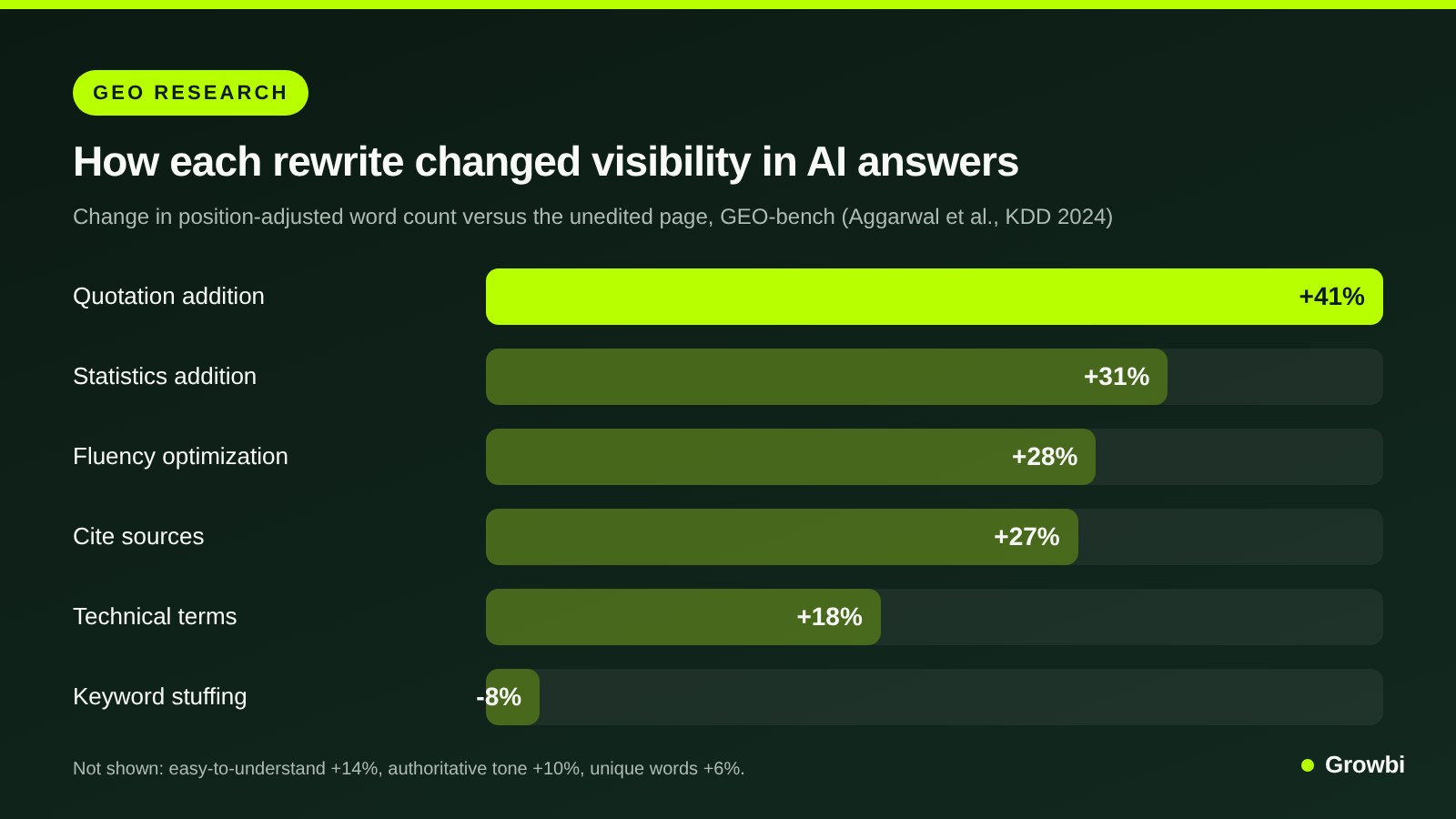
Adding evidence worked, and old keyword tactics did not. On position-adjusted word count, the unedited page scored 19.3. Here is how each rewrite changed that score:
- Quotation addition: 27.2, about 41% higher.
- Statistics addition: 25.2, about 31% higher.
- Fluency optimization: 24.7, about 28% higher.
- Cite sources: 24.6, about 27% higher.
- Technical terms: 22.7, about 18% higher.
- Easy-to-understand language: 22.0, about 14% higher.
- Authoritative tone: 21.3, about 10% higher.
- Unique words: 20.5, about 6% higher.
- Keyword stuffing: 17.7, about 8% lower.
Source: Aggarwal et al., GEO: Generative Engine Optimization (KDD 2024), Table 1
The authors repeated the test on Perplexity, a live generative engine. Quotation addition again performed best, with a 22% gain in position-adjusted word count, and keyword stuffing did 10% worse than the unedited page.
Combining methods helped further. The best pair in the paper, fluency optimization plus statistics addition, beat any single method by more than 5.5%.
Read these numbers with their limits in mind. The tests ran on a research engine and on Perplexity in 2023 and 2024, with mostly informational questions. The exact percentages will not carry over to today's ChatGPT or AI Mode; the direction of the findings is what matters.
Why GEO Favors Smaller Websites
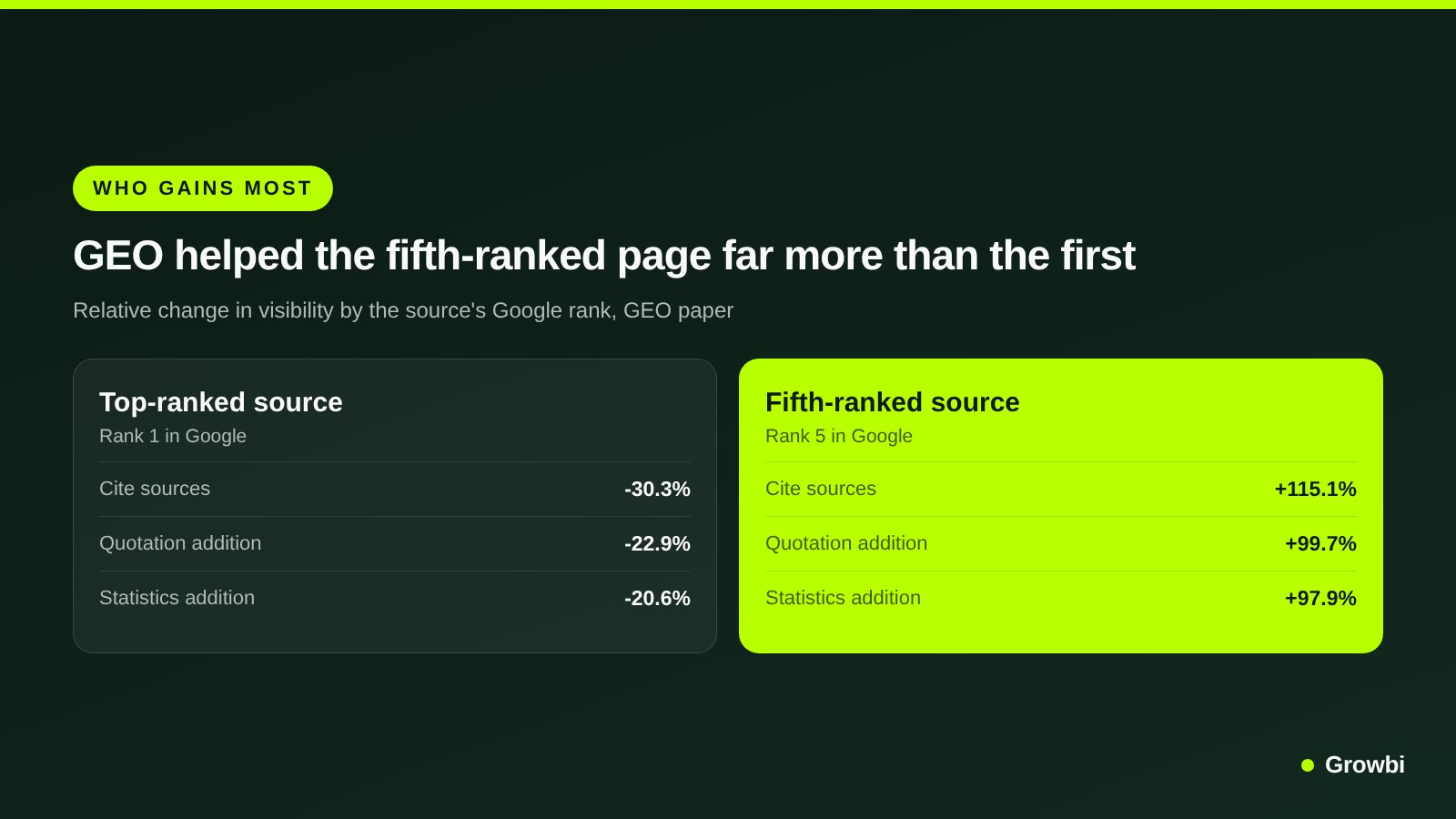
The finding that matters most for a local business sits in the paper's later sections. When the researchers grouped sources by their Google rank, GEO helped lower-ranked pages far more than top-ranked ones.
Citing sources raised the visibility of the fifth-ranked result by 115.1%, while the top-ranked result lost 30.3% on average. Quotation addition lifted the fifth result by 99.7% and statistics addition by 97.9%.
Source: Aggarwal et al., GEO: Generative Engine Optimization (KDD 2024), Table 3
The authors' explanation is simple. A generative model reads the content of every source it retrieves, so backlinks and brand size count for less once a page is in the pool. A clinic or contractor that will never outrank a national directory can still be the most quotable source in that pool.
There is a catch: the page has to be retrieved first. In the study, only the top five Google results were fed to the engine, so ranking somewhere near the top is still the entry ticket.
How Generative Engines Pick and Cite Sources
Most generative engines follow the same loop: rewrite the question, search, read the most relevant passages, write the answer and attach citations.
- The question is rewritten. A conversational prompt becomes one or more search queries, often with a location added.
- Several searches run. Google calls this query fan-out: AI Overviews and AI Mode issue multiple related searches across subtopics and data sources.
- Passages are read, not whole sites. The model pulls the parts of each page that answer a sub-question.
- The answer is written and cited. Sources that contributed specific facts get the citation links.
Google's AI features guide for site owners describes the fan-out step directly. It also says there are no additional technical requirements: a page must be indexed and eligible to show a snippet.
Fan-out explains why ranking for the exact query is no longer enough. In its 2026 update, Ahrefs found that about 38% of AI Overview citations also ranked in the organic top 10 for the same query, down from about 76% in its July 2025 study, across 863,000 keyword results. Ahrefs notes it also improved its parsing between the two studies.
In practice, a page that answers the follow-up questions around a service, such as cost, recovery time, financing and who it suits, has more chances to be pulled into an answer than a page that targets only the headline keyword.
ChatGPT runs the same loop with its own crawler and search partners, which OpenAI documents in its crawler overview.
GEO Tactics That Have Evidence Behind Them
Apply the research to the pages that already earn you customers: services, locations, pricing and FAQs.
- Add real numbers. Session counts, typical price ranges, warranty lengths, years in business. Statistics addition was one of the strongest methods.
- Quote named experts. A line from your medical director, lead technician or a published guideline, attributed by name and credential.
- Cite your sources. Link the FDA label, the manufacturer's spec or the professional association behind a claim.
- Write fluently and plainly. Fluency optimization added about 28%, and the paper lists business, science and health among the categories where it worked best.
- Answer the fan-out questions. Cover cost, timeline, risks, alternatives and who the service suits, on the page or one click away.
- Skip keyword stuffing. It lowered visibility in both the research engine and Perplexity.
Keep every claim accurate. A quotation or statistic only helps if it is true and sourced, and health or home-safety claims carry real risk when they are not.
Pro tip: Keep a simple source log for each page, with every statistic or quote, its link and the date you checked it, and review it whenever you change prices or services, so a figure an AI tool quotes never outlives its source.
Your website is only one input. Generative engines also read reviews, directories and editorial mentions, which is why the off-site work in our AI SEO services matters as much as page edits.
How to Measure GEO
Neither Google nor OpenAI offers a GEO rank report, so track four signals and compare them month over month.
- A fixed prompt set. Write 15 to 25 questions your customers ask, with your city in them, and run them in ChatGPT, Perplexity, Gemini and Google AI Mode each month. Log whether you are cited, where, and with which page.
- AI referral traffic. In Google Analytics 4, look for sessions from chatgpt.com, perplexity.ai and gemini.google.com. ChatGPT links normally carry utm_source=chatgpt.com.
- Search Console. Google counts AI Overviews and AI Mode clicks inside the Web search type of the Performance report, not as a separate line.
- Booked revenue. Ask every new customer how they found you, with an AI tool as one of the answers.
Expect noise. AI answers change from run to run, so one test proves little; look for a trend across many prompts.
Pro tip: Log the prompt set in a spreadsheet with one row per prompt and engine and columns for date, cited or not, position and cited URL. Run each prompt in a logged-out or fresh session so your own history does not shape the answer.
Tracking can break too. In mid-October 2026 a ChatGPT bug briefly removed both the UTM tag and the referrer from its links, so for several days those visits were filed as direct traffic, as Search Engine Roundtable reported.
Then connect visibility to bookings. The Growbi System keeps the source of each lead and the appointment in one record, so AI referrals are judged on revenue like every other channel.
What GEO Means for a Local Business
For a med spa, dental practice or home service company, GEO is not a separate channel. It is a writing standard applied to the local pages you already need.
- Med spas: treatment pages with session counts, downtime ranges and the injector's credentials, quoted by name.
- Dental practices: implant, aligner and emergency pages that state typical timelines, what happens at the first visit and how insurance usually applies.
- Home services: repair and replacement pages with price ranges, warranty terms and seasonal guidance a homeowner can act on.
This is also where the two meanings of geo SEO meet. When someone adds a city or neighborhood to a prompt, the engine searches for local pages, so city and service-area pages are exactly what it retrieves.
Pro tip: Open each city or service-area page with one plain sentence that names the business, the service and the place, for example "Riverside Dental offers same-week emergency visits in Plano", so a search that adds a location finds a passage it can quote as written.
The local foundation decides whether you are retrieved at all. Clinics can start with our med spa SEO guide, which covers the profile, reviews and page structure.
Dental practices should begin with their listing, as set out in our guide to Google Business Profile optimization.
Contractors will find the service and city page plan in our roofing SEO guide, and it applies just as well to HVAC and plumbing.
FAQs
What is GEO in SEO?
GEO stands for generative engine optimization. It is the practice of making your content more likely to be quoted and cited inside AI-generated answers from tools such as ChatGPT, Perplexity, Google AI Overviews and AI Mode. The term comes from a 2023 research paper that found adding quotations, statistics and cited sources made pages more visible in those answers.
Is GEO different from SEO?
GEO builds on SEO rather than replacing it. Generative engines still search the web before they answer, so a page has to be crawlable, indexed and reasonably well ranked to be considered. GEO adds a second goal: once your page is retrieved, making it the most quotable source, with clear answers, specific numbers and named sources.
What is the difference between GEO and AEO?
The two overlap almost completely. GEO is the academic term, introduced in the 2023 GEO paper and measured by how much of an AI answer cites your page. AEO, answer engine optimization, is the marketing term for being the answer or the recommended business. For a local business the work is the same: answer-first pages, consistent listings and reviews.
What is LLM SEO?
LLM SEO is another label for optimizing content and brand signals so large language model tools like ChatGPT, Gemini and Perplexity mention and cite you. It describes the same goal as GEO and AEO. The tactics with published evidence are the GEO ones: add statistics, quotations and cited sources, write plainly, and avoid keyword stuffing.
Does GEO work for local businesses?
Yes, and the research suggests smaller sites gain the most. In the GEO paper, citing sources raised the visibility of the fifth-ranked Google result by 115% while the top result lost ground. A local business still needs to be retrieved first, so a strong Google Business Profile, consistent listings and city service pages remain the foundation.
How do you measure generative engine optimization?
Run the same set of 15 to 25 customer questions through ChatGPT, Perplexity, Gemini and Google AI Mode every month and log whether you are cited. Track AI referral sessions in Google Analytics 4, including chatgpt.com, read Search Console knowing AI Overviews sit inside the Web report, and tie every AI referral to a booked appointment.
Conclusion
GEO began as a research question: what makes a generative engine quote one page over another? The answer so far is evidence. Quotations, statistics and cited sources made pages more visible, keyword stuffing made them less visible, and smaller sites gained the most.
For a local business that means writing service pages the way an expert explains a treatment or a repair, with real numbers and named sources, on top of a local SEO foundation that gets those pages retrieved in the first place.
If you want to see whether AI tools cite your business today, book a free 15-minute call and we will run the prompt test for your city with you.
Get this system built for your business
Book a strategy call and we will model a realistic appointment target from your budget, market, and offer.