Final Expense Leads: Real Prices, Cost per Policy and When to Run Your Own Ads

Key Takeaways
- Final expense demand is flat all year, with 8,100 to 12,100 monthly US searches for final expense insurance.
- Published lead prices run from $0.25 for year-old aged records to $110 for a live transfer and $250 to $300 for a pre-screened one.
- In our illustrative math, cost per issued policy varies only about 3.4 times across sources, so follow-up speed matters most.
- Consent must name the seller, Do Not Call scrubs must be under 31 days old, and an inquiry covers a registered number for only 3 months.
Final expense leads are seniors who asked about small whole life insurance policies for funeral costs. Published prices in October 2026 run from $0.25 for year-old aged records to $17 to $50 for exclusive web leads and $110 for live transfers. The number that decides profit is cost per issued policy, not lead price.
Final expense is the easiest life product to explain and one of the hardest to sell profitably, because the lead bill arrives every week whether policies issue or not.
What final expense leads are
A final expense lead is a person, usually a senior, who asked about a small whole life policy to cover funeral costs. The need is concrete and easy to price.
According to the National Funeral Directors Association, the 2023 national median for a funeral with viewing and burial was $8,300 before cemetery costs, and $6,280 with cremation. That number is the whole sales conversation.
Unlike Medicare, final expense has no enrollment window. Google searches for "final expense insurance" stayed between 8,100 and 12,100 every month from October 2025 to September 2026, so your lead budget runs all year.
Final expense lead types and published prices
Four formats dominate the final expense insurance leads market, and three vendors we checked publish real prices. Here is what each one charges as of October 2026.
- Aged, 3 to 30 days. Published price: $2.00 to $4.50; Vendor: Aged Lead Store; Who else gets it: Shared
- Aged, 86 to 365 days. Published price: $0.25 to $0.80; Vendor: Aged Lead Store; Who else gets it: Shared
- Exclusive real-time web. Published price: $17 to $25, by volume and term; Vendor: Caboom Leads; Who else gets it: Only you
- Exclusive real-time web. Published price: $50; Vendor: InsureLeads; Who else gets it: Only you
- Live transfer. Published price: $110 per call; Vendor: InsureLeads; Who else gets it: One agent
- Pre-screened transfer. Published price: $250 to $300; Vendor: InsureLeads; Who else gets it: One agent
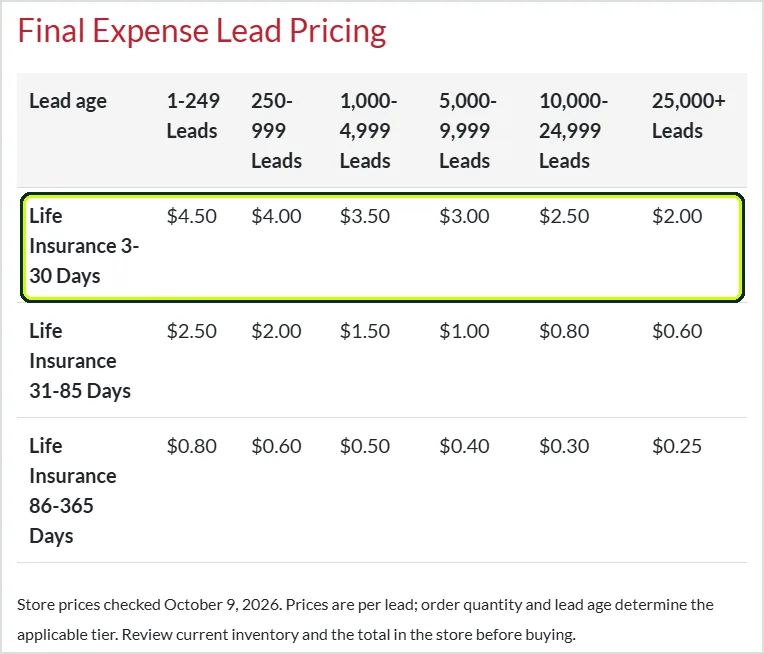
Aged Lead Store prices by age and quantity, with a $100 minimum order, and says plainly that other agents may already have purchased or contacted the same people.
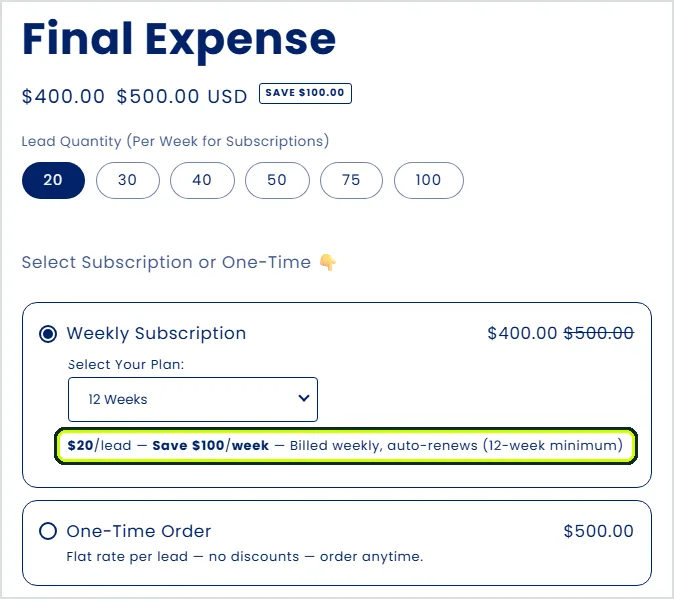
Caboom Leads sells 20 leads, exclusive at delivery, for $500 one time, or $400 a week on a 12-week subscription. It also sells overflow and 30-day unsold leads. Its refund policy says all sales are final and non-refundable; replacements fall under the same policy.
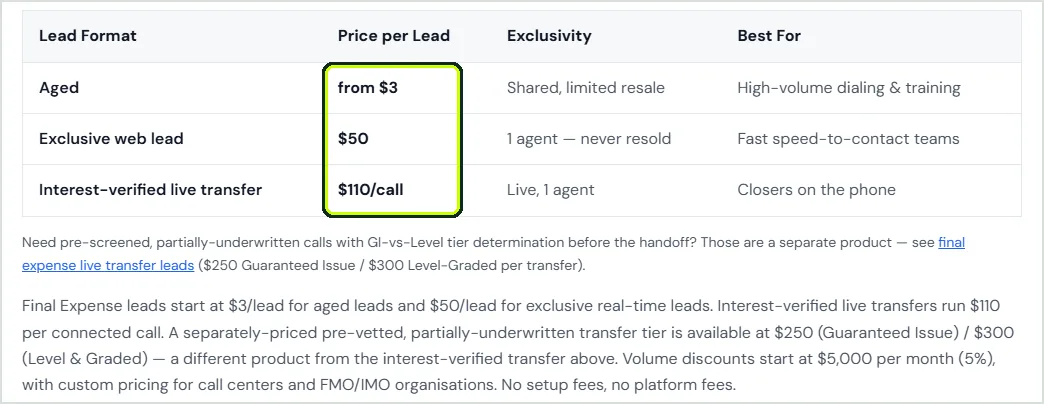
InsureLeads lists exclusive web leads at $50, interest-verified live transfers at $110 per connected call, and pre-screened transfers at $250 for guaranteed issue or $300 for level and graded.
Cost per issued policy is the number that matters
Lead price is an input. What you pay for is an issued policy, and the gap between the two is your contact rate, follow-up speed and underwriting fit.
The table applies assumed issue rates to the published prices. They are illustrations, not measured results, so replace them with your own before you sign a 12-week subscription.
- Aged 86 to 365 days, $0.80. Policies per 100 leads: 0.5 (assumed); Cost per policy: $160; Note: Plus about 200 records worked per sale
- Aged 3 to 30 days, $4.50. Policies per 100 leads: 2 (assumed); Cost per policy: $225; Note: Shared records
- Exclusive web, $20. Policies per 100 leads: 7 (assumed); Cost per policy: $286; Note: 12-week commitment
- Exclusive web, $50. Policies per 100 leads: 10 (assumed); Cost per policy: $500; Note: No contract
- Live transfer, $110. Policies per 100 leads: 20 (assumed); Cost per policy: $550; Note: Closers only
- TTC managed campaign. Policies per 100 leads: 37 policies on $7,583 spend; Cost per policy: $205; Note: Vendor-reported, Dec 2025
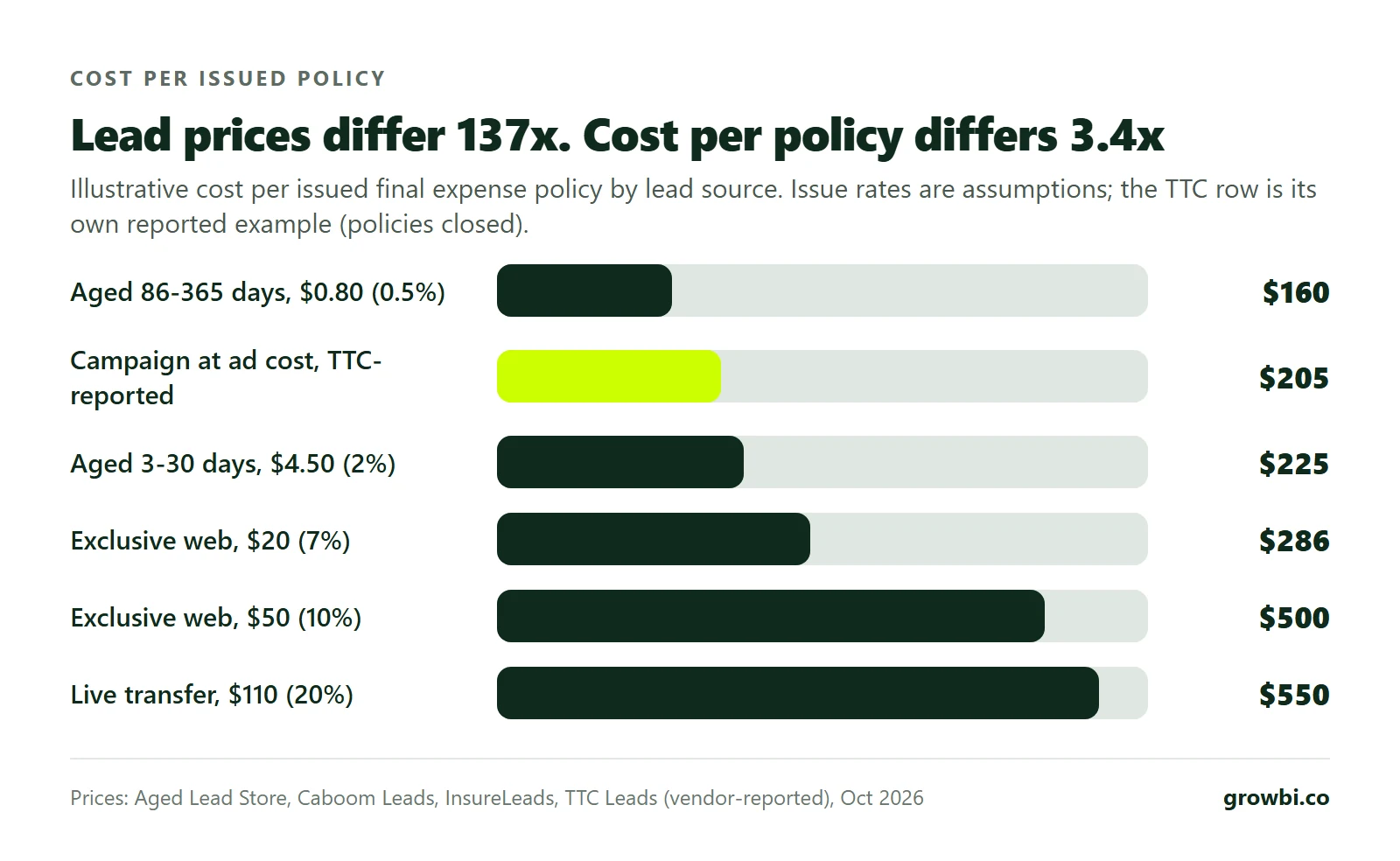
The break-even rule is simple: issued policies per lead times your first-year commission. At 10 policies per 100 leads and a $600 commission, a lead is worth $60 at most.
Aged leads look cheapest until you count the phone time. At 0.5 policies per 100 records, one sale takes about 200 records worked, and your hours are the expensive part.
Growbi's published CPL vs CPA research makes this case from med spa advertising, not an insurance book: the ads were judged by patients who arrived, not by form fills.
Where exclusive final expense leads come from
Most real-time life insurance leads start as a social ad and a short form. Caboom says it advertises "Affordable final expense insurance plans in your area" with an 11-question survey.
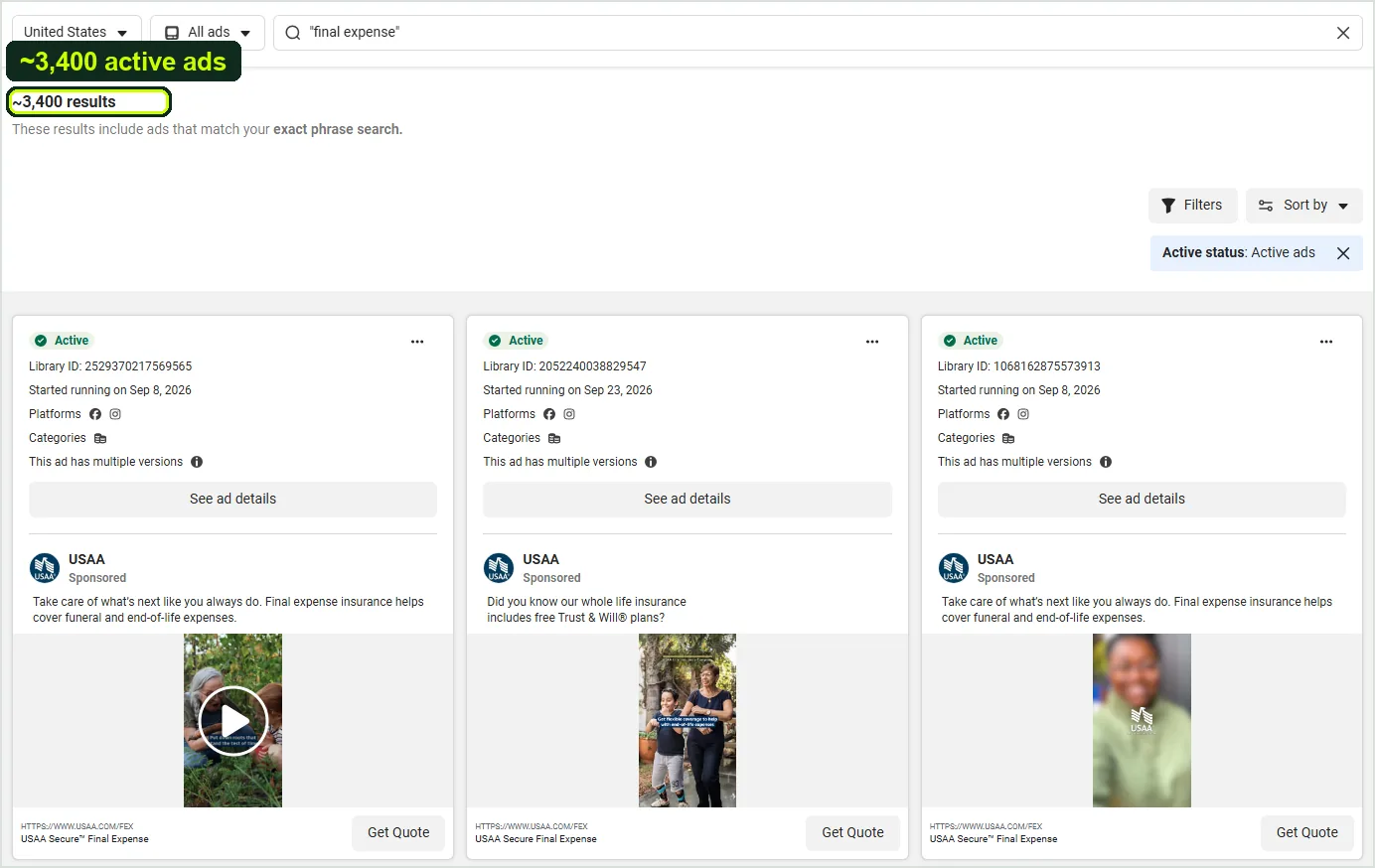
An exact-phrase search for "final expense" in Meta's Ad Library showed about 3,400 active US ads in October 2026, with USAA among the advertisers. Every vendor and agent bids in that same auction.
Meta treats insurance as a financial product, so these ads run in a special ad category. In it, age, gender and ZIP code targeting are limited or unavailable, and the creative has to call out the age group itself.
That is why vendor forms ask so many questions. The ad cannot select seniors, so the form does, and you pay for that filtering in the price of these leads.
Google search for burial insurance
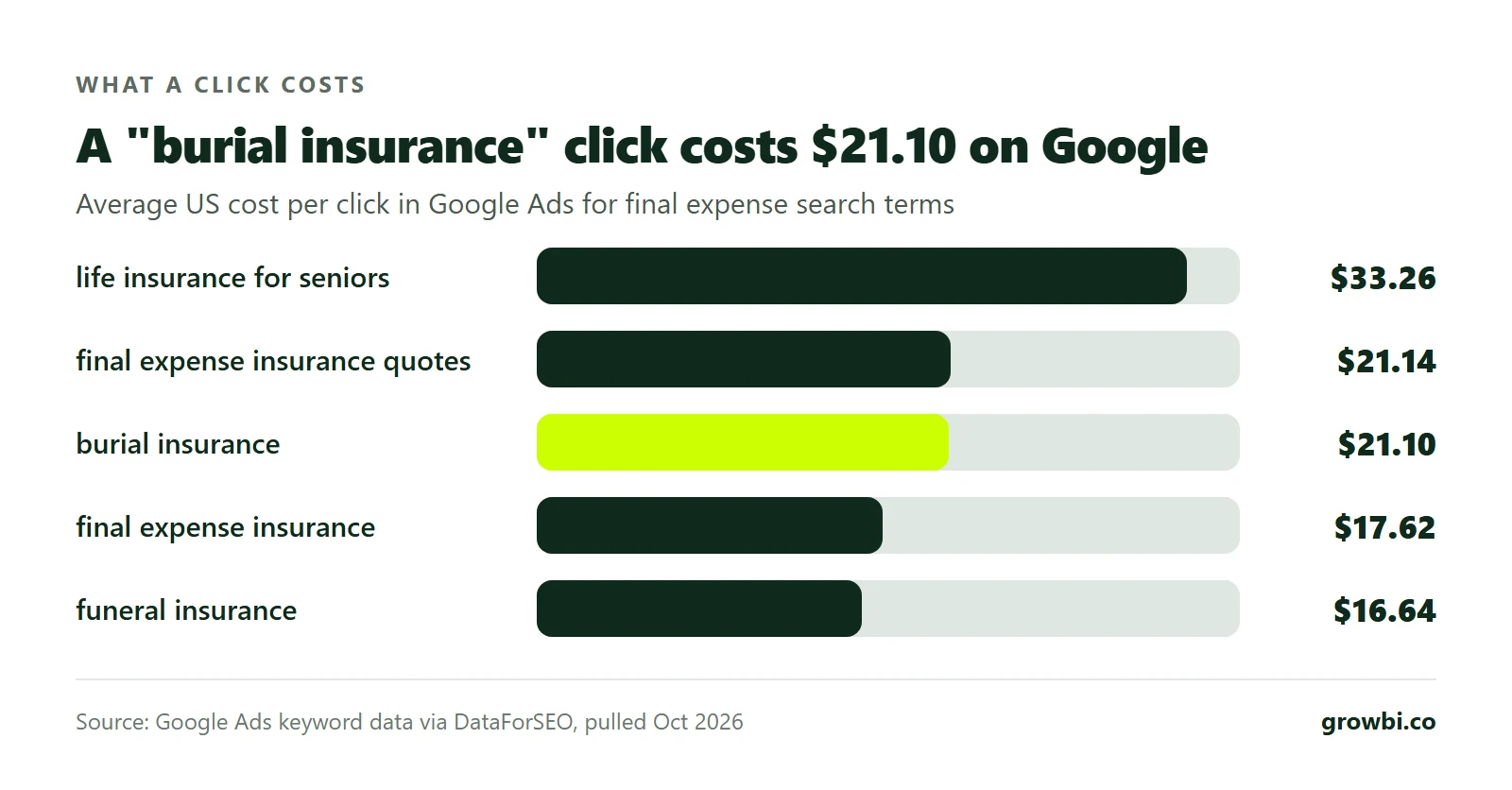
Search is the other source, and every click is expensive. "Burial insurance" averages 9,900 US searches a month at a $21.10 average click cost.
In Birmingham, Alabama, the paid results for "burial insurance" showed USAA next to a guaranteed-approval ad quoting rates "as low as $5 per week". Price and acceptance are the two hooks searchers see.
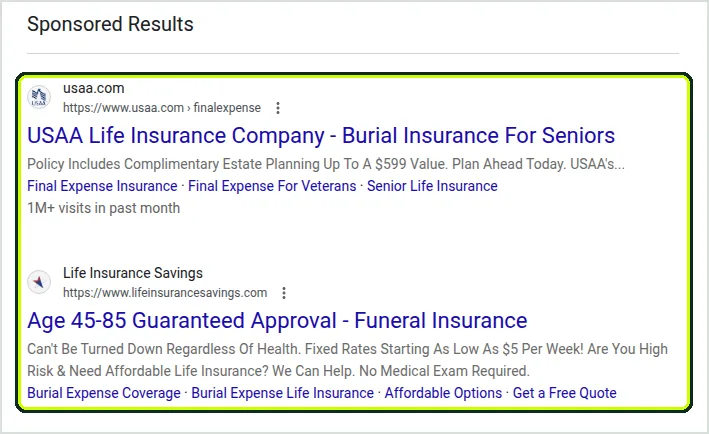
Source: Google Search, Birmingham AL, captured Oct 2026 via DataForSEO
At $21 a click and an assumed 10% form rate, a search lead costs about $211. That only works for agents who issue at a high rate, which is why we would test Meta first.
When running your own campaigns beats buying
TTC Leads shows the markup most clearly. It runs campaigns at ad cost and reports $8.72 to $10.70 per lead for six agents in December 2025.
Compare that with $20 to $50 for exclusive leads bought by the piece. The spread pays for the creative, form, verification and margin.
Running your own campaigns removes that margin but adds work: a licensed landing page, consent language, a CRM and someone calling within 5 minutes. The method matches our guide to roofing lead generation costs.
Our rule of thumb: buy while you learn your issue rate, then build once you know it. If you cannot measure cost per policy by source, start with tracking cost per booked appointment.
Compliance: consent, Do Not Call and licensing
Final expense calls fall under the FCC's TCPA rules, not CMS, and a few of them decide whether a bought lead is usable at all.
- Consent names the seller. Under 47 CFR 64.1200, prior express written consent authorizes the seller to send autodialed or prerecorded marketing. Check that the form names you or your agency.
- Scrub every 31 days. The Do Not Call safe harbor requires a registry version no more than 31 days old.
- Inquiries expire for Do Not Call. The FCC counts an inquiry as an established business relationship only within the 3 months before the call.
- Call between 8 a.m. and 9 p.m. in the consumer's local time.
- No one-to-one rule. The FCC removed it on July 14, 2025 after a court vacated it.
Licensing comes before all of it. The NAIC states that anyone who sells, solicits or negotiates insurance must be licensed as a producer, with nonresident licenses for other states.
If you also sell Medicare, keep the products apart: CMS bans cross-selling non-health products during Medicare Advantage sales activity. This is not legal advice; your carriers and counsel decide your scripts.
Questions to ask a final expense lead vendor
Every vendor promises fresh, exclusive, high-intent leads. These answers, in writing, separate the ones worth a test from the rest.
- Which ad and form produced it? Ask for the creative and every form question.
- Who is named in the consent? It should be you, not a list of partners.
- What is the replacement policy? Wrong numbers, duplicates and out-of-state leads should be replaced on a deadline.
- Is it ever resold? Exclusive today should not become aged inventory next quarter.
- What is the minimum commitment? A 12-week subscription is a $4,800 decision at $400 a week.
A first-month plan for final expense lead generation
Most agents lose money on leads by scaling before they know their numbers. This order fixes that.
Four weeks, one source at a time.
- Week 1: set up tracking. Tag every lead by source and record contact, appointment, application and issue dates in your CRM.
- Week 1: buy one small batch. Start with one source and one state where you hold appointments, for example 20 exclusive leads.
- Weeks 1 to 4: call within 5 minutes. Call fast, text if no answer, and log every attempt. Speed changes issue rate more than source does.
- Week 4: compute cost per issued policy. Divide spend by issued policies. Keep sources under your break-even; cut the rest.
- Month 2: test your own campaign. Run a small Meta campaign with your own form and consent text, and compare its cost per policy.
FAQs
What are the best final expense leads?
The best leads are the ones that issue at a cost per policy below your first-year commission. For most agents that means exclusive real-time leads called within 5 minutes, tested in small batches against one or two other sources.
Where can I find free final expense leads?
Free leads come from your own book: referrals from current policyholders, a Google Business Profile with reviews, and community events. They cost time instead of money, so track them as their own source next to the leads you buy.
Is final expense easy to sell?
The product is simple: a small whole life policy sized to a funeral bill of about $8,300 for burial, before cemetery costs (NFDA, 2023). The hard part is reaching people, so contact rate and follow-up speed decide most of an agent's results.
Conclusion
Final expense leads are priced per lead and paid back per policy. Judge every source on cost per issued policy, and a 137 times gap between an $0.80 record and a $110 transfer shrinks to about 3.4 times.
Buy small while you learn your issue rate, keep consent and Do Not Call records clean, and move budget toward your own finance marketing campaigns once you know what a policy is worth to you.
Book a free 15-minute call if you want this run on your own book. Bring spend and issued policies by vendor, and we will show which sources clear your commission and whether a Meta campaign of your own would beat them.
Get this system built for your business
Book a strategy call and we will model a realistic appointment target from your budget, market, and offer.