Medicare Leads: What They Cost in AEP 2026 and the CMS Rules That Decide Which Pay Off
 Mor RomanoCTO, Growbi11 min read
Key Takeaways
- AEP runs October 15 to December 7, and Medicare Advantage searches in October were four times the June level.
- CMS caps 2027 first-year Medicare Advantage commission at $725 nationally, so a lead is worth your enrollment rate times $725.
- Since October 1, 2026, an appointment can follow a recorded Scope of Appointment right away; the 48-hour wait is gone.
- Unsolicited calls, texts, voicemails and social media messages to beneficiaries are still banned, so every usable lead needs documented consent.
Medicare leads are contact records of people with Medicare, or about to get it, who asked to hear about plans. In 2026, published prices run from $5 aged records to $70 exclusive web leads and $125 live transfers. Judge each against CMS's 2027 cap of $725 per new Medicare Advantage enrollment.
Table of Contents
During AEP every Medicare lead vendor in your inbox says its leads close, and most of them price as if every single lead will enroll.
This guide prices each lead type against what CMS lets a carrier pay you per enrollment, then covers the rules that changed on October 1, 2026.
AEP 2026 sets the price of every Medicare lead
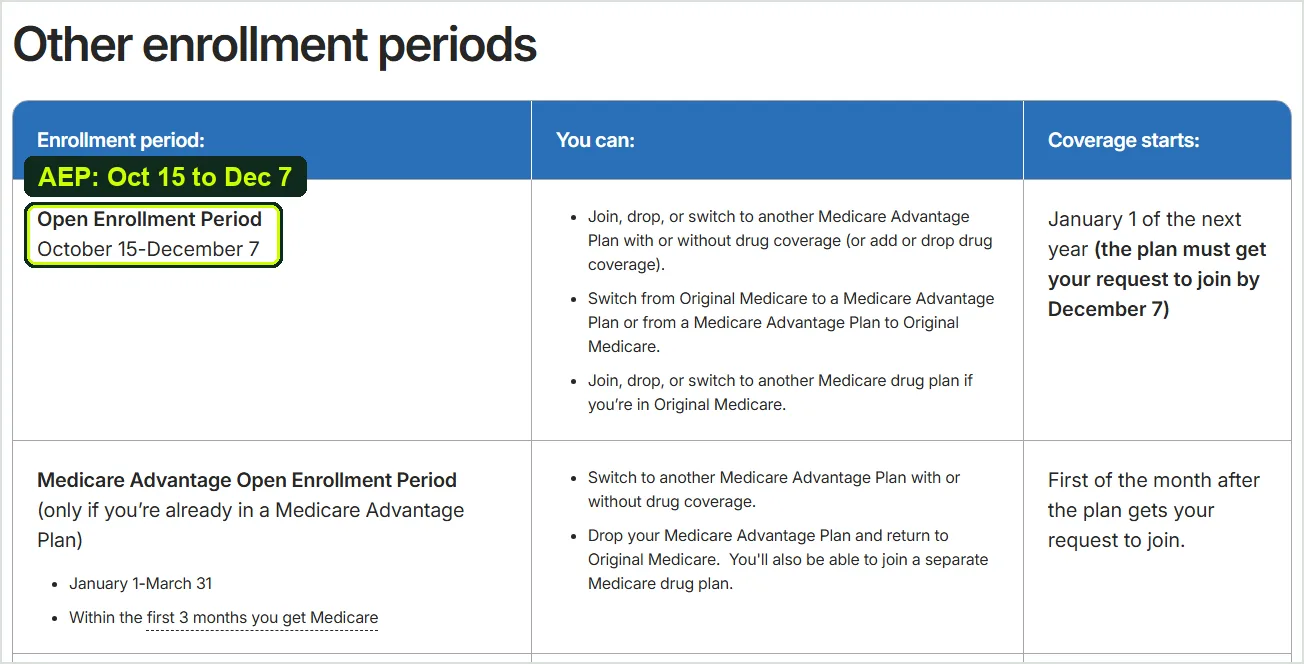
The Annual Enrollment Period runs October 15 to December 7, with coverage starting January 1. Demand and competition peak inside those 54 days.
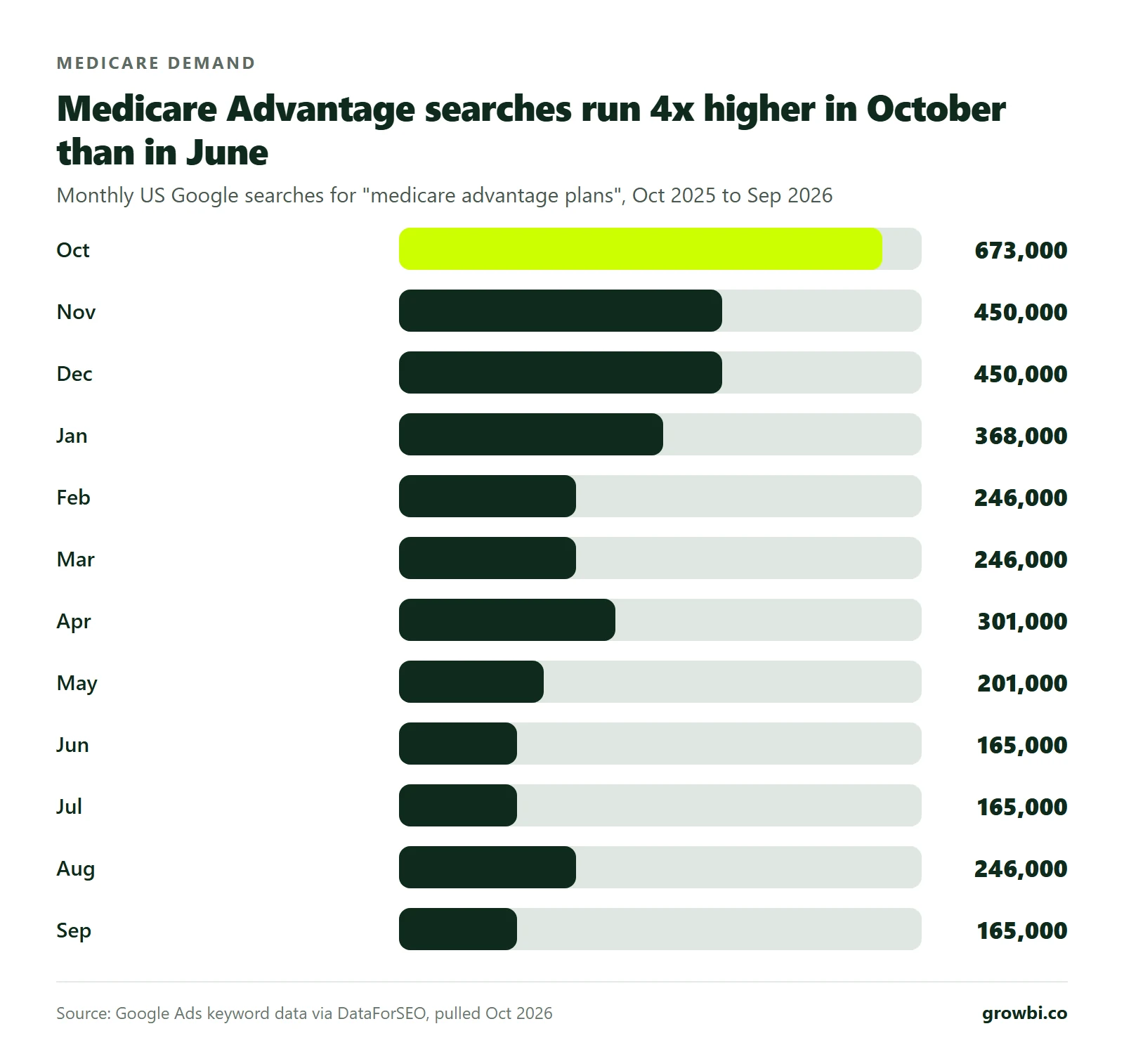
Search data shows how sharp that peak is. Google searches for "medicare advantage plans" reached 673,000 in October 2025 and fell to 165,000 in June and July 2026.
InsureLeads notes that its AEP pricing varies with demand, and a lead bought in late November has the fewest selling days left.
Under 42 CFR 422.2263, marketing for 2027 plans opened October 1, the day the new CMS rules below took effect.
Six kinds of Medicare leads
Medicare Advantage and Medicare Supplement leads come in six formats. They differ in price, in who else gets the same person, and in the consent attached.
| Lead type | How it reaches you | Who else gets it | Best use |
|---|---|---|---|
| Aged leads | Inquiries 30 or more days old | Usually resold | Email nurture, dialer practice |
| Shared web leads | Real-time form sold to several agents | 2 or more agents | Teams that call in minutes |
| Exclusive web leads | Real-time form, one buyer | Only you | Agents with fast follow-up |
| Live transfers | Screened caller patched to your phone | One agent per call | Closers with open AEP calendars |
| T65 direct mail | Reply cards from people turning 65 | Varies by vendor | Pipeline outside AEP |
| Your own campaigns | Search, Meta, Google Business Profile, events | Only you | Building a book you own |
A T65 lead is someone approaching 65. Medicare.gov describes their Initial Enrollment Period as 7 months, starting 3 months before the 65th birthday month and ending 3 months after it.
What Medicare leads cost in 2026
Few Medicare lead generation companies publish a rate card for insurance agents. Most vendor pages we checked show no prices at all.
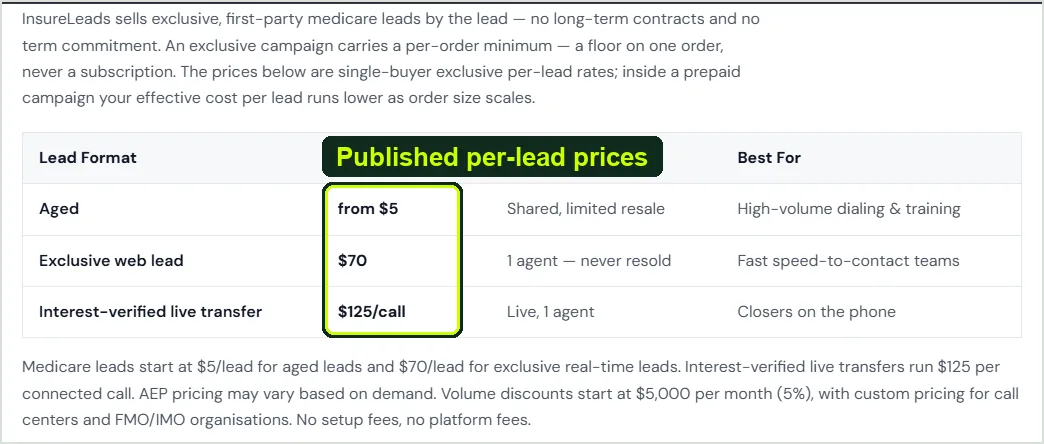
InsureLeads' Medicare page, last updated August 1, 2026, lists aged leads from $5 (its summary line says $0.75 to $5 by record age), exclusive web leads at $70 and interest-verified live transfers at $125 per connected call.
Google's AI Overview for "medicare leads" quotes $35 to $75 for exclusive web leads without naming a source. Ask any vendor for a written price, minimum order and return terms.
The ceiling: what CMS lets a carrier pay you
Medicare Advantage commission is capped by CMS, so the most any lead is worth is known before you buy it. Few other insurance lines give you that ceiling.
CMS's June 1, 2026 compensation memo sets the 2027 fair market value amounts carriers may pay independent agents and brokers:
| Plan type and area | Initial year | Renewal years |
|---|---|---|
| Medicare Advantage, national | $725 | $363 |
| Medicare Advantage, CT, PA, DC | $816 | $408 |
| Medicare Advantage, CA and NJ | $902 | $451 |
| Part D plan (PDP) | $130 | $65 |
These are maximums, and a carrier can pay less. Referral payments are capped as well: $100 for a referral into a Medicare Advantage plan and $25 for a PDP, under 42 CFR 422.2274.
The same rule sets the second limit, rapid disenrollment. If a member changes plans within the first three months of enrollment, the carrier must recover the compensation it paid.
That hits AEP sales hardest. An enrollment effective January 1 that switches during the January to March Medicare Advantage Open Enrollment Period falls inside those three months, so a poorly matched sale can cost you the whole commission.
Cost per enrollment decides whether to buy or build
The break-even price for a Medicare lead is your enrollment rate times the commission. At 10% enrollment and the $725 national cap, that is $72.50 per lead.
Here is that math across lead types, using the published prices above. The enrollment rates are our assumptions for illustration, not measured results, so swap in your own numbers before deciding.
| Source and price | Enrolls (assumed) | Cost per enrollment | vs $725 cap |
|---|---|---|---|
| Aged lead, $5 | 1% | $500 | Under |
| Exclusive web lead, $70 | 10% | $700 | Barely under |
| Exclusive web lead, $70, slow callback | 5% | $1,400 | Nearly double |
| Live transfer, $125 per call | 25% | $500 | Under |
| Own search campaign, $88 per lead | 20% | $439 | Under |
The own-campaign row uses the $13.17 average US click cost for "medicare agent near me" and assumes 15% of clicks become a call or form. You can measure both inputs in the first week.
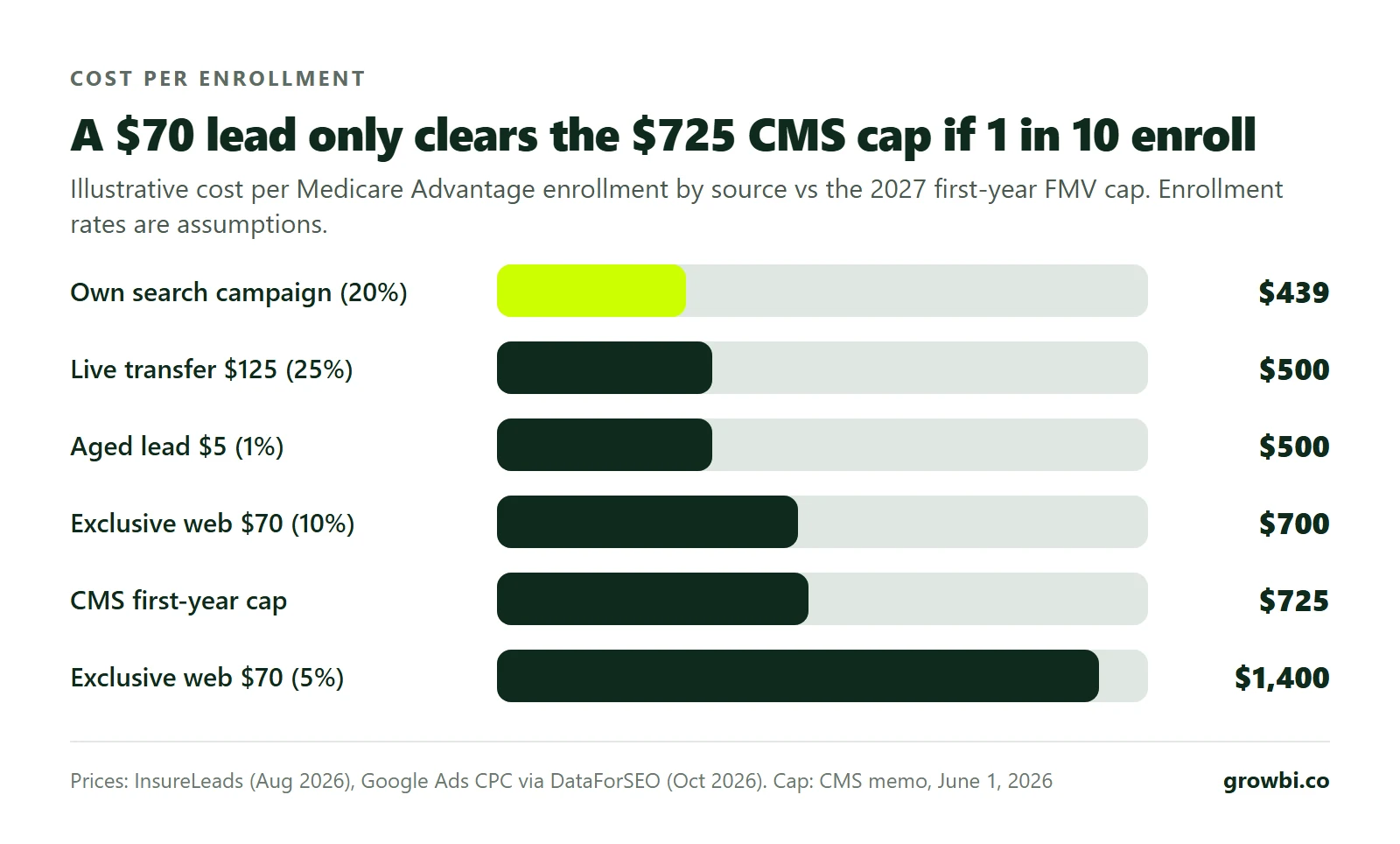
Two points hold whatever rates you plug in. Follow-up speed alone can turn the same $70 lead from profit to loss, and a member who stays earns renewals of up to $363 a year.
This is the argument behind Growbi's CPL vs CPA press release. In the Predire Champlain med spa case study, 392 leads at $16 each turned into 163 arrivals at $38.48 per arrival, and the second figure is the one that runs a business.
If you buy from more than one source, tag every lead and record when it books, shows and enrolls. Our guide to tracking cost per booked appointment walks through that setup step by step.
CMS marketing rules that changed on October 1, 2026
CMS published its 2027 Medicare Advantage and Part D rule on April 6, 2026, and its marketing changes apply to all 2027 materials from October 1, 2026.
The CMS partner tip sheet lists six changes. These touch Medicare leads, checked against the old and current federal text:
| Rule | Before | From October 1, 2026 |
|---|---|---|
| Scope of Appointment timing | At least 48 hours before the appointment, with exceptions | Appointment any time after the SOA is recorded |
| SOA forms at educational events | Not allowed | Allowed |
| Marketing event after an educational event | Not within 12 hours in the same building | Right after, if attendees are told and can leave |
| TPMO disclaimer on sales calls | Within the first minute | Before any benefits are discussed |
| Resources named in the disclaimer | Included SHIPs | Medicare.gov and 1-800-MEDICARE only |
| Sales call recordings | Kept 10 years | Kept 6 years, transcripts allowed in years 4 to 6 |
For lead generation the first two rows matter most. A same-day appointment from a fresh lead is allowed once the SOA is recorded, so speed to contact is no longer capped by a waiting period.
The SOA still sets the boundaries. It must be in writing for in-person appointments, it limits the meeting to the products the beneficiary agreed to discuss, and it stays valid for 12 months, per 42 CFR 422.2264.
The TPMO disclaimer, word for word
Sell plans for more than one carrier and you are a third-party marketing organization (TPMO). For agents who do not sell every plan in the area, the disclaimer reads:
Under 42 CFR 422.2267 it is said on sales calls before benefits come up, sent in emails and chats, displayed prominently on your website and included in print and TV ads. A landing page is a website, so the disclaimer belongs there too.
Contact rules that decide whether a lead is usable
A cheap lead is worthless if you are not allowed to call it. CMS bans unsolicited calls, texts and voicemails to beneficiaries, including calls based on referrals.
The same section bans door-to-door visits without an appointment, approaching people in parking lots or lobbies, and unsolicited direct messages on social media. Mail and email with an opt-out are allowed.
A call stops being unsolicited when the beneficiary started the contact or gave consent, such as returning your call or sending back a reply card asking to be contacted. That consent record is the asset you are buying.
The TCPA adds phone rules. The FCC's one-to-one consent rule never took effect: a court vacated it and the FCC removed it on July 14, 2025.
Autodialed or prerecorded sales calls and texts still need prior express written consent, and the FCC's October 1, 2026 order keeps the 10-business-day deadline for honoring a revocation.
Licensing is the last filter. CMS requires agents licensed in the state and appointed by the carrier, so a lead from a state where you lack either is a refund request.
None of this is legal advice. Your carriers' compliance teams and your counsel have the final word on scripts and consent language.
Generating your own Medicare leads on Meta and Google
Running your own digital marketing means the leads, consent records and call recordings belong to you. Two platform rules shape every campaign.
On Meta, health insurance and every other insurance line falls under the "Financial products and services" special ad category, required for US advertisers since January 21, 2025.
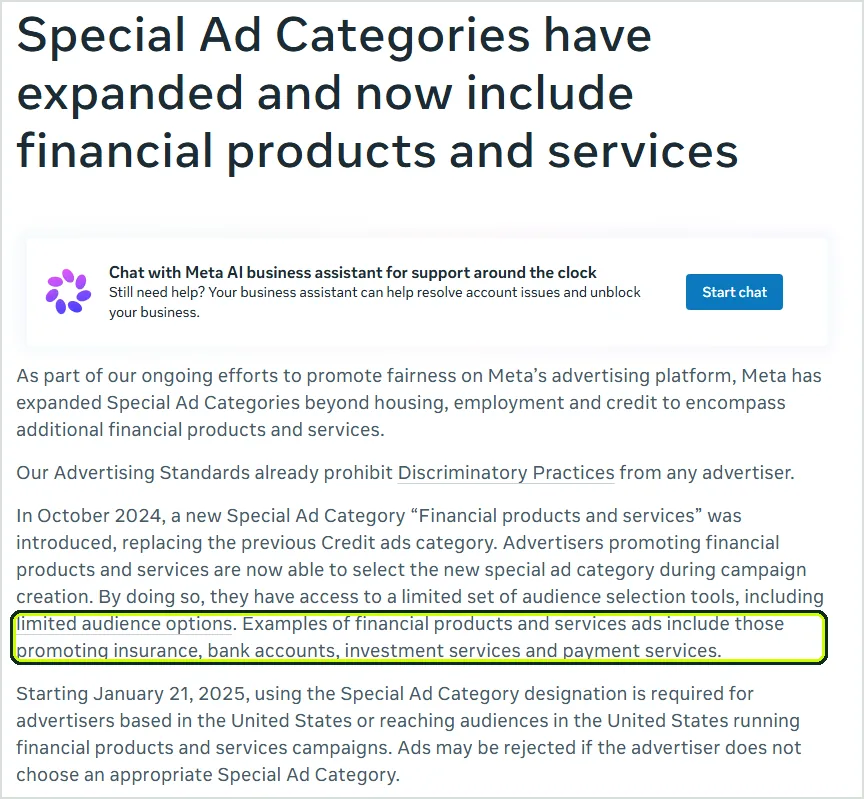
In that category, Meta limits or removes age, gender, ZIP code, lookalike and saved audiences. You cannot target 65-year-olds by age, so the copy does the targeting: "Turning 65 this winter?" filters better than any interest.
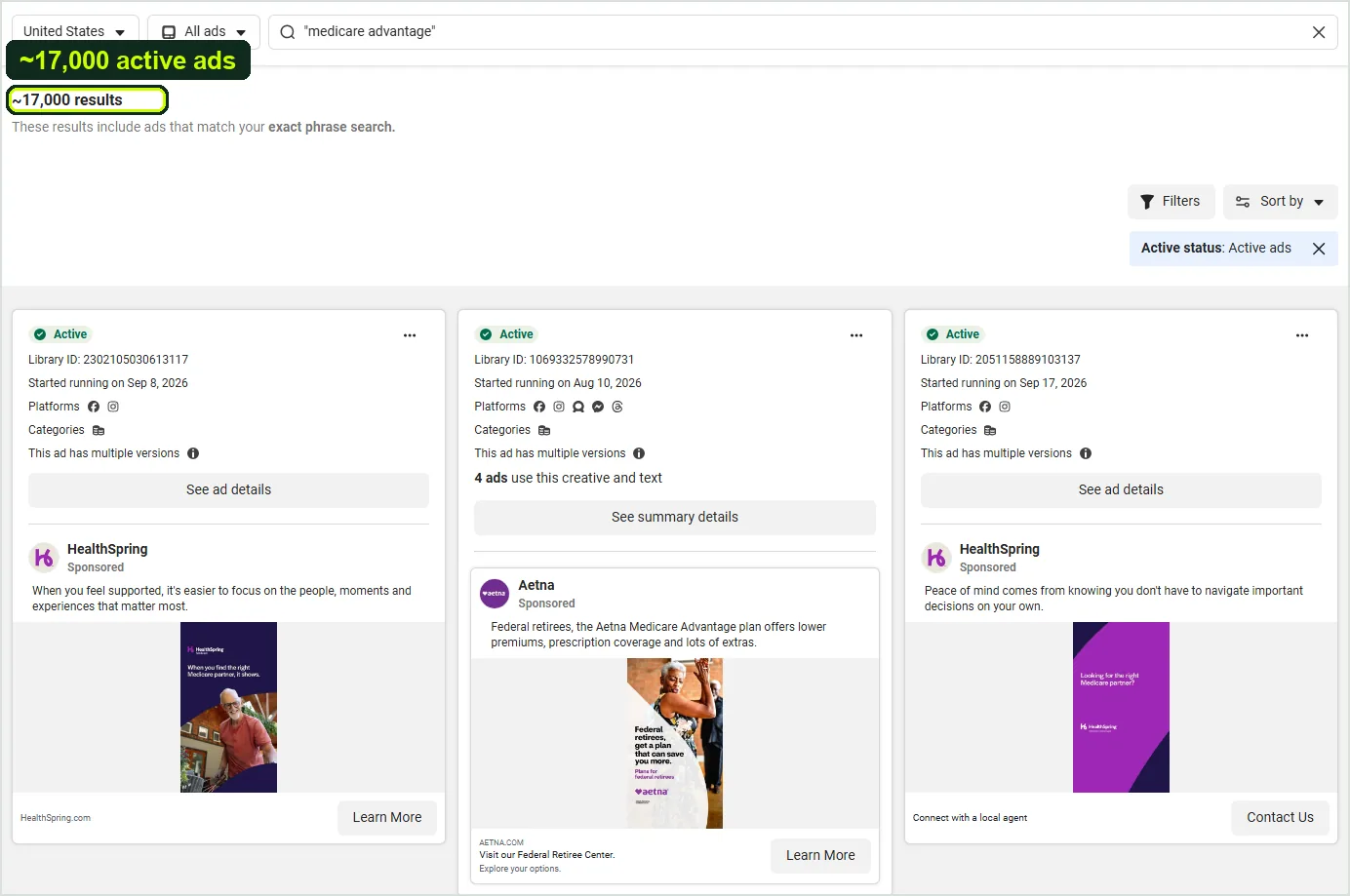
Google search is the higher-intent channel. "Medicare agent near me" averaged 8,100 US searches a month at a $13.17 average click cost, and reached 18,100 in October 2025.
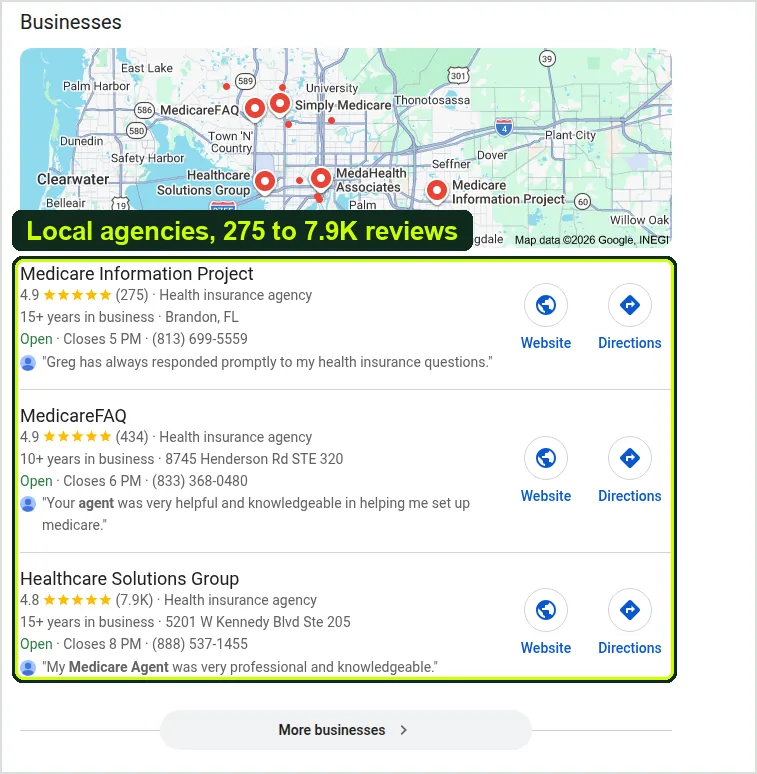
Those listings carry 275 to 7,900 reviews. A Google Business Profile with steady reviews is the cheapest lead source an agent controls.
Google's financial services verification does not block a US campaign today. Its country list covers 42 locations, and the United States was not one of them in October 2026.
Every ad, form and landing page you run as a TPMO carries the disclaimer. Write it into the creative brief before anyone drafts an ad; that is step one of our finance campaign management process.
Questions to ask any Medicare lead vendor
Before you buy a single AEP lead, get written answers to five questions. A vendor that dodges any of them is pricing its risk into your budget.
- Show me the consent. The form wording, timestamp, page URL and verified contact information for each lead.
- Who else gets it? Exclusive should mean one buyer, never resold later as an aged record.
- Which subcontractors touched it? CMS requires TPMOs to disclose subcontracted lead generation relationships to the plans.
- What is the return policy? Wrong numbers, out-of-state and already-enrolled leads should earn credit by a written deadline.
- Are transfer calls recorded? You need every sales call kept 6 years, the first 3 in audio.
Then test small: one batch, every lead called within 5 minutes, and enrollments counted at 90 days before you scale.
It is the method from our guide to roofing lead generation costs: judge each source on the outcome you are paid for.
A 90-day plan from AEP to T65 leads
AEP lasts 54 days. The agencies that come out ahead treat it as the start of a year-round pipeline, not a sprint.
The order we would follow from mid-October.
Now to December 7: work AEP intent
Fund search, inbound calls and transfers that come with consent records. Book same-day appointments once the SOA is recorded.
Every sale: protect the commission
Check doctors and drugs before enrolling. A member who switches between January and March triggers rapid disenrollment recovery.
January 1 to March 31: respect the MA OEP
CMS bars knowingly sending unsolicited marketing to members during the Medicare Advantage Open Enrollment Period. Shift budget to age-ins.
Year-round: build T65 flow
Run Meta and search ads for people turning 65, plus reply-card mail. Each prospect has a 7-month window.
Weekly: judge enrollments, not leads
Track cost per enrollment by source and cut any source that stays above your commission.
FAQs
What is a T65 Medicare lead?
A T65 lead is a person turning 65 who asked for Medicare information. Their Initial Enrollment Period lasts 7 months, starting 3 months before the 65th birthday month, which makes T65 the main lead source outside AEP.
Which Medicare lead vendors are the best?
The one whose leads enroll and stay enrolled past 90 days at a cost below your commission. Ask for consent records, exclusivity terms and a written return policy, then test small.
How do I get Medicare leads?
Buy them as aged, web, direct mail or live transfer leads, or generate your own through Google search, Meta ads, a Google Business Profile, referrals and educational events. Since October 1, 2026, you can collect Scope of Appointment forms at educational events.
Conclusion
Medicare leads are one of the few insurance leads with a known ceiling. CMS caps 2027 first-year Medicare Advantage commission at $725 nationally, so every source can be priced in advance: enrollment rate times the cap.
Use AEP to buy what converts, call it within minutes and document every SOA and disclaimer. Then build your own T65, search and referral flow, so next October starts with a pipeline instead of a vendor invoice.
Want that math before next AEP? Book a free 15-minute call. We will price each of your lead sources against the $725 cap and show where your own campaigns would beat buying.
Get this system built for your business
Book a strategy call and we will model a realistic appointment target from your budget, market, and offer.