Key Takeaways
- Set the ad budget backward: the arrived patients you need times your cost per arrived patient.
- The same 100 patients cost $3,848 at Predire Champlain's rate and $13,200 at the industry's $132 average.
- Meta ad sets need about 50 results a week to leave the learning phase, which sets a minimum weekly spend.
- Fix tracking, offer, creative and follow-up before raising spend, or the extra budget buys the same leaks.
A med spa marketing ad budget should be set backward from the patients you need: target arrivals times your cost per arrived patient. Growbi's Predire Champlain account had 163 patients arrive at $38.48 each from $6,272 of Meta spend. A bigger budget only helps once tracking, offer and follow-up already convert.
Table of Contents
The standard fix for an empty calendar is a bigger ad budget. It feels logical, and it is frequently the wrong move, because every leak in the funnel grows with the spend.
This guide shows how to size your med spa ad budget from the patients you need, the minimums Meta and Google set, and the checks to pass before you add a dollar.
Why a bigger budget rarely fixes bookings
Extra spend buys more leads at the same conversion rates. If those rates are poor, you pay more for the same problem.
Picture a clinic where half the leads wait a day for a call back. Doubling the budget doubles the leads nobody calls in time. In our accounts, cost per arrived patient then holds flat at best and climbs as ads reach colder people.
That is the myth in one line: the budget sets how many leads arrive, while the funnel sets how many of them become patients. Fix the second before you buy more of the first.
Start from the patients you need
The cleanest way to set a med spa marketing ad budget is to work backward from a monthly patient target.
The formula: arrived patients you need, times your cost per arrived patient, equals the monthly ad budget. No cost per arrival yet? Borrow a reference point, then swap in your own after two months of tracking.
| Arrivals per month | At $38.48 (Predire Champlain) | At $58.55 (Nuvera) | At $132 (industry average) |
|---|---|---|---|
| 50 | $1,924 | $2,928 | $6,600 |
| 100 | $3,848 | $5,855 | $13,200 |
| 150 | $5,772 | $8,783 | $19,800 |
The first two columns use August numbers from the Predire Champlain case study and the Nuvera case study. The third uses the $132 average new patient acquisition cost in the 2026 Growth99 report published by AmSpa.
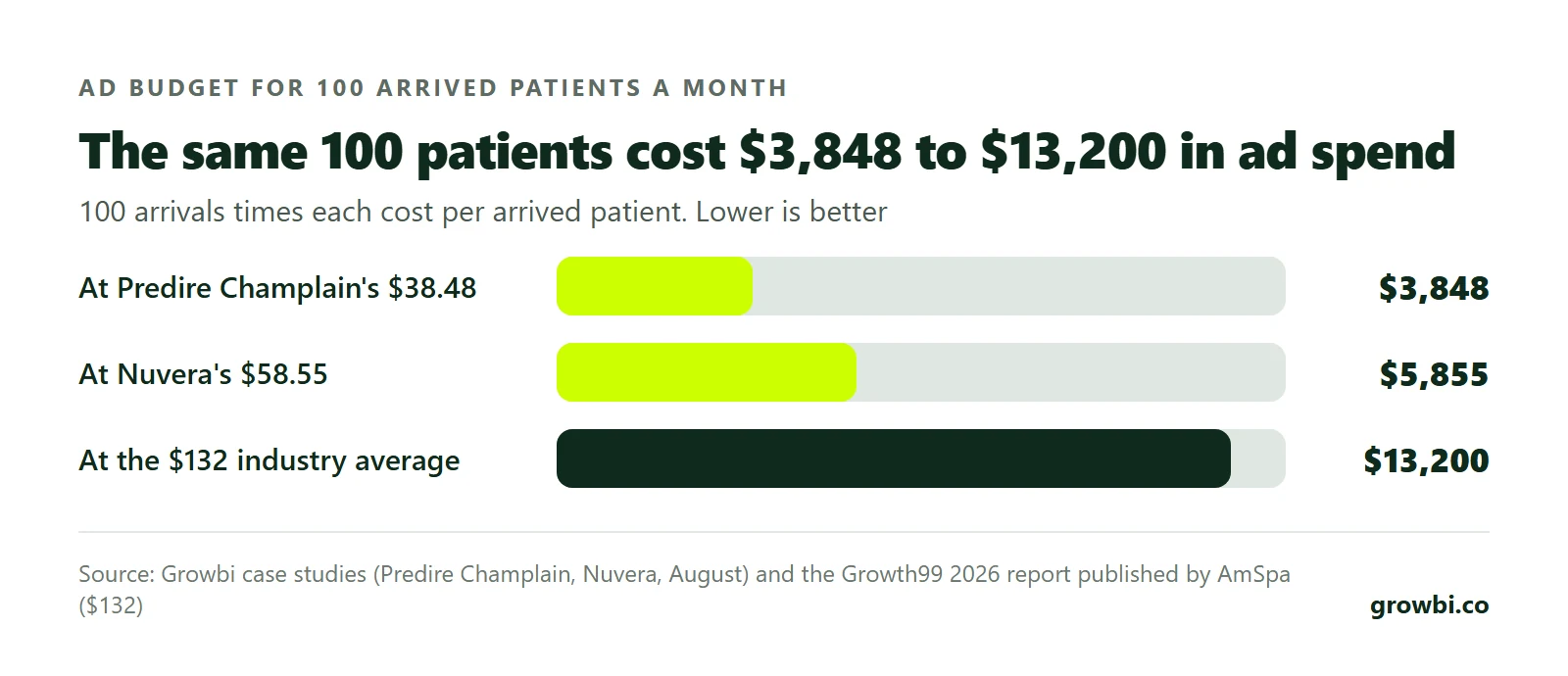
The gap between columns is the point. The same 100 patients cost under $4,000 or over $13,000, and the difference comes from offer, creative and follow-up, not from the size of the budget.
Revenue benchmarks as a sanity check
Once you have a patient-based number, compare it with what the industry spends as a share of revenue.
An AmSpa article by Growth99 CEO Rob Pickell cites AmSpa's 2024 State of the Industry Report: the average med spa puts about 7% of revenue into marketing, within a range of 2% to 15%.
The same article suggests 8% to 12% for a two-year-old practice, or $4,000 to $7,000 a month on about $60,000 of monthly revenue, and 4% to 6% for a four-year-old practice.
These percentages cover all marketing, agency fees included. If your patient-based budget lands far above them, the target is too ambitious for now or your cost per arrival needs work. Our breakdown of med spa marketing agency cost shows how the fee sits on top.
The minimum budget Meta needs to learn
A budget too small to finish Meta's learning phase wastes money, because delivery never settles on who should see the ads.
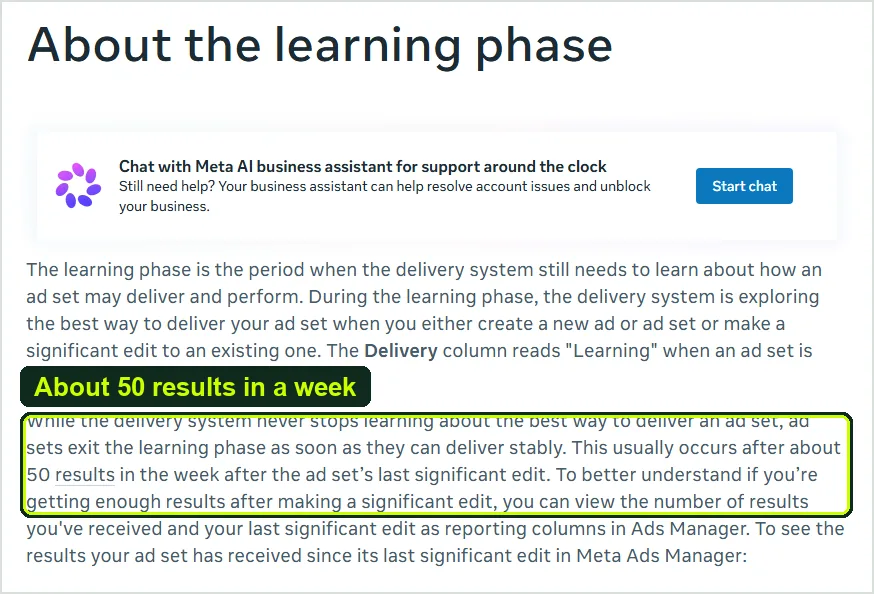
Meta's help page on the learning phase says ad sets usually exit it after about 50 results in the week after the last significant edit. In a lead campaign, a result is a lead.
So the floor is about 50 times your cost per lead, per ad set, per week. At Predire Champlain's $16 cost per lead, that is $800 a week. At Nuvera's roughly $32, it is about $1,600.
If your budget cannot reach that floor, run fewer ad sets with one offer each instead of spreading the money thin. Both accounts above run a single treatment with a single entry offer.
How Google spends a daily budget
Google Ads works with an average daily budget, not a monthly one, so convert your plan before you enter it.
Per Google Ads Help, a campaign may spend up to twice its average daily budget on a given day, but no more than 30.4 times that daily budget across the month.
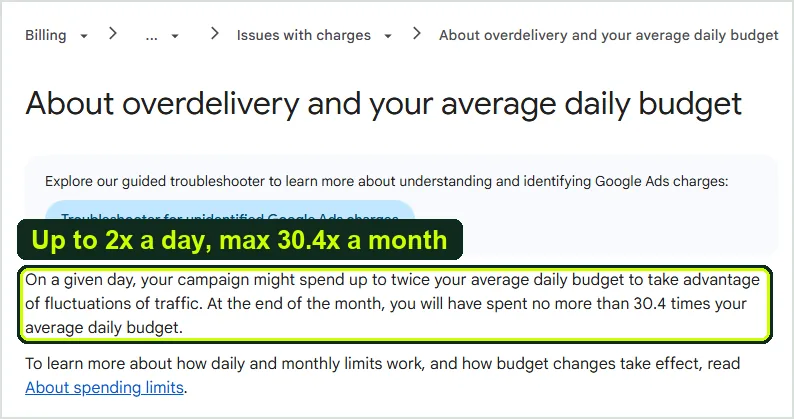
For a $3,000 monthly search budget, enter about $99 a day, which is $3,000 divided by 30.4. Some days will run near $197 and others well below, and the month evens out.
How much goes to Google versus Meta depends on your treatments and market. Our comparison of Meta vs Google ads for med spas walks through the split.
Fix these before you raise the budget
Five checks decide whether new spend turns into patients. Run them in order, because each one depends on the one before.
Pass each check before adding spend.
Track arrivals, not only leads
Record who booked and who walked in, by campaign. Without that, nobody can say which ads produce patients.
Run one treatment and one entry offer
Predire Champlain advertised a face and neck lift at $79.99 against a $249.99 regular price. One offer keeps the message and the test clean.
Replace creative before it wears out
In a fixed local area the same people see your ads every month. On Nuvera's account, replacing ads before they fatigue is most of the work.
Talk to every lead
Royal Wellness connected every lead to an in-house call center that confirmed the appointment, and booked 112 new appointments in its first month.
Confirm on more than one channel
Garden Retreat confirmed every appointment by phone, email and SMS, and turned more than 150 of over 300 new leads into appointments in 60 days.
The full setups are in the Royal Wellness case study and the Garden Retreat case study. None of these steps needs a bigger budget, and each one makes the next dollar work harder.
When to raise the budget, and by how much
Raise spend when the funnel is proven and the calendar has room, not because one month felt slow.
The signals we look for: a steady cost per arrived patient for at least four weeks, an arrival rate you are happy with, and open slots your providers can fill. With a full calendar, more budget only builds a waitlist.
Increase in steps rather than one jump, and give each step a full week before you judge it, since a significant edit sends a Meta ad set back into learning. Watch cost per arrival, not cost per lead.
If cost per arrival climbs after a raise, the local audience is likely saturating. That is the moment for a new offer or creative angle, not more money. To check where your account stands, book a free 15-minute call.
FAQs
How much should a new med spa spend on ads?
Start from the patients you need and an expected cost per arrival, then check the total against revenue. The AmSpa article cited above suggests 8% to 12% of revenue for a two-year-old practice, about $4,000 to $7,000 a month on $60,000 of monthly revenue, for all marketing.
Is $1,000 a month enough for med spa ads?
Only for a narrow test. At a $16 cost per lead, one Meta ad set needs about $800 a week to reach 50 results, roughly $3,500 a month. A $1,000 budget struggles to give the system enough results to learn.
How long should you test a new ad budget before judging it?
Give each change at least one full week so the ad set can collect about 50 results, then judge it on cost per arrived patient over a full month. Bookings and arrivals lag leads by days or weeks, so earlier verdicts mislead.
Conclusion
A bigger ad budget is not a plan. Start from the patients you need, multiply by what each arrived patient costs, and check the result against revenue benchmarks.
Then respect the floors: enough weekly spend for Meta to learn, Google budgets entered as daily averages, and a funnel that converts before any increase.
If you want that number worked out for your clinic, book a free 15-minute call and we will size your ad budget from your patient goal.

Mor Romano
CTO, Growbi
Written and fact checked by Mor Romano, published , last reviewed .
More about Mor RomanoGet this system built for your business
Book a strategy call and we will model a realistic appointment target from your budget, market, and offer.