Are Angi Leads Worth It? An Honest Cost Breakdown for Contractors
 Mor RomanoCTO, Growbi11 min read
Key Takeaways
- Angi matches each homeowner request with no more than five pros, so the first contractor to call usually wins.
- Angi does not publish lead prices; contractor reports commonly put them around $15 to $85, with high-value trades higher.
- Credits require a call attempt within 24 hours and a lead under 45 days old, and annual subscribers get no lead credits.
- Own campaigns take longer to build but cost less per job over time and the leads are yours alone.
Angi leads can be worth it for a contractor who calls back within minutes and closes well, because Angi delivers homeowners fast with no ad setup. But each request is matched with up to five pros, prices vary by task, location and demand, and credits have strict rules. Judge Angi on cost per booked job, not cost per lead.
Table of Contents
Almost every home service owner has tried Angi at some point. No ads to build, no website to fix, just a homeowner with a problem sent to your phone. Then the first month's statement arrives next to the number of jobs actually sold, and the question starts: is this paying for itself?
Two contractors can buy the same Angi leads in the same ZIP code and get opposite answers. The difference is rarely the leads. It is how many minutes pass before someone calls, and what happens on that call. Here is how Angi works in 2026, what it costs, the credit rules in Angi's own words, and the math to decide.
How Angi Leads Work in 2026
Angi (formerly Angie's List, with its HomeAdvisor lead business now sold as Angi Leads) connects homeowners who submit a project request with service pros in their area. When a request matches your services and ZIP codes, it is offered to you as an opportunity.
Angi's own Opportunities and Leads FAQ explains the rest. An opportunity becomes a lead, and you are charged, when both you and the homeowner show interest in connecting. Each homeowner request is matched with no more than five pros.
- Opportunities are projects that fit your profile. You are not charged unless you accept and the homeowner does too.
- Leads are opportunities where both sides want to connect. These are what you pay for.
- Matching sends each request to up to five pros, so you are rarely the only contractor calling.
- Pricing varies with the task, the homeowner's location and how much demand there is for the work.
How Much Angi Leads Cost
Angi does not publish a price list. Lead fees are set per task and market, so a gutter cleaning lead and a roof replacement lead in the same city can differ several times over.
Contractor reports give a working range. Housecall Pro's guide to how Angi works puts typical lead fees at about $15 to $85, with high-value trades such as roofing sometimes above $100, plus an annual fee commonly around $300 for many accounts.
- Lead fee, most trades. Typical range: About $15 to $85 per lead; Notes: Set by task, location and demand
- Lead fee, high-value trades. Typical range: Can exceed $100 per lead; Notes: Roofing, remodeling, large installs
- Annual membership. Typical range: Commonly around $300 a year; Notes: Varies by plan and promotion
- Pros matched per request. Typical range: Up to 5; Notes: Per Angi's help center
Ask your rep for your actual numbers. Because pricing depends on your task list and ZIP codes, the only reliable number is your own. Pull 90 days of Angi charges and divide by the jobs you actually booked from them before deciding anything.
The Real Cost of an Angi Lead per Booked Job
Lead price is the smallest part of the story. What decides profit is how many of those leads you reach, how many book an estimate, and how many estimates turn into paid work.
- Call within 5 minutes. Leads reached: 70%; Reached leads that book: 40%; Bookings that become jobs: 50%; Cost per job: $357
- Call within 1 hour. Leads reached: 55%; Reached leads that book: 30%; Bookings that become jobs: 45%; Cost per job: $673
- Call next morning. Leads reached: 40%; Reached leads that book: 20%; Bookings that become jobs: 40%; Cost per job: $1,563
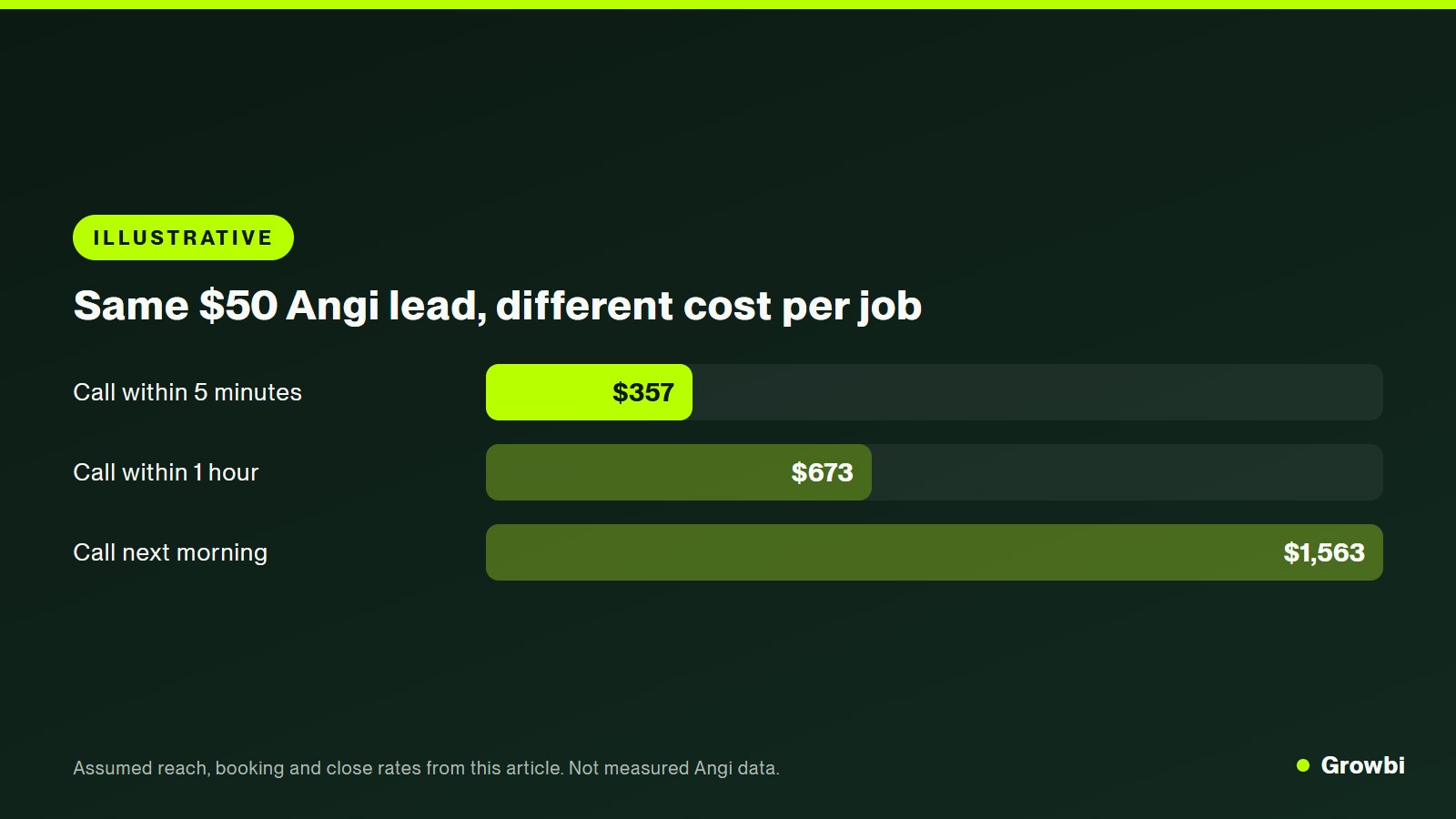
Source: Growbi illustrative model; lead price within the range reported by Housecall Pro
The rates above are our assumptions, chosen to show the shape of the problem. With up to five pros on each request, the gap between the first caller and the third is much wider than with an exclusive lead. Plug in your own reach, booking and close rates to get your real number.
If you have never measured this, start with the same scoreboard we use in our roofing lead generation guide: cost per booked appointment and cost per closed job, by source.
How Angi Lead Credits Work
Credits are possible, but the rules are narrow and they reward fast follow-up.
Angi's lead credit help article, updated in August 2026, lists the reasons Angi may credit a lead after an investigation.
- Invalid contact information, such as a disconnected number or a number that does not match the homeowner.
- Wrong location, with the project outside your profile's ZIP codes.
- Service mismatch, where the project does not match the services or tasks on your profile.
- Duplicate lead, if you were charged twice for the same homeowner within 45 days.
- Paused leads, if you were charged while your lead flow was paused.
To be considered, the lead must be less than 45 days old, you must have tried to call the homeowner within 24 hours, and your account must be in good standing. Annual subscribers can report leads, but Angi says credits are not offered for those leads, and credits that are issued expire after six months.
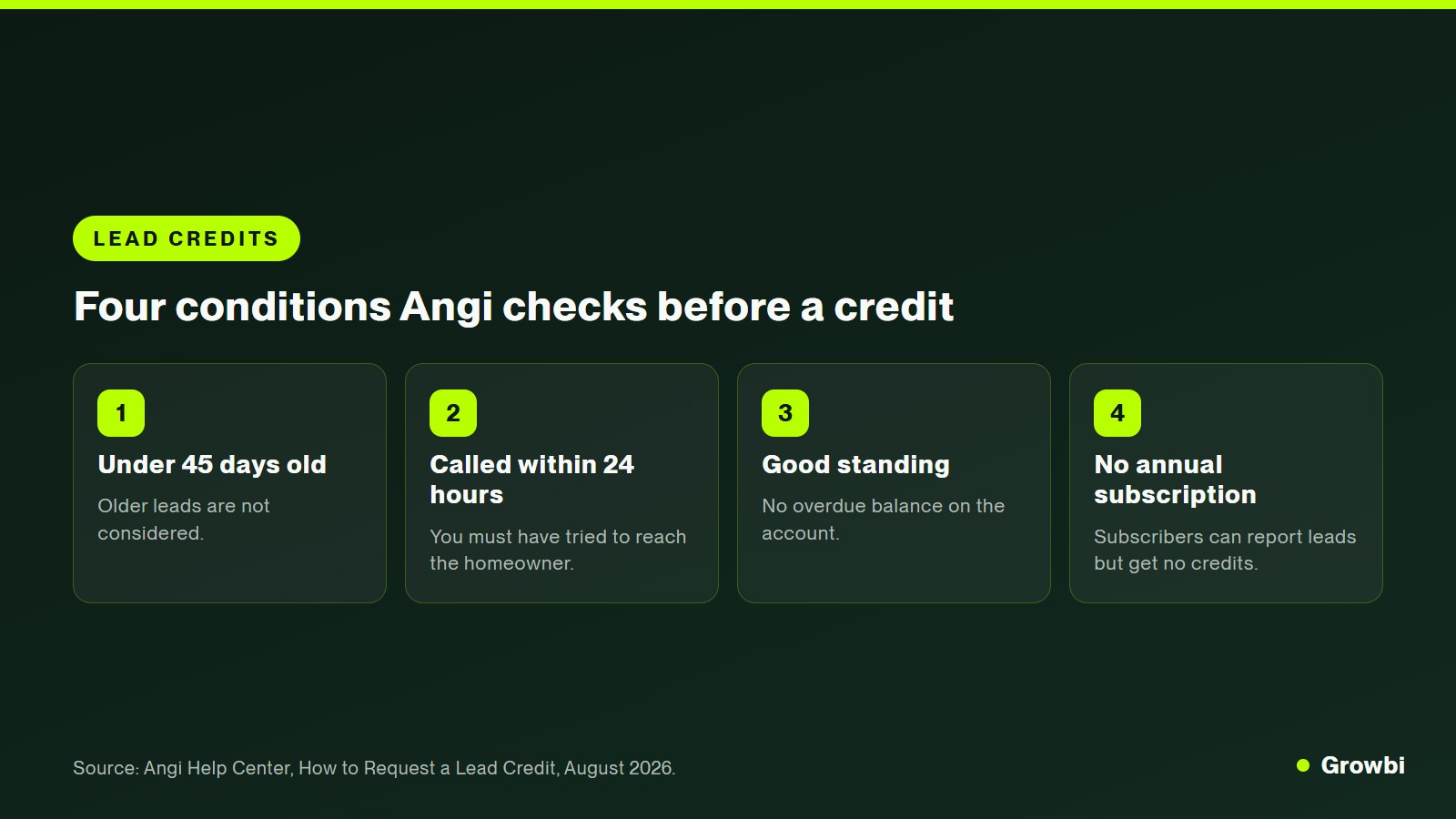
Source: Angi Help Center, How to Request a Lead Credit (August 2026)
Why So Many Contractors Complain About Angi Leads
Most complaints come down to three things: competition on every lead, homeowners who are only collecting prices, and charges for leads that never answer. These are built into any shared marketplace, not unique to Angi.
There is also history. In 2023 the Federal Trade Commission finalized an order against HomeAdvisor, now part of Angi, over how it marketed its leads to service providers. According to the FTC's announcement of the final order, the order bars false or misleading claims about its leads, and the company agreed to pay up to $7.2 million in redress.
HomeAdvisor did not admit wrongdoing.
The order does not mean Angi leads are bad today. It does mean you should judge them on your own data, not on lead quality claims in a sales call.
When Angi Leads Are Worth It
Angi earns its place in specific situations. In these cases, speed to market and zero setup are worth paying a marketplace margin.
- You are new in a market and need jobs this month while you build reviews and your own campaigns.
- You have someone answering the phone all day who can call every lead within minutes.
- Your close rate on estimates is strong, so winning the appointment usually means winning the job.
- You do smaller, fast jobs where the lead fee is a small share of the ticket, such as handyman work, cleaning or minor repairs.
- You use it to fill gaps, turning it on in slow weeks and pausing when the calendar is full.
When to Stop Buying Angi Leads
- Your callback happens hours later. With up to five pros per request, slow follow-up turns most leads into wasted fees.
- Your cost per job is higher than from any other source after 90 days of honest tracking.
- You sell high-ticket work like roof replacements or HVAC installs, where your own campaigns can pre-qualify homeowners before the call.
- You are on an annual subscription and losing money on bad leads, since those leads are not eligible for credits.
- You want an asset. Money spent on Angi buys leads, while money spent on your own profile, reviews and campaigns keeps paying after you stop.
Angi vs. Local Services Ads vs. Your Own Campaigns
Put every source on the same table and the trade-offs become clear. Each one is a different mix of speed, control and exclusivity.
- Who else gets the lead. Angi: Up to 4 other pros; Google Local Services Ads: Only you; Your own Google and Meta campaigns: Only you
- How you pay. Angi: Per lead, plus a common annual fee; Google Local Services Ads: Per valid lead; Your own Google and Meta campaigns: Per click or impression
- Setup time. Angi: Days; Google Local Services Ads: Weeks, for verification; Your own Google and Meta campaigns: Weeks, for pages and tracking
- Control over job type. Angi: Task list on your profile; Google Local Services Ads: Job types in your settings; Your own Google and Meta campaigns: Full control by keyword and offer
- Qualification before contact. Angi: Homeowner's request form; Google Local Services Ads: None, mostly calls; Your own Google and Meta campaigns: Your own form and questions
- Asset you keep. Angi: None; Google Local Services Ads: Reviews on your Google profile; Your own Google and Meta campaigns: Data, audiences, reviews and pages
Our guide to Google Local Services Ads covers how that format bills and ranks in 2026, including the new rules on missed calls.
How to Test Angi Against Your Own Campaigns Fairly
Use the same scoreboard for every source, or the comparison means nothing.
- Tag every lead with its source. Angi, Local Services Ads, Google search, Meta, referral. Log each one in a CRM or a shared sheet the day it arrives.
- Hold follow-up constant. Call every lead from every source within 5 minutes, with the same script, so speed does not decide the winner.
- Track each step to revenue. Record reached, estimate booked, estimate held, job sold and job value for every lead.
- Include all costs. Lead fees, annual fees, ad spend, agency or software fees. Subtract credits you actually received.
- Compare cost per job and profit per job. After 90 days, divide total cost by jobs sold for each source, then compare gross profit per job.
- Move budget to the winner. Keep Angi only for the job types or seasons where it beats your own campaigns, and pause the rest.
If you would rather have a team run the test, see what to look for in a home service marketing agency before you hand over the budget.
Plumbers in particular should read how the best marketing agencies for plumbers report results, because the same booked-job scoreboard applies to every source in this test.
Questions to Ask Before You Sign Up With Angi
Most frustration with lead marketplaces starts in the first sales call, when the terms are agreed quickly and read later. Ask these questions and write down the answers before you commit any budget.
- What will a lead cost for my exact task list and ZIP codes? Ask for a range per task, not an average across your trade.
- Is there an annual fee or subscription, and what does it include? Remember that annual subscribers are not offered lead credits.
- How many other pros will see each request? Angi's help center says up to five, so confirm how that applies to your categories.
- Can I set a weekly budget or lead cap, and pause at any time? You want control during busy weeks and slow seasons.
- Which tasks can I switch off? Removing low-value tasks is often the fastest way to lower cost per job.
- How are credits requested and how long do they take? Keep a log of every credit request and its outcome.
Put the answers in your tracking sheet next to the lead data. After 90 days you will know whether the terms you were promised match the results you got.
The Future of Angi and How Homeowners Find Contractors
Angi is changing, and AI is the reason. In September 2026 Angi announced it was among the first brands in OpenAI's Sponsored Agents pilot in ChatGPT, where an Angi agent can appear in home project conversations and route people into its service request flow.
That makes your own visibility in AI answers more valuable, not less. If homeowners increasingly ask ChatGPT for a contractor, you want to be the business it names directly. Our guide to answer engine optimization shows how to get there.
FAQs
Are Angi leads worth it?
Angi leads can be worth it if you call every lead within minutes, close estimates well and do jobs where the lead fee is a small share of the ticket. Because each request is matched with up to five pros, slow follow-up makes them expensive. Track cost per booked job for 90 days before deciding to keep or cut Angi.
How much does Angi charge per lead?
Angi does not publish a price list. Lead fees vary with the task, the homeowner's location and demand for the work. Contractor reports commonly put most leads at about $15 to $85, with high-value trades such as roofing sometimes above $100, and many accounts also pay an annual fee commonly around $300.
How many contractors get the same Angi lead?
According to Angi's help center, each homeowner request is matched with no more than five pros. That means you may be competing with up to four other contractors for the same homeowner, which is why the first business to call usually gets the estimate. Older HomeAdvisor material described fewer pros per lead, so check current terms.
Can I get a refund for a bad Angi lead?
Angi may credit a lead after investigating invalid contact details, a project outside your ZIP codes, a service mismatch, a duplicate charge within 45 days or a charge while paused. The lead must be under 45 days old and you must have tried to call within 24 hours. Annual subscribers are not offered lead credits, and credits expire after six months.
Conclusion
Angi is a fast way to get homeowner leads without building anything, and for some contractors it pays. But every request can go to up to five pros, pricing is set by Angi, and the credit rules are strict, so the value depends almost entirely on how fast you call and how well you close.
Judge it the way you judge every other source: cost per booked job and profit per job over 90 days. If your own campaigns win, move the budget and keep Angi only where it beats them.
If you want that comparison done with your real numbers, book a free strategy call and we will model your Angi spend against your own campaigns.
Get this system built for your business
Book a strategy call and we will model a realistic appointment target from your budget, market, and offer.